Ethereum Price Rejected At The $2,000 Level, Will It Retrace To $1,700 Soon?

newsbtcPublished on 2022-08-17Last updated on 2022-08-17

Abstract

Ethereum price has retraced over the past few days, in the last 24 hours the coin depreciated 2%. The current price action pointed towards consolidation. In the past trading sessions,...

Ethereum price has retraced over the past few days, in the last 24 hours the coin depreciated 2%. The current price action pointed towards consolidation. In the past trading sessions, ETH has retraced beneath the $1,900 price mark.
Continued consolidation for Ethereum has now pushed Ethereum price close to $1,800. In case the king altcoin is unable to break past the $1,800 level, it would be targeting the next support level for the coin.
Technical outlook had turned bearish as the coin was mainly consolidating causing a loss of value. Buying strength witnessed a fall on its chart which made ETH turn bearish at press time. If Ethereum needs to cross above the $1,900 price level, the buying strength needs to recover considerably on its chart.

The global cryptocurrency market cap today is $1.18 Trillion, with a 1.6% negative change in the last 24 hours. Market movers were also dipping on their respective charts, this had an effect on the coin’s overall price movement.
Ethereum Price Analysis: Four Hour Chart
Ethereum price

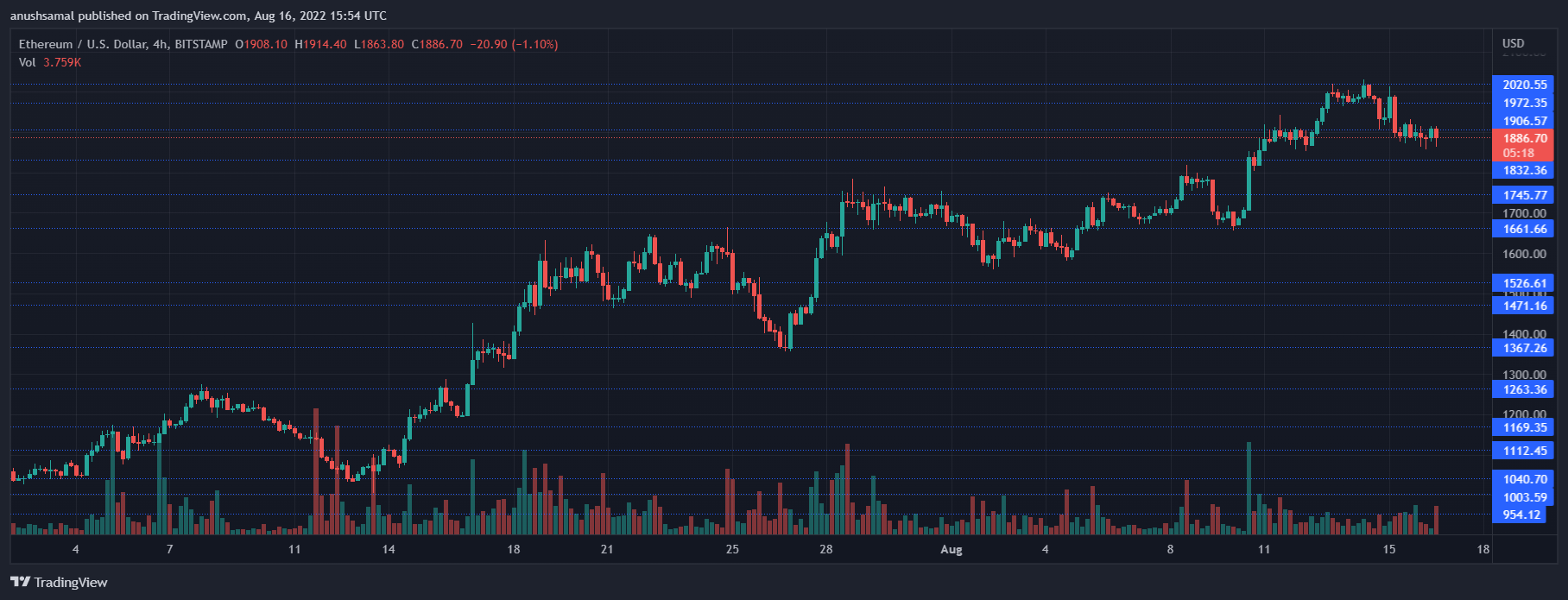
Ethereum was priced at $1,880 on the four hour chart | Source: ETHUSD on TradingView

ETH was trading at $1,880 at the time of writing. The coin had witnessed rejection at the $2,000 price mark multiple times. At the moment Ethereum price witnessed a correction after it attempted to trade near the $2,000 price level.
Overhead resistance for the coin was at $1,900 and a jump beyond the mentioned price level will push ETH to touch the $2,000 mark.
Local support for the coin was at $1,700 but consistent lateral movement might end up pushing Ethereum price to $1,500.
Amount of Ethereum traded depicted an increase in selling pressure indicating that sellers were starting to drive control in the market.
Technical Analysis
Ethereum price

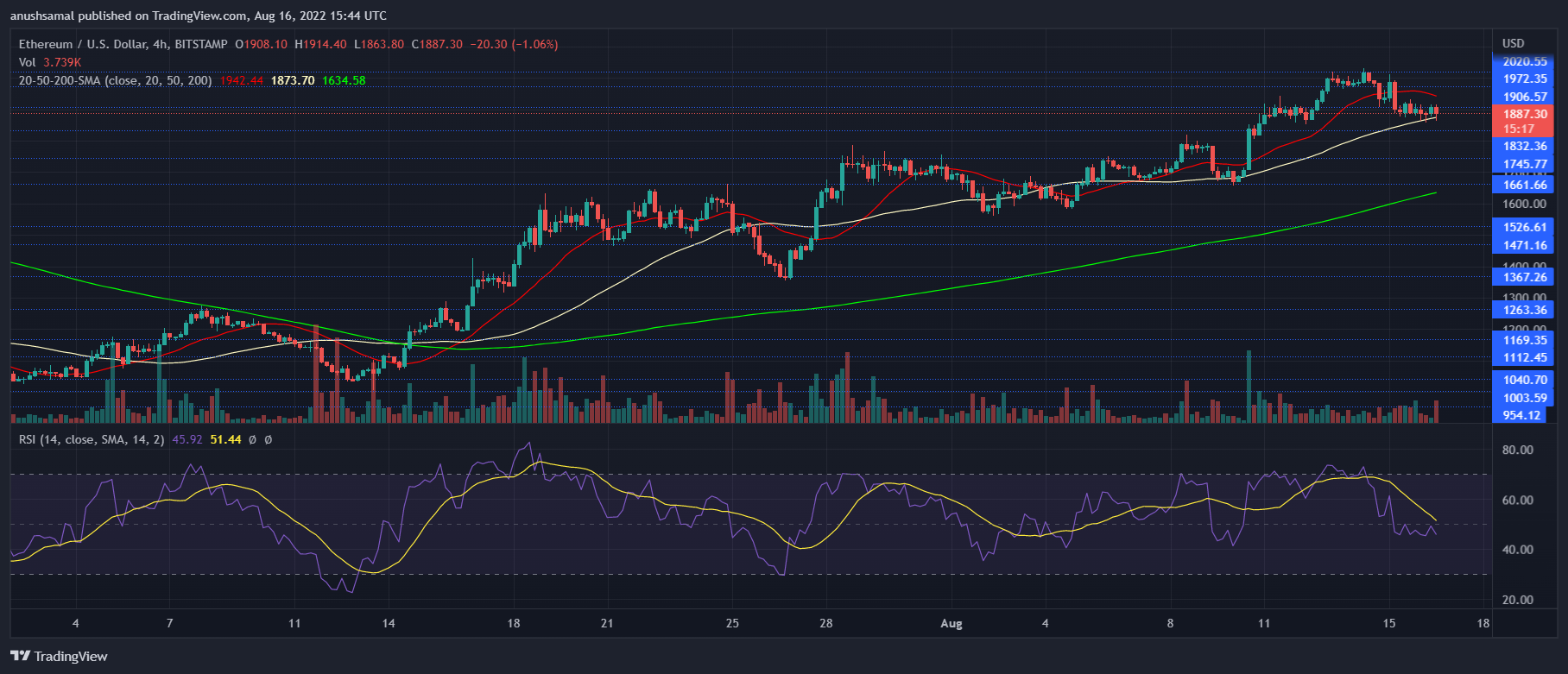
Ethereum depicted low buying strength on the four hour chart | Source: ETHUSD on TradingView

The altcoin’s lateral trading had taken a toll on its buying strength. The indicator on the four hour chart reflected the same. The Relative Strength Index was under the half-line which indicated that buyers are lesser than sellers in the market.
This fall in buying strength could cause Ethereum price to revisit $1,745 where the altcoin might again witness demand. Ethereum price was above 20-SMA line and pointed towards buyers driving the price momentum in the market.
Ethereum price

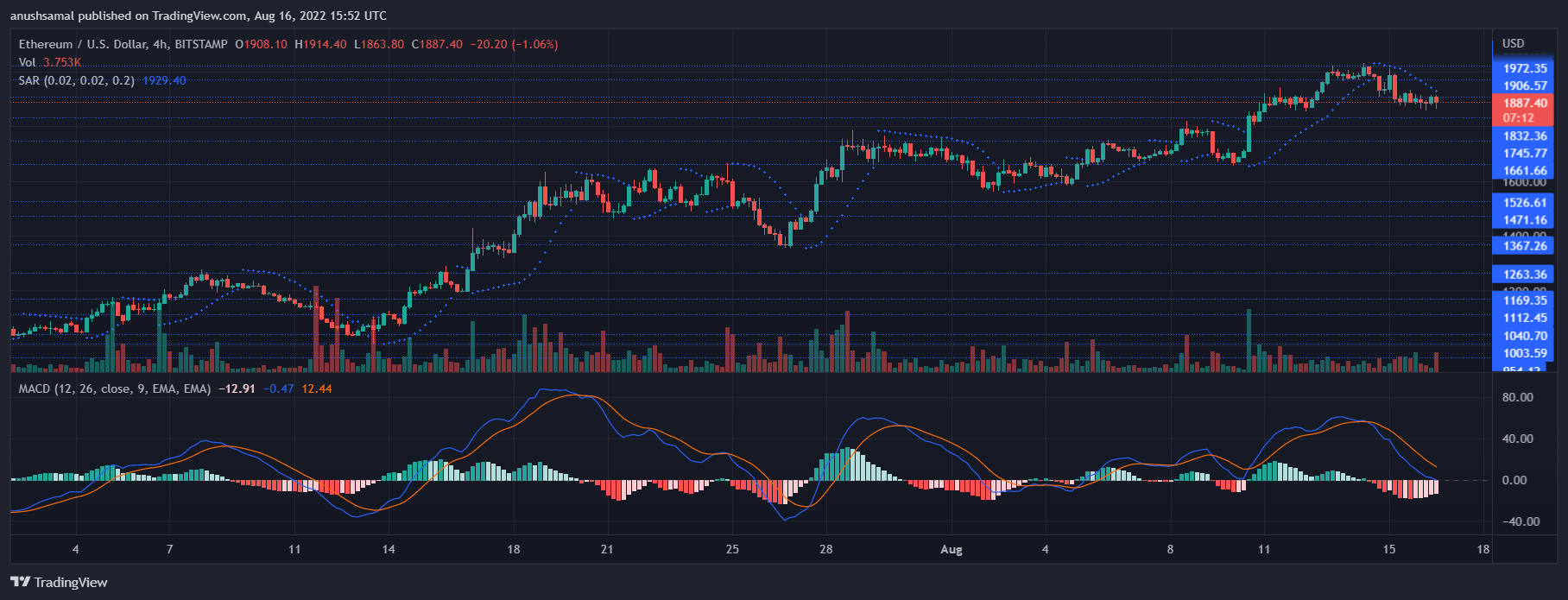
Ethereum pictured sell signal on the four hour chart | Source: ETHUSD on TradingView ETH’s price movement has also indicated that the coin registered sell signal on its chart pointing towards bearishness.
The Moving Average Convergence Divergence underwent a bearish crossover and formed red histograms under the zero-line.
These formations are related to sell signal for Ethereum. Parabolic SAR which depicts the price direction of the coin was also negative.
The dotted lines of the indicator above the candlesticks indicated that the price direction of Ethereum was heading south proving that the bears were stronger than the bulls on the four hour chart.


Related Reads

When Technology Is No Longer a Moat, Only One Thing Remains as the Ultimate Moat in the AI Field

In the rapidly converging AI landscape, where technology and product differentiators can be copied in months, the ultimate moat for a company is no longer its product, but its organizational form. Great companies innovate in their very structure, creating new institutional models that attract, empower, and unleash a specific type of talent. Examples like OpenAI and Palantir show how unique architectures—built around frontier model development or navigating complex client systems—foster new kinds of hybrid roles that competitors cannot replicate. These organizations compete on identity and emotional resonance, not just salary. They offer talent a path to become a version of themselves they aspire to be, fulfilling core human desires: to feel unique, destined, part of exponential progress, or proven. This requires structural alignment: if customer proximity is key, client-facing roles must have high status; if speed matters, decision rights must be decentralized. For founders, the critical question is: "What kind of person can only become themselves here?" They must build a company form that matches their ambitious narrative. For job seekers, the warning is to distinguish between feeling "chosen" (emotional validation) and being "seen" (tangible power, scope, and reward). The most dangerous promise is deferred compensation. While AI makes replicating products easy, it cannot replicate a novel, high-trust organizational system that compounds judgment over time. The future will belong not to companies that merely make employees feel special, but to those that invent entirely new structures, enabling a new breed of talent to emerge and thrive.

marsbit2h ago

When Technology Is No Longer a Moat, Only One Thing Remains as the Ultimate Moat in the AI Field

marsbit2h ago

Undercover in Crypto for 8 Years, 5 Jobs: The Revolution and Scam in My Eyes

"Undercover in Crypto for 8 Years, 5 Jobs: The Revolution and the Scam I Saw" In 2017, the author entered crypto believing it would revolutionize everything: replacing fiat, disintermediating finance, and shifting power to users. Eight years later, almost none of that has happened as predicted. The author worked at Circle, Messari, Coinbase, and Crossmint, witnessing the asset class grow from under $10B to over $4T, through multiple speculative bubbles and a near-systemic crisis. The journey began with the 2017-18 ICO frenzy, an "internet bubble 2.0" fueled by Ethereum. The promised "decentralized Uber" never materialized; instead, it was an era of greed, fraud, and rampant speculation where founders cashed out early. In the 2018-19 hangover, the focus shifted. The seeds of crypto's next phase were planted: stablecoins (like USDC) for borderless dollars and DeFi (decentralized finance) for rebuilding financial primitives like lending and trading on-chain. The COVID-19 pandemic and massive monetary stimulus triggered "DeFi Summer" in 2020-21. DeFi's value soared 250x to $180B, but it resembled a high-stakes game for mercenary traders with "food-themed" tokens. A new bubble formed around NFTs, with digital art selling for millions. The 2022 "crypto winter" mirrored the 2008 financial crisis. The collapse of the algorithmic stablecoin Terra (UST) triggered a chain reaction, bringing down hedge funds (Three Arrows Capital) and lending platforms (Celsius, Voyager). The final blow was the implosion of FTX and Sam Bankman-Fried, who had misused customer funds. This was crypto's "Lehman Moment." After the crash, the Biden administration's hostile regulatory crackdown under the SEC pushed innovation toward the legally safest, most absurd path: meme coins. The 2024 meme coin mania peaked at $150B before imploding. This political pressure, however, mobilized the industry. Donald Trump capitalized, promising a crypto-friendly stance, which many credit for helping him win the 2024 election. Trump's victory marked a turning point. A pro-crypto SEC chair took over, the "GENIUS Act" provided clear stablecoin rules in 2025, and institutional adoption accelerated. Circle (maker of USDC) IPO'd, and traditional giants like MoneyGram began using stablecoins for cross-border payments via firms like Crossmint. Looking back, the predicted consumer revolution (decentralized Uber) didn't happen. Instead, crypto built the plumbing for a new internet financial system. Each boom/bust cycle refined the infrastructure for global, 24/7 finance accessible to anyone online. The $300B+ stablecoin market, settling tens of trillions annually and creating demand for U.S. debt, is now a strategic U.S. priority. The future lies in convergence, not replacement. Crypto will be the backend, invisible to most users. The next frontier is integration with AI, where autonomous agents will use crypto wallets and stablecoins to transact. The result will be a global financial system equally accessible in New York or Nigeria, paving the way for countless new innovations.

marsbit2h ago

Undercover in Crypto for 8 Years, 5 Jobs: The Revolution and Scam in My Eyes

marsbit2h ago

Trading

Spot
Futures
活动图片