Arthur Hayes buys $72K ETHFI 5 hours before Upbit listing: Market takes note

ambcryptoPublished on 2026-03-19Last updated on 2026-03-19

Abstract

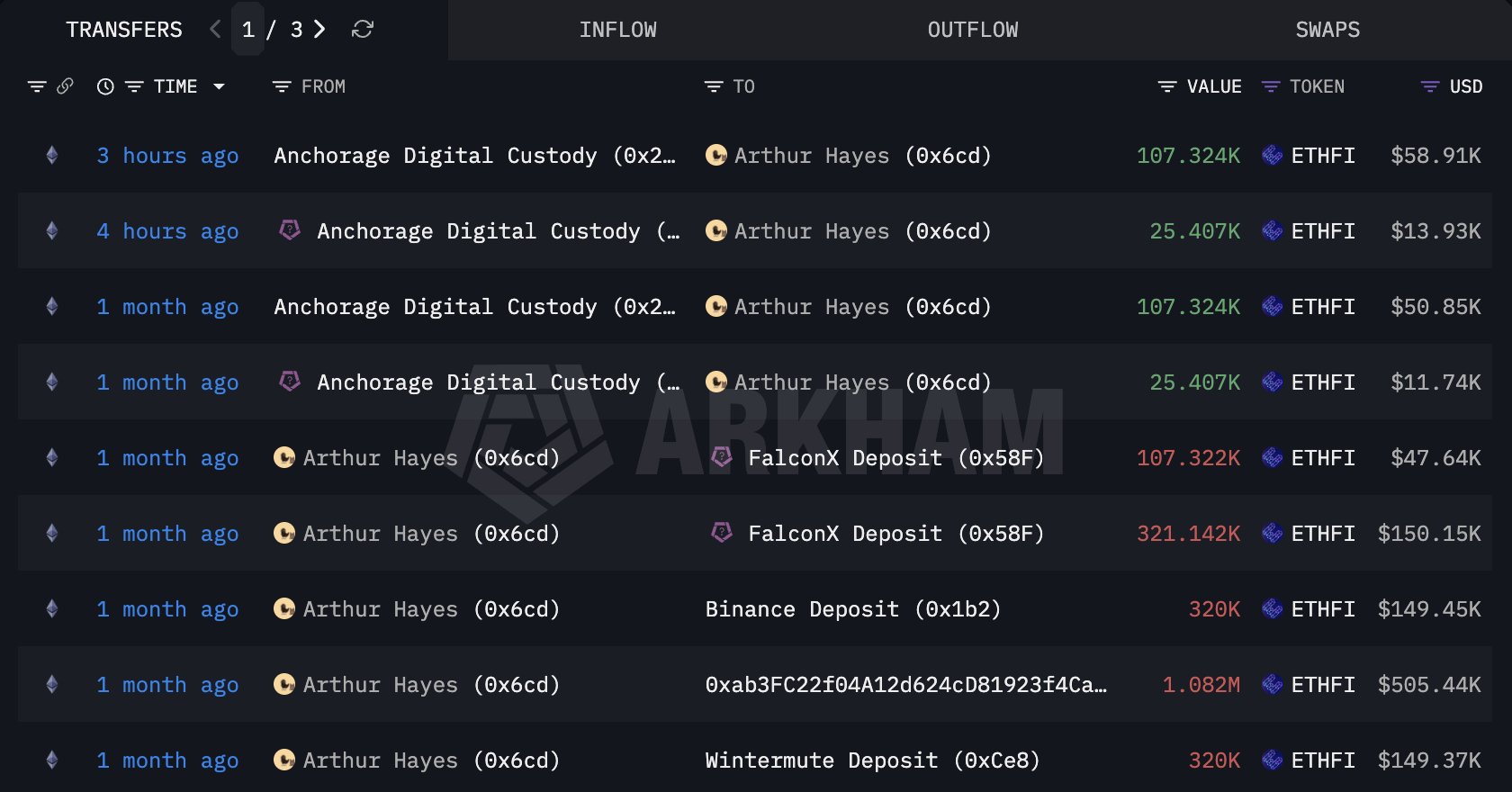
Arthur Hayes, co-founder of BitMEX and CIO of Maelstrom, purchased 132,730 ETHFI (worth approximately $72,800) just five hours before South Korea's largest crypto exchange, Upbit, announced its listing of the token. The well-timed trade has fueled allegations of insider trading, given the significant market impact of such a listing in a region known for strong retail participation. Data shows Hayes had previously moved large amounts of ETHFI and deployed over $3.4 million into various DeFi tokens earlier this year. The listing on Upbit included temporary trading restrictions, such as a brief buy freeze and limit-only orders during the initial phase.

EthereumFi [ETHFi] is grabbing eyeballs after a major exchange listing and a well-timed trade.

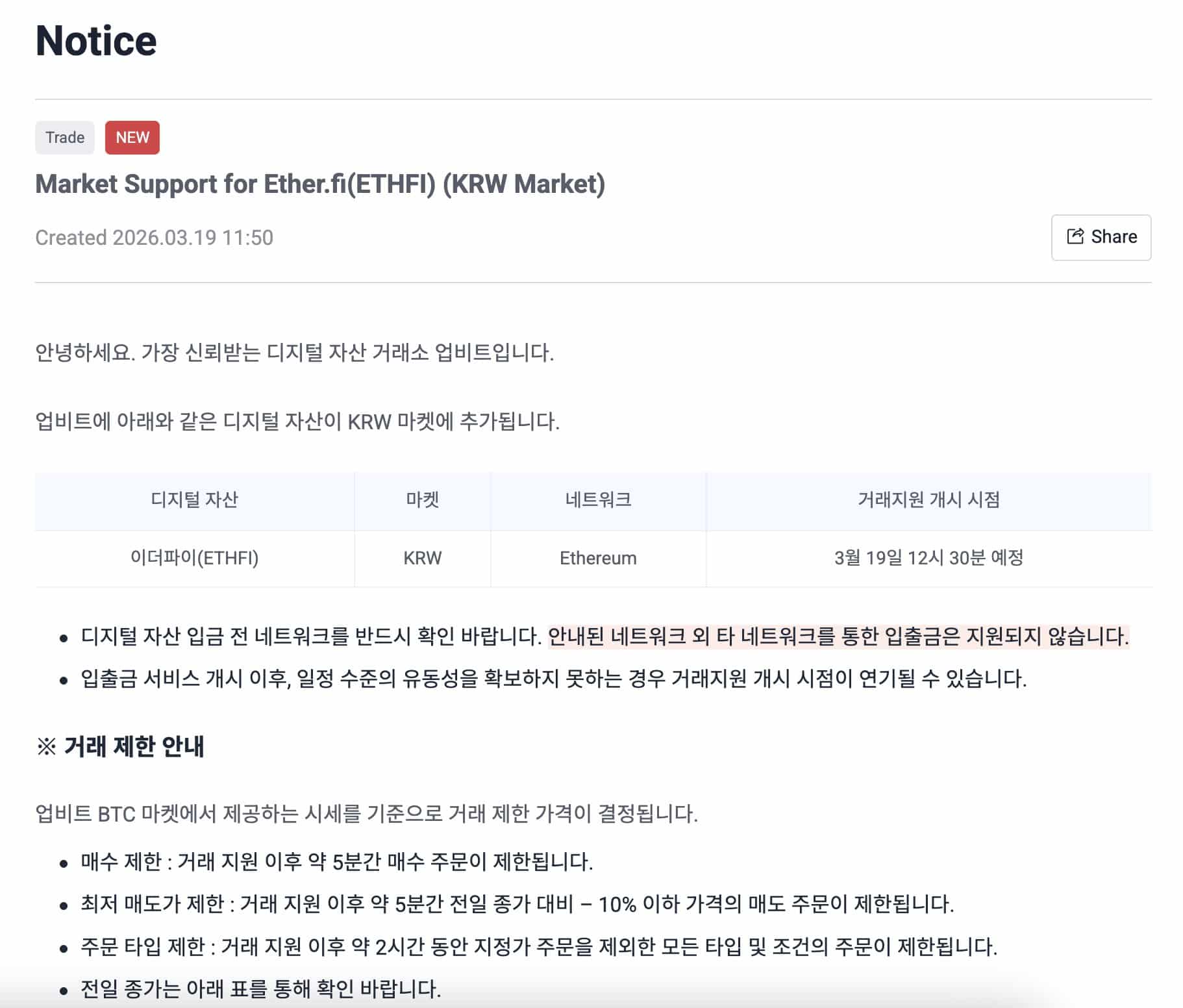
Just hours before South Korea’s Upbit announced an ETHFi listing, Arthur Hayes was seen buying the token. For context, this listing is quite significant, given South Korea’s strong retail participation and preference for altcoins.

Hayes and the insider trading allegations

Arthur Hayes, co-founder of BitMEX and CIO of Maelstrom, accumulated ETHFI shortly before a key listing on South Korea’s largest crypto exchange, Upbit.
Source: X

Per data from Lookonchain, Hayes received 132,730 ETHFI (approximately $72,800) from Anchorage Digital roughly five hours before the exchange confirmed the token’s addition to its KRW market.

The timing, of course, has added fuel to the insider trading narrative.
Source: X

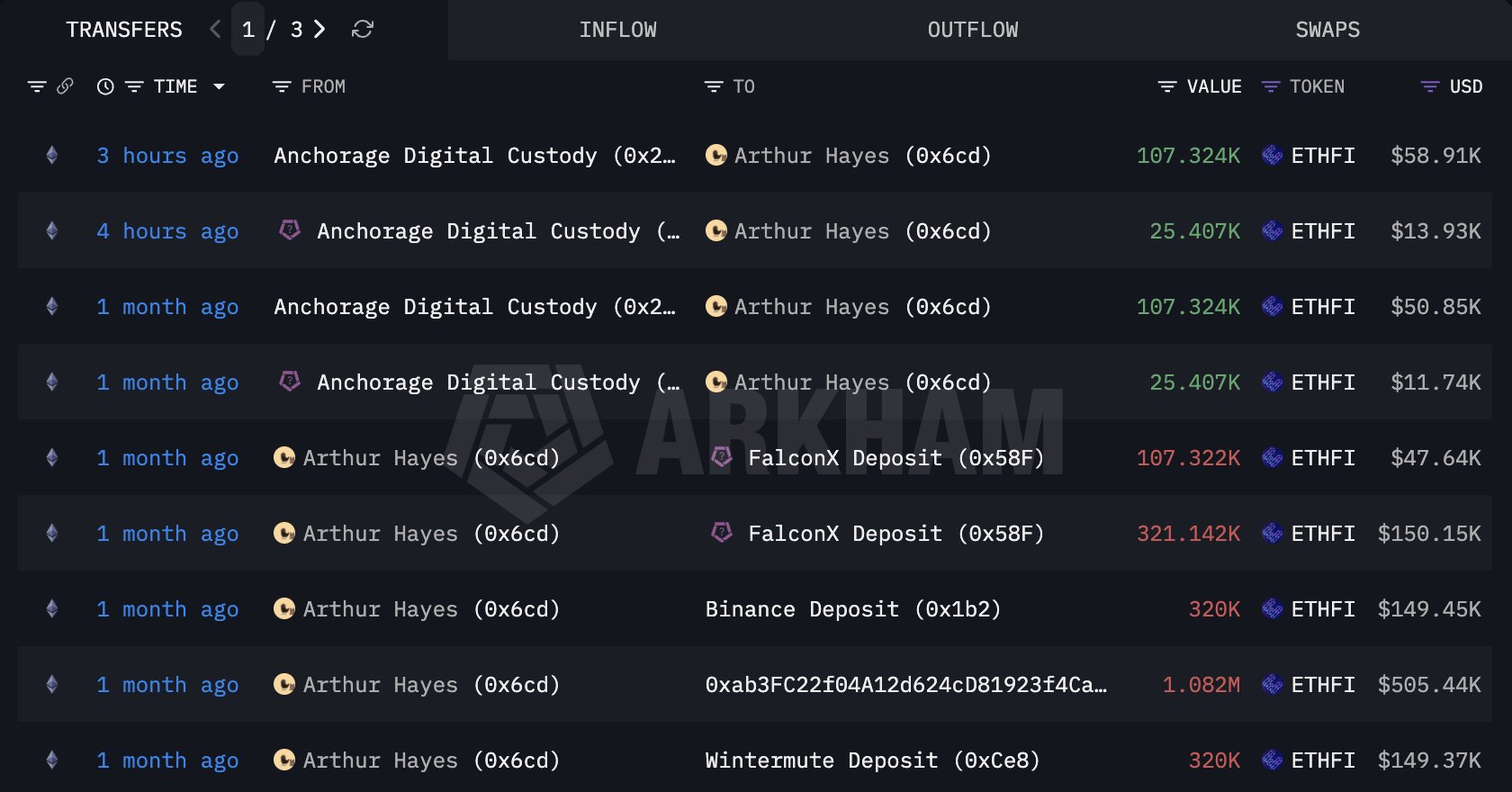
Earlier this year, he deployed over $3.4 million across multiple DeFi tokens, including ETHFI. Data also revealed that about a month prior, Hayes moved 2.15 million ETHFI at around $0.47, which could be earlier distribution activity.

The latest acquisition occurred near $0.55 per token.

It is notable that as part of standard listing controls, Upbit temporarily restricted orders. This included a brief buy freeze and limits on low-priced sell orders, while enforcing limit-only trading during the initial phase.


A look at the big picture

Trending Cryptos

Related Questions

QWho is Arthur Hayes and what significant action did he take regarding ETHFI?

AArthur Hayes is the co-founder of BitMEX and CIO of Maelstrom. He bought 132,730 ETHFI (worth approximately $72,800) just five hours before it was listed on the South Korean exchange Upbit.

QWhy is the listing of ETHFi on Upbit considered significant for the market?

AThe listing is significant because South Korea has strong retail participation in cryptocurrency markets and a notable preference for trading altcoins, which can lead to substantial trading volume and price impact.

QWhat allegations have arisen from the timing of Arthur Hayes' ETHFI purchase?

AThe timing of his purchase, occurring just hours before the official Upbit listing announcement, has fueled allegations of insider trading.

QFrom which company did Arthur Hayes receive the ETHFI tokens, and what was the price per token?

AHe received the tokens from Anchorage Digital, and the latest acquisition occurred at a price of approximately $0.55 per token.

QWhat trading controls did Upbit implement as part of the standard listing process for ETHFI?

AUpbit temporarily restricted orders, which included a brief freeze on buy orders and limits on low-priced sell orders. It also enforced limit-only trading during the initial phase of the listing.

Related Reads

Wall Street Morning News: V-shaped Rebound at Month-end, but Nasdaq Suffers Worst July in 12 Years; Funds Accelerate Concentration Towards Cloud Giants

Despite a V-shaped rebound at the end of July, the Nasdaq posted its worst July since 2004, while the S&P 500 had its worst July since 2014. Markets were jolted by geopolitical shifts, as President Trump canceled a planned strike on Iran, leading WTI crude to plunge over 8%. This, alongside OPEC+ announcing a supply increase, reversed crude's sharp July gains. Treasury yields surged, with the 10-year yield rising over 30 basis points in July—its largest July increase since 2005. In a rare move, the US and Japan jointly intervened to weaken the USD/JPY, aiming to prevent potential Japanese sales of US Treasuries. While the tech sector faced deleveraging pressure throughout July, cloud giants staged a massive rally on strong earnings. Microsoft, Amazon, and Google collectively added nearly $1.5 trillion in market value last week. Amazon soared over 15% on accelerating AWS growth, Microsoft extended historic gains, Google fully recovered post-earnings losses, and Meta ended an 11-day losing streak. In contrast, Apple tumbled over 7% on supply chain and guidance concerns, ceding its "world's most valuable company" title to Nvidia. The memory and storage sector corrected sharply. Gold edged up 0.91% in July, with analysts viewing the ~30% pullback from January highs as a potential basing period, supported by long-term central bank demand. Key events to watch this week include earnings from Palantir, AMD, SpaceX (its first post-IPO report), and memory giants like Western Digital. The US July non-farm payrolls report on Friday will be critical for gauging the Fed's policy path. SpaceX also faces a significant lock-up expiration, testing market liquidity.

marsbit1h ago

Wall Street Morning News: V-shaped Rebound at Month-end, but Nasdaq Suffers Worst July in 12 Years; Funds Accelerate Concentration Towards Cloud Giants

marsbit1h ago

Rubin Ultra Makes Major Cuts, Even Nvidia Can't Handle Memory Price Hikes?

NVIDIA's Rubin Ultra, the top-tier variant of the newly announced Rubin AI accelerators, has reportedly seen significant specification downgrades, according to an industry report from SemiAnalysis. Initially designed with four compute dies (4-die), the Rubin Ultra is now said to be reduced to a 2-die design. Key changes highlighted in the report include: * **No increase in peak theoretical compute performance**, remaining at 35 PFLOPs like the standard Rubin. * **Severe reduction in memory capacity** to 192GB using 8-Hi HBM stacks, which is less than the standard Rubin's 288GB using 12-Hi stacks. * **Negligible memory bandwidth improvement** of only 1 TB/s. * **Slightly higher chip-level power consumption**. * The **primary upgrade is a massive increase in scale-up interconnect capacity**, supporting connections for up to 576 GPUs via NVLink, compared to 72 for the standard Rubin. The report suggests the redesign is primarily a cost-optimization move driven by the sharp rise in HBM (High-Bandwidth Memory) prices. By reducing the expensive HBM content and shifting investment towards enhanced system-scale networking, NVIDIA aims to maintain the platform's value for large-scale AI training clusters while managing soaring material costs. The news reportedly triggered a sell-off in South Korean memory stocks, with SK Hynix and Samsung shares falling around 8%, as markets grew concerned that NVIDIA—a major HBM buyer—might be reducing its reliance on high-capacity memory, potentially capping future pricing power for memory makers.

Odaily星球日报1h ago

Rubin Ultra Makes Major Cuts, Even Nvidia Can't Handle Memory Price Hikes?

Odaily星球日报1h ago

Trading

Spot

Hot Articles

Ether.fi Explained

Ether.fi aims to further engage in the staking ecosystem by building its own AVS.

28.3k Total ViewsPublished 2024.03.28Updated 2024.03.28

Ether.fi Explained

How to Buy ETHFI

Welcome to HTX.com! We've made purchasing ether.fi (ETHFI) simple and convenient. Follow our step-by-step guide to embark on your crypto journey.Step 1: Create Your HTX AccountUse your email or phone number to sign up for a free account on HTX. Experience a hassle-free registration journey and unlock all features.Get My AccountStep 2: Go to Buy Crypto and Choose Your Payment MethodCredit/Debit Card: Use your Visa or Mastercard to buy ether.fi (ETHFI) instantly.Balance: Use funds from your HTX account balance to trade seamlessly.Third Parties: We've added popular payment methods such as Google Pay and Apple Pay to enhance convenience.P2P: Trade directly with other users on HTX.Over-the-Counter (OTC): We offer tailor-made services and competitive exchange rates for traders.Step 3: Store Your ether.fi (ETHFI)After purchasing your ether.fi (ETHFI), store it in your HTX account. Alternatively, you can send it elsewhere via blockchain transfer or use it to trade other cryptocurrencies.Step 4: Trade ether.fi (ETHFI)Easily trade ether.fi (ETHFI) on HTX's spot market. Simply access your account, select your trading pair, execute your trades, and monitor in real-time. We offer a user-friendly experience for both beginners and seasoned traders.

3.4k Total ViewsPublished 2024.03.29Updated 2026.06.02

How to Buy ETHFI

Discussions

Welcome to the HTX Community. Here, you can stay informed about the latest platform developments and gain access to professional market insights. Users' opinions on the price of ETHFI (ETHFI) are presented below.

活动图片