PENGU kini diperdagangkan pada level make-or-break – Apakah reli 22% akan terjadi?

ambcryptoPublished on 2026-03-17Last updated on 2026-03-17

Abstract

PENGU, memecoin berbasis Solana, mengalami kenaikan harga 12.13% menjadi $0.0081 dengan volume perdagangan melonjak 170%, menunjukkan minat pasar yang kuat. Analisis menunjukkan sentimen trader bullish dengan posisi long mendominasi, sementara investor dan whale mengakumulasi token dalam jumlah signifikan. Secara teknis, PENGU berada di level kritis $0.00815 yang sebelumnya gagal ditembus. Jika berhasil menutup di atas $0.0085, kenaikan 22% ke $0.0104 mungkin terjadi. Namun, kegagalan breakout dapat memicu penurunan. Analis lain bahkan memprediksi kenaikan 250% jika tren bearish terputus. Semua ini tergantung pada kemampuan PENGU mengatasi level resisten kunci.

Memecoin berbasis Solana yang populer, Pudgy Penguins (PENGU), menarik perhatian para penggemar kripto karena kinerja kuatnya selama seminggu terakhir. Hari ini, setelah kenaikan harga 12%, memecoin tersebut mencapai level yang berpotensi membuka pintu untuk pergerakan kenaikan besar.

Pada saat berita ini ditulis, PENGU telah naik lebih dari 12,13% dalam 24 jam terakhir dan diperdagangkan pada harga $0,0081. Sementara itu, dalam periode yang sama, volume perdagangan melonjak 170% – Tanda minat kuat dari peserta pasar.

Kenaikan volume perdagangan ini tidak hanya menjadi bukti tingginya partisipasi, tetapi juga bahwa trader dan investor mungkin tertarik dengan tren memecoin yang sedang berlangsung.

PENGU – Trader dan investor berubah bullish!

Saat menganalisis data dari alat derivatif Coinglass dan platform analitik Nansen, tampaknya baik investor maupun trader mungkin sedang memperkuat tren saat ini dengan melakukan taruhan pada posisi long dan mengakumulasi token.

Data terbaru dari Peta Likuidasi Exchange PENGU mengungkapkan bahwa trader intraday sangat kuat berada di posisi $0,00735 di sisi downside dan $0,00824 di sisi upside. Pada level-level ini, mereka membangun posisi leveraged long senilai $3,11 juta dan posisi leveraged short senilai $815K (Saat ini di ambang likuidasi).

Hal ini menunjukkan bahwa sentimen trader mungkin condong ke sisi bullish. Terutama karena mereka tampaknya percaya bahwa PENGU tidak mungkin jatuh di bawah level $0,00735 dalam waktu dekat.
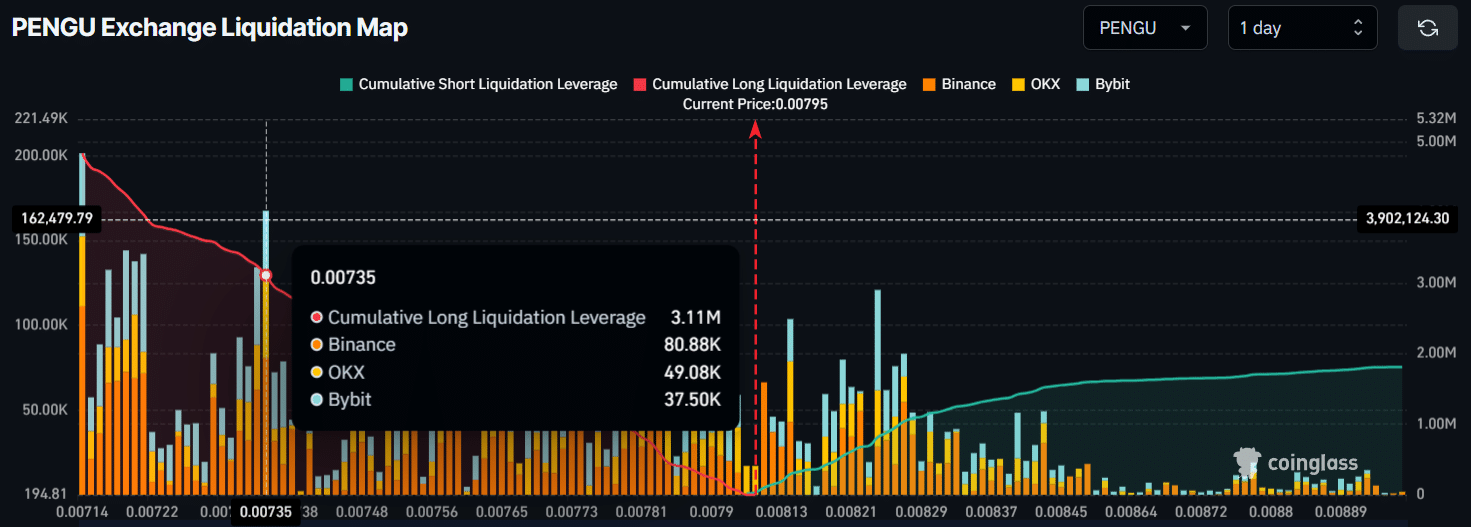
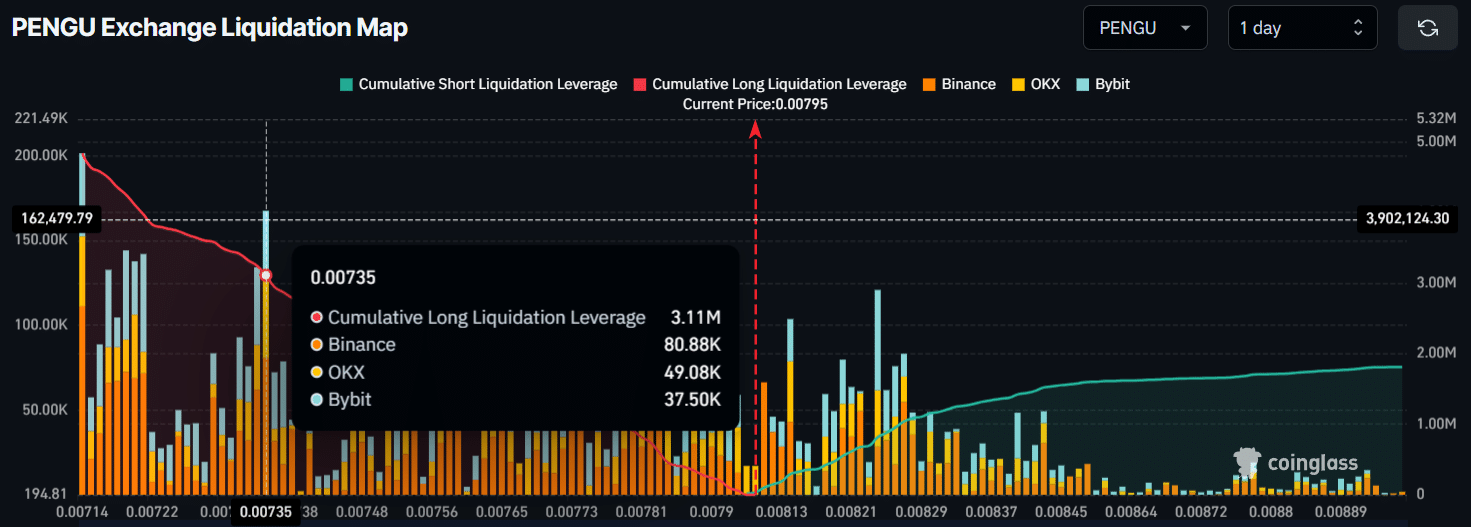
Sumber: Coinglass

Di sisi lain, investor telah mengakumulasi.

Dompet segar mencatat inflow senilai $327K dari memecoin – Dua kali lipat rata-rata selama 24 jam terakhir. Dalam periode yang sama, paus PENGU juga meningkatkan kepemilikan mereka sebesar 881,89 juta token – Setara dengan 3,90%.
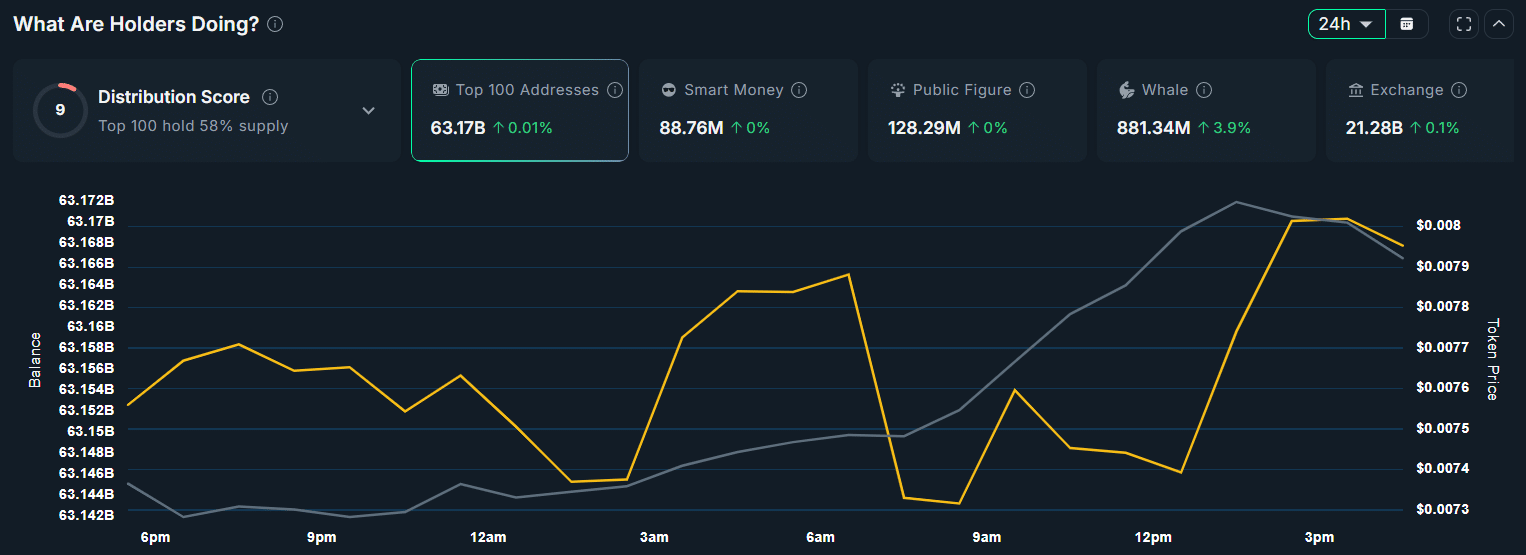
Sumber: Nansen

Memecoin mengincar lompatan harga 22%

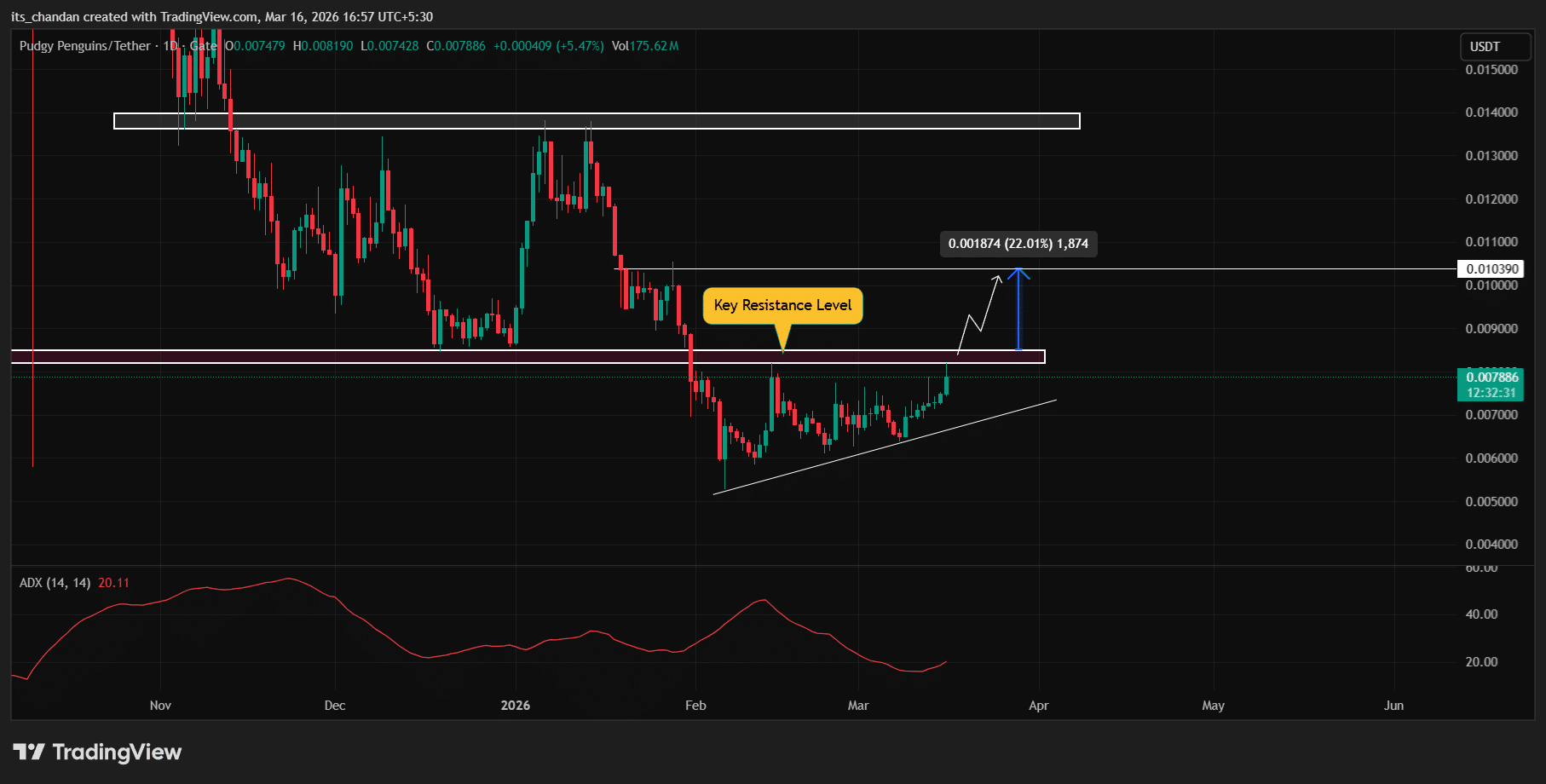
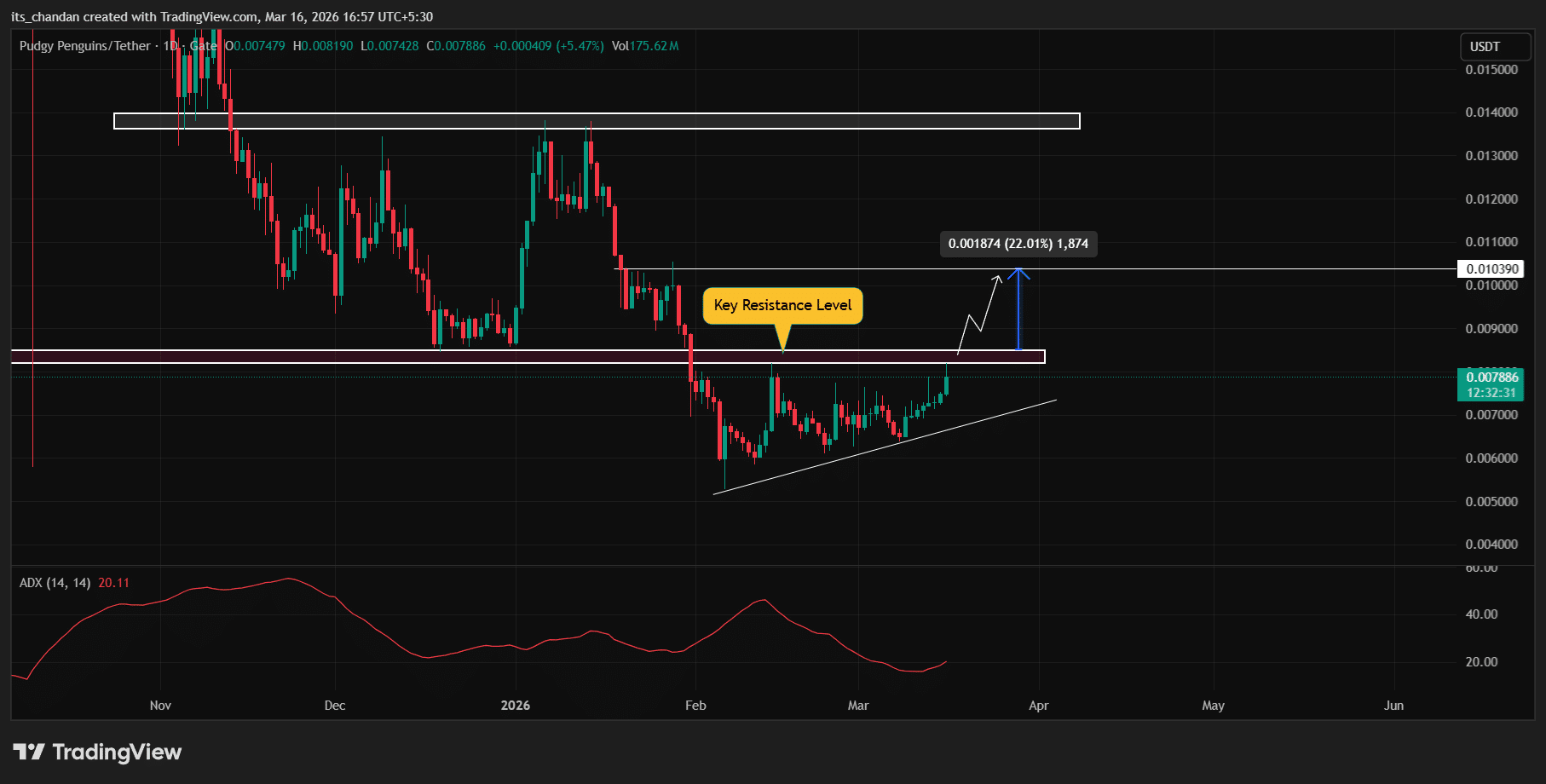
Menurut analisis teknis AMBCrypto, PENGU tampaknya berada pada level make-or-break pada grafik harian. Terutama karena pada saat berita ini ditulis, token tersebut menghadapi resistance kunci di $0,00815.

Sejak awal Februari, memecoin ini telah mencapai level ini beberapa kali. Namun, selalu gagal untuk break di atasnya, mengakibatkan pembalikan harga.
Sumber: TradingView

Kali ini, bagaimanapun, pembalikan dapat dihindari jika PENGU menutup lilin harian di atas level $0,0085. Jika ini terjadi, ada kemungkinan kuat bahwa memecoin dapat melihat lompatan harga 22% lagi dan berpotensi mencapai level $0,0104.

Namun, pembalikan juga dapat terjadi jika gagal break di atas level ini.

Pada saat berita ini ditulis, indikator teknis Average Directional Index (ADX) yang mengukur kekuatan tren, berada di 20,11, di bawah ambang batas kunci 25 – Mengindikasikan momentum directional yang lemah.

Seperti yang diduga, temuan ini memicu beberapa prediksi. Dalam sebuah postingan di X, seorang ahli berbagi grafik harian PENGU di mana tampaknya memecoin tersebut mungkin breakout dari garis tren turun yang berkepanjangan. Menandai breakout ini, ahli tersebut mencatat, "mengharapkan reli bullish +250%."
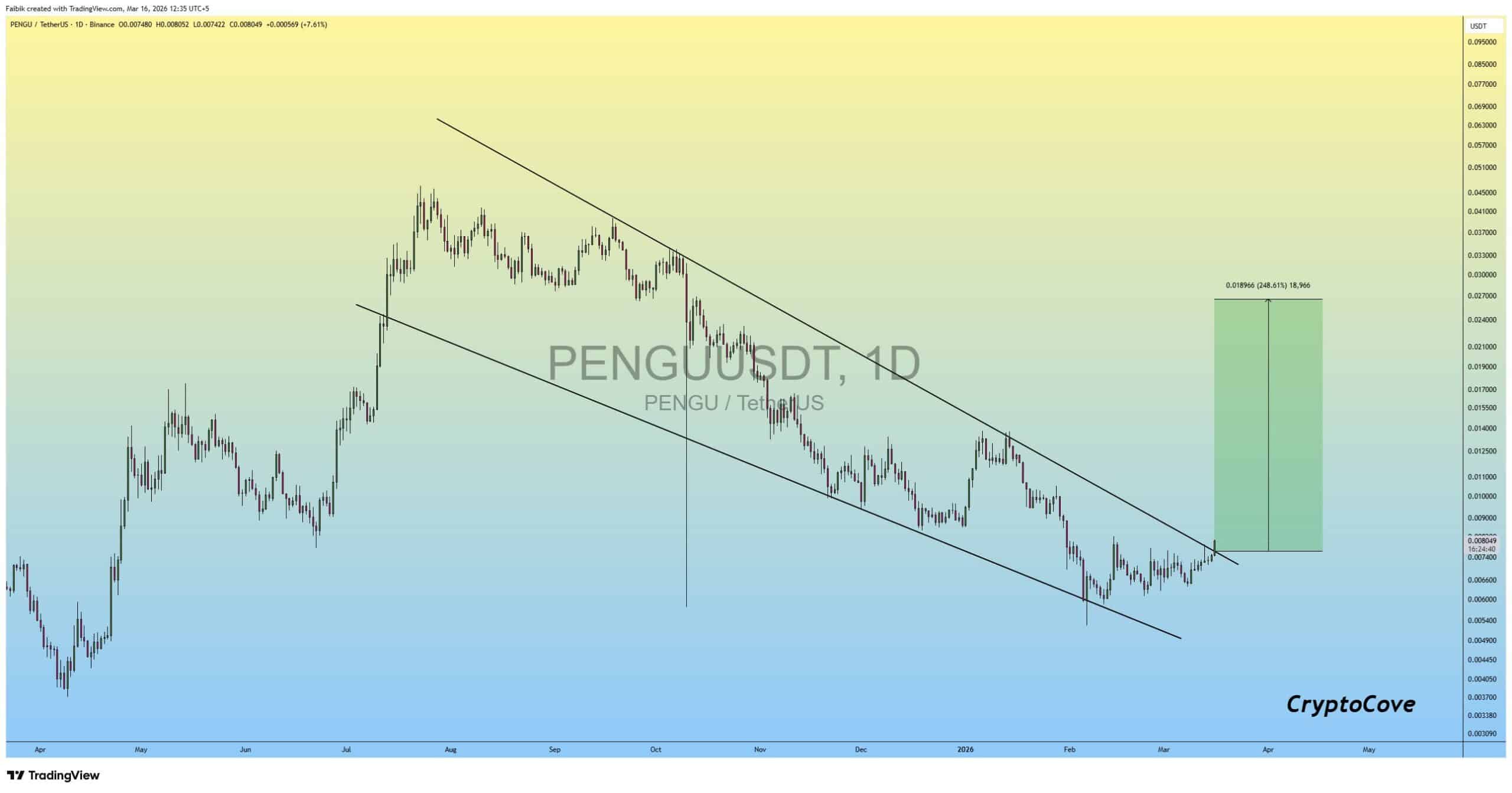
Sumber: X/CryptoFaibik

Semua hal ini bersama-sama mungkin menjadi tanda potensi kenaikan kuat PENGU. Memecoin tersebut mungkin melihat kenaikan signifikan dalam hari-hari mendatang. Namun, itu bisa terjadi jika berhasil mengatasi rintangan $0,00815.


Ringkasan Akhir

  • Dengan lompatan harga 12,05%, PENGU bisa mendekati breakout yang sukses dan kenaikan harga 22%.
  • Partisipasi pasar mengisyaratkan minat kuat pada aset tersebut, dengan paus juga meningkatkan kepemilikan mereka sebesar 4,01%.


Related Questions

QApa yang menyebabkan minat yang kuat terhadap PENGU dalam perdagangan 24 jam terakhir?

AVolume perdagangan PENGU meningkat 170% dalam 24 jam terakhir, menunjukkan minat yang kuat dari peserta pasar. Harga juga naik 12,13%, diperdagangkan pada $0,0081.

QApa yang ditunjukkan oleh data likuidasi dan posisi perdagangan tentang sentimen trader terhadap PENGU?

AData likuidasi menunjukkan trader membangun posisi long senilai $3,11 juta dan posisi short $815K. Sentimen cenderung bullish karena mereka percaya PENGU tidak akan jatuh di bawah $0,00735.

QBagaimana perilaku investor dan paus (whale) terhadap PENGU berdasarkan data Nansen?

ADompet baru mencatat inflow $327K (dua kali lipat rata-rata), sementara paus meningkatkan kepemilikan mereka sebesar 881,89 juta token (setara 3,90%).

QTingkat resistensi kunci apa yang harus dilewati PENGU untuk mencapai kenaikan 22%?

APENGU harus menutup candle harian di atas level $0,0085 untuk menghindari reversal dan berpotensi mencapai kenaikan 22% ke level $0,0104.

QApa yang diindikasikan oleh nilai Average Directional Index (ADX) sebesar 20,11 untuk PENGU?

ANilai ADX 20,11 berada di bawah ambang batas kunci 25, yang mengindikasikan momentum directional yang lemah untuk PENGU.

Related Reads

The 'Chip' Challenge and Breakthroughs in China's Optical Industry Chain

China's Photonics Industry: Bottlenecks and Breakthroughs In the global AI race, computing chips dominate the narrative, but the underlying bottleneck increasingly defining the scale of AI clusters is light—or more specifically, optical connectivity. Optical modules, which translate electrical signals to light and vice versa, are crucial for connecting thousands of GPUs in AI data centers, preventing data congestion and ensuring efficient model training. High-speed modules (800G, 1.6T) are now standard, with performance hinging on advanced DSP (Digital Signal Processor) chips. This is where a critical dependency lies. Two US giants—Marvell and Broadcom—collectively dominate over 90% of the high-end DSP chip market. Chinese optical module leaders like Zhongji Innolight and Eoptolink rely on these chips to manufacture modules for overseas AI customers, primarily in North America. While this creates a supply chain vulnerability, complete decoupling is difficult. Marvell derives over half its revenue from Greater China, and the US firms depend on Chinese partners for chip packaging and optical components. The risk from laser chips (e.g., from Lumentum), another key component, is considered more manageable due to multiple global suppliers and faster progress in domestic alternatives from companies like YOFC and Accelink. To mitigate risks, China's industry is pursuing a multi-pronged strategy: diversifying supply chains and locking in long-term orders; fostering a domestic market ecosystem to adopt homegrown DSPs from firms like Huawei HiSilicon and CETC; accelerating R&D in high-speed DSPs and advanced packaging; and investing in next-gen technologies like silicon photonics and Co-Packaged Optics (CPO) to reduce reliance on discrete DSPs. The ultimate solution lies not in short-term博弈 but in persistent advancement of domestic high-end chip R&D and manufacturing. While challenges remain in performance, certification, and ecosystem building, China's vast domestic market and manufacturing base provide a crucial buffer, buying time for the industry to achieve greater technological independence.

marsbit9m ago

The 'Chip' Challenge and Breakthroughs in China's Optical Industry Chain

marsbit9m ago

Behind SpaceX's $2 Trillion Market Cap: Why Does Musk Always Have the Next Move Planned?

On June 12th, SpaceX debuted on the Nasdaq, reaching a valuation that briefly touched $2 trillion. This marked the culmination of a 24-year journey from its founding in 2002, driven by Elon Musk's frustration at the high cost of buying rockets. The company's path was defined by early failures, with its first three Falcon 1 launches ending in explosions before a successful 2008 flight opened the era of commercial spaceflight. Key to its model was a fixed-price NASA contract, incentivizing cost reduction. SpaceX mastered rocket reusability, first achieving a Falcon 9 landing in 2015, which drastically cut launch costs. This enabled its profitable Starlink satellite internet constellation, envisioned years before reusability was proven, to create an internal market for frequent launches. Similarly, the next-generation Starship rocket was in development long before its first flight, with its business case evolving from Mars colonization to supporting the emerging concept of in-orbit data centers for AI—a story now central to its valuation. The company's recent IPO, a reversal of its long-standing "no IPO" stance, is funding this ambitious "space-based compute" vision. While major tech players like Google, Blue Origin, and others are investing heavily, significant technical and cost hurdles remain. Ultimately, SpaceX's history is one of creating its own demand: first with Starlink and now with space-based AI compute, betting that its next rocket will enable its next giant market.

marsbit12m ago

Behind SpaceX's $2 Trillion Market Cap: Why Does Musk Always Have the Next Move Planned?

marsbit12m ago

When Crypto Meets the World Cup: CoinW and Modrić's Art of "Navigating Cycles"

When Encryption Meets the World Cup: CoinW and Modrić's "Transcending Cycles" Philosophy In the context of the 2026 FIFA World Cup and its massive global audience, the crypto exchange CoinW announced football legend Luka Modrić as its global brand ambassador. This move is framed not merely as a marketing tactic, but as a strategic experiment in user profile migration. It targets mature, financially stable football fans—particularly in Europe, Southeast Asia, and Latin America—who traditionally have low crypto awareness but value trusted, time-tested authority figures like Modrić. The article draws parallels between Modrić's enduring, disciplined career—marked by consistency and success at the highest level over two decades—and CoinW's own development path. Founded in 2017 during a volatile industry period, CoinW focused on building robust infrastructure and risk management. It weathered the 2022 industry crisis without major security incidents, subsequently earning recognition like "Europe's Most Trusted Exchange" and growing to over 20 million registered users. This "long-termism" is translated into user-centric products. CoinW Academy lowers the initial knowledge barrier. Its integrated ecosystem (CoinW, GemW, DeriW, PropW) and the recent launch of a TradFi section—offering perpetual contracts on traditional assets like stocks, gold, and oil—aim to create a unified platform for diverse assets. For the World Cup, CoinW launched the "We Are The Game" campaign, collaborating with Alchemy Pay to offer zero-fee deposits and local payment options, aiming to transform spectators into participants and lower entry barriers. Ultimately, CoinW's sports partnerships and product strategy are presented as a concerted effort to build trust and accessibility for the "silent majority" still outside crypto—shifting the industry narrative toward inclusivity and long-term value.

Foresight News18m ago

When Crypto Meets the World Cup: CoinW and Modrić's Art of "Navigating Cycles"

Foresight News18m ago

A Panoramic View of the Solana Privacy Ecosystem: The Complete Privacy Stack from Computation to AI

**Solana Privacy Ecosystem: A Comprehensive Overview from Computation to AI** Solana's privacy ecosystem, while nascent, is rapidly evolving to address key challenges across multiple layers. Key figures like Helius CEO Mert acknowledge that Solana has lagged in privacy but highlight its unique potential for scalable, composable privacy protocols, potentially leveraging technologies like ZK compression without persistent rollups. The foundational layer is **Private Compute**, addressed by providers like Arcium and Magic Block. Arcium utilizes Multi-Party Computation (MPC) networks to process encrypted data off-chain with final settlement on Solana, supporting use cases like confidential payments (via its C-SPL token standard) and encrypted data analysis. Magic Block employs Trusted Execution Environments (TEEs) to create private, ephemeral rollups, offering confidentiality, scalability, and composability. Both enable private order books, dark pools, and DeFi rails. Building on this infrastructure are applications for **Private Transfers and Balances**. Umbra, built on Arcium, offers encrypted token accounts with amount, balance, and sender-receiver linkage privacy, plus compliance features. Privacy Cash uses Tornado-style shielded pools for SOL, while Hush provides private staking and trading with integrated swaps via Jupiter. To eliminate **On-Chain Trails** from everyday activities like trading, protocols like encifherio and VanishTrade are emerging. encifherio privately routes swaps through Jupiter by encrypting transaction details within TEEs. VanishTrade routes trades through shielded liquidity pools. Darklake offers a ZK-native "blind slippage" AMM and private perpetuals to hide trading intent and prevent front-running. More advanced applications include **Private Prediction Markets**. Platforms like Melee Markets use Arcium's MPC to encrypt order books, allowing participants to place hidden bets without revealing their market position until settlement. Finally, the ecosystem is expanding into **Private AI**. Loyal leverages both Magic Block and Arcium to create a decentralized protocol where user-AI interactions, queries, and preferences are encrypted on-chain, giving users ownership and control over their data while enabling private transactions and yield generation. In summary, Solana's privacy stack is developing from core compute and transfer privacy towards sophisticated applications in DeFi, prediction markets, and AI, aiming for a future where Fully Homomorphic Encryption (FHE) and Zero-Knowledge (ZK) proofs combine for a complete privacy solution.

marsbit20m ago

A Panoramic View of the Solana Privacy Ecosystem: The Complete Privacy Stack from Computation to AI

marsbit20m ago

Trading

Spot
Futures

Hot Articles

How to Buy PENGU

Welcome to HTX.com! We've made purchasing Pudgy Penguins (PENGU) simple and convenient. Follow our step-by-step guide to embark on your crypto journey.Step 1: Create Your HTX AccountUse your email or phone number to sign up for a free account on HTX. Experience a hassle-free registration journey and unlock all features.Get My AccountStep 2: Go to Buy Crypto and Choose Your Payment MethodCredit/Debit Card: Use your Visa or Mastercard to buy Pudgy Penguins (PENGU) instantly.Balance: Use funds from your HTX account balance to trade seamlessly.Third Parties: We've added popular payment methods such as Google Pay and Apple Pay to enhance convenience.P2P: Trade directly with other users on HTX.Over-the-Counter (OTC): We offer tailor-made services and competitive exchange rates for traders.Step 3: Store Your Pudgy Penguins (PENGU)After purchasing your Pudgy Penguins (PENGU), store it in your HTX account. Alternatively, you can send it elsewhere via blockchain transfer or use it to trade other cryptocurrencies.Step 4: Trade Pudgy Penguins (PENGU)Easily trade Pudgy Penguins (PENGU) on HTX's spot market. Simply access your account, select your trading pair, execute your trades, and monitor in real-time. We offer a user-friendly experience for both beginners and seasoned traders.

4.6k Total ViewsPublished 2024.12.23Updated 2026.06.02

How to Buy PENGU

Discussions

Welcome to the HTX Community. Here, you can stay informed about the latest platform developments and gain access to professional market insights. Users' opinions on the price of PENGU (PENGU) are presented below.

活动图片