Sóng Thần Phố Wall Lan Tỏa Trong Thương Vụ Bùng Nổ 500 Triệu Đô

bitcoinistPublished on 2025-12-09Last updated on 2025-12-09

Abstract

Ripple đã huy động thành công 500 triệu USD từ các định chế tài chính hàng đầu Phố Wall như Citadel Securities và Fortress Investment, nâng định giá công ty lên 40 tỷ USD. Các nhà đầu tư được đảm bảo quyền bán lại cổ phần sau 3-4 năm với lợi suất 10%/năm nếu Ripple chưa lên sàn, đồng thời được ưu tiên thanh khoản. Giao dịch này được xem như một cược có cấu trúc vào XRP - tài sản chiếm 90% giá trị ròng của Ripple, dù token đã giảm 40% từ đỉnh tháng 7. Ripple cũng đang thực hiện các thương vụ M&A trị giá hơn 2 tỷ USD, khiến áp lực dòng tiền gia tăng.

Ripple đã trở thành cược cấu trúc mạnh mẽ nhất trong lĩnh vực crypto blue-chip sau khi một nhóm các công ty lớn trên Phố Wall chuyển khoảng 500 triệu đô la vào công ty vào tháng 11, đưa định giá của công ty lên khoảng 40 tỷ đô la và biến công ty trở thành một trong những công ty tư nhân có giá trị cao nhất trong ngành. Bloomberg đưa tin rằng đợt bán cổ phần của Ripple đã thu hút một số cái tên lớn nhất của Phố Wall nhưng chỉ sau khi các nhà đầu tư đảm bảo được một loạt các biện pháp bảo vệ giảm giá.

Phố Wall Dồn Hết Vào Ripple

Danh sách nhà đầu tư giống như một bảng who's who của cấu trúc thị trường hiện đại: Citadel Securities, Fortress Investment Group, Marshall Wace, các phương tiện liên kết với Brevan Howard, Galaxy Digital và Pantera Capital đều tham gia, coi vòng này ít nhiều như một giao dịch tín dụng có cấu trúc hơn là một cược mạo hiểm.

Theo nhiều thông tin về thỏa thuận, một số quỹ đã bảo lãnh cho Ripple về cơ bản như một khoản đầu tư tập trung vào chính XRP. Báo cáo của Bloomberg nêu rõ nhiều nhà đầu tư kết luận ít nhất 90% giá trị tài sản ròng của Ripple gắn liền với XRP, với công ty kiểm soát khoảng 124 tỷ đô la token theo giá thị trường vào tháng 7.

Khoản đệm XRP đó đã được kiểm tra. XRP giảm khoảng 40% so với đỉnh giữa tháng 7 và khoảng 15–16% kể từ cuối tháng 10, nhưng ngay cả sau mức giảm đó, các ước tính trong phạm vi thỏa thuận vẫn đặt kho bạc XRP của công ty vào hàng chục tỷ đô la, với một phần lớn bị khóa trong ký quỹ và được giải phóng dần dần theo thời gian.

Sự bảo vệ mà Phố Wall khăng khăng đòi hỏi đã trở thành đặc điểm xác định của thỏa thuận. Các nhà đầu tư đã đảm bảo quyền bán lại cổ phần của họ cho Ripple sau ba hoặc bốn năm với mức lợi tức được đảm bảo 10% hàng năm, trừ khi công ty đã lên sàn vào thời điểm đó.

Ngược lại, Ripple có thể buộc mua lại trong cùng những khung thời gian đó chỉ bằng cách mang lại khoảng 25% hàng năm. Trên hết, các quỹ đã đàm phán một điều khoản ưu tiên thanh lý, cho họ quyền ưu tiên hơn các cổ đông cũ trong một vụ bán hàng hoặc vỡ nợ.

Con số liên quan là không nhỏ. FinTech Weekly ước tính rằng nếu quyền chọn bán được thực hiện đầy đủ ở mốc bốn năm, số tiền mặt chi ra của Ripple sẽ tiến tới 700–730 triệu đô la, bất kể hiệu suất hoạt động hoặc giá token tại thời điểm đó. Những nghĩa vụ đó tồn tại song song với một chương trình vốn vốn đã nặng nề: Ripple đã đồng ý mua nền tảng môi giới chính Hidden Road với giá khoảng 1,3 tỷ đô la và chuyên gia kho bạc doanh nghiệp GTreasury với giá khoảng 1 tỷ đô la, đồng thời xác nhận đã mua lại hơn 25% cổ phiếu đang lưu hành.

Ngân hàng và các bàn giao dịch hiện đang coi vòng tháng 11 như một điểm tham chiếu mới cho rủi ro tín dụng crypto. FinTech Weekly báo cáo rằng "những điều khoản đó đang định hình cách các ngân hàng, quỹ và bàn giao dịch đánh giá bảng cân đối kế toán, rủi ro thoát và thanh khoản trong tương lai của Ripple", với các cửa sổ thoát ba và bốn năm được mô hình hóa rõ ràng cùng với các kịch bản giá XRP và đường cong lãi suất.

Ban lãnh đạo của Ripple duy trì rằng "không có kế hoạch, không có mốc thời gian" cho một IPO, nhưng cấu trúc của thỏa thuận về cơ bản đóng dấu ngày tháng cho vốn tư nhân của nó: hoặc công ty niêm yết hoặc tìm thanh khoản mới theo các điều khoản thuận lợi trước khi các cửa sổ quyền chọn bán mở ra, hoặc nó phải tài trợ cho một lối thoát có lợi tức cố định, được đảm bảo cho một số người chơi tinh vi nhất trên Phố Wall.

Vào thời điểm biên tập, XRP được giao dịch ở mức 2.0498 đô la.
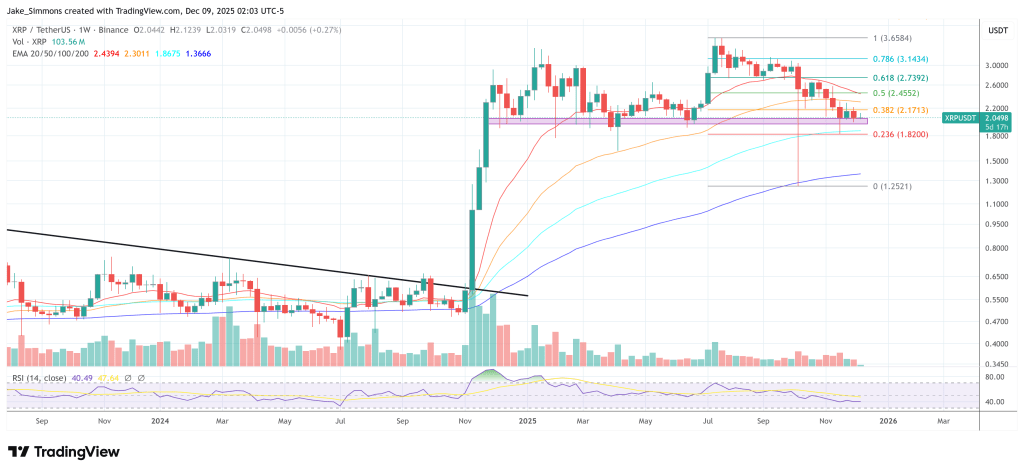
XRP giữ trên mức hỗ trợ chính, biểu đồ 1 tuần | Nguồn: XRPUSDT trên TradingView.com

Trending Cryptos

Related Questions

QCác công ty Wall Street nào đã đầu tư 500 triệu đô la vào Ripple vào tháng 11?

ANhóm các công ty lớn bao gồm Citadel Securities, Fortress Investment Group, Marshall Wace, các phương tiện liên kết Brevan Howard, Galaxy Digital và Pantera Capital.

QĐiều khoản bảo vệ đặc biệt nào mà các nhà đầu tư Wall Street đã đàm phán trong thỏa thuận?

AHọ đảm bảo quyền bán lại cổ phiếu cho Ripple sau 3-4 năm với lợi nhuận được đảm bảo 10% hàng năm, cùng quyền ưu tiên thanh lý trong trường hợp bán công ty hoặc phá sản.

QTại sao thỏa thuận này được xem như một cột mốc quan trọng đối với rủi ro tín dụng trong lĩnh vực crypto?

ACác điều khoản của thỏa thuận đang định hình cách các ngân hàng và quỹ đánh giá bảng cân đối kế toán, rủi ro thoát vốn và thanh khoản tương lai của Ripple, với các kịch bản giá XRP và lãi suất được mô hình hóa rõ ràng.

QRipple phải đối mặt với nghĩa vụ tài chính tiềm ẩn nào nếu các nhà đầu tư thực hiện quyền bán lại cổ phần?

ANếu thực hiện đầy đủ quyền bán lại sau 4 năm, Ripple sẽ phải chi trả khoảng 700-730 triệu đô la, bất kể hiệu suất hoạt động hay giá token tại thời điểm đó.

QMối quan hệ giữa giá trị tài sản ròng của Ripple và XRP được mô tả như thế nào?

ATheo báo cáo, ít nhất 90% giá trị tài sản ròng của Ripple gắn liền với XRP, với công ty kiểm soát khoảng 124 tỷ đô la token này theo giá thị trường vào tháng 7.

Related Reads

After Three Consecutive Quarters of Decline, Can the Crypto Market Find a Window for Stabilization in Q3?

The cryptocurrency market has just concluded its worst-performing quarter since 2022, with total capitalization dropping 12.6% to $2.1 trillion. All core metrics indicate capital is leaving the sector, not just rotating within it. Bitcoin fell 14.2% and Ethereum dropped 25.4% in Q2, breaking their previous correlation with US tech stocks. A key driver is the reversal in US spot Bitcoin ETF flows, which saw a net outflow of approximately $4.67 billion in Q2, including a record monthly outflow near $4.5 billion in June. While recent data suggests long-term holders are accumulating again, sustained ETF outflows mean continued selling pressure. Market focus is now singularly on the Federal Reserve. The upcoming July FOMC meeting is seen as the most critical event for Q3. A dovish signal could support Bitcoin reclaiming a $68,000-$84,000 range, while a hawkish stance might establish a new trading band around $50,000-$56,000. Additionally, regulatory uncertainty persists, with the progress of the crucial *CLARITY Act* stalling in the Senate, reducing its perceived 2026 passage probability to 40-45%. Despite the broad downturn, a few sectors showed growth. Prediction markets saw nominal volume surge 48.7% year-over-year to $113.8 billion, and tokenized collectibles transaction volume rose 143% quarterly to $1.4 billion. The Real-World Asset (RWA) tokenization sector also continued steady growth, now representing ~$28.1 billion in on-chain value. The market's foundation for an extreme crash appears limited, with Bitcoin price hovering near its 200-week moving average. However, the trading paradigm has shifted from narrative-driven speculation to decisions based on price action, policy developments, and interest rate expectations, making a broad sentiment-driven rally unlikely in the near term.

marsbit1h ago

After Three Consecutive Quarters of Decline, Can the Crypto Market Find a Window for Stabilization in Q3?

marsbit1h ago

BIT Trading Moment: BTC Still Suppressed by Weekly 200 EMA, Rejection May Restart Decline; Storage and Semiconductors that Surged Last Night Begin Falling in Evening Trading

**Crypto & Stock Market Wrap: Bitcoin Tests Resistance, Stocks Retreat After AI Surge** Bitcoin consolidates around $66,000, facing key resistance near $68,000—an area seen as a major psychological and technical hurdle where previous rallies have failed. Analysts note the cryptocurrency is caught between its 200-week moving average (~$63,333) and 200-week EMA (~$68,328). A clear break above $68k is needed to signal a stronger bullish trend, while a rejection could lead to a retest of $63k support. Market sentiment remains cautious, with low futures open interest pointing to a low-liquidity rebound rather than a full bull market. Bitcoin spot ETFs saw another $203 million inflow. US stock futures pointed lower after a strong Tuesday session led by a massive rebound in semiconductors and memory stocks. The rally was fueled by renewed optimism about AI-driven hardware demand, with Micron, SanDisk, and SK Hynix surging. However, those gains reversed in pre-market trading. Super Micro Computer (SMCI) soared over 20% after hours on strong guidance and a record backlog. Other standouts included Rocket Lab and nuclear energy plays Oklo and X-Energy. Rising oil prices (Brent above $91) and climbing Treasury yields (10-year near 4.64%), however, are reigniting inflation concerns and acting as a headwind for equities. In Asia, markets were mixed. South Korea's KOSPI pared early gains to close slightly higher as semiconductor stocks like SK Hynix gave back initial surges. Japan's Nikkei edged lower as the yen hit a fresh 38-year low against the dollar, raising fears of potential market intervention. Key events to watch include the Samsung Galaxy launch, AMD's AI event, and a slew of major tech earnings from Alphabet, Tesla, and IBM after the close on Wednesday, followed by the ECB meeting and Intel's earnings on Thursday.

marsbit1h ago

BIT Trading Moment: BTC Still Suppressed by Weekly 200 EMA, Rejection May Restart Decline; Storage and Semiconductors that Surged Last Night Begin Falling in Evening Trading

marsbit1h ago

Former CFTC Chairman, Circle President Tarbert: Preaching Long-Termism While Cashing Out $30 Million Himself

Former CFTC Chairman and Circle President Heath Tarbert has consistently advocated for a long-term vision in public, urging patience from investors as Circle’s stock price has fallen significantly from its peak. However, it has been revealed that since Circle’s IPO, Tarbert has continuously sold his CRCL shares through pre-arranged trading plans, cashing out approximately $30 million, without making any public market purchases. This contrast between his public messaging and personal actions has drawn criticism. Tarbert joined Circle in July 2023 as Chief Legal Officer, leveraging his regulatory experience to help guide the company through its IPO and expansion. Despite promoting stablecoins as long-term infrastructure, he established a 10b5-1 trading plan just before Circle went public, leading to substantial stock sales over the following year. In March 2026, he initiated another plan to sell more shares. His career trajectory highlights a pattern of moving between high-level regulatory roles and influential positions in the financial sector. After resigning as CFTC Chairman in early 2021, he joined Citadel Securities as Chief Legal Officer just 27 days later, during a period of intense regulatory scrutiny for the firm. He later joined Circle, aiding its efforts to navigate regulatory challenges for its public listing. While Tarbert's expertise in policy and compliance is valuable to companies like Circle, his actions—advocating long-term confidence while personally divesting—raise questions about the alignment between his public statements and his private financial decisions, leaving investors who followed his advice to bear the market risks.

marsbit1h ago

Former CFTC Chairman, Circle President Tarbert: Preaching Long-Termism While Cashing Out $30 Million Himself

marsbit1h ago

Gate Research Institute: The 'Wall Street-ization' Wave of Crypto Financial Products – Competition or Integration?

The article titled "Gate Research Institute: Are Crypto Financial Products Sparking a 'Wall Street' Wave—Competition or Convergence?" explores the evolving relationship between the crypto ecosystem and traditional finance (TradFi). The piece begins by reflecting on Bitcoin's original 2009 vision of decentralization, disintermediation, and moving away from banks. It then contrasts this with the 2024 landscape, where key crypto assets like Bitcoin are increasingly held through Wall Street products like ETFs issued by giants like BlackRock. The article questions whether this signifies that TradFi is systematically taking over the rights to issue, price, custody, and distribute crypto financial assets. The core argument is that this is not a zero-sum takeover but rather a bidirectional convergence where each side addresses the other's weaknesses. Crypto offers 24/7 global markets, programmable settlement, and open access but lacks compliant channels, institutional-grade custody, deep fiat liquidity, and mainstream distribution. TradFi possesses these but is constrained by legacy systems, limited operating hours, and slow settlement. Two primary convergence paths are highlighted: * **Path A (CEX to TradFi):** Exemplified by Gate, which has progressed from offering tokenized stocks and CFDs to providing direct, real stock trading (US, Hong Kong, South Korea) within its platform, using USDT. * **Path B (TradFi to Crypto):** Exemplified by Robinhood, which has integrated crypto trading, acquired exchanges like Bitstamp, and is moving traditional assets like stocks onto the blockchain via tokenization and its own Layer 2. Both paths are ultimately competing to become the next-generation, unified financial account—a "super account" where users can seamlessly trade cryptocurrencies, stocks, ETFs, RWA (Real World Assets), and tokenized treasury products in one interface. The growth of RWA and tokenized treasuries (e.g., BlackRock's BUIDL) is presented as the asset-layer fusion, providing stable, yield-bearing assets on-chain and acting as a bridge between the two worlds. In conclusion, the "Wall Street-ization" of crypto is framed as a mutual transformation. Decentralized ideals persist in the protocol layer, while at the application layer, a more efficient, global, and accessible unified capital market is emerging from this convergence. The future competition lies not between crypto exchanges and stockbrokers, but between platforms vying to offer the most comprehensive asset coverage, liquidity, and user experience within a single account.

marsbit1h ago

Gate Research Institute: The 'Wall Street-ization' Wave of Crypto Financial Products – Competition or Integration?

marsbit1h ago

Trading

Spot

Hot Articles

What is VRJAM(BLUE)

VRJAM(BLUE): Revolutionizing Live Experiences in the Virtual World Introduction to VRJAM(BLUE), $vrjam(blue) In an age where virtual experiences are becoming increasingly prevalent, VRJAM(BLUE), represented by the token $vrjam(blue), emerges as a pioneering project within the cryptocurrency space. Launched in 2022, VRJAM(BLUE) seeks to transform how live events are conducted in the digital realm by utilizing the power of blockchain technology and the Hedera Hashgraph platform. As a unique blend of immersive social gaming and interactive virtual events, VRJAM(BLUE) strives to create a comprehensive, engaging experience that resonates with users worldwide. What is VRJAM(BLUE), $vrjam(blue)? At its core, VRJAM(BLUE) is a live experience platform harnessing blockchain to facilitate immersive interactions during virtual events. It stands out as a futuristic solution that allows users to engage with one another in real time, bridging the gap between the physical and digital worlds. The platform leverages advanced technologies, including AI-powered virtual humans, which introduce customizable digital representations of users. These entities serve as avatars that enhance the social dynamics of virtual gatherings. Coupling these virtual beings with the use of non-fungible tokens (NFTs) introduces a layer of security and authenticity, ensuring that unique digital assets can be traded and valued properly within the platform's ecosystem. Moreover, VRJAM(BLUE) integrates a native cryptocurrency, the VRJAM Coin, which acts as the medium of exchange within its virtual world. This digital currency facilitates transactions for services, content, and assets while enabling users to participate seamlessly in live events and interactive experiences. Creator of VRJAM(BLUE), $vrjam(blue) The specific identity of the creator of VRJAM(BLUE) remains undisclosed, though the project is under the leadership of CEO Sam Speaight. His vision for the platform aims at leveraging innovative technology and strategic partnerships to expand the reach and impact of VRJAM(BLUE) in the rapidly evolving web3 ecosystem. Investors of VRJAM(BLUE), $vrjam(blue) VRJAM(BLUE) has garnered considerable interest from various investors and funding rounds, successfully raising a total of $5.34 million throughout 12 funding events. These various initiatives, including Initial DEX Offerings (IDO) and token launches, have provided the necessary capital to propel the project forward. However, specific details regarding the individual investors or organizations backing VRJAM(BLUE) have not been disclosed. How Does VRJAM(BLUE), $vrjam(blue) Work? The innovative approach of VRJAM(BLUE) revolves around multiple cutting-edge technologies, notably artificial intelligence, virtual reality, and blockchain. AI-Powered Virtual Humans A distinguishing feature of VRJAM(BLUE) is its integration of AI-powered virtual humans. These customizable characters respond dynamically to user interactions, enriching the overall experience of virtual events. This personalization allows users to create unique identities and facilitating more meaningful connections within the community. NFT Technology By incorporating NFT technology into its framework, VRJAM(BLUE) provides users with enhanced security and ownership of digital assets. Users can purchase, sell, or trade NFTs that represent virtual tickets, memorabilia, or other digital creations linked to live events, ensuring that ownership is verifiable and protected. Native Cryptocurrency The VRJAM Coin serves as the platform's native currency, allowing users to transact seamlessly within the virtual environment. This cryptocurrency not only supports traditional user activities but also bolsters a larger economic ecosystem tailored to the needs of VRJAM’s community. DeFi Solutions The project also embraces decentralized finance (DeFi) by incorporating trustless protocols. These solutions aim to stabilize token prices and enhance liquidity, allowing users to engage in financial transactions without intermediary restrictions. Timeline of VRJAM(BLUE), $vrjam(blue) To fully understand the evolution of VRJAM(BLUE), it's essential to take a closer look at its timeline: 2022: Launch of VRJAM(BLUE) – The platform made its debut, ushering in a new era for virtual event experiences. November 30, 2022: Completion of the Token Generation Event (TGE) – This marked a significant milestone, as the platform's native cryptocurrency became available for investor engagement. Post-TGE: Following the TGE, the distribution of tokens initiated, featuring a 20% immediate release, followed by a linear vesting phase of the remaining 80% over a period of six months. Key Features and Partnerships The success of VRJAM(BLUE) can also be attributed to its strategic partnerships and innovative features. Partnerships In its quest to bring life to the metaverse, VRJAM(BLUE) has formed alliances with prominent entities in the industry. Notably, its collaboration with Polygon aims to enhance the efficiency and reach of live events. Additional partnerships with organizations such as Agora and Enjin further bolster content distribution and the utilization of NFT technology. These collaborations are enhancing VRJAM(BLUE)'s capabilities and expanding its influence in the web3 ecosystem. Token Liquidity Protocol Operating on the Hedera Hashgraph, VRJAM(BLUE) employs a token liquidity protocol that aggregates liquidity across various trading platforms. This initiative is designed to unify token pricing, thus enhancing user confidence in the VRJAM Coin and promoting stability within the ecosystem. Web3 Economy With the overarching aim of fostering a sustainable web3 economy, VRJAM(BLUE) is diligently working on its DeFi product suite. By providing users with tools for financial engagement, such as yield farming or staking, the project is paving the way for broader participation in its virtual economy. Conclusion VRJAM(BLUE), with its token $vrjam(blue), stands at the forefront of the revolution in virtual experiences and live interactions within the digital space. By intertwining advanced technologies such as AI, virtual reality, and blockchain, the project has developed a platform that not only facilitates immersive experiences but also builds a vibrant, interactive community. As the landscape of the crypto and web3 industries continues to evolve, VRJAM(BLUE) aims to play a critical role in shaping the future of virtual events and experiences. With its commitment to innovation and community engagement, VRJAM(BLUE) is well-positioned to pave a prosperous path for digital interactions in the years to come.

875 Total ViewsPublished 2024.12.03Updated 2024.12.03

What is VRJAM(BLUE)

How to Buy BLUE

Welcome to HTX.com! We've made purchasing Bluefin (BLUE) simple and convenient. Follow our step-by-step guide to embark on your crypto journey.Step 1: Create Your HTX AccountUse your email or phone number to sign up for a free account on HTX. Experience a hassle-free registration journey and unlock all features.Get My AccountStep 2: Go to Buy Crypto and Choose Your Payment MethodCredit/Debit Card: Use your Visa or Mastercard to buy Bluefin (BLUE) instantly.Balance: Use funds from your HTX account balance to trade seamlessly.Third Parties: We've added popular payment methods such as Google Pay and Apple Pay to enhance convenience.P2P: Trade directly with other users on HTX.Over-the-Counter (OTC): We offer tailor-made services and competitive exchange rates for traders.Step 3: Store Your Bluefin (BLUE)After purchasing your Bluefin (BLUE), store it in your HTX account. Alternatively, you can send it elsewhere via blockchain transfer or use it to trade other cryptocurrencies.Step 4: Trade Bluefin (BLUE)Easily trade Bluefin (BLUE) on HTX's spot market. Simply access your account, select your trading pair, execute your trades, and monitor in real-time. We offer a user-friendly experience for both beginners and seasoned traders.

4.5k Total ViewsPublished 2024.12.11Updated 2026.06.02

How to Buy BLUE

Discussions

Welcome to the HTX Community. Here, you can stay informed about the latest platform developments and gain access to professional market insights. Users' opinions on the price of BLUE (BLUE) are presented below.

活动图片