TeraWulf привлекает $500 млн на строительство ЦОДа для ИИ

cryptonews.ruPublished on 2025-03-29Last updated on 2025-10-30

Криптовалютная майнинговая компания TeraWulf планирует привлечь $500 млн путем размещения конвертируемых облигаций. Полученные средства будут направлены на финансирование строительства нового кампуса центров обработки данных в Абернати, Техас.

Частное размещение ориентировано на квалифицированных институциональных инвесторов, сообщила компания в среду. TeraWulf также предоставила андеррайтерам опцион на покупку дополнительных облигаций на $75 млн в течение 13 дней с момента выпуска, в зависимости от рыночных условий.

Конвертируемые старшие облигации со сроком погашения 1 мая 2032 года не будут предусматривать регулярные процентные платежи. Конвертация будет возможна только при соблюдении определенных условий до февраля 2032 года. Инвесторы получат право конвертировать облигации в денежные средства, акции TeraWulf или их комбинацию, при этом точные условия конвертации будут определены в ходе финальных переговоров.

TeraWulf заявила, что вырученные средства пойдут на финансирование техасского проекта по строительству центра обработки данных, а также на общие корпоративные цели.
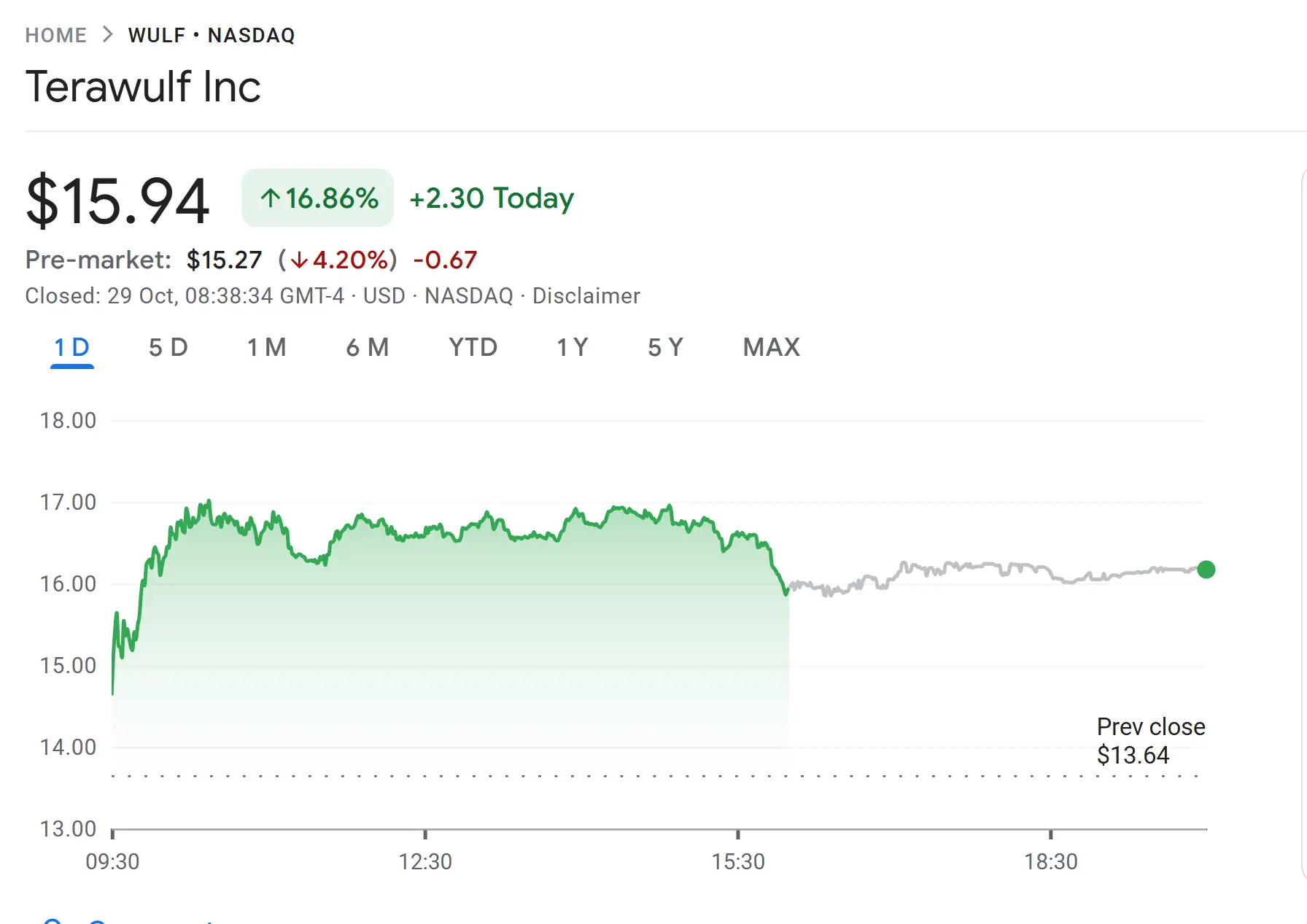

Акции TeraWulf завершили торги во вторник с ростом на 16%. Источник: Google Finance

Стратегический переход TeraWulf к искусственному интеллекту

Новое размещение следует за недавними сообщениями о том, что TeraWulf сотрудничает с Morgan Stanley для привлечения до $3 млрд долгового финансирования. При этом Google предоставляет гарантию на $1,4 млрд для расширения мощностей компании, готовых к работе с искусственным интеллектом, и укрепления ее роли в обеспечении вычислительных мощностей следующего поколения.

В августе TeraWulf также заключила контракт на $3,7 млрд с компанией по инфраструктуре искусственного интеллекта Fluidstack, которая поддерживается Google. В рамках сделки Google приобрел 14% долю в майнинговой компании.

Активные действия TeraWulf происходят на фоне бума искусственного интеллекта, который вызвал серьезный дефицит площадей центров обработки данных, графических процессоров и доступа к надежным источникам электроэнергии. Крупные криптовалютные майнинговые компании имеют выгодные позиции для использования этой ситуации, поскольку они уже обладают существующей инфраструктурой центров обработки данных и обеспеченными энергетическими мощностями.

Galaxy Digital привлекает $460 млн для ускорения работы центра искусственного интеллекта в Техасе

В начале этого месяца компания Galaxy Digital Майка Новограца привлекла $460 млн от одного из крупнейших мировых управляющих активами для расширения своего кампуса центров обработки данных Helios в Техасе. Сделка, включающая покупку 12,77 млн акций класса А по $36 каждая, направлена на ввод в эксплуатацию 133 мегаватт IT-мощностей к началу 2026 года.

Это финансирование дополняет кредит в $1,4 млрд, полученный Galaxy в августе для финансирования 80% строительства Helios. В рамках 15-летнего соглашения с CoreWeave компания Galaxy будет поставлять вычислительные мощности для рабочих нагрузок искусственного интеллекта и высокопроизводительных вычислений, что, по оценкам, будет приносить около $1 млрд ежегодного дохода.


Related Reads

Jensen Huang: Prompts are Becoming Obsolete, Loops are the New Paradigm

Jensen Huang, alongside AI leaders like Peter Norvig, Boris Cherny, and Andrew Ng, is advocating for a shift from "prompt engineering" to "loop engineering" as the new paradigm for AI development. Instead of manually crafting individual prompts, the focus is now on designing autonomous loops—systems where AI agents execute tasks, self-validate results, and iterate until completion without constant human oversight. A loop is a management framework that enables agents to operate independently. Key implementations are seen in Claude Code (with features like /loop, /goal, and /schedule) and OpenAI Codex, which employ multiple agents working in parallel within isolated environments. A core principle is the separation of roles: one agent (or model) performs the task, while an independent agent (or a smaller, separate model) validates the output to ensure objectivity. The article outlines a practical roadmap for implementing loops, starting with a "four-condition test" to assess suitability, building a minimal viable loop, and emphasizing critical pitfalls to avoid, such as lacking hard stop conditions or allowing loops to handle tasks requiring human judgment. This evolution is framed as the fourth major shift in AI interaction: from Prompt Engineering (crafting instructions) to Context Engineering (providing background information), then to Harness Engineering (building tool-enabled environments), and finally to Loop Engineering (creating self-sustaining systems). This progression reflects a consistent trend of increasing abstraction, moving human involvement from direct instruction to system design and rule-setting. The concept has academic roots in frameworks like ReAct, which formalized the "reason-act-observe" cycle. While loop engineering promises greater automation, experts caution about managing token costs and warn against outsourcing understanding—AI can assist, but deep problem comprehension remains essential.

marsbit31m ago

Jensen Huang: Prompts are Becoming Obsolete, Loops are the New Paradigm

marsbit31m ago

GPT Designs GPT

OpenAI has unveiled its first custom AI chip, Jalapeño, a move signaling a strategic shift beyond being a mere model company. While many see it as a challenge to NVIDIA, its core aim is to control the entire intelligent production pipeline—from models and chips to data centers and energy. The key driver is the evolving competitive landscape: model advantages are shrinking, while the computational gap in areas like cost-per-token, system throughput, and energy efficiency is becoming the true long-term barrier. Jalapeño is primarily an inference chip, targeting the massive and growing "inference tax"—the daily operational cost of generating tokens for services like ChatGPT and APIs. By designing its own hardware optimized for its specific workloads and future product roadmaps (even using AI to aid the chip design process), OpenAI aims to drastically reduce token generation costs and improve system efficiency. This creates a potential flywheel: better models help design better chips, which lower costs for running next-generation models, supporting more users and products, which in turn provides more data to refine future chips. The strategy mirrors Apple’s integrated approach, building a closed loop where hardware, software, and applications are co-optimized. In the long term, OpenAI is not trying to become the next NVIDIA (a supplier of "shovels" to all AI companies) but to own and operate the entire "mine"—selling the end product of intelligence itself. This move marks OpenAI's ambition to evolve from creating the smartest models to controlling the foundational infrastructure of AI production.

marsbit56m ago

GPT Designs GPT

marsbit56m ago

Ethereum Foundation Interim Executive Director Speaks Out: What Is Our Mission?

The Ethereum Foundation's core mission is to ensure Ethereum remains a truly permissionless, censorship-resistant, private, and open infrastructure for large-scale, sovereign coordination. The article clarifies the EF's focus and dismisses irrelevant objectives, such as pursuing institutional popularity or short-term speculation. Its core work centers on eliminating systemic weaknesses. This involves fortifying Ethereum across multiple layers—protocol, access, user, and institutional—against exploitation, control, or surveillance. Key initiatives include minimizing harmful MEV and preventing privileged control over transaction flow, making unconditional privacy a foundational default, ensuring staking remains permissionless and decentralized, and strengthening user-facing access points to uphold autonomy. Concurrently, the EF aims to seize strategic opportunities. These include leading the transition to post-quantum cryptography, achieving a fully verifiable protocol stack, establishing Ethereum as private digital cash, integrating user-owned AI agents with personal wallets, and demonstrating that trusted-neutral infrastructure can competitively handle disintermediated coordination at an institutional scale. The article also addresses recent organizational changes, stating that personnel departures were due to strategic realignment, role fit, or natural evolution. It clarifies the approach to spin-outs, emphasizing that external funding will be provided only for work critical to the EF's mission that reduces Ethereum's dependency without creating new risks or mission drift. Ultimately, the EF is committed to building an enduring, neutral system that reshapes global coordination, focusing relentlessly on the principles of censorship resistance, openness, privacy, and sovereignty (CROP).

链捕手1h ago

Ethereum Foundation Interim Executive Director Speaks Out: What Is Our Mission?

链捕手1h ago

Trading

Spot
Futures
活动图片