Here’s Why Litecoin Is Rising To The Limelight Again: Is This The Future Of Crypto Payments?

bitcoinistPublished on 2025-10-28Last updated on 2025-10-28

Abstract

Litecoin (LTC) is stepping back into the spotlight, positioning itself as more than just a digital asset but a reliable...

Trusted Editorial content, reviewed by leading industry experts and seasoned editors. Ad Disclosure

Litecoin (LTC) is stepping back into the spotlight, positioning itself as more than just a digital asset but a reliable medium for everyday transactions. Recent reports reveal that global investment giant T. Rowe Price has filed for a crypto ETF that includes LTC, proving its credibility beyond retail markets. Moreover, Litecoin’s unique attributes are drawing interest from institutional investors and digital cash advocates as blockchain networks compete for dominance. With developments highlighting its scalability and long-term reliability, Litecoin could soon emerge as a serious contender for the future of crypto payments.  

Institutional Moves Push Litecoin Back Into The Spotlight

Recent moves from major financial players suggest that Litecoin is finally being recognized as a legitimate, institutional-grade cryptocurrency. Crypto commentator Santolita highlighted in a recent X post that T. Rowe Price has filed for an Active Crypto ETF with the US Securities and Exchange Commission (SEC), explicitly naming it as an eligible commodity

This development signals that large-scale investors are beginning to acknowledge the broader crypto asset class, with Litecoin positioned as a resilient and reliable choice for crypto payments. Santolita notes in a follow-up post that, unlike projects chasing hype, Litecoin has maintained consistent merchant adoption and processed real transactions across market cycles.  

She disclosed that the crypto network boasts proven longevity and low-cost transactions, which make it an attractive option for both everyday users and investors seeking a dependable store of value. Santolita also stated that its organic, grassroots adoption further strengthens its position as a practical and utilitarian digital asset. 

The crypto commentator further described Litecoin as “digital silver,” highlighting its core functionality, which includes Peer-to-Peer digital cash with zero-cost payments, a fully decentralized ecosystem with significant industry supply and liquidity. She also noted that Litecoin boasts faster confirmation times and battle-tested security. All of which could be setting the altcoin up as a contender in the crypto payments industry

Advanced Network Capabilities Reinforce LTC Role In Crypto Payments

Beyond institutional recognition, Litecoin continues to attract significant interest for its operational efficiency and scalability as a crypto payments provider. Crypto analyst Sean points out that anyone seeking true control over their digital cash should consider holding LTC. 

His statement came in response to the Litecoin team’s post on X, which provided a technical foundation for why the digital asset excels in the crypto payments market. They noted that low transaction fees, well below $0.0007, make LTC an ideal vehicle for digital cash. They also highlighted that the network can handle up to 56 transactions per second (TPS), far exceeding its current daily load of around 200,000 transactions (2.5 TPS). 
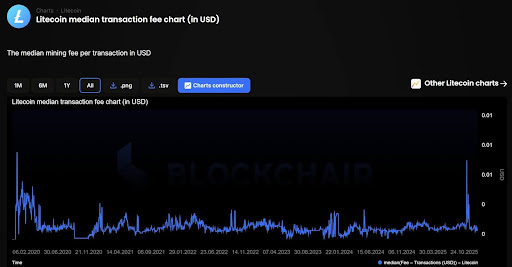
Litecoin
Source: Litecoin

The team explained that Litecoin’s network structure, including the merging of mining and consistent block rewards, ensures that LTC miners remain incentivized even as transaction volumes increase. Historical trends highlighted in the post further reinforce its utility as a crypto payments provider. 

According to the team, during Bitcoin’s congestion from October 2023 to October 2024, LTC handled a substantial increase in transactions with minimal cost, demonstrating the practicality of its design for real-world crypto payments. With more than 14 years of uninterrupted operation, fully decentralized mining, no founder’s stash, and strong volunteer-based support, the team emphasizes that the network remains secure, efficient, and accessible. 

Litecoin price chart from Tradingview.com
LTC continues to trend below $100 | Source: LTCUSD on Tradingview.com
Featured image created with Dall.E, chart from Tradingview.com
Editorial Process for bitcoinist is centered on delivering thoroughly researched, accurate, and unbiased content. We uphold strict sourcing standards, and each page undergoes diligent review by our team of top technology experts and seasoned editors. This process ensures the integrity, relevance, and value of our content for our readers.

I'm Sandra White, a writer at Bitcoinist, and I provide the latest updates on the world of cryptocurrencies. I believe crypto a gateway to a new order and I have made it my life's mission to help educate as much people as possible. When I'm not at work, I love listening to music, learning new things, and dream of traveling around the world.

Trending Cryptos

Related Reads

The Biggest Crypto Bull? Are Compliant Token Fundraisers Making a Comeback?

On August 18th, the U.S. Securities and Exchange Commission (SEC) released a draft proposal titled "Regulation Crypto Assets." This proposal establishes a new legal framework for compliant token fundraising in the United States, aiming to create a structured path for projects from initial offering to regulatory "graduation." The draft introduces two primary fundraising exemptions for projects. The "startup exemption" allows early-stage projects to raise up to $5 million over four years. Larger projects can use a tiered system to raise $20 million or $75 million within 12 months, subject to stricter disclosure and auditing requirements. These exemptions provide a legal alternative to full securities registration, mandating that projects disclose details on governance, development plans, security risks, and team information. A core concept in the proposal is the "investment contract" relationship formed when tokens are sold based on promises of future development work. The SEC's focus shifts from debating whether a token is a security to tracking whether the issuer has fulfilled its key promises to investors. A token can "graduate" from this regulated status—entering a "safe harbor"—only after the issuer publicly certifies that all significant commitments made during the fundraising have been either completed or permanently ceased. This "promise-based" approach significantly impacts project strategy. To facilitate an earlier graduation, projects may be incentivized to make fewer and more modest public promises during fundraising, creating a tension between attracting investors with ambitious roadmaps and simplifying the path to regulatory exit. The proposal also influences airdrop design. Retroactive airdrops that reward past user activity without prior promises are less likely to be regulated. However, "points" programs that explicitly promise future tokens in exchange for current user actions (like trading or providing services) could be considered part of the fundraising and count toward exemption limits. Currently a draft open for public comment, the "Regulation Crypto Assets" proposal represents a potential shift toward a more defined, compliance-focused era for U.S. crypto fundraising, where the amount raised is capped by rules and a token's regulatory status depends on the fulfillment of explicit developer promises.

marsbit25m ago

The Biggest Crypto Bull? Are Compliant Token Fundraisers Making a Comeback?

marsbit25m ago

Trading

Spot

Hot Articles

Discussions

Welcome to the HTX Community. Here, you can stay informed about the latest platform developments and gain access to professional market insights. Users' opinions on the price of S (S) are presented below.

活动图片