DeFi regulation fight derails U.S. crypto bill, odds of passage collapse to 17%

ambcryptoPubblicato 2025-10-19Pubblicato ultima volta 2025-10-20

Key Takeaways 

Will the upcoming meeting resolve the Democrats hold-out?

This could be the end-goal, but market expectation was very low.

What’s the bone of contention in Congress? 

The controversial DeFi regulation proposal by Democrats irked the industry and Republicans at large. 


The crypto market structure regulation has hit the fan amid Congress fall-out. This followed a push by the Senate Democrats to regulate decentralized finance (DeFi).

Republicans, in response, withdrew from engagements, further putting the year-end deadline for passage of the bill into limbo.

Now, crypto executives will meet with the pro-crypto Senate Democrats on the 22nd of October, likely to resolve the stalemate. 

According to former FOX Business reporter Eleanor Terrett, the crypto leaders will include Coinbase CEO Brian Armstrong, Galaxy’s Mike Novogratz, Uniswap [UNI] CEO Hayden Adams, and others. 

Democrats’ hard stance

For closure, the Senate’s version of the crypto market structure bill has not made it out of the committee yet. 

The stand-off between Republicans and Democrats on the scope and certain key areas has complicated the path forward for the bill.

Pro-crypto Senate Democrats, led by Reuben Gallego, blamed Republicans for ‘crashing out.’ 

Jacques Petit, spokesman for the Sen. Gallego, told Politico that, 

“They (Republicans) asked for paper and substance, and we delivered. They then turned around and leaked our proposal and pretend to be surprised that our parties have policy differences.”

In response, the representative for Senate Banking Chair, Tim Scott, slammed Democrats, adding that the proposal wasn’t in a “good faith” for the market structure bill. 

“The document was not written in legislative text, included multiple incoherent policy ideas, and was not a good-faith effort to engage on market structure.”

For Blockchain Association, the umbrella body that champions for crypto advocacy, the proposal was “dissapointing.”

Crypto bill

Source: X

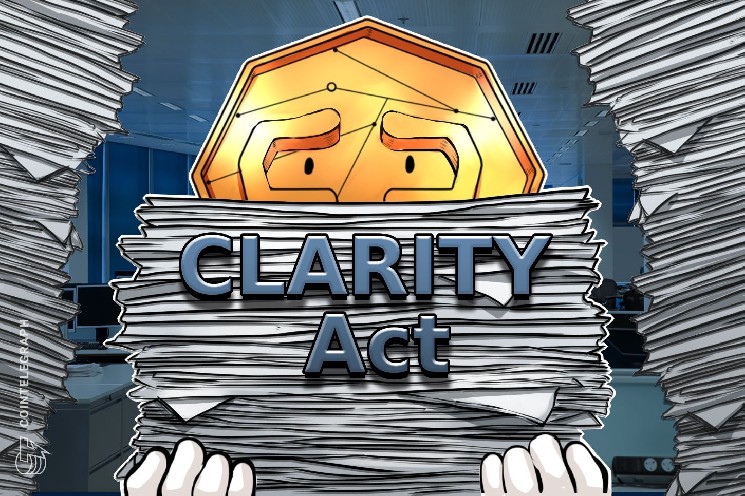
Worth pointing out that the stalled draft is totally separate from the one advanced from the House (the CLARITY Act) in July.

A harmonized version, if achieved, should pass a Senate floor vote. After that, it will go back to the House before hitting the president’s desk to be signed into law.

Republicans had initially planned to advance the bill from committee by the 30th of October and pass it to law by the end of the year.

But with the chaos, Polymarket showed there was only 17% chance it could become a law by the end of 2025. That’s a 60% drop in market expectations seen mid-July. 

Crypto bill

Source: Polymarket

Share

Letture associate

Morning News | Coinbase Partners with Standard Chartered to Expand Multi-Currency Fiat Channels; Sharplink and Forward to be Included in Russell Indices; JPMorgan May Issue Stablecoin in the Future

Daily Crypto Recap: Key Developments Institutional adoption continues: Coinbase partners with Standard Chartered to expand multi-currency fiat rails for institutions via Coinbase Prime, supporting AUD, SGD, CAD, CHF, EUR, and GBP. Meanwhile, Sharplink and Forward Industries, companies holding significant ETH and SOL reserves respectively, are set to be included in the Russell indexes, providing indirect crypto exposure to traditional index investors. Regulatory and compliance moves are in focus. Hong Kong's monetary authority announced new measures for investment accounts of mainland Chinese investors, including retroactive document checks to January 2023. Prediction market Polymarket is considering implementing KYC requirements to address sanctions and legal risks. Major financial players signal deeper involvement. JPMorgan Chase CEO Jamie Dimon suggested the bank might issue a stablecoin in the future. Concurrently, Falcon Finance and Anchorage Digital launched fUSD, a compliant, institution-focused stablecoin. Market sentiment presents a mixed picture. Bitmine's Tom Lee predicts an incoming crypto "supercycle," driven by Wall Street tokenization and AI agents, with Ethereum as a key beneficiary. However, a prominent trader cautions that the current period of investor losses may not be long enough to confirm a bear market bottom, and TD Cowen analysts note diminished chances for U.S. crypto market structure legislation this year due to a worsening political climate. Other notable news includes a16z crypto's observation that most tokenized assets are merely "digitized" and not actively used in DeFi, South Korea's crypto trading volume falling to about 8% of KOSPI's, and the Chinese Supreme Court stating it will research judicial rules for virtual currency cases.

链捕手59 min fa

Morning News | Coinbase Partners with Standard Chartered to Expand Multi-Currency Fiat Channels; Sharplink and Forward to be Included in Russell Indices; JPMorgan May Issue Stablecoin in the Future

链捕手59 min fa

Sitting on a Trillion-Dollar Market, Why Hasn't Real Estate Tokenization Taken Off?

For years, real estate tokenization has been hailed as a breakthrough technology poised to democratize property investment. In theory, it promises fractional ownership of premium assets, rapid transactions, and enhanced liquidity. Yet, in practice, it has failed to gain traction, accounting for less than 0.1% of the global real estate market. The core issue is not a lack of tokens, but the absence of a robust legal, operational, and compliant framework that grants them credibility as financial instruments. The industry initially erred by prioritizing technology over investor needs, creating products with unclear ownership and unreliable liquidity. Key infrastructure remains missing: legally sound ownership structures, compliant transfer mechanisms, professional servicing, and interoperability with traditional finance. This regulatory ambiguity and operational complexity deter institutional investors, who already have access to established, well-governed investment channels. A mature model would feature low minimum investments in institutional-grade assets, transparent rental income distribution, and genuine liquidity through regulated secondary markets. While regulatory progress in regions like the UAE and growth in other tokenized asset sectors (like treasuries) are positive signs, the focus must shift from issuing tokens to building foundational systems. The investment proposition of tokenized real estate is not to create new returns, but to improve access, efficiency, and liquidity for existing income-generating properties. For mainstream adoption, the sector must demonstrate tangible economic advantages over traditional models, not just technical novelty. The next phase depends on proving scalable, compliant operations with auditable track records. The barrier is no longer technology, but infrastructure and regulation. The vision remains unfulfilled until this gap is bridged.

marsbit1 h fa

Sitting on a Trillion-Dollar Market, Why Hasn't Real Estate Tokenization Taken Off?

marsbit1 h fa

Large Language Models Ace All Exams, Yet Move Farther from AGI: What Does This Paper Reveal?

The article discusses the ongoing challenge of defining and achieving Artificial General Intelligence (AGI). It notes that industry leaders have set vague, often profit- or time-based benchmarks for AGI, while the concept itself lacks a consensus definition—a situation the article compares to a "Rorschach test." It highlights a recent 2025 paper by researcher Michael Timothy Bennett, who proposes a new, measurable definition. Bennett frames AGI not as mimicking human performance on tests, which current large language models (LLMs) have already mastered, but as an "artificial scientist." A true AGI, according to this view, should be able to widely and efficiently adapt to new environments and tasks within real-world constraints (like computational and energy limits), focusing on the *discovery of new knowledge* rather than the replication of existing data. The author contrasts this with the current dominant approach of "scale-maxing"—massively scaling up data, parameters, and compute. While powerful, this method leads to models that fail on out-of-distribution problems and lack core intelligent abilities: they are passive learners, cannot reason causally, and cannot actively experiment or balance exploration with exploitation. The article argues that Bennett's framework offers a crucial shift. It makes AGI a quantifiable engineering problem and proposes new evaluation "adaptation benchmarks" that test an AI's ability to actively learn in novel scenarios. The conclusion is that achieving AGI will require a fundamental reset—a fusion of multiple methodologies beyond simple scaling, moving AI from mimicking patterns to embodying the scientific spirit of inquiry and discovery.

marsbit2 h fa

Large Language Models Ace All Exams, Yet Move Farther from AGI: What Does This Paper Reveal?

marsbit2 h fa

Trading

Spot
Futures
活动图片