Ethereum опередил Solana и биткоин по числу новых разработчиков

cryptonews.ruPublished on 2025-03-15Last updated on 2025-10-16

С начала 2025 года количество разработчиков в экосистеме второй по капитализации криптовалюты выросло на 16 181. Об этом сообщили представители Ethereum Foundation со ссылкой на данные Electric Capital.

1/ New data confirms: @Ethereum is the #1 ecosystem for new developers in 2025. pic.twitter.com/ZThdbGDf0X

— Ethereum Foundation (@ethereumfndn) October 15, 2025

Блокчейн стал лидером по этому показателю. В первую тройку вошли Solana и биткоин, которые привлекли 11 534 и 7494 новых специалистов соответственно. Четвертое место занял Polygon (3681), а пятое — Stacks (3246).

Ethereum остается главным блокчейном по числу активных разработчиков — 31 869. Это почти вдвое больше ближайшего конкурента — Solana, на базе которой работают 17 708 специалистов.
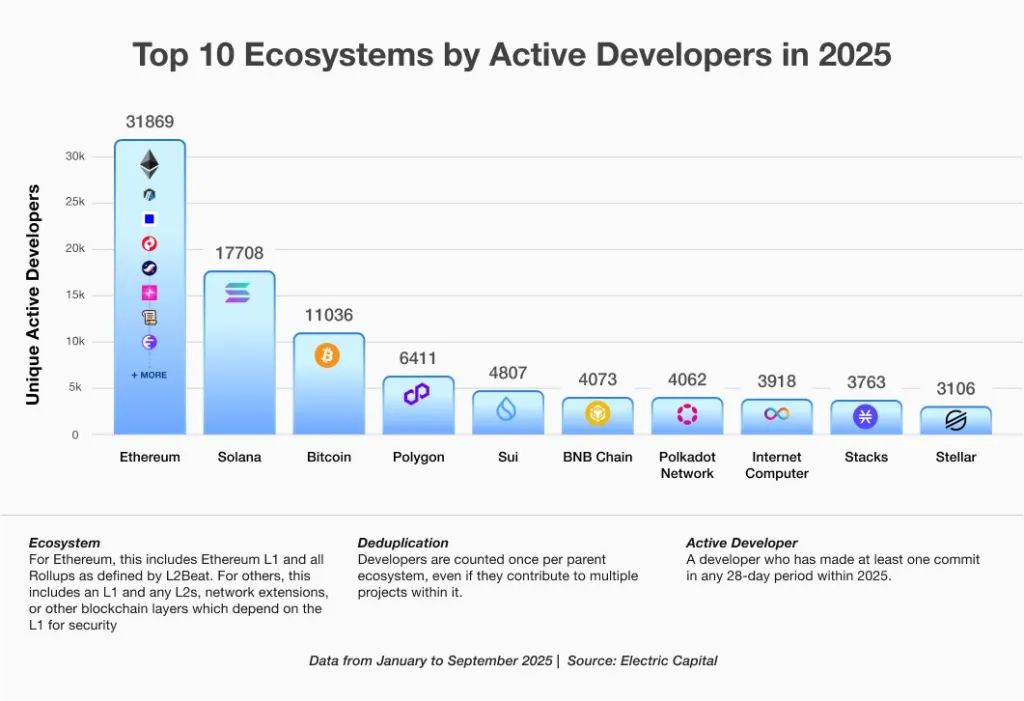
Источник: X/Electric Capital.

Как отметил один из пользователей, разработчики выбирают Ethereum по нескольким причинам:

  • глубокая ликвидность;
  • мощные инструменты;
  • развитый второй уровень;
  • ончейн-спрос.

Блокчейн второй по капитализации криптовалюты остается крупнейшей экосистемой в индустрии. На базе Ethereum работают десятки L2-решений.

Согласно L2Beat, в сетях второго уровня заблокировано более $52,94 млрд. За последний год показатель вырос на 28,8%.
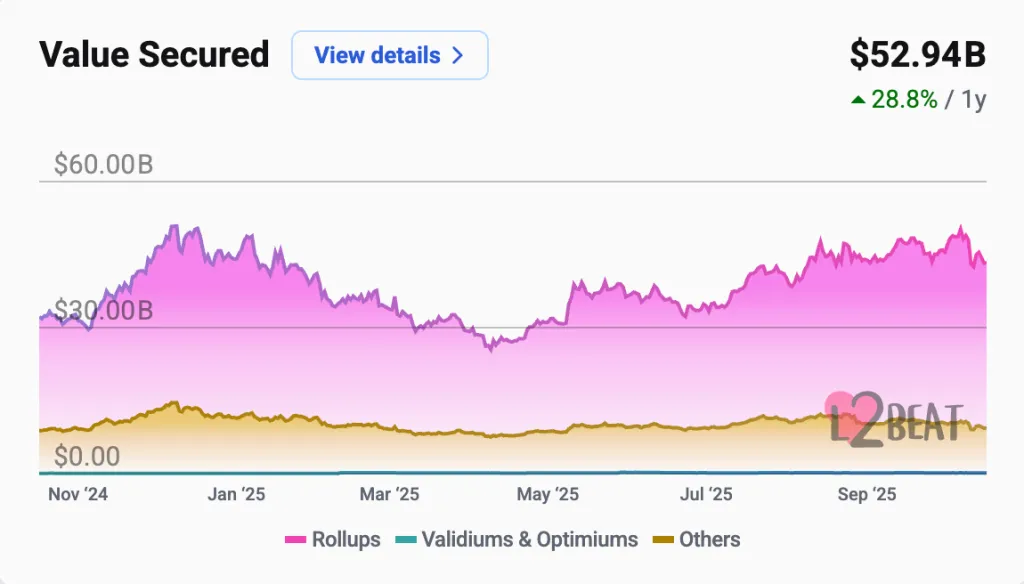
Источник: L2Beat.

В тройку крупнейших решений входят Arbitrum, Base и Optimism.

Ethereum также является «домом» для децентрализованных приложений и протоколов. TVL DeFi-сектора на основе сети второй по капитализации криптовалюты превышает $87,2 млрд.
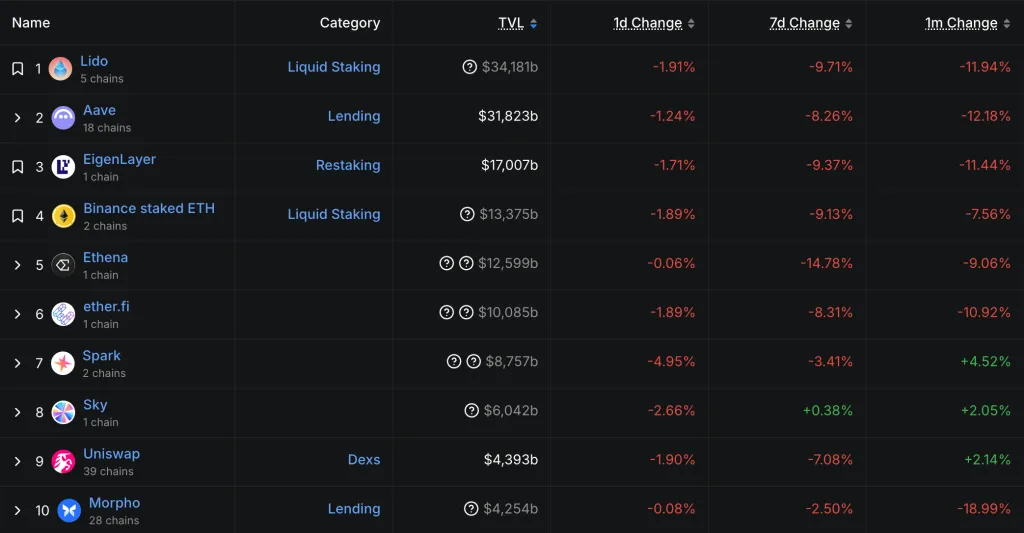
Топ-10 крупнейших DeFi-проектов на Ethereum. Источник: DeFi Llama.

Реакция сообщества

Мнения пользователей относительно достижения Ethereum разделились. Некоторые усомнились, что специалисты действительно могут предпочитать сеть ведущего альткоина для разработки.

«Я работаю на Ethereum уже восемь лет, и это по-прежнему наихудший пользовательский опыт из всех возможных. Я не драматизирую и не преувеличиваю для эффекта. Это абсолютно ужасная платформа с точки зрения обычного пользователя, и я не понимаю, почему у нее так много разработчиков — раз уж их так много, почему они не могут просто сделать ее лучше?», — написал юзер под ником Guy on the Earth.

Другие подчеркнули, что любой пришедший в блокчейн специалист «в конечном счете переходит на Ethereum».

Многих также удивило количество новых и активных разработчиков в сети первой криптовалюты.

«Чем вообще занимаются эти 7000+ биткоин-специалистов целыми днями?», — поинтересовался участник сообщества под псевдонимом Suraj Sharma.

Напомним, специализирующийся на масштабировании Ethereum проект Brevis представил zkEVM-технологию под названием Pico Prism. Она приблизила блокчейн к целевому показателю 10 000 TPS.


Trending Cryptos

Related Reads

EIP-8363 Quantitative Review: Cutting Staking 'Subsidies' – What Does Ethereum Hope to Gain?

**EIP-8363 Quantitative Review: Reducing Staking "Subsidies" – What Does Ethereum Want in Return?** EIP-8363 proposes burning an increasing portion of validator rewards as the staking rate rises, reaching 100% burn when 50% of ETH is staked. This analysis models its impact on issuance, yield, and staking equilibrium, examines whether ETH's yield explains its price, quantifies the chain economy's reliance on this yield, and presents conclusions. Key findings: 1. **EIP-1559 Burns Are Ineffective:** Post-merge, burning (via base fees) has collapsed by 98% and now offsets only 2.4% of new ETH issuance, making issuance policy Ethereum's sole remaining supply lever. 2. **EIP-8363's Real Impact:** At the current ~42.2M ETH staked, the proposal would cut issuance by ~58.6% and staking APR by ~56.4%, removing ~633k ETH ($1.55B) in annual dilution (0.53% of market cap). It's not zero issuance; that would require 43% more ETH staked. 3. **Self-Limiting Mechanism:** The design has a built-in equilibrium. At reasonable required returns (e.g., 2%), the system stabilizes at ~26% staking rate and ~0.48% annual inflation. 4. **Yield vs. Price:** No detectable statistical relationship exists between changes in staking yield and ETH price returns over 43 months. The natural 37% yield decline since 2023 did not drive price action. 5. **Chain Economy Dependence:** While LSTs like wstETH form ~34% of collateral in major lending markets, their utility as collateral remains if yield is positive. The direct revenue hit to protocols like Lido is significant (~50% of fee income) but not systemic. Staking-focused ETFs represent only 0.19% of ETH supply. 6. **Core Conflict:** The debate masks a zero-sum redistribution: cutting ~$1.55B in annual issuance transfers value from concentrated staking intermediaries (LST/LRT protocols, leverage players) to the dispersed majority of non-staking ETH holders. 7. **Outlook:** The proposal is economically sound for ETH's scarcity but politically difficult due to concentrated opposition. It is unlikely to pass in its current form.

marsbit7m ago

EIP-8363 Quantitative Review: Cutting Staking 'Subsidies' – What Does Ethereum Hope to Gain?

marsbit7m ago

Pharos Introduces On-Chain Institutional-Grade U.S. Corporate Bond Credit, Expanding Its RealFi Asset Portfolio

Pharos Network has launched the pRNH Vault, introducing institutional-grade US corporate high-yield bond exposure to its on-chain RealFi (Real World Finance) ecosystem. Developed by the R25 protocol, the vault provides qualified users access to a tokenized portfolio of high-yield corporate debt, broadening Pharos's asset offerings beyond stablecoins and cash-equivalents. The vault's underlying asset is the NYLIM Anemoy US High Yield Corporate Bond separate account (HYB), managed by New York Life Investment Management (NYLIM) and tokenized in collaboration with Anemoy and Centrifuge. Users can deposit USDC into the vault to receive pRNH tokens, representing indirect ownership of the HYB portfolio, which targets an annualized yield of approximately 7%. The structure offers programmability and composability for on-chain financial applications. Pharos views this move as a key evolution from basic asset tokenization towards building a dynamic marketplace where institutional assets can be actively discovered, evaluated, and utilized programmatically. The pRNH Vault architecture incorporates agent-assisted functionalities for credit screening, liquidity monitoring, and on-chain operations, signaling tighter integration between real-world finance and intelligent on-chain systems. To support this vision, Pharos employs a technical stack including the SALI engine for parallel execution, modular SPNs, protocol-level compliance, ZK-KYC/AML, and native AI agent support. The network positions itself as the "value discovery layer" for the agent economy, aiming to make real-world value, smart agents, and institutional assets widely accessible. The pRNH launch adds a core credit asset to this ecosystem and serves as a practical test case for its infrastructure.

marsbit23m ago

Pharos Introduces On-Chain Institutional-Grade U.S. Corporate Bond Credit, Expanding Its RealFi Asset Portfolio

marsbit23m ago

Trading

Spot

Hot Articles

Discussions

Welcome to the HTX Community. Here, you can stay informed about the latest platform developments and gain access to professional market insights. Users' opinions on the price of ETH (ETH) are presented below.

活动图片