Ethereum Breaks Key Resistance: Will ETF Inflows Help ETH Sustain Above $4,300?

bitcoinistPublished on 2025-10-03Last updated on 2025-10-03

Abstract

Currently trading near $4,380, Ethereum (ETH) recently broke above the $4,400 resistance level, a move that has fueled renewed optimism...

Trusted Editorial content, reviewed by leading industry experts and seasoned editors. Ad Disclosure

Currently trading near $4,380, Ethereum (ETH) recently broke above the $4,400 resistance level, a move that has fueled renewed optimism among investors despite a minor pullback.

The boost occurred as crypto ETF inflows increased, institutional interest grew, and market sentiment suggested a potential prolonged bullish trend. However, questions remain about whether ETH can maintain momentum above $4,300 without facing short-term corrections.
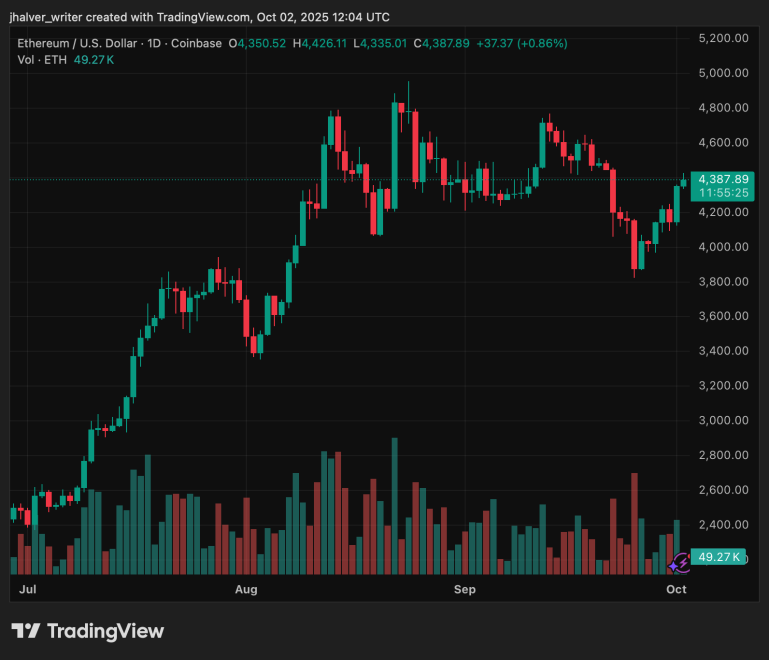
Ethereum ETH ETHUSD

ETH's price trends to the upside on the daily chart. Source: ETHUSD on Tradingview

ETF Inflows and Institutional Demand Fuel Ethereum’s Rally

The recent surge coincides with a wave of capital flowing into Ethereum-focused exchange-traded funds. According to SoSoValue, ETH spot ETFs saw over $80 million in net inflows, continuing their winning streak for three consecutive days.

This momentum shows Ethereum’s increasing appeal as the second-largest cryptocurrency and a key layer for decentralized finance (DeFi) and tokenization.

In the U.S., October is being called “ETF Month,” with regulators expected to decide on several crypto ETFs, including those linked to Solana, XRP, and Dogecoin.

Meanwhile, regulators in Asian countries like Thailand are working on frameworks to grow the altcoin ETF market. As a result, Ethereum is widely regarded as one of the leading beneficiaries of these institutional products beyond Bitcoin.

Technical Outlook: Bullish But Overbought

Ethereum’s break above $4,300 also indicates a technical breakout, backed by a sharp increase in trading volumes.

Spot volume surged to $7.17 billion, while futures trading jumped to $97.3 billion, with open interest rising nearly 2% to $59 billion. This suggests that both retail and institutional traders are actively buying ETH at current levels.

On the charts, ETH’s price has moved away from its 30-day moving average around $4,380, strengthening the bullish outlook. However, the Relative Strength Index (RSI) stays near 52, signaling ETH is in a bullish zone.

Historically, this often leads to periods of consolidation or mild pullbacks as traders take profits. Immediate resistance is at $4,450–$4,500, with strong support near $4,330–$4,350.

Can Ethereum Sustain Uptober Momentum?

The rally shows a 9.1% weekly rise in ETH’s price, boosting its market cap to $531 billion. However, not all signs are consistently positive. Analysts warn that staking growth has stabilized at 36 million ETH, ETF inflows slowed earlier this year before this rebound, and stablecoin liquidity on exchanges has decreased.

These risks highlight the potential for volatility even as optimism grows. Still, as long as ETH stays above $4,300, the trend favors the bulls. If ETF inflows continue and risk appetite remains stable, Ethereum could soon challenge higher resistance levels near $4,600, with the $5,000 milestone back in reach.

For now, Ethereum’s break above $4,400 signals that institutions and traders are willing to make significant bets on Uptober’s rally.

Cover image from ChatGPT, ETHUSD on Tradingview

Editorial Process for bitcoinist is centered on delivering thoroughly researched, accurate, and unbiased content. We uphold strict sourcing standards, and each page undergoes diligent review by our team of top technology experts and seasoned editors. This process ensures the integrity, relevance, and value of our content for our readers.

Related Reads

Ethereum Foundation Researcher: Quantum Day Is Approaching, Plans to Complete Quantum-Resistant Migration by 2029

Ethereum Foundation researcher Justin Drake discusses the implications of a recent quantum computing breakthrough by Google’s quantum AI team, which demonstrated a 10x efficiency improvement in Shor’s algorithm against the secp256k1 elliptic curve used in Bitcoin and Ethereum. Notably, Google kept key algorithmic details confidential, using zero-knowledge proofs to verify the result without disclosure—a first in academia. Shortly after, the core optimization was independently reproduced, and an open-source competition (ecdsa.fail) emerged, further improving the algorithm by 8.4%. Meanwhile, startup Oratomic published research suggesting that neutral-atom quantum architectures could break secp256k1 with only 10,000 physical qubits, accelerating the timeline for "Q-Day"—the day quantum computers can break widely used cryptography. Drake estimates a 50% probability of Q-Day by 2032 and a 10% chance by 2030, contrasting with the U.S. government’s more conservative 2035 forecast. He warns against panic but stresses timely migration to post-quantum cryptography. Ethereum plans to complete its migration by 2029, covering consensus, data, and execution layers with hash-based systems. The Foundation is also developing leanVM, a formally verifiable zkVM, and has launched two $1 million initiatives to advance SNARK-friendly cryptography.

foresightnews_api3m ago

Ethereum Foundation Researcher: Quantum Day Is Approaching, Plans to Complete Quantum-Resistant Migration by 2029

foresightnews_api3m ago

UBS: The Crowdedness of A-Share Tech Stocks Is Far From Reaching Historical Peaks

UBS: A-share tech stocks still far from peak crowding levels A-shares' technology sector has seen a strong rebound, with trading activity hitting record highs, raising concerns about market crowding. However, UBS Securities argues that a key indicator of institutional positioning suggests the current crowding level remains well below historical peaks. While the large-cap tech sector's share of total A-share trading volume and market capitalization have reached historical highs, the overweight ratio of domestic mutual funds in this sector stood at 9.9% in Q1 2026. This is down from 11.6% in Q3 2025 and significantly lower than the historical peak of 14.1% in Q4 2015. It also pales in comparison to the historical peak overweight of 18.7% for the consumer sector. UBS notes that typical cycles from a low to a peak in fund overweighting last about three years, and the current outperformance of the tech/growth style has lasted less than two years since the policy pivot in September 2024. UBS expects A-share earnings recovery to accelerate, providing fundamental support. It forecasts 2026 A-share profit growth to rise to 11% from 3.9% in 2025. Non-financial A-share profits grew 11.8% YoY in Q1 2026, with gross and net profit margins at their highest since 2023. Persistent fund inflows, the expansion of thematic ETFs, and a recovery in private fund issuance are supporting market liquidity. In tactical allocation, UBS favors growth and cyclical styles under its "slow bull" base case, with overweight ratings on six sectors: Electronics (benefiting from semiconductor inventory recovery and AI innovation), Communications (driven by AI computing demand), Machinery (aided by domestic capex recovery), Non-ferrous Metals (due to rising copper/aluminum prices), Chemicals (supported by anti-involution policies), and Electrical Equipment (driven by policy support and AI data center power demand).

marsbit1h ago

UBS: The Crowdedness of A-Share Tech Stocks Is Far From Reaching Historical Peaks

marsbit1h ago

Trading

Spot
Futures

Hot Articles

Discussions

Welcome to the HTX Community. Here, you can stay informed about the latest platform developments and gain access to professional market insights. Users' opinions on the price of ETH (ETH) are presented below.

活动图片