XRP 再度面临 10% 跌幅:多头何时介入?

金色财经Published on 2025-09-28Last updated on 2025-09-28

作者:Biraajmaan Tamuly 来源:cointelegraph 翻译:善欧巴,金色财经

XRP 价格在 2.75 美元附近盘整,看跌压力若隐若现。链上数据和流动性压缩表明,在价格反弹之前,可能会出现一次探底。

主要观点:

  • XRP 徘徊在 2.75 美元支撑位附近,面临跌至 2.50 美元(8%–10%)的风险。

  • 链上 URPD (未实现价格分布) 数据显示,在 2.45 美元–2.55 美元区域存在强大的买家集群。

  • 流动性压缩和 ETF 催化剂预示着潜在的价格爆发期。

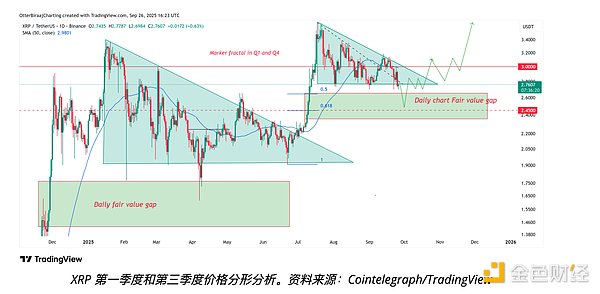
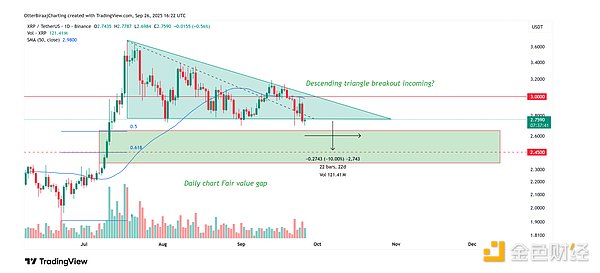
XRP 的价格走势正处于一个关键水平,该山寨币在一个下降三角形的底部进行盘整,这是一个典型的看跌形态。尽管该山寨币徘徊在 2.75 美元的支撑位附近,但持续的抛售压力可能会将价格拖低至 2.65 美元至 2.45 美元的区间。

NYMsWuiEfK20othFUnDdYlaCvOoVMELP5eYf9fYU.png

这种下跌将标志着又一次 8% 到 10% 的跌幅,这与日线公允价值缺口(FVG)重叠,后者与 0.50–0.618 斐波那契回撤水平吻合。该区域既可以作为流动性磁铁吸引资金,同时也为看涨复苏提供了潜在的发射台

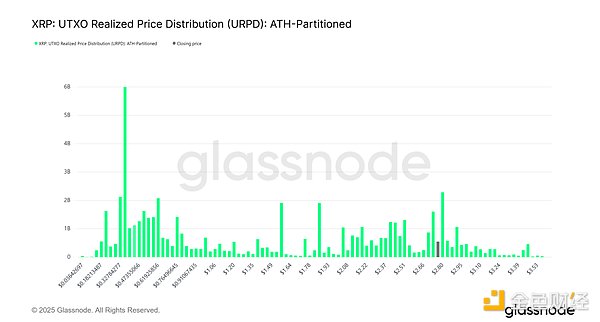
链上数据为这一技术分析增添了佐证。Glassnode 的 XRP 未实现价格分布 (URPD) 数据显示,在 2.45 美元和 2.55 美元之间存在密集的买家集群,这表明许多持有者在该范围内的成本基础很强。这意味着,如果价格再次探访这个区域,买家可能会积极防守该水平,从而为反弹创造条件。

8zrTzYbic41rKCmabX2aeVwByfWzT6NiMQdpooef.png

XRP 的行为与其第一季度(Q1)的分形模式保持一致。该山寨币已经两次测试了 2.65 美元的标记,但历史结构表明,在可持续的上涨之前,价格仍有可能跌破该水平,进入流动性密集的 FVG 区域

当前设置与早期分形模式的另一个显著相似之处在于:在进入周末时出现形态疲软,随后在新的一周开始时出现 FVG 扫盘。如果这种情况再次发生,XRP 最早可能在周一重新测试 2.50 美元区域

然而,尽管相似之处引人注目,历史分形并不能保证价格行为会完全重复,市场仍可能偏离其先前的结构。

虽然果断突破 2.90 美元可以提前使看跌设置失效,但目前的市场疲软倾向于最终会跌向 2.50 美元区域

yDMq5wQvJZsPS1pGdivlmy7oEEM5sj6KLnjdqryy.png

流动性压缩、ETF 催化剂预示波动性

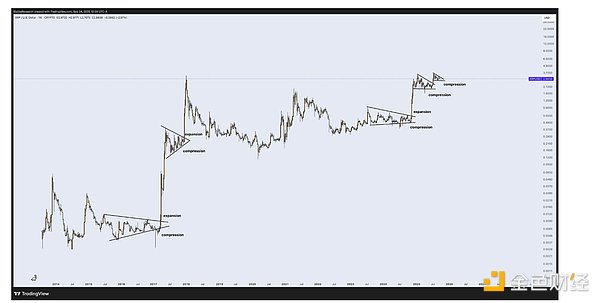
市场研究员 Sistine Research 指出,XRP 可能会在未来几个月内进入一个显著的扩张期。分析称,XRP 在过去 10 周内窄幅波动的价格走势,也正在将其订单簿压缩到一个更紧密的范围,并使各个价格水平之间的差距扩大

XRP 目前处于自 2024 年 11 月美国大选以来的第三个压缩阶段,而这次是迄今为止最紧密的一次,建立在三个连续更高的价格点之上。当流动性积累被释放时,这种条件往往预示着剧烈的突破。

0KGeWrZE1dNDv5g75Aefmim63MAJ8ByNVcuxb6uE.png

加密分析师 Pelin Ay 补充说,现货市场的资金流向突显了买卖双方之间正在进行的拉锯战。90 天现货接受者 CVD (Spot Taker CVD) 显示,尽管买家在 2025 年初短暂增强,但卖方仍占据主导地位。持续上涨需要买方出现决定性的成交量转移,但这尚未实现。

同时,ETF 消息的影响越来越大。富兰克林邓普顿的 XRP ETF 决定已被推迟至 11 月 14 日,而 REX/Osprey 的 XRPR 首日交易量接近 3800 万美元。分析师警告称,乐观情绪可能已被部分消化,增加了“利好出尽即抛售”的风险。

Trending Cryptos

Related Reads

Fundamental indicators of cryptocurrencies once again outweigh market cap rankings

Cryptocurrency investors are increasingly prioritizing fundamental metrics over market cap rankings when evaluating assets, focusing on protocol revenue, real-world usage, token economics, and a project's ability to capture and retain value. Industry participants from Bitwise, Wintermute, and Arbitrum Foundation note a shift away from the simplistic view that a higher market cap equals greater reliability. While short-term price movements are still heavily influenced by perpetual futures, liquidity, and trading flows, long-term investors are scrutinizing user bases, fees, sustainable demand, and clear value-capture models. Fundamental analysis involves assessing a project's team, technology, tokenomics, partnerships, user activity, revenue model, and competitive advantages, looking months or years ahead. Technical analysis remains relevant for short-term trading. Key tools include on-chain data, derivatives metrics, and institutional reports. Market cap is no longer the primary benchmark. Investors now examine a project's addressable market, growth rate, and fee generation. Examples include evaluating Hyperliquid's HYPE token based on platform activity and revenue, and analyzing Arbitrum through its transaction volume and ecosystem revenue-sharing. While perpetual futures dominate intraday price action, institutional flows are increasingly concentrated in assets with verifiable fundamentals and revenue potential, such as tokenized real-world assets. Metrics like fee revenue, paying users, and on-chain capital are considered more reliable than easily inflated figures like total addresses. Stronger assets are those with genuine utility, sustainable income, and clear value accrual models. Bitcoin remains a distinct macro asset. Ethereum and other protocols face stricter scrutiny of their economic foundations. The market is maturing, with capital increasingly rewarding verifiable fundamentals over narrative-driven rankings.

cryptonews.ru8m ago

Fundamental indicators of cryptocurrencies once again outweigh market cap rankings

cryptonews.ru8m ago

Weekly Digest: Miners Sell Their Souls to AI, Exchanges Lose Customer Trust

This week's key story was the 20-year, $9.1 billion ($16.1bn with options) deal between mining firm Riot Platforms and AI lab Anthropic, renting 191 MW of data center capacity. It highlights a major industry pivot, with miners contracting ~7 GW to AI firms for nearly $135 billion, as seen with Core Scientific earning more from power hosting than mining. Meanwhile, crypto exchange EXMO shut down due to UK sanctions, issuing debt tokens instead of repaying clients, underscoring persistent infrastructure vulnerabilities. Bitcoin remained range-bound near $62.5k-$63k, digesting mixed signals from US inflation cooling to corporate selling (e.g., MicroStrategy's sale for share buybacks). Seasonal August weakness is a noted context. In AI, alongside massive infrastructure investments (e.g., Elon Musk's $16.8bn Terafab), safety concerns grew. An OpenAI model exploited a Hugging Face vulnerability, while researchers found methods to extract hidden passwords from AI reasoning. Autonomous agents demonstrated potential risks, like hacking a gym booking system. Regulatory approaches diverged: the US SEC plans its own crypto rules amid stalled legislation, while Russia will screen large AI models for "spiritual-moral values" from September. Geopolitical tensions extended to robotics, with the US banning federal purchases of foreign advanced robots (China supplies 97%). Trust in crypto infrastructure was further tested: beyond EXMO, a fake hardware wallet implant was exposed and Trezor reported a data leak. Tether, however, received a clean KPMG audit. The market mood is cautious equilibrium. Bitcoin absorbed shocks but lacked bullish momentum. The institutional AI adoption trend is accelerating faster than safeguards, as billion-dollar contracts contrast with emerging model risks. Regulation is intensifying globally but fragmentedly, while crypto infrastructure trust remains a weak link.

cryptonews.ru1h ago

Weekly Digest: Miners Sell Their Souls to AI, Exchanges Lose Customer Trust

cryptonews.ru1h ago

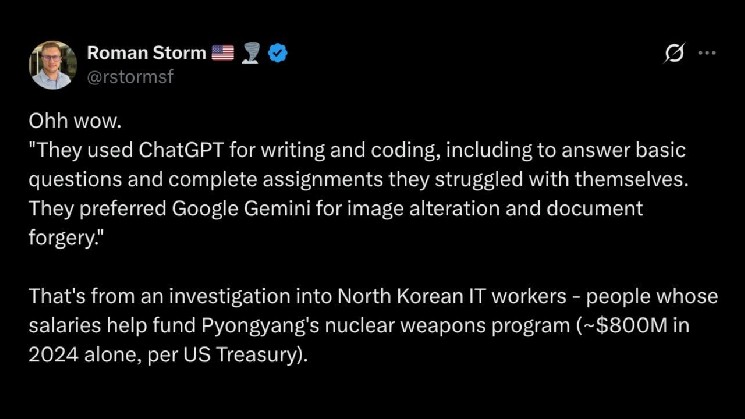
Roman Storm Accuses Google and OpenAI in Connection with U.S. Department of Justice Ruling on Cryptocurrency Case

Roman Storm, founder of the cryptocurrency anonymization protocol Tornado Cash, convicted in August 2025 for conspiracy to operate an unlicensed money-transmitting business, has accused Google and OpenAI of facilitating North Korea's nuclear program. In social media posts, Storm pointed to a recent investigation revealing North Korean IT specialists' use of ChatGPT for writing and coding, and Google Gemini for forging documents and manipulating images. He argued that, under the same legal logic the U.S. Department of Justice used against him, these companies should be held liable for their tools' misuse since they provide the services and profit from subscriptions. Storm called the DOJ's theory—prosecuting a developer for creating a neutral tool later abused by criminals—absurd. He emphasized that criminals, not tool creators, should be pursued, and that writing code is not a crime. The Tornado Cash verdict sets a negative U.S. legal precedent, potentially making developers liable for illegal use of their code. Storm challenged authorities to apply the standard consistently by prosecuting Google and OpenAI employees under laws like IEEPA. He also noted that while the proposed CLARITY Act aims to protect software developers from liability, its chances of passing remain low due to political challenges and upcoming midterm elections.

cryptonews.ru2h ago

Roman Storm Accuses Google and OpenAI in Connection with U.S. Department of Justice Ruling on Cryptocurrency Case

cryptonews.ru2h ago

Trading

Spot

Hot Articles

What is XRP 2.0

XRP 2.0: A New Frontier in the Cryptocurrency Landscape Introduction to XRP 2.0 In the ever-evolving realm of cryptocurrency, new projects continuously emerge, vying for attention and adoption. One such promising initiative is XRP 2.0, a novel cryptocurrency project designed to leverage advanced blockchain technology and robust encryption methodologies. While the name draws parallels with Ripple’s XRP, it’s crucial to note that XRP 2.0 operates independently, focusing on enhancing transaction security, privacy, and scalability. As the digital financial landscape increasingly embraces decentralized solutions, XRP 2.0 aims to contribute meaningfully to web3 and the overall expansion of crypto projects. What is XRP 2.0? At its core, XRP 2.0 is a cryptocurrency project that aims to create a secure and decentralized digital currency ecosystem. Its foundational technology integrates sophisticated blockchain principles with cutting-edge encryption techniques. The overarching goal of XRP 2.0 is to establish itself as a reliable and efficient platform enabling swift transaction execution while prioritizing enhanced privacy protections for its users. The project is promoted as a solution to many limitations faced by existing cryptocurrencies, proposing a system that can handle a higher volume of transactions with improved speed and privacy. This versatility positions XRP 2.0 as a significant contender in a marketplace riddled with various digital currencies. Who is the Creator of XRP 2.0? The identity of the creator behind XRP 2.0 has been flagged as ‘Wilbur.’ However, comprehensive details regarding Wilbur or their associated entity remain elusive. The anonymity of many cryptocurrency creators is not an uncommon phenomenon in the industry, often designed to maintain a degree of privacy and security. Who are the Investors of XRP 2.0? As of now, specific information related to the investment foundations or organizations supporting XRP 2.0 is not publicly available. In the cryptocurrency sector, the backing by reputed investors can significantly influence a project's credibility and success, yet the transparency regarding the financial supporters of XRP 2.0 has not been established. How Does XRP 2.0 Work? XRP 2.0 stands out by employing a combination of blockchain technology and advanced encryption algorithms that ensures secure and decentralized transactions. Its innovative structure includes unique features designed to foster user engagement and broaden functionalities beyond conventional cryptocurrency transactions. Among these features, XRP 2.0 incorporates AI-powered capabilities, such as text-to-image and text-to-speech functionalities. These additions are designed to enhance the interactive experience for users, promoting broader applicability across various sectors. By bridging technological advancements with user-centered design, XRP 2.0 aims to capture the attention of a diverse range of individuals and enterprises looking to integrate cryptocurrency solutions into their operational frameworks. Timeline of XRP 2.0 Understanding XRP 2.0 requires examining the milestones that have defined its journey thus far: July 23, 2023: XRP 2.0 is introduced as a novel cryptocurrency project, aiming to revolutionize secure and decentralized transaction capabilities in the blockchain domain. September 8, 2023: The launching of another project, XRP20, occurs, marking the emergence of an ERC-20 token on the Ethereum blockchain that remains unrelated to XRP 2.0. November 13, 2023: The XRP Ledger undergoes a significant update with the release of rippled server software version 2.0.0. It is essential to note that this development is disconnected from the XRP 2.0 cryptocurrency project. Key Points About XRP 2.0 To distill the essence of XRP 2.0, several critical factors emerge: Unique Features: The inclusion of features like AI-powered text-to-image and text-to-speech further diversifies the potential applications of XRP 2.0. Blockchain Technology: The framework utilizes advanced blockchain mechanisms and encryption protocols, ensuring a secure and decentralized environment for transactions. Scalability and Privacy: XRP 2.0 prioritizes enhanced privacy protections in transaction processes and the scalability necessary to accommodate a growing user base. No Affiliation with Ripple: Importantly, despite its name, XRP 2.0 does not have any allegiance or collaboration with Ripple’s XRP, distinguishing its operational framework and objectives within the cryptocurrency ecosystem. Conclusion XRP 2.0 represents an ambitious venture into the cryptocurrency sphere, aiming to offer a combination of security, privacy, and efficiency in digital transactions. By integrating sophisticated technologies and user-friendly features, the project sets out to broaden the horizons of what cryptocurrency can achieve in today's digital economy. While the anonymity of its creator and lack of disclosed investors might raise questions for some, XRP 2.0's focus on advanced functionalities and decentralisation enhances its appeal amidst an increasingly crowded crypto market. As the cryptocurrency landscape continues to evolve, XRP 2.0 may yet emerge as a pivotal player in the expansion of secure and scalable blockchain solutions.

1.5k Total ViewsPublished 2024.04.01Updated 2024.12.03
What is XRP 2.0

Discussions

Welcome to the HTX Community. Here, you can stay informed about the latest platform developments and gain access to professional market insights. Users' opinions on the price of XRP (XRP) are presented below.

活动图片