DAT经济学:它与ETFs、SPACs 和底层资产究竟有何不同?

比推Pubblicato 2025-09-16Pubblicato ultima volta 2025-09-16

来源:Fintech Blueprint

作者:Lex Sokolin

原标题:Analysis: The Economics of a Digital Asset Treasury


摘要:

本文分析了数字资产金库(DATs)的运作机制,重点阐述了它们与交易所交易基金(ETFs)、特殊目的收购公司(SPACs)以及直接持有加密资产的区别。

DATs 是公开上市公司,它们积极管理加密资产金库,通过质押(staking)、再质押(restaking)、杠杆操作以及经营业务等策略来提高回报。一个建模的 DAT 显示,通过 10 亿美元的 PIPE 融资和每月资本募集,如果 ETH 增值且 mNAV(资产净值倍数)倍数扩张,金库将迅速增长。业绩表现取决于杠杆率、市场溢价和资产升值等假设——DATs 在积极管理和看涨的宏观条件同时支持基础代币和股权结构时表现最佳。

以下为正文:

DATs 的关键区别

在过去几个月里,各个平台都在详细报道数字资产金库(DAT)公司的发展,因为这些工具已进入市场。涉及的数字非常可观,多个 DATs 已经完成融资并达到数十亿美元的市值。然而,分析师们对这个行业的看法不一,本文希望通过建模来找出区分 DATs 与 ETFs 或直接持有底层加密资产的最大驱动因素。
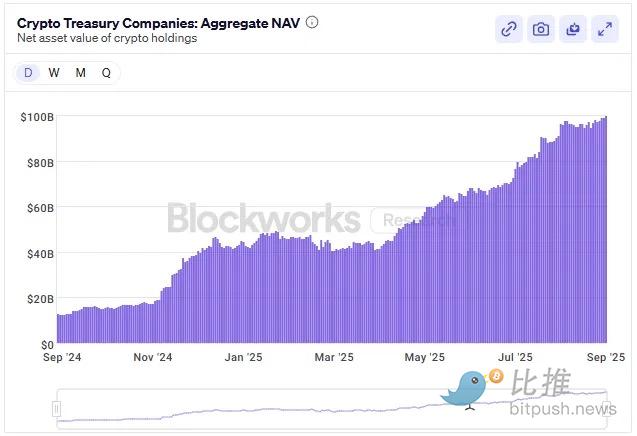
image.png

我们首先从几个定性观点入手。

DATs 和 SPACs 的结构不同。 SPACs 是公开资本工具,募集一定数量的现金,然后寻找一家私人公司作为收购目标。私人公司的估值基于倍数,2021 年的主要问题之一是私人市场以 100 倍估值金融科技营收,而公开市场仅以 10 倍估值,导致了 90% 的价值崩溃。DATs 持有的底层代币已经有既定的市场价格。对于像 BTC(2.5 万亿美元)和 ETH(0.5 万亿美元)这样流动性高且规模大的资产,其市场价格已经是“公开的”,不太可能出现估值断裂。

其次,DATs 最近被拿来与投资信托基金进行比较。 投资信托基金是封闭式的公开交易工具,其估值也通过 mNAV 比率与其底层资产进行比较。然而,信托基金通常用于需要永久资本的长期投资或开发项目。相比之下,加密市场流动性要高得多。此外,DATs 具有通过质押/验证来保护底层区块链的运营组成部分,这类似于比特币矿工。比特币矿工不是投资信托基金,即使积极管理其资产负债表,它们也具有不同的特征。

最后,DAT 既不是 ETF,也不是底层加密资产的直接持有。 它是一家积极管理的上市公司,拥有运营业务和金库策略。1虽然它确实存在运营成本会拖累业务,但 DAT 具有灵活性和增长性——它可以 (1) 积极利用杠杆和结构化产品(如 MicroStrategy),(2) 围绕其专有资本建立相邻的业务线,扮演代币基金会的角色,以及 (3) 根据宏观经济环境和市场风险偏好分配资本。例如,一个 DePIN DAT 可能持有某些协议代币,但同时也拥有一大堆使用该代币的硬件基础设施。

让我们进入模型,看看这一切是如何关联起来的。

建模经济学

我们将从几个假设开始。

该 DAT 将会:

  • 专注于以太坊(例如:像 Bitmine、Sharplink、Ehzilla 或 Ether Machine 这样的公司)

  • 通过 PIPE(私募股权投资)融资 10 亿美元

  • 一旦实体上市,每月以市价(ATM)额外获取 1 亿美元的资金,且不会影响股价(实际情况可能并非如此)。

  • 它还将能以大约每年 12% 的利率获取债务工具,并将每年使用 3 次杠杆。

image.png

(来源:FB 分析)

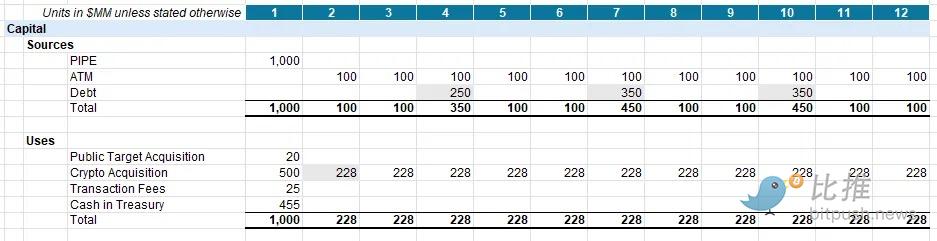
上图展示了初始交易和后续的资本募集。在第 1 个月,模型考虑了交易的核心经济效益。PIPE 投资者投入了 10 亿美元的现金和实物资产,这些收益有多种用途:

  • 2000 万美元用于收购一家上市公司的空壳(shell)

  • 大约 2500 万美元用于支付给 PIPE 的配售代理和其他发起人方

  • 在这里,我们选择立即花费 5 亿美元购买加密资产,并将剩余部分保留为现金,分阶段进行其余购买

目前一切顺利。您还可以看到在第 2 至第 12 个月,该公司通过在公开市场发行股票和借贷获得额外资金,从而以每月约 2.3 亿美元的速度购入更多加密资产。

让我们看看金库的视图。
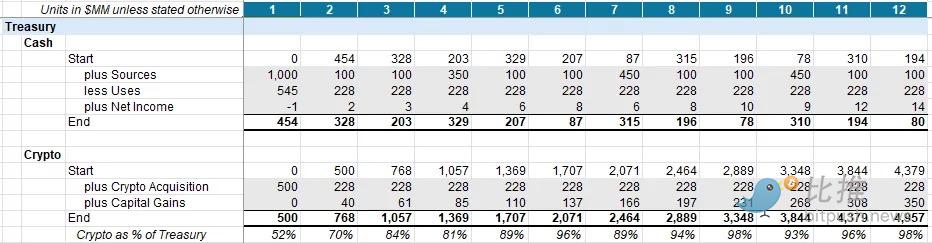
image.png

(来源:FB 分析

我们有两个组成部分:(1) 现金 和 (2) 加密资产。对于每一个部分,我们都建模了期初金额、各种变化以及期末金额。

例如:

  • 我们在第 1 个月从 0 美元现金开始,然后增加 10 亿美元,用掉 5.45 亿美元,剩下 4.54 亿美元现金。净收入有 100 万美元的亏损(稍后解释)。

  • 在加密资产方面,我们在第 1 个月从 0 美元开始,然后从收购中增加 5 亿美元,但没有计入资本利得,因为期初金额为零。

在第 2 个月,期初现金头寸为 4.54 亿美元。我们通过 ATM 募集了 1 亿美元,花费 2.3 亿美元用于购买加密资产(见上表中的资本使用部分),并从运营中获得一些现金。在加密资产方面,我们 5 亿美元的资本产生了 4000 万美元的资本利得,并新增了 2.3 亿美元的购买,使总头寸达到 7.7 亿美元。

现在,假设的一部分是底层资产的价格升值。生活中没有什么是保证的,我们也不是试图表明对 ETH 价格的观点。但是,采用这种策略的人必须看好底层资产,所以我们假设 ETH 将从 4,200 美元升值到年底的约 10,000 美元。

您可能会认为这过于保守或过于激进,请随意使用模型进行调整!
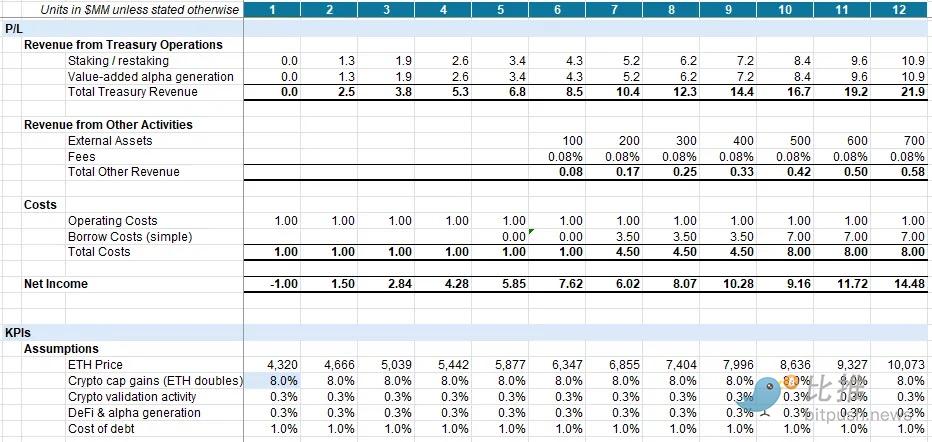
image.png

(来源:FB 分析)

让我们看看损益表(P&L)。

有几个核心假设:

该模型有两个主要的运营活动。首先,金库被部署用于保护底层网络,以赚取质押奖励,类似于比特币矿工。我们假设每年有 3% 的质押奖励,以及每年 3% 来自再质押、DeFi 操作和做市的额外收益。

其次,该业务发起或收购了一家相邻公司,该公司接受第三方资产并收取 1% 的费用。这可以是托管人、主要经纪人、资产管理公司或交易所。它也可能是一些不相关的业务,例如用于整合电信公司的私募股权策略(例如 Inversion Capital)。

我们假设债务成本为每月 1%,运营成本为每年 1200 万美元且不随规模扩大。这些假设可能会受到质疑,但它们是简单且具有指导性的。

由于金库运营从加密资产中产生收入,我们看到回报从每月 0 美元迅速增加到每月 2000 万美元,全年总计约 1 亿美元或 2.5 亿美元的年化收入(ARR)。运营业务的增长较慢,但我们可能会在第 2 年和第 3 年看到有意义的数字,开始与金库收入竞争。

在借贷成本方面,您可以看到在这种设置下,债务并没有压倒收入,它占用了略低于一半的收入生成,并保留了 50% 的预算。一些参与者可能希望减少杠杆,而另一些人则会希望将其最大化。这其中存在风险,因为收入是根据资产负债表上代币价值的百分比份额计算的。

这项努力需要极其审慎的风险管理。

所有这一切都引向了股价,以及投资 PIPE 是否会优于投资底层代币或在公开市场购买。
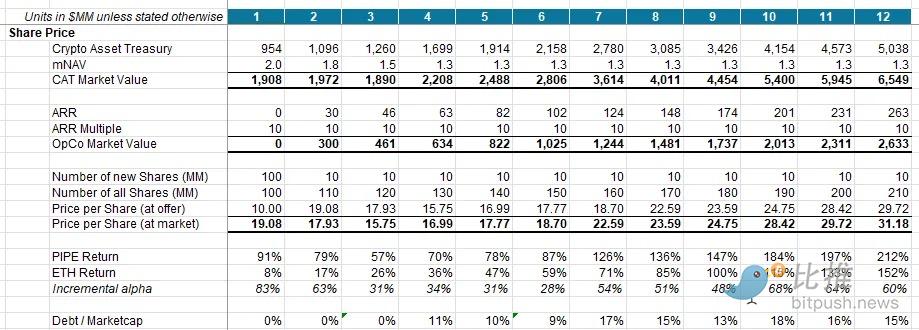
image.png

(来源:FB 分析)

市值下限和上限有两种价值计算方法:

使用 mNAV 倍数,我们将金库持有的资产(现金 + 加密资产)乘以该倍数。通常会有一个交易溢价(trading pop),这里最高达到 2 倍,然后它会稳定到一个长期数字。根据市场动态,该数字可能在 0.7 倍到 1.3 倍之间。我们采用了乐观的情况。
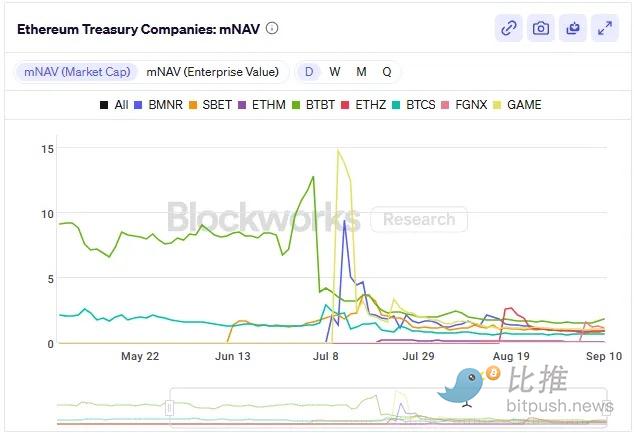
image.png

我们可以将公司的年化收入(ARR)乘以一个倍数,这里假设为 10 倍。这个倍数可以更激进或更保守。例如,Circle 的交易价格是净收入的 15-30 倍。

正如您所看到的,由于持续的 ATM 发行和底层资产的升值,企业价值正在扩张。如果没有这种升值,市值当然不会增长得如此之快。如果没有杠杆或 mNAV 溢价,这项工作将更具挑战性。

为什么不直接持有底层代币?

模型化回报是不精确的,因为交易动态通常不如上文所示的那么简单。

但如果我们假设 PIPE 的股价为 10 美元,那么 mNAV 扩张在第一个月就带来了 91% 的回报,而底层加密资产的回报为 8%。随着时间的推移,这种差距会缩小,因为 mNAV 会被压缩。然而,管理资产负债表和运营业务的积极影响会产生额外的加速度。

我们构建的案例可以用以下图表总结:
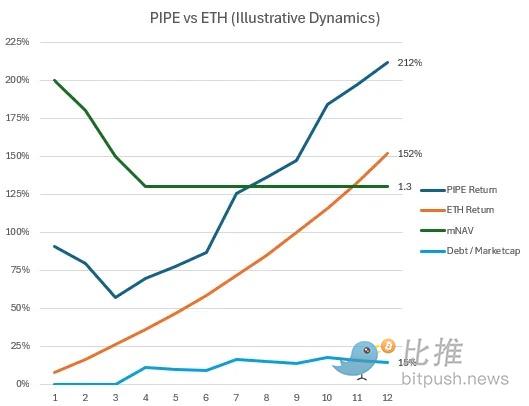
image.png

(来源:FB 分析)

底层抵押品会随着时间增值,但对 DAT 的投资具有几个杠杆,使其能够加速更快。这些数字是说明性的,但突出了积极管理的效果。

情况并非总是如此。如果我们将所有假设都调低,mNAV 为 0.9,加密资产回报率为每月 1%,并且没有杠杆,那么该工具的表现就会逊于预期。但在这种情况下,它未能按照其设计功能运作。
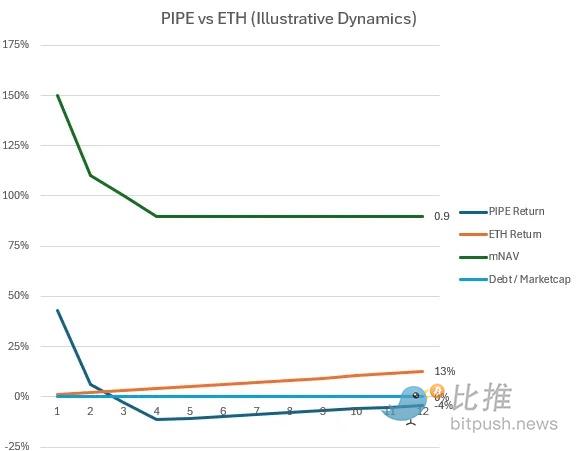
image.png

(来源:FB 分析)

如果我们变得超级激进,将 mNAV 驱动得非常高,并投入更多的杠杆,预测看起来又会非常健康。
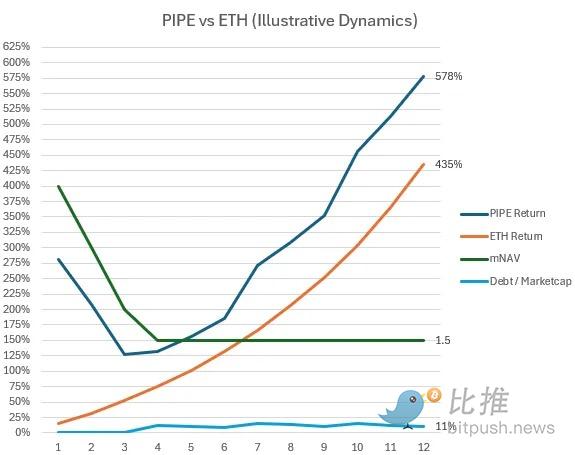
image.png

(来源:FB 分析)

债务仍然很低,因为资产负债表上的加密资产通过 mNAV 估值获得了提升,超过了债务增长速度。这种机制有效地使 MicroStrategy 进入了 1000 亿美元的估值平流层。

不同的人会相信不同的情景,但我们希望这个模型能帮助您揭开这一现象的神秘面纱。如果您想获取模型的副本,可点击下载:

https://docs.google.com/spreadsheets/d/1QfM9QdCMwb9da5XwQppSvkB7zJroV_CG/edit?gid=735874357#gid=735874357


Twitter:https://twitter.com/BitpushNewsCN

比推 TG 交流群:https://t.me/BitPushCommunity

比推 TG 订阅: https://t.me/bitpush

说明: 比推所有文章只代表作者观点,不构成投资建议

Crypto di tendenza

Letture associate

BitMart's Final 9 Days: A True Exchange Crisis Is Never About Shutting Down

BitMart's Final 9 Days: A True Exchange Crisis Is Not About Shutting Down On August 17, 2026, with just 9 days until BitMart's scheduled cessation of trading, the focus shifted from the platform's orderly closure to serious questions about user withdrawals, platform solvency, employee payments, and reserve transparency. Stakeholders, claiming to represent users and staff, publicly demanded asset/liability disclosures, explanations for withdrawal delays, a user repayment plan, and an independent audit, setting an August 19 deadline. While BitMart CEO Sheldon Lee denied allegations of insolvency or wrongdoing, the controversy highlighted a core vulnerability of centralized exchanges (CEXs). When an exchange announces its shutdown, normal user behavior changes dramatically, triggering a mass withdrawal event—the ultimate stress test for its liquidity and custodial integrity. The key question becomes not whether the platform has assets, but whether it holds sufficient *liquid* assets to cover all user liabilities on demand. The article argues that the trust placed in CEXs is based on the convenience they provide, abstracting users from direct control of their private keys. This trust is rarely questioned during normal operations but becomes critically exposed during a wind-down. The situation underscores the limitations of simple Proof of Reserves, which shows "what we have" but not the crucial "what we owe." True financial credibility requires transparent, auditable data on assets, liabilities, and segregated user funds. BitMart's situation reflects a broader, often overlooked issue in the crypto industry: while there is extensive focus on growth mechanisms for exchanges, there is little discussion or established protocol for a safe and transparent "exit mechanism." The final measure of an exchange's integrity, the article concludes, is not its user count or trading volume during a bull market, but its ability to ensure every last user can successfully withdraw their assets when the doors are closing. The outcome will be determined not by statements, but by whether the final user's funds securely leave the platform.

marsbit25 min fa

BitMart's Final 9 Days: A True Exchange Crisis Is Never About Shutting Down

marsbit25 min fa

Don't Speculate on 100x Coins, Just Bet on 'Cash Cows': Which Projects Are Worth Dollar-Cost Averaging in the Bear Market?

In a bearish crypto market, finding sustainable investments is more prudent than chasing speculative meme coins. This article analyzes projects generating consistent revenue, highlighting them as potential "cash cows" for long-term dollar-cost averaging (DCA). The top performers are "picks-and-shovels" plays. **Pump.fun**, a Solana-based meme coin launchpad, leads with $415.3M in monthly revenue, profiting from a 1.25% fee on token transactions. Despite market volatility, it has averaged tens of millions in monthly income in 2024. Perpetual DEX **Hyperliquid** stands out as a "bear market star," accumulating ~$352M in revenue over seven months. Its model funnels ~99% of fees into buying back and permanently burning its HYPE token. Established giants are also adapting. **Uniswap**, after enabling its fee switch, now earns protocol revenue (e.g., $5.6M recently), which is used to buy back and burn UNI, giving the token direct value accrual. Similarly, oracle provider **Chainlink** generates stable monthly revenue (~$4.57M recently) from its essential data, cross-chain, and automation services. Its new Payment Abstraction feature automatically converts service fees into LINK, accruing value in its treasury. The core thesis is clear: in a downturn, focus on projects with proven, resilient business models—those acting as essential infrastructure or capturing consistent transaction fees—rather than speculative narratives.

marsbit40 min fa

Don't Speculate on 100x Coins, Just Bet on 'Cash Cows': Which Projects Are Worth Dollar-Cost Averaging in the Bear Market?

marsbit40 min fa

Trends in U.S. Stocks (August 18): U.S.-Iran Deal Prospects Dim, Major Indices See Two Consecutive Down Days, Chip Stocks Defy Market Decline

**Market Overview:** On August 18th, U.S. stock indices declined for a second consecutive day. The S&P 500 fell 0.52%, the Dow dropped 0.51% to a two-week low, and the Nasdaq slipped 0.32%. The decline was driven by heightened geopolitical risk as U.S.-Iran negotiations reached a key deadline without an extension, dimming the prospect of a long-term agreement. **Key Drivers:** * **Geopolitics & Oil:** The failure to extend the U.S.-Iran memorandum led to a surge in oil prices, with Brent crude closing above $90/barrel for the first time in three weeks. * **Treasury Yields:** The 30-year U.S. Treasury yield hit a high not seen since 2007, driven by heavy corporate issuance (notably for AI investments) and ongoing fiscal deficits. * **Sector Performance:** While the "Magnificent Seven" tech giants all closed lower, semiconductor stocks bucked the trend. The Philadelphia Semiconductor Index rose 1.6%, led by memory chipmakers (e.g., SanDisk, Micron) and optical communication companies, as investors focused on the strong demand outlook for AI-related hardware. * **Currency & Safe Havens:** The U.S. Dollar Index fell for a third day, while the offshore Chinese Yuan hit a three-year high. Gold prices rose to a two-month peak, supported by safe-haven demand outweighing pressure from rising yields. Bitcoin also gained. **Outlook:** Market focus remains on potential escalation in the Middle East and its impact on oil, alongside continued scrutiny of AI-related earnings and demand signals.

marsbit46 min fa

Trends in U.S. Stocks (August 18): U.S.-Iran Deal Prospects Dim, Major Indices See Two Consecutive Down Days, Chip Stocks Defy Market Decline

marsbit46 min fa

Trading

Spot

Articoli Popolari

Come comprare NAVER

Benvenuto in HTX.com! Abbiamo reso l'acquisto di NAVER Corp (NAVER) semplice e conveniente. Segui la nostra guida passo passo per intraprendere il tuo viaggio nel mondo delle criptovalute.Step 1: Crea il tuo Account HTXUsa la tua email o numero di telefono per registrarti il tuo account gratuito su HTX. Vivi un'esperienza facile e sblocca tutte le funzionalità,Crea il mio accountStep 2: Vai in Acquista crypto e seleziona il tuo metodo di pagamentoCarta di credito/debito: utilizza la tua Visa o Mastercard per acquistare immediatamente NAVER CorpNAVER.Bilancio: Usa i fondi dal bilancio del tuo account HTX per fare trading senza problemi.Terze parti: abbiamo aggiunto metodi di pagamento molto utilizzati come Google Pay e Apple Pay per maggiore comodità.P2P: Fai trading direttamente con altri utenti HTX.Over-the-Counter (OTC): Offriamo servizi su misura e tassi di cambio competitivi per i trader.Step 3: Conserva NAVER Corp (NAVER)Dopo aver acquistato NAVER Corp (NAVER), conserva nel tuo account HTX. In alternativa, puoi inviare tramite trasferimento blockchain o scambiare per altre criptovalute.Step 4: Scambia NAVER Corp (NAVER)Scambia facilmente NAVER Corp (NAVER) nel mercato spot di HTX. Accedi al tuo account, seleziona la tua coppia di trading, esegui le tue operazioni e monitora in tempo reale. Offriamo un'esperienza user-friendly sia per chi ha appena iniziato che per i trader più esperti.

71 Totale visualizzazioniPubblicato il 2026.08.14Aggiornato il 2026.08.14

Come comprare NAVER

Cosa è KODEX200

Il contratto perpetuo KODEX200USDT segue il prezzo dell'ETF Samsung KODEX 200. Segue la performance dell'indice KOSPI 200, offrendo un'ampia esposizione alle principali aziende blue-chip a grande capitalizzazione della Corea del Sud.

95 Totale visualizzazioniPubblicato il 2026.08.14Aggiornato il 2026.08.14

Cosa è KODEX200

Come comprare KODEX200

Benvenuto in HTX.com! Abbiamo reso l'acquisto di Samsung KODEX 200 ETF (KODEX200) semplice e conveniente. Segui la nostra guida passo passo per intraprendere il tuo viaggio nel mondo delle criptovalute.Step 1: Crea il tuo Account HTXUsa la tua email o numero di telefono per registrarti il tuo account gratuito su HTX. Vivi un'esperienza facile e sblocca tutte le funzionalità,Crea il mio accountStep 2: Vai in Acquista crypto e seleziona il tuo metodo di pagamentoCarta di credito/debito: utilizza la tua Visa o Mastercard per acquistare immediatamente Samsung KODEX 200 ETFKODEX200.Bilancio: Usa i fondi dal bilancio del tuo account HTX per fare trading senza problemi.Terze parti: abbiamo aggiunto metodi di pagamento molto utilizzati come Google Pay e Apple Pay per maggiore comodità.P2P: Fai trading direttamente con altri utenti HTX.Over-the-Counter (OTC): Offriamo servizi su misura e tassi di cambio competitivi per i trader.Step 3: Conserva Samsung KODEX 200 ETF (KODEX200)Dopo aver acquistato Samsung KODEX 200 ETF (KODEX200), conserva nel tuo account HTX. In alternativa, puoi inviare tramite trasferimento blockchain o scambiare per altre criptovalute.Step 4: Scambia Samsung KODEX 200 ETF (KODEX200)Scambia facilmente Samsung KODEX 200 ETF (KODEX200) nel mercato spot di HTX. Accedi al tuo account, seleziona la tua coppia di trading, esegui le tue operazioni e monitora in tempo reale. Offriamo un'esperienza user-friendly sia per chi ha appena iniziato che per i trader più esperti.

73 Totale visualizzazioniPubblicato il 2026.08.14Aggiornato il 2026.08.14

Come comprare KODEX200

Discussioni

Benvenuto nella Community HTX. Qui puoi rimanere informato sugli ultimi sviluppi della piattaforma e accedere ad approfondimenti esperti sul mercato. Le opinioni degli utenti sul prezzo di A A sono presentate come di seguito.

活动图片