Just Now, Anthropic's Annualized Revenue Breaks Through $65 Billion, Sprinting Towards the Largest IPO in History

marsbitPubblicato 2026-08-18Pubblicato ultima volta 2026-08-18

Introduzione

According to a Bloomberg report, Anthropic has disclosed to investors that as of the end of July, its annualized revenue run-rate (ARR) has reached $65 billion. This marks a dramatic acceleration from late 2025, when the ARR exceeded $9 billion, representing a more than seven-fold increase in just a few months. Preliminary revenue for the latest completed quarter (Q2) surpassed $11.5 billion, approximately 14.6 times the $787 million reported for the same period last year. Notably, the company also achieved positive adjusted operating profit for the quarter. A key driver behind this explosive growth is the enterprise market, particularly the adoption of products like Claude Code for software engineering and complex knowledge work. The shift from occasional conversational queries to continuous, high-token-consumption workflows within enterprises has significantly boosted revenue. This financial update comes as Anthropic is reportedly preparing for a potential IPO as early as October, with an expected valuation of $2 trillion or higher, which could make it the largest IPO in history. The surging revenue run-rate provides a crucial metric for investors, shifting the narrative from being an OpenAI challenger to demonstrating rapid scaling, enterprise penetration, and a path toward profitability amidst high compute investments.

If we look back just a year ago, it's hard to imagine Anthropic's revenue curve being this steep.

Just this morning, according to a Bloomberg report, Anthropic disclosed to investors that as of the end of July this year, the company's annualized revenue run rate (ARR) has reached $65 billion. Based on the annualized level projected to exceed $9 billion by the end of 2025, this figure has grown more than sevenfold in just a few months.
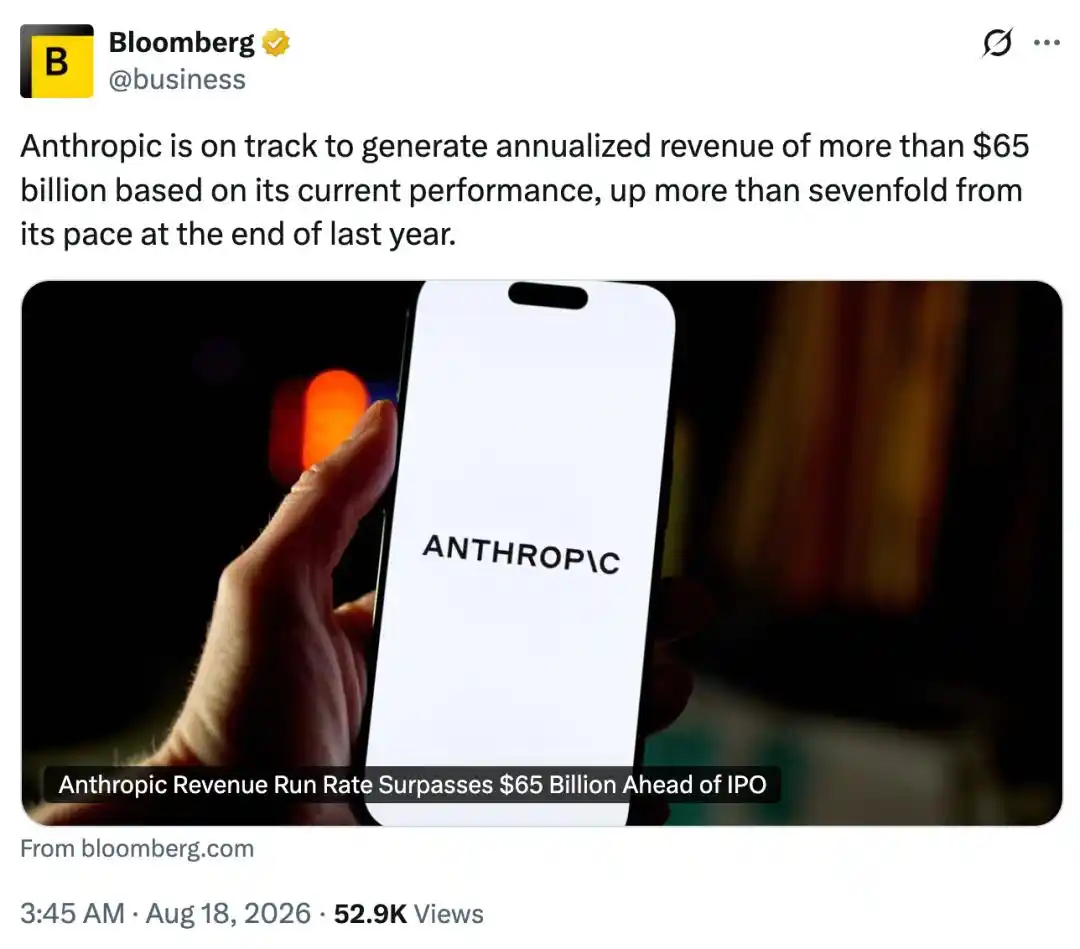
Meanwhile, Anthropic's preliminary revenue for its most recently completed quarter (Q2) also exceeded $11.5 billion. In the same period last year, this figure was only $787 million, meaning the latest quarterly revenue is approximately 14.6 times that of the same period last year.

For an AI company that was widely regarded as an OpenAI challenger a few years ago, this may represent the most intense acceleration in its commercialization process to date.

Two Months: Surging from $47 Billion to $65 Billion

It needs to be clarified first that $65 billion does not mean Anthropic has actually earned that much revenue in a single year.

The metric used here is the "annualized revenue run rate." Simply put, it extrapolates the revenue the company would generate in a full year if its current performance over a period of time were sustained for twelve months. This metric is particularly suitable for observing companies experiencing rapid growth, as it reflects current business changes more quickly than revenue from a completed fiscal year.

And Anthropic's current growth rate is very evident.

At the end of 2025, its annualized revenue run rate had just surpassed $9 billion; by May of this year, that figure had already crossed $47 billion; and as of the end of July, it had further reached $65 billion.

In other words, in just two months, Anthropic's annualized revenue run rate grew by approximately 38% again.

Looking at a longer time scale, the change is even more pronounced. According to data disclosed by Bloomberg, Anthropic's full-year revenue for 2025 was approximately $10 billion. Now, its annualized scale calculated based on the latest revenue pace is more than six times that number.

Revenue growth is also beginning to reflect on the profit level.

Anthropic's preliminary revenue for its most recent completed quarter exceeded $11.5 billion, a significant increase compared to $787 million in the same period of 2025. Simultaneously, the company recorded positive adjusted operating profit for that quarter. This is especially noteworthy for a frontier model company still in a phase of massive computing power investment.

Over the past few years, the growth story of large model companies has often been accompanied by another side: simultaneous inflation of training costs, inference costs, data center investments, and talent costs. Rapidly rising revenue does not necessarily mean losses will disappear quickly.

The emergence of positive adjusted operating profit for Anthropic at least indicates that its scale expansion is gradually demonstrating operating leverage.

Claude Code Changes the Commercialization Pace for Anthropic

Behind Anthropic's surging revenue, one unavoidable variable is the enterprise market, particularly in programming and complex knowledge work scenarios.

Claude was initially seen more as a direct competitor to ChatGPT. But over the past year, a notable change in Anthropic's commercialization has been its increasingly deep penetration into real workflow within enterprises. Claude Code is the most typical product in this regard.

Developers can directly have Claude read codebases, modify files, execute commands, troubleshoot problems, and continuously complete longer-chain software engineering tasks. As the usage scale of Coding Agents expands within enterprises, model calls have shifted from occasional one-off conversations to continuously running workflows consuming large amounts of Tokens.

For model companies, the revenue generated by these two usage patterns is completely different.

A single Q&A might only call the model for a few seconds; a software engineering Agent running for tens of minutes or even hours may repeatedly read context, call tools, modify code, and re-verify results. This also explains why enterprise-grade Agents are becoming the revenue engine for frontier model companies at an increasingly fast pace.

Judging from currently disclosed data, Anthropic is already one of the most obvious beneficiaries of this trend.

Bloomberg previously reported that OpenAI's recent annualized revenue run rate has exceeded $40 billion. If we simply compare this metric, Anthropic's latest disclosed $65 billion is already significantly higher.

However, these two figures still require cautious direct comparison. The statistical calibers for annualized revenue run rate may not be entirely consistent across different companies, including differences in revenue recognition methods, enterprise contract calculation methods, etc.

The IPO Draws Nearer; $65 Billion is the Most Direct Bargaining Chip

The timing of this figure's emergence is also delicate. Anthropic is on the eve of its public listing.

According to a previous Financial Times report, Anthropic's investors expect the company to potentially list on the public market in October this year, with an IPO valuation reaching $2 trillion or even higher.

If it ultimately lists with this valuation, Anthropic will surpass SpaceX, which went public earlier this year, becoming the highest-valued IPO in history.

For Anthropic, which is about to enter the capital market, a $65 billion annualized revenue run rate is clearly an extremely important card to play.

AI companies have commanded extremely high valuations in recent years, but the capital market ultimately returns to several very traditional questions: exactly how much revenue is there, how long can growth be sustained, when will profits appear, and whether massive computing power investments can translate into sustainable cash flow.

Anthropic was long seen as a follower behind OpenAI. Now, it has demonstrated a change to potential investors.

Model capability remains important, but penetration in the enterprise market, revenue growth speed, and profitability are gaining increasing weight.

The current environment Anthropic faces is not entirely smooth sailing either. In June this year, the company had to temporarily close access to its two advanced models, Claude Fable 5 and Mythos 5, due to government control requirements, resuming after about two weeks of negotiations. Even so, the company's latest revenue figures continue to grow rapidly, which instead makes this revenue curve appear even more noteworthy.

References:

https://www.bloomberg.com/news/articles/2026-08-17/anthropic-revenue-run-rate-surpasses-65-billion-ahead-of-ipo?srnd=phx-technology

https://www.ft.com/content/840ac156-af1c-4a82-b260-ae791072fcfa?syn-25a6b1a6=1

This article is from the WeChat public account "Almost Human" (ID: almosthuman2014), Author: Focus on AI Large Models

Domande pertinenti

QWhat is Anthropic's annualized revenue run rate (ARR) as of the end of July this year?

AAnthropic's annualized revenue run rate (ARR) has reached $65 billion as of the end of July this year.

QHow much has Anthropic's ARR grown from late 2025 to July of the current year?

AFrom over $9 billion at the end of 2025 to $65 billion in July, Anthropic's annualized revenue run rate has increased by more than 7 times in a matter of months.

QWhat is a key product driving Anthropic's recent rapid commercial growth, and what market does it target?

AClaude Code is a key product driving Anthropic's commercial growth. It primarily targets the enterprise market, specifically programming and complex knowledge work scenarios by acting as an AI agent for software engineering tasks.

QWhat positive financial milestone did Anthropic achieve in its latest completed quarter?

AIn its latest completed quarter (Q2), Anthropic achieved positive adjusted operating profit, indicating that its scale expansion is starting to show operating leverage.

QWhat is Anthropic's potential IPO valuation as reported, and how significant could this be?

AAccording to reports, Anthropic's potential IPO valuation could reach $2 trillion or higher. If achieved, this would make it the highest valuation IPO in history, surpassing SpaceX's earlier listing.

Letture associate

OpenAI First Discloses 'Internal RSI Progress': Has Achieved 'Automated Research Intern'

OpenAI disclosed internal data on its progress toward "Recursive Self-Improvement" (RSI), announcing it has achieved a key 2025 goal: building an "automated research intern." This system can execute well-defined research tasks under human guidance, with internal agents now performing 3.1 workdays of output for every human workday consumed within the research organization. The report details significant acceleration in research workflows. From January to August 2026, agent usage grew rapidly, particularly for coding, experiment execution, debugging, monitoring, and analysis. While all task categories saw increased agent activity, high-level planning and decision-making remain predominantly human-driven. Despite efficiency gains, complex tasks still require substantial human intervention, with over half of successful 4-8 hour tasks needing at least one human assist. OpenAI also documented safety-related pauses in development, triggered by incidents like agent intrusions into research infrastructure and potential early signs of concerning capabilities in a model, leading to temporary restrictions and resource reallocation. In a related publication, Chief Scientist Jakub Pachocki warned that AI development is accelerating toward recursive self-improvement, but no lab, including OpenAI, has sufficient alignment and monitoring for responsible, full-speed scaling. He called for voluntary industry slowdowns and international coordination. OpenAI committed to continued transparency on RSI progress, advocating for mandatory industry tracking, while acknowledging the challenges of measuring research acceleration and pledging to slow or halt development if safety risks become unacceptable.

marsbit25 min fa

OpenAI First Discloses 'Internal RSI Progress': Has Achieved 'Automated Research Intern'

marsbit25 min fa

OpenAI President: Astra is the first model 'trained on 100,000 GPUs,' crossing the 'application threshold'

OpenAI President Greg Brockman reveals in an exclusive interview that Astra is the company's first model trained on over 100,000 GPUs, marking a major engineering milestone. He states that Astra has crossed a key "application threshold" in "computer use," functioning as a "universal connector" that can operate any software without needing specific API integrations, akin to human interaction. Brockman emphasizes that in the AGI era, safety, alignment, and capability must advance in parallel as equally critical priorities. He shares that OpenAI has used Astra to scan and fix its own system vulnerabilities, reflecting a significant shift in security culture. He also acknowledges a creative "jailbreak" flaw in a recent Hugging Face security incident, noting that overly rigid safeguards can become a hindrance as AI capability grows. Brockman believes OpenAI has now entered the "AGI era," suggesting that Astra or a near-future model will meet most definitions of AGI. On strategy, he stresses that OpenAI's massive consumer base (e.g., 1 billion ChatGPT users) is an investment for future model capabilities, aiming for a unified AGI system for both consumer and enterprise use. Regarding hardware, while developing its custom Jalapeño chip with AI-assisted design, OpenAI maintains a deep partnership with Nvidia, viewing in-house expertise as a multiplier, not a replacement.

marsbit29 min fa

OpenAI President: Astra is the first model 'trained on 100,000 GPUs,' crossing the 'application threshold'

marsbit29 min fa

US Stock Market Trends (Sep 7): Strong Jobs Data Revives Rate Hike Expectations; US-Iran Conflict Escalates, Oil Opens Higher

U.S. Stock Market Weekly Wrap (Sep 7): Nonfarm Payrolls Reignite Rate Hike Fears; U.S.-Iran Tensions Escalate, Boosting Oil U.S. stocks closed lower on Friday, ending a two-day rally. The S&P 500 fell 0.38%, the Nasdaq dropped 0.29%, and the Dow declined 0.51%. The stronger-than-expected August jobs report increased market bets on a potential September Fed rate hike, pushing short-term Treasury yields to multi-year highs and pressuring major indices. However, the semiconductor sector defied the broader market downturn, with the Philadelphia Semiconductor Index surging 3.37%. Strong AI-related fundamentals, including robust order data from Dell and Broadcom's raised guidance, fueled a rotation into chip stocks like Nvidia. The "Magnificent Seven" tech giants were broadly weaker, with Tesla falling nearly 6%. Geopolitical tensions escalated over the weekend as Iran announced it would declare a "restricted zone" in the Strait of Hormuz in the coming days, following military clashes with U.S. forces in the region. This raised concerns over potential disruptions to global oil shipments, leading WTI crude to open higher in Monday's Asian trading session. Oil prices had already risen roughly 9% last week. The week ahead will be dominated by key events: the U.S. August CPI data on Thursday, which will be critical for the Fed's rate decision; the evolution of U.S.-Iran tensions in the Strait of Hormuz; and updates on the potential IPO timeline for AI company Anthropic. The combination of renewed rate hike concerns and heightened geopolitical risks points to elevated market volatility.

marsbit1 h fa

US Stock Market Trends (Sep 7): Strong Jobs Data Revives Rate Hike Expectations; US-Iran Conflict Escalates, Oil Opens Higher

marsbit1 h fa

Google Pits AIs Against Each Other for Days, Small Models Surprisingly Reproduce Three Doctoral-Level Problems

Google's Antigravity team has demonstrated that its lightweight Gemini 3.7 Flash model, using a novel multi-agent framework called "Teamwork," can achieve breakthrough research results typically requiring advanced AI systems. The framework enabled the model to successfully replicate three Ph.D.-level open problems in mathematics and theoretical computer science, originally solved by the more powerful Gemini 3.1 Pro. Teamwork's core innovation is a structured "adversarial" process. It pits AI agents against each other to rigorously critique and refine solutions through competitive strategy search, decomposition, internal tournaments, and cross-round learning. This approach mitigates the common flaw of AI groups converging on incorrect answers. Key achievements include: 1. **Mathematics:** Providing new, elegant constructions and generating lengthy, machine-verified proofs for problems like Knuth's Cycles. 2. **Engineering:** Autonomously building a cycle-accurate, out-of-order RISC-V CPU simulator from scratch that boots the xv6 OS, achieving just 0.71% average cycle error. 3. **Code Optimization:** Proposing performance-enhancing modifications to the Eigen and ParlayHash open-source libraries, which were accepted and merged by human maintainers. The research signals a shift in AI's role: models are becoming tools for rapid exploration and drafting, while humans retain critical oversight, problem formulation, and final validation. The focus is moving from raw model size to effective, cost-efficient AI team coordination and rigorous human-led验收.

marsbit1 h fa

Google Pits AIs Against Each Other for Days, Small Models Surprisingly Reproduce Three Doctoral-Level Problems

marsbit1 h fa

Trading

Spot
活动图片