Strategy’s Michael Saylor Breaks Into Bloomberg’s Billionaire Rankings

bitcoinistPublished on 2025-09-08Last updated on 2025-09-08

Abstract

MicroStrategy (now Strategy) co-founder Michael Saylor has made his first entry on the Bloomberg Billionaires Index, joining the list with...

Trusted Editorial content, reviewed by leading industry experts and seasoned editors. Ad Disclosure

MicroStrategy (now Strategy) co-founder Michael Saylor has made his first entry on the Bloomberg Billionaires Index, joining the list with an estimated net worth of $7.37 billion and taking the 491st spot.

Reports have disclosed that his wealth rose by about $1 billion since the start of 2025, a gain of nearly 16% year-to-date.

Strategy Holdings Drive Wealth

According to Bloomberg’s breakdown, roughly $6.70 billion of Saylor’s reported net worth is tied to his equity in Strategy, while about $650 million is held in cash. That split leaves the bulk of his public wealth exposed to the market value of the company’s stock and, by extension, the company’s Bitcoin reserves.

Source: Bloomberg

Different Counts For Bitcoin Hoard

Different outlets list different totals for Strategy’s BTC stash. Some reports cite about 580,000 BTC held as of May 2025, while others report figures above 630,000 BTC or near 660,000 BTC depending on timing and source.

The range reflects ongoing purchases and the lag in public filings, which mean the company’s Bitcoin tally can look different from story to story.
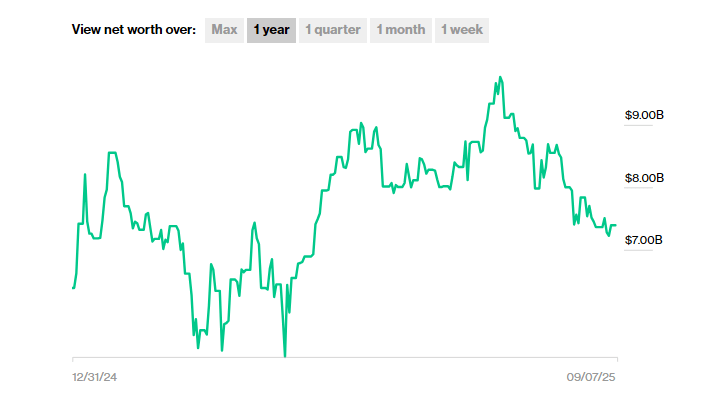
Saylor’s Fortune Moves With Markets

Bloomberg’s live index shows short-term swings in Saylor’s number: his net worth rose by about $167 million in a single recent update, underscoring how quickly the headline figure can change when Strategy shares or Bitcoin move.

Based on reports, the sharp moves this year were driven by a rise in Strategy’s share price and Bitcoin’s run toward higher levels.

BTCUSD now trading at $111,966. Chart: TradingView

From Dot-Com Highs To A Bitcoin Bet

Saylor’s path to the list traces back to earlier highs and setbacks in the dot-com era and a major strategy shift beginning in 2020, when Strategy began buying Bitcoin as a treasury asset.

The change in company focus is what analysts and commentators point to now when they link most of his public net worth to the firm’s holdings rather than to cash or other assets.

Index Entry Joins Crypto Titans

Based on reports, Saylor’s arrival on the Bloomberg list places him among other tech and crypto-linked billionaires who have seen fortunes tied to digital assets or crypto firms.

His entry follows a year in which several public companies and their leaders have gained or lost ground in step with Bitcoin’s swings.

For now, Saylor’s rank on the list is a snapshot — a number that can rise or fall quickly. Investors and observers will watch Strategy’s filings and Bitcoin’s price for the clearest clues about where his net worth might head next.

Featured image from Sky History, chart from TradingView

Editorial Process for bitcoinist is centered on delivering thoroughly researched, accurate, and unbiased content. We uphold strict sourcing standards, and each page undergoes diligent review by our team of top technology experts and seasoned editors. This process ensures the integrity, relevance, and value of our content for our readers.

Christian, a journalist and editor with leadership roles in Philippine and Canadian media, is fueled by his love for writing and cryptocurrency. Off-screen, he's a cook and cinephile who's constantly intrigued by the size of the universe.

Trending Cryptos

Related Reads

Just now, DeepSeek V4 updates with DSpark, improving inference speed by 80%

DeepSeek has updated its DeepSeek V4 model with the DSpark speculative decoding framework, achieving a significant 60-85% speedup in generation for Flash models and 57-78% for Pro models while maintaining the same overall throughput. This engineering-focused update, rather than a core architectural change, introduces DSpark to address latency and throughput bottlenecks in high-concurrency production environments. DSpark combines high-throughput parallel generation with adaptive load-aware verification. Its key innovations include a semi-autoregressive generation architecture to model dependencies within token blocks and a hardware-aware confidence-scheduled verification system. This system uses a confidence head to predict token acceptance probabilities, allowing it to dynamically optimize verification length per request and allocate compute only to tokens with the highest expected payoff. The asynchronous scheduler is designed for real-world deployment, ensuring zero-overhead scheduling and continuous CUDA graph replay while preserving the target model's output distribution. In tests across mathematical reasoning, code generation, and daily dialogue, DSpark outperformed state-of-the-art models like Eagle3 and DFlash, increasing average acceptance length by 26.7%-30.9% and 16.3%-18.4% respectively on Qwen3 target models. DeepSeek also open-sourced DeepSpec, a full-stack codebase for training and evaluating speculative decoding draft models, providing a standardized toolkit that includes data preparation tools, model implementations, training code, and evaluation scripts.

marsbit3h ago

Just now, DeepSeek V4 updates with DSpark, improving inference speed by 80%

marsbit3h ago

BIT Research: The 2028 Halving Is Not the End, the Real Shake-Up of the Bitcoin Mining Industry Is Just Beginning

The Bitcoin mining industry is undergoing its most complex structural adjustment since inception. Despite Bitcoin's price holding near $61,000 and the network hash rate approaching a record 1 ZH/s, miner profitability is deteriorating. The industry is operating close to its breakeven point, with the 2028 halving expected to accelerate consolidation. The challenges extend beyond the halving's subsidy reduction; the industry's revenue model has yet to successfully transition towards a fee-driven structure. Increasingly, mining companies are evolving from simple Bitcoin producers into infrastructure and energy operators, including providers of AI/HPC computing power. Competition is shifting from pure hash rate expansion to business model upgrades. Economic pressure is evident. The theoretical daily mining revenue at current prices is around $78 million, yet the actual figure is only about $33 million—a 136% gap. Transaction fees remain low at roughly $220k daily, far below historical implied levels. With a current estimated industry-wide breakeven price near $65,000, mining alone is struggling to generate ideal profits. The 2028 halving is projected to push the fundamental production cost floor to approximately $93,289. This will likely accelerate a shift towards consolidation among larger, well-capitalized miners with diversified revenue streams. Competitive advantage will belong to institutionalized players with access to low-cost energy, AI/HPC hosting operations, and stronger balance sheets. In essence, Bitcoin mining is transitioning from a "mining business" to an "infrastructure business." Future profitability and resilience will depend less on block rewards and more on diversified income sources like energy management and computational infrastructure services. For investors, the key question is not the halving itself, but which miners can successfully navigate this business model transformation.

marsbit4h ago

BIT Research: The 2028 Halving Is Not the End, the Real Shake-Up of the Bitcoin Mining Industry Is Just Beginning

marsbit4h ago

This is How God Karpathy Uses Claude?

Andrej Karpathy, a prominent figure in AI, has reportedly joined Anthropic, leading to a noticeable decrease in his open-source contributions and social media activity. A document claiming to be his personal "CLAUDE.md" file—a set of instructions for the Claude AI to follow within a specific codebase—has been circulating online. While its authenticity is unverified, the content aligns closely with Karpathy's publicly shared principles on effective AI-assisted programming. The document outlines key rules for AI coding assistants, emphasizing the importance of reading existing code thoroughly before writing new code to maintain consistency. It advises against over-engineering, advocating for simple, surgical modifications that match the project's existing style. Other guidelines include clarifying assumptions upfront, writing meaningful tests, thoughtful debugging, and carefully considering dependencies. The core message is that these principles help prevent common AI coding failures, such as introducing unnecessary abstractions, style drift, or making invisible architectural decisions. The community has noted that even experts like Karpathy require detailed instructions to guide AI effectively, akin to managing a junior developer. A related GitHub repository, "andrej-karpathy-skills," which encapsulates these ideas, is reported to significantly reduce Claude's code error rate. Ultimately, the advice stresses that the best CLAUDE.md is tailored to one's own tech stack and coding practices.

marsbit4h ago

This is How God Karpathy Uses Claude?

marsbit4h ago

Trading

Spot

Hot Articles

Discussions

Welcome to the HTX Community. Here, you can stay informed about the latest platform developments and gain access to professional market insights. Users' opinions on the price of S (S) are presented below.

活动图片