WGC’s Digital Gold Move in the UK: $BEST Is the Key to a New Era

bitcoinistPublished on 2025-09-08Last updated on 2025-09-08

Abstract

The World Gold Council (WGC) is taking a bold step in the London gold market, and it could transform everything....

Trusted Editorial content, reviewed by leading industry experts and seasoned editors. Ad Disclosure

The World Gold Council (WGC) is taking a bold step in the London gold market, and it could transform everything.

They’ve introduced a new proposal for a digital token called Pooled Gold Interest (PGI). This token acts as a digital substitute for actual, physical gold bars stored in London’s vaults. For the first time, traders can legally own a portion of a large 400-ounce bar without needing to buy the entire bar.

Mike Oswin, the WGC’s global head of market structure and innovation, states that the main goal is to make gold easier to use. Whether you’re investing in it or using it as collateral, the PGI token is designed to be simple.

Although gold is technically accepted as backing for loans and trades, it’s a big hassle to physically transport, so most people prefer bonds or cash.

The WGC aims to simplify gold pledging, making it as easy as any other digital asset. This could attract many new participants, especially with gold prices hitting record highs recently.

And with new players entering the market, they’ll need tools. Tools like Best Wallet and its native Best Wallet Token ($BEST) can become your all-in-one resource for everything crypto-related.

The WGC’s Global Ambitions

The WGC is launching in the UK, but they’re already exploring how the model could work in the U.S. and other major markets.

In a recent whitepaper, they outlined their long-term plan to expand well beyond London’s 930B market. This market, known as the Loco London market, handles a staggering 20 million ounces of gold traded daily.

Image of the whitepaper about PGI

The WGC believes the PGI token could completely change how all that volume is handled.

However, not everyone is convinced by the idea. Russ Mould, an investment director at AJ Bell, believes some traditional gold investors won’t even bother with this digital version. He suggests that WGC is just trying to keep up with the popularity of cryptocurrencies and stablecoins.

Mould mentioned in an interview with CNBC that many ‘gold bugs’, the true enthusiasts, love gold specifically because it’s a tangible asset that isn’t made out of thin air.

They might not see the point of a digital token, no matter how securely it’s backed. The WGC, though, is betting that the sheer convenience of the PGI token will be enough to win them over. And convenience is exactly what you get with $BEST and Best Wallet.

Why $BEST is a Game Changer for Digital Assets

The WGC’s move to tokenize gold shows that even trad finance sees the future in digital assets. But while PGI tokens are focused on a single commodity, the Best Wallet Token ($BEST) is designed to be the key to your entire crypto portfolio.

It’s the native token of the Best Wallet app, a next-gen platform that brings all your crypto activities into one seamless experience. Think of it as your all-in-one hub for the digital economy.

The $BEST token offers a variety of powerful benefits that go beyond just discounts. Token holders gain exclusive access to a built-in DEX aggregator, making sure you always get the best rates on swaps by routing your trades through hundreds of decentralized exchanges.
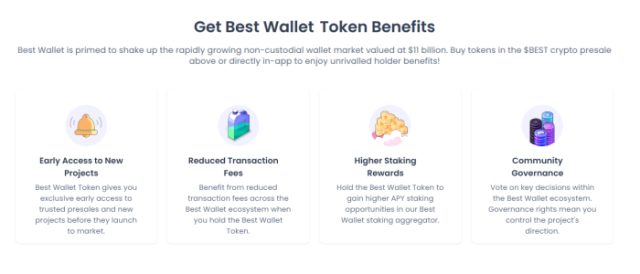
Best Wallet Token benefits

You can also influence the future of the platform through community governance, giving you a voice in how the Best Wallet ecosystem develops. With the presale having already raised over $15.5M, it’s clear that the market is ready for a token that offers real, tangible utility.

We even see it reaching the giddying heights of $0.072 by the end of 2025, giving you an ROI of 181% if you invested at today’s price. You can see how far we think $BESt will go in the future in our ‘Best Wallet Token Price Prediction’.

Get Ahead of the Curve with Best Wallet and $BEST

Just as gold-backed tokens are bringing a new level of efficiency to the gold market, the Best Wallet Token ($BEST) is giving you the edge in the fast-paced world of crypto. While other wallets just store your assets, Best Wallet is a complete ecosystem.

Holding $BEST unlocks exclusive opportunities. The platform’s unique ‘Upcoming Tokens’ feature provides early, vetted access to new projects before they reach major exchanges, so you can get in early on what could be the next big thing.
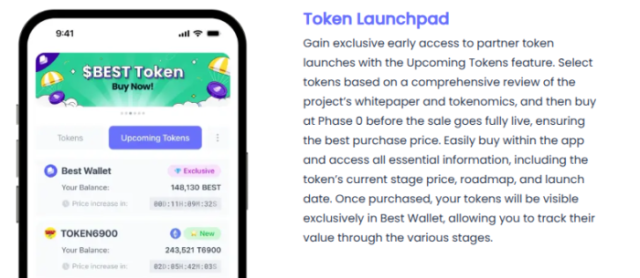
Upcoming Tokens section of Best Wallet

And that’s not all. The team is also developing a revolutionary ‘Best Card,’ a crypto debit card enabling you to spend your digital assets in the real world.

As a $BEST holder, you can connect your wallet and receive special discounts on fees, making it cheaper and easier than ever to use your crypto for everyday purchases.

It’s a game-changing move that connects the digital and physical worlds, showing that $BEST is more than just a token; it’s a way forward for the future of finance.

Make sure you get your $BEST now for $0.025605 and grab those 85% staking rewards. Check out how to get in on the action with our ‘How to Buy Best Wallet Token’ guide.

Bridging the Past and Future with Digital Gold

The WGC’s news is the clearest signal yet that the world’s moving toward a digital-first economy. Whether it’s the London gold market adopting PGI tokens to simplify an industry or the rise of next-gen platforms like Best Wallet, the trend is undeniable.

As trad finance and crypto converge, tools that offer both security and seamless utility will be critical for new and experienced investors alike. The $BEST token, with its ecosystem of features, is perfectly positioned to serve as that bridge.

Before you start that crossing, though, remember to do your own research to understand the risks and rewards. This isn’t financial advice.

Editorial Process for bitcoinist is centered on delivering thoroughly researched, accurate, and unbiased content. We uphold strict sourcing standards, and each page undergoes diligent review by our team of top technology experts and seasoned editors. This process ensures the integrity, relevance, and value of our content for our readers.

Ben is a freelance writer specializing in crypto developments (mainly altcoins) and the intricate ways global economics shape the digital asset space. His B.Ed. in Education provides a unique foundation for his writing, enabling him to distill complex crypto concepts and market shifts into clear, digestible insights. This skill is key to helping readers adapt and apply their understanding to the ever-evolving world of crypto investment. Passionate about making crypto accessible, Ben crafts content designed to educate a broad audience, from current market events to the essential foundational knowledge that underpins them. His goal is to empower readers through understanding. When he’s not immersed in crypto analysis and breaking down complex topics, Ben is an avid Pokémon fan and enjoys all things Disney.

Trending Cryptos

Related Reads

Just now, DeepSeek V4 updates with DSpark, improving inference speed by 80%

DeepSeek has updated its DeepSeek V4 model with the DSpark speculative decoding framework, achieving a significant 60-85% speedup in generation for Flash models and 57-78% for Pro models while maintaining the same overall throughput. This engineering-focused update, rather than a core architectural change, introduces DSpark to address latency and throughput bottlenecks in high-concurrency production environments. DSpark combines high-throughput parallel generation with adaptive load-aware verification. Its key innovations include a semi-autoregressive generation architecture to model dependencies within token blocks and a hardware-aware confidence-scheduled verification system. This system uses a confidence head to predict token acceptance probabilities, allowing it to dynamically optimize verification length per request and allocate compute only to tokens with the highest expected payoff. The asynchronous scheduler is designed for real-world deployment, ensuring zero-overhead scheduling and continuous CUDA graph replay while preserving the target model's output distribution. In tests across mathematical reasoning, code generation, and daily dialogue, DSpark outperformed state-of-the-art models like Eagle3 and DFlash, increasing average acceptance length by 26.7%-30.9% and 16.3%-18.4% respectively on Qwen3 target models. DeepSeek also open-sourced DeepSpec, a full-stack codebase for training and evaluating speculative decoding draft models, providing a standardized toolkit that includes data preparation tools, model implementations, training code, and evaluation scripts.

marsbit6h ago

Just now, DeepSeek V4 updates with DSpark, improving inference speed by 80%

marsbit6h ago

BIT Research: The 2028 Halving Is Not the End, the Real Shake-Up of the Bitcoin Mining Industry Is Just Beginning

The Bitcoin mining industry is undergoing its most complex structural adjustment since inception. Despite Bitcoin's price holding near $61,000 and the network hash rate approaching a record 1 ZH/s, miner profitability is deteriorating. The industry is operating close to its breakeven point, with the 2028 halving expected to accelerate consolidation. The challenges extend beyond the halving's subsidy reduction; the industry's revenue model has yet to successfully transition towards a fee-driven structure. Increasingly, mining companies are evolving from simple Bitcoin producers into infrastructure and energy operators, including providers of AI/HPC computing power. Competition is shifting from pure hash rate expansion to business model upgrades. Economic pressure is evident. The theoretical daily mining revenue at current prices is around $78 million, yet the actual figure is only about $33 million—a 136% gap. Transaction fees remain low at roughly $220k daily, far below historical implied levels. With a current estimated industry-wide breakeven price near $65,000, mining alone is struggling to generate ideal profits. The 2028 halving is projected to push the fundamental production cost floor to approximately $93,289. This will likely accelerate a shift towards consolidation among larger, well-capitalized miners with diversified revenue streams. Competitive advantage will belong to institutionalized players with access to low-cost energy, AI/HPC hosting operations, and stronger balance sheets. In essence, Bitcoin mining is transitioning from a "mining business" to an "infrastructure business." Future profitability and resilience will depend less on block rewards and more on diversified income sources like energy management and computational infrastructure services. For investors, the key question is not the halving itself, but which miners can successfully navigate this business model transformation.

marsbit7h ago

BIT Research: The 2028 Halving Is Not the End, the Real Shake-Up of the Bitcoin Mining Industry Is Just Beginning

marsbit7h ago

Trading

Spot

Hot Articles

Discussions

Welcome to the HTX Community. Here, you can stay informed about the latest platform developments and gain access to professional market insights. Users' opinions on the price of S (S) are presented below.

活动图片