MemeCore Explodes 244% In Weekly Gains, Sparks Hunt for Next 1000x Altcoins

bitcoinistPublished on 2025-09-04Last updated on 2025-09-04

Abstract

The altcoin market is back on the rise. Just look at MemeCore ($M), for instance. Since last week, it has...

Trusted Editorial content, reviewed by leading industry experts and seasoned editors. Ad Disclosure

The altcoin market is back on the rise. Just look at MemeCore ($M), for instance. Since last week, it has spiked by an eye-boggling 244%+.

Today marks the first time $M has reached the $1 mark. It’s now valued at a commendable $1.44 and, at least for the time being, shows no signs of slowing down.

And it’s not the only big mover in the altcoin arena. Pump.fun has jumped by over 10% in the past 24 hours, propelled by a hefty $359.2M in trading volume during the same time period.

With more capital flowing into the top altcoins, now might be the perfect time to explore the next crypto to explode to position yourself for potential gains.

Altcoin Market Exceeds 1.6T, Traders Rotate Away From $BTC

MemeCore and Pump.fun’s rallies align with broader market trends.

With the altcoin market cap above $1.6T, it shows that traders are shifting preference from $BTC – despite it being the world’s largest crypto, currently donning a $110K price tag.
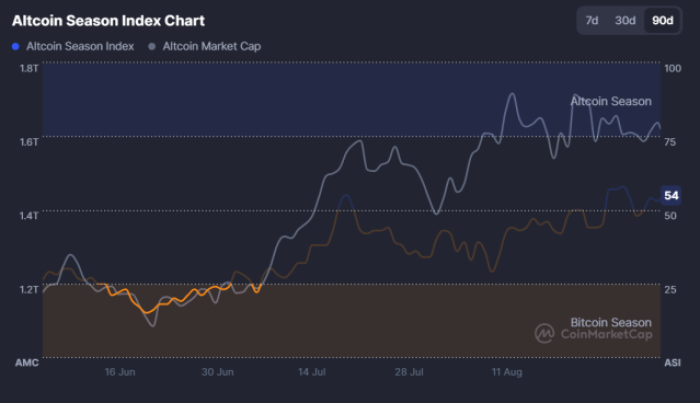
Altcoin Season Index Chart.
Source: CoinMarketCap

Also confirming the altcoin market’s current strength, the Altcoin Season Index (ACI) now sits at 55, up from 43 compared to last month.

In fact, crypto analyst ‘Crypto GEMs’ suggests that the altcoin market is on the verge of its biggest breakout to date.

On a recent X post, they posted a chart that highlights that altcoins surged 34x in 2017 and 68x in 2021–2022 following long accumulation phases.

Now, in 2025, they believe the altcoin sector is about to hit another exciting accumulation period. Their prediction points to a potential 136x rally that could propel the market cap beyond $2.1T.
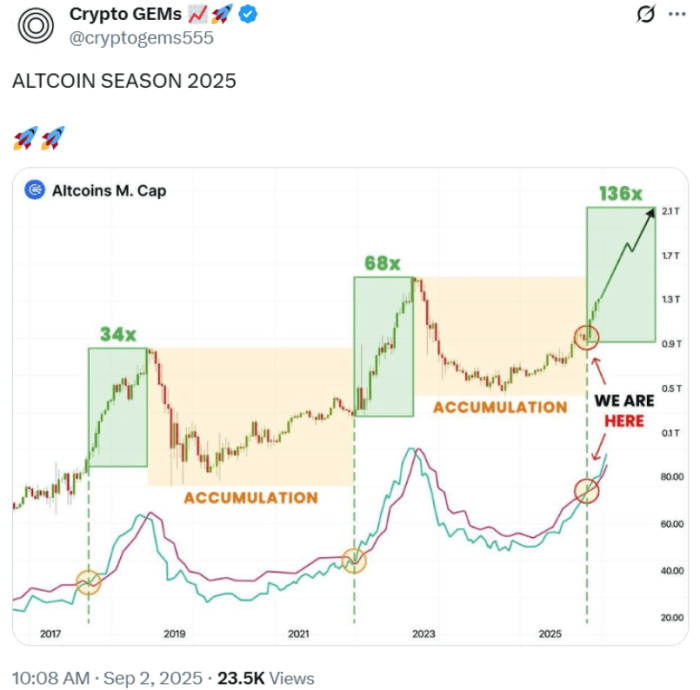
Crypto Gems tweet about alt season

With altcoins poised for even more mighty growth, there may not be a better time to check out top coins with optimal potential.

We have high hopes for Snorter Token ($SNORT), PinLink ($PIN), and Maxi Doge ($MAXI) – and for superb reasons.

1. Snorter Token ($SNORT) – Presale Tops $3.7M as Telegram Bot Launch Nears

Snorter Token ($SNORT) has quickly scooped up $3.7M+ on presale, thanks to its role as the backbone of a novel Telegram trading bot.

Once launched this quarter, Snorter Bot aims to give you a potent edge in the market by allowing you to execute trades instantly, set strategies, and tap into top market opportunitie

All can be achieved through its cutting-edge features, spanning ultra-fast swaps, automated sniping, and copy trading.

Snorter Bot features.
Source: Snorter Token

First, you can anticipate the bot launching on the Solana network as part of its plan to deliver fast execution with super low fees at just 0.85%. Owing to this, it claims that it’ll override rival bots like Maestro and Trojan.

Then, it’ll expand to Ethereum, BNB Chain, and other EVM networks. This way, you’ll be able to capture the hottest crypto opportunities across networks without having to turn to different platforms and tools.

Best of all, it promises to achieve all this without compromising security. With built-in MEV protection, plus honeypot and rugpull alerts, you can rest assured that the bot will shield you from malicious activity.

To also access premium features, governance rights, and staking rewards (currently at a 125% APY), you can purchase $SNORT on presale for just $0.1033.

But don’t wait around. Once the bot officially goes live and expands multi-chain, it’s anticipated to reach a high of $1.92 in 2026. This means that buying in now could potentially deliver an ROI exceeding 1,759% – and that’s not even counting the passive income from staking rewards.

2. PinLink ($PIN) – RWA-Tokenized Protocol Surges 10% Following Hashrate Initiative Teaser

$PIN is the foundation of PinLink, a cutting-edge RWA-tokenized protocol that connects AI developers with cost-friendly compute power. Why? To unlock new revenue streams for asset owners.

Through ERC-1155 fractionalization, DePin operators can tokenize their assets to raise capital for reinvesting in new infrastructure: expanding compute power, scaling storage, or energy networks.

In return, those who invest in these fractions gain access to steady passive income, even if they don’t own DePin hardware.

If you’re an AI developer, you’ll likely be interested in PinLink’s marketplace that delivers enterprise-grade compute and storage solutions at discounted rates.

$PIN powers the marketplace, enabling transactions, staking, and governance. Additionally, it unlocks dual revenue streams for asset owners.

And it doesn’t end there. PinLink is expanding beyond AI compute with HashLink, its new Bitcoin primitive. It’ll enable future hashrate speculation and direct $BTC payouts via Ethereum – another avenue to give you exposure to mining economics without owning traditionally pricey DePin hardware.
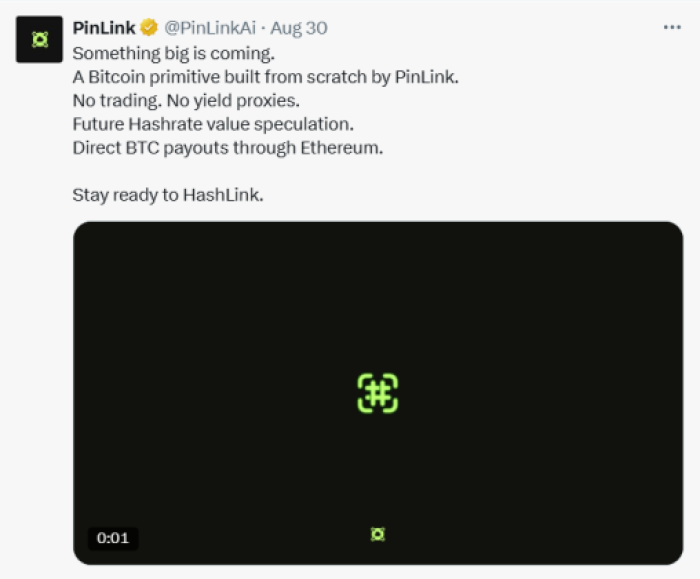
PinLink announced its new hashrate initiative on X.
Source: PinLink

Following this news breaking out, $PIN rose by over 10%. Now signals an opportune time to purchase the token, available for roughly $0.61 on some of the best crypto exchanges.

3. Maxi Doge ($MAXI) – Offers 172% Staking Rewards, Eyes Degen Trading Tournaments

Maxi Doge ($MAXI) is a meme coin on a mission to dominate the $45.1B dog-themed token niche.

As yet another Shiba Inu-inspired coin, it builds on the legacy of the top dogs on the market, $DOGE and $SHIB. But it visually sets itself apart from them, with muscles and a bold heavyweight persona that symbolizes its push toward extreme trading and market strength.

Maxi Doge presale.
Source: Maxi Doge

Despite its meme coin facade and origins, $MAXI wants to bring more to the arena than just speculation, a bit like $SHIB. But instead of launching a DEX or card game like its predecessor, it’s barking up its own path.

Despite only being live on presale thus far, it’s already engaging its community through staking. You can lock up $MAXI to earn daily rewards through smart contract distribution. Right now, its staking APY stands at an eye-catching 172% APY.

To top it off, Maxi Doge plans to host contests and reward top ‘ROI hunters’ with prizes. For the time being, the key details remain under wraps.

The project also aims to integrate futures platform integrations and host gamified tournaments in the future. Then, it’ll offer you a distinct way to partake in degen-style trading. For more information, check out our review.

Considering all the above, it’s no surprise that $MAXI has already raised over $1.8M in presales since launching on July 29, 2025.

You can join the action by acquiring $MAXI on presale for just $0.0002555. And there’s no better time to do precisely that; its price will go up tomorrow and is anticipated to break $0.0024 before 2026 gets going.

Verdict – MemeCore & Pump.fun’s Rally Sparks Growth for Top Altcoins

Hype surrounding altcoins is real, as evidenced by MemeCore and Pump.fun’s surge, plus a rising ASI.

If you’re seeking the next 1000x crypto, it might be wise to consider projects with strong utility and community hype, just like $SNORT, $PIN, and $MAXI.

Whichever one floats your boat, they each have significant growth potential.

Still, only time will truly tell their success. So, as always, DYOR and never invest more than you’d be sad to lose.

Editorial Process for bitcoinist is centered on delivering thoroughly researched, accurate, and unbiased content. We uphold strict sourcing standards, and each page undergoes diligent review by our team of top technology experts and seasoned editors. This process ensures the integrity, relevance, and value of our content for our readers.

Leah is a British journalist with a BA in Journalism, Media, and Communications and nearly a decade of content writing experience. Over the last four years, her focus has primarily been on Web3 technologies, driven by her genuine enthusiasm for decentralization and the latest technological advancements. She has contributed to leading crypto and NFT publications – Cointelegraph, Coinbound, Crypto News, NFT Plazas, Bitcolumnist, Techreport, and NFT Lately – which has elevated her to a senior role in crypto journalism. Whether crafting breaking news or in-depth reviews, she strives to engage her readers with the latest insights and information. Her articles often span the hottest cryptos, exchanges, and evolving regulations. As part of her ploy to attract crypto newbies into Web3, she explains even the most complex topics in an easily understandable and engaging way. Further underscoring her dynamic journalism background, she has written for various sectors, including software testing (TEST Magazine), travel (Travel Off Path), and music (Mixmag). When she's not deep into a crypto rabbit hole, she's probably island-hopping (with the Galapagos and Hainan being her go-to's). Or perhaps sketching chalk pencil drawings while listening to the Pixies, her all-time favorite band.

Related Reads

Apple and the Power Rebalancing with 'The Microns': Dissecting the Profit Ledger Behind the iPhone

The article analyzes the shifting profit dynamics and power balance between Apple and memory suppliers like Micron within the iPhone supply chain. It highlights a social media post criticizing Apple for raising iPhone prices while blaming memory chip cost increases, despite historically paying suppliers like Micron very little. An estimated iPhone 18 cost breakdown is referenced. Historically, memory was a minor cost component. In 2017's iPhone X, memory accounted for only about 1.6-2.3% of the price, with Apple capturing nearly 50% net profit. Over time, memory's share of the Bill-of-Materials (BOM) cost has grown significantly, reaching an estimated 12-15% for the iPhone 17 series. The core driver of this change is soaring demand for memory from the AI industry, particularly for High Bandwidth Memory (HBM) and AI servers, which is diverting production capacity and squeezing supply for consumer electronics. Memory manufacturers, after enduring periods of low profits, now hold greater pricing power. This is reflected in their recent strong financials, like Micron's 84.6% gross margin. Apple CEO Tim Cook initially described the memory price pressure as unprecedented in his 40-year career, later calling it a "once-in-a-century flood," before Apple announced price hikes across several product lines, causing a significant stock drop. Elon Musk echoed Cook's sentiment about the dramatic cost surge. The article concludes that the era of memory suppliers being at the mercy of Apple's pricing power has temporarily reversed, thanks to AI-driven demand. It notes Apple is reportedly seeking to diversify its supply chain, including exploring chips from China's CXMT.

Odaily星球日报5m ago

Apple and the Power Rebalancing with 'The Microns': Dissecting the Profit Ledger Behind the iPhone

Odaily星球日报5m ago

Conversation with the Founder of 42 Macro: The Fed's 'Boiling the Frog Slowly' and the K-Shaped Economy

In a conversation with Anthony Pompliano, Darius Dale, founder of 42 Macro, discusses the Federal Reserve's monetary policy and the K-shaped U.S. economy. Dale characterizes new Fed Chair Kevin Warsh as a "dove in hawk's clothing," expecting the Fed to signal or enact policy tightening in the coming quarters to create room for later easing. He argues current economic signals, including high deficit spending, debt monetization, and credit growth, strongly indicate inflation is not on a credible path back to 2%, forcing the Fed to act. The discussion highlights the stark "K-shaped" economic reality. While top earners, buoyed by massive cash savings (up ~$8 trillion since pre-pandemic), continue robust spending, those at the bottom face severe financial strain, with delinquency rates on consumer loans reaching crisis-era highs. Dale attributes much of the current social and political anxiety to this divergence, driven by the "Cantillon effects" of monetary expansion, which disproportionately benefits asset owners. He emphasizes that in this environment of "financial repression," individuals must participate in asset markets to avoid being left behind. On equities, Dale notes a rotation from the "Magnificent Seven" tech giants into broader AI-exposed companies, while warning that the tech giants' massive capital expenditure cycles could eventually puncture over-optimistic cash flow projections. Dale concludes by stressing that the core desire across all economic strata is simply the dignity to provide for one's family, a goal currently undermined by systemic policies that act as a "wealth siphon" from the bottom to the top.

marsbit34m ago

Conversation with the Founder of 42 Macro: The Fed's 'Boiling the Frog Slowly' and the K-Shaped Economy

marsbit34m ago

The Domestic Answer to Space Computing Power: Photonics Are More Efficient, Musk and Huang's Approaches Are Too Roundabout

The Space Computing Race: A Photonic Advantage The competition for space-based computing has intensified, with figures like Elon Musk and NVIDIA's Jensen Huang highlighting its potential. Musk predicts solar-powered AI satellites could offer the most cost-effective computing by 2032. However, space presents extreme challenges for traditional electronic chips: radiation from cosmic particles can cause errors, the vacuum environment hinders heat dissipation, and limited solar power constrains energy-hungry systems. Photonic computing, using light instead of electrons, offers a promising solution. Its core advantages for space are threefold: 1) **Radiation Resistance**: Photons are charge-neutral, making them inherently immune to particle interference. 2) **Low Heat Generation**: Light propagation in waveguides generates minimal heat, bypassing critical thermal management issues. 3) **Low Power Consumption**: Photonic chips have near-zero static power draw, aligning perfectly with the energy constraints of satellites. Furthermore, for a given payload weight and volume, photonic systems can potentially deliver higher total compute density. Since they require less bulky cooling and power infrastructure, more space can be allocated to the compute units themselves. While photonic computing holds great promise, current industry approaches face hurdles like the memory-compute bottleneck (separate storage and processing) and challenges in large-scale integration. Engineering for space—withstanding launch vibrations and validating full system operation in orbit—remains a critical step. The path forward resembles the evolution from single GPUs to computing clusters, but via a photonic route. As electronic chips approach physical limits in miniaturization, photonic computing and optical interconnects (光算光联) may provide a key alternative to bypass these constraints and define the next generation of space-based computing capabilities.

marsbit1h ago

The Domestic Answer to Space Computing Power: Photonics Are More Efficient, Musk and Huang's Approaches Are Too Roundabout

marsbit1h ago

Trading

Spot
活动图片