Покупать и держать ETH ради максимальной доходности крайне рискованно для компаний

cryptonews.ruPublished on 2025-05-02Last updated on 2025-09-03

По словам содиректора Sharplink Gaming Джозефа Чалома, компании, которые покупают и держат Ethereum, пытаясь выжать из своих активов максимальную доходность, подвергнутся значительно большему риску в случае спада рынка.

«Как и в традиционных финансах, найдутся люди, которые захотят получить эти последние 100 базисных пунктов доходности и будут считать, что это безрисково», — сказал Чалом в интервью Bankless в понедельник.

Он сказал, что хотя есть способы достичь двузначной доходности по ETH, они сопряжены со значительными рисками:

«Это сопряжено с кредитным риском, с контрагентским риском, с риском дюрации, с риском смарт-контрактов. Я думаю, самый большой риск заключается в том, что люди, которые сильно отстают, пойдут на риск, который я не считаю разумным».

Более широкая отрасль может быть испорчена «неосмотрительными» действиями

Чалом заявил, что сектор «может быть запятнан людьми, которые совершают неблагоразумные поступки», например, в том, как они привлекают капитал или выделяют себя в доходности, которую они получают от своих активов в ETH.

«Если вы перенаращиваете капитал и наступает спад, как вы можете быть уверены, что ваша структура коллов будет такой, чтобы вы нарастили капитал до самой высокой цены Ethereum?» — спросил он.

Sharplink Gaming является вторым по величине публичным держателем ETH с капиталом в 3,6 млрд долларов США, уступая только BitMine Immersion Technologies, которой принадлежит 8,03 млрд долларов США.
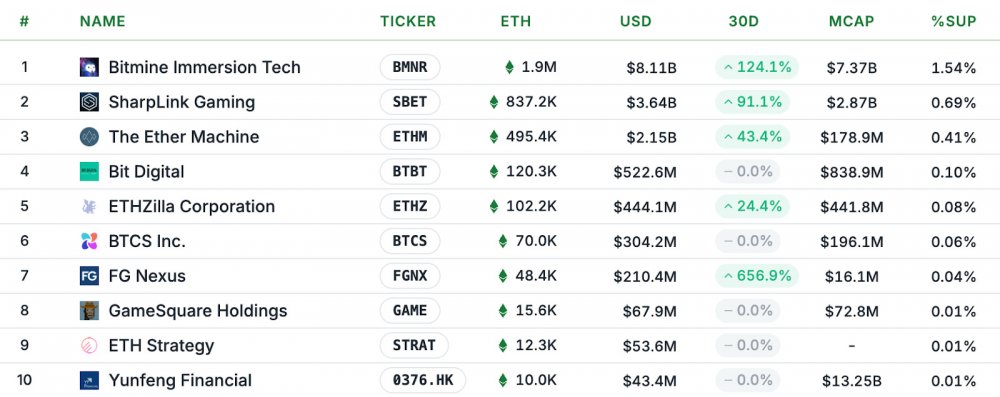
10 крупнейших компаний, владеющих казначейскими облигациями Ethereum по размеру активов. Источник: StrategicETHReserve.

По данным StrategicETHReserve, на момент публикации казначейские компании владеют примерно 3,6 млн ETH на сумму около 15,46 млрд долларов США. Интерес институциональных инвесторов к активу продолжает расти.

Некоторые считают, что модель имеет ужасные последствия

Йосип Рупена, генеральный директор кредитной платформы Milo и бывший аналитик Goldman Sachs, недавно сообщил, что компании, занимающиеся казначейскими операциями с криптовалютами , представляют собой те же риски, что и обеспеченные долговые обязательства, секьюритизированные корзины ипотечных кредитов и другие виды долга, которые спровоцировали финансовый кризис 2008 года.

С другой стороны, Мэтт Хоуган, главный инвестиционный директор Bitwise, недавно заявил, что казначейские и холдинговые компании Ethereum упаковали цифровой актив таким образом, который понятен традиционным инвесторам, что привлекло больше капитала и ускорило принятие.

Чалом сказал, что «преимущество» компаний, занимающихся казначейскими облигациями ETH, заключается в их практически бесконечной масштабируемости. По данным CoinMarketCap, на момент публикации статьи эфир торгуется по $4327.

В последнее время растет обеспокоенность по поводу более широкой модели крипто-казначейства.

Ведущий аналитик Glassnode Джеймс Чек заявил в своем посте X 5 июля, что его “инстинкт” подсказывает:

“Стратегия биткоин-казначейства казначейства имеет гораздо более короткий срок службы, чем многие ожидают”.

29 июня венчурная компания Breed заявила, что лишь немногие компании, занимающиеся казначейскими активами Bitcoin, выдержат испытание временем и избегут порочной «спирали смерти», которая повлияет на компании, владеющие BTC и торгующие по цене, близкой к чистой стоимости активов.


Trending Cryptos

Related Reads

The "Impossible Triad" Is Fundamentally a Pseudo-Problem

The article argues that blockchain's fundamental limitation is not the scalability trilemma (decentralization, scalability, security), which has been largely solved, but the lack of **privacy** and, until recently, clear **legitimacy**. Blockchain is described as a slow, expensive, globally shared computer whose core value is censorship resistance and verifiability. While ideal for native digital assets like money (e.g., stablecoins), its default transparency acts as a **tax**, exposing all transactions and enabling MEV extraction, which deters serious institutional capital. Simultaneously, its permissionless nature created regulatory ambiguity. The piece contends that **privacy** is the missing critical feature. It rejects the false choice between total transparency and complete anonymity. Modern cryptography (like zero-knowledge proofs) enables **compliant privacy**: users can prove facts (solvency, KYC status, compliance) without revealing the underlying sensitive data (specific holdings, identities). This preserves auditability for regulators and eliminates the leak of financial information. With recent regulatory progress (e.g., the GENIUS Act) addressing legitimacy, adding default, provably compliant privacy becomes a pure upgrade. It transforms blockchain from a costly, public ledger into a confidential settlement layer, finally bridging the gap to mainstream institutional and individual adoption of on-chain finance.

链捕手11h ago

The "Impossible Triad" Is Fundamentally a Pseudo-Problem

链捕手11h ago

Optical Chips: Collective Capacity Expansion

The global optical chip industry is experiencing a massive wave of expansion driven by surging AI data center demand. Major players across the US, Japan, Europe, and China are aggressively investing to ramp up production capacity. In the US, Coherent is expanding its 6-inch Indium Phosphide (InP) semiconductor fab in Texas, supported by CHIPS Act funding and a $2 billion strategic investment from NVIDIA. Lumentum is building a new factory for InP optical devices, and Nokia is scaling its advanced photonic chip packaging and testing capabilities. NVIDIA's investments aim to secure future supply of critical lasers and optical interconnect products for AI infrastructure. Japan's JX Advanced Metals, a leading InP substrate supplier, plans a multi-billion yen investment to increase its capacity 7-10 times, strengthening its grip on the crucial upstream materials market. In Europe, IQE and Tower Semiconductor settled a patent dispute and signed a multi-year InP epitaxial wafer supply agreement, highlighting that next-generation silicon photonics platforms will integrate high-performance InP components. STMicroelectronics and Sivers Semiconductors are also expanding silicon photonics production and partnerships. China is rapidly building out its domestic supply chain. Dongshan Precision's subsidiary, Source Photonics, announced a $12 billion project to expand optical chip and module production. Companies like Sanan Optoelectronics and Yunnan Germanium are scaling up InP chip manufacturing and substrate production, moving towards vertical integration from materials to modules. While debate continues around the exact future architecture—whether CPO (Co-Packaged Optics), NPO, or pluggables will dominate—analysts like Morgan Stanley argue the underlying driver is unchangeable: the explosive growth in bandwidth demand. This will inevitably increase the volume of optical engines, lasers, and related content per GPU, regardless of the final technical path. The competition for "more light" in the AI era has intensified into a global, full-chain capacity race.

marsbit13h ago

Optical Chips: Collective Capacity Expansion

marsbit13h ago

Stablecoins Finally Find Real Yield: An In-Depth Look at On-Chain Reinsurance Re | A Conversation with Re Founder Karan Saroya

Stablecoin Real Yield Found: A Deep Dive into On-Chain Reinsurance with Re's Karan Saroya As stablecoin supply exceeds $170 billion, the search for sustainable, non-speculative yield intensifies. Re, an on-chain reinsurance platform, provides an answer: connecting stablecoin capital to the trillion-dollar traditional reinsurance market. Re operates as a regulated reinsurer, accepting stablecoin deposits as collateral to back US insurance companies. These insurers pay premiums, generating yield that flows back to on-chain depositors. Currently supporting 35 insurers and underwriting $500 million, Re projects scaling to over $1 billion soon. Key insights from a Bankless podcast with founder Karan Saroya and investor Avichal of Electric Capital: 1. **Uncorrelated, Real-World Yield:** Re offers stablecoin holders access to reinsurance returns (targeting 12-14%+), an asset class entirely separate from crypto or equity markets. 2. **Operational Efficiency via Smart Contracts:** Re replaces traditional, labor-intensive capital fundraising with smart contracts, allowing a ~12-person team to compete with industry giants. 3. **Regulatory Leverage:** For every $1 of collateral, regulations allow backing $5-7 in written premiums. This leverage amplifies returns from the underlying risk-free rate. 4. **DeFi Integration:** Depositors receive receipt tokens, which can be used in protocols like Morpho for "looping," potentially pushing yields to 18-20%+. 5. **The "DeFi Mullet" Model:** A compliant front-end (regulated reinsurer) paired with a decentralized back-end (smart contracts, DeFi capital markets). 6. **RE Governance Token:** Modeled on Lloyd's of London, the token governs the central capital pool's allocation, counterparty acceptance, and parameters. 7. **Real Economic Impact:** Capital funds real-world productivity (factories, clinics, businesses) via insurance, moving beyond crypto's internal loops. The discussion highlights a pivotal moment: DeFi's supply-side infrastructure is now met by real demand for productive yield, potentially kickstarting a flywheel where vast on-chain stablecoin capital seeks these real-world returns.

链捕手14h ago

Stablecoins Finally Find Real Yield: An In-Depth Look at On-Chain Reinsurance Re | A Conversation with Re Founder Karan Saroya

链捕手14h ago

Trading

Spot
Futures

Hot Articles

Discussions

Welcome to the HTX Community. Here, you can stay informed about the latest platform developments and gain access to professional market insights. Users' opinions on the price of ETH (ETH) are presented below.

活动图片