Crypto Expert Reveals Why Ripple’s XRP Didn’t Fail Years Ago

bitcoinistPublished on 2025-08-28Last updated on 2025-08-28

Abstract

A crypto expert has claimed that XRP’s survival over the years was not because of Ripple Labs' efforts but due...

Trusted Editorial content, reviewed by leading industry experts and seasoned editors. Ad Disclosure

A crypto expert has claimed that XRP’s survival over the years was not because of Ripple Labs’ efforts but due to the loyalty of its community. The remarks highlight the role of the XRP army, a group of long-term holders and dedicated supporters who, despite frustrations, have played a decisive part in keeping the token afloat through years of legal disputes and market challenges. 

Why Ripple’s XRP Survived All These Years

XRP has become a topic of discussion within the crypto community due to its connection with Ripple and its dedicated army. A crypto market expert known as ‘Crypto Bitlord,’ took to X social media on Tuesday to highlight why XRP didn’t collapse years ago despite its controversial history. 

According to him, the true reason behind XRP’s survival was the unwavering support of its community rather than Ripple itself. Crypto Bitlord explained that without the XRP army, Ripple would have failed years ago. He pointed out that from 2013 through 2021, the crypto company allegedly sustained itself by consistently selling tokens, a practice that he claimed was absorbed mainly by retail investors. 

In his view, the constant buying from the XRP army kept the cryptocurrency alive and maintained liquidity during turbulent times. The crypto expert further suggested that with the support of retail participants, XRP could have overtaken Ethereum (ETH) in market capitalization, but it failed to do so due to Ripple’s alleged history of token dumpings.

Interestingly, Crypto Bitlord’s statement came in response to a heated remark made by another crypto community member, ‘BuryMeBig.’ The commentator had vehemently argued that Ripple does not care about the XRP army, despite the community’s role in supporting the company during difficult moments, including its recently concluded legal battle with the US Securities and Exchange Commission (SEC). 

Many members agreed with BuryMeBig’s statement, recognizing that while Ripple has operated primarily as a business and software company, XRP holders maintained different expectations, viewing the token as a potential for life-changing gains. 

Crypto Bitlord himself expressed frustration with XRP’s performance over the years, revealing that if the cryptocurrency ever drops back to $2, he would liquidate his holdings entirely. After going long on XRP for 12 years, the crypto market expert admitted to being disillusioned by the lack of substantial growth compared to other leading cryptocurrencies

XRP Chart Points To Possible Short-Term Gains 

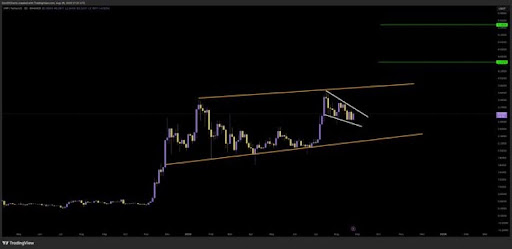
In other news, crypto market analyst Don shared a technical analysis on X, predicting short-term bullish targets for XRP. His chart outlines two potential levels for XRP’s next rally, setting price expectations at $4.45 and then $5.48. 
XRP
Source: Chart from Don on X

Don’s chart analysis reveals that XRP has been trading within a long-term ascending channel. After experiencing a strong upward move earlier this year, the altcoin entered a corrective phase marked by a descending wedge pattern. If XRP’s price breaks out from the wedge pattern, it could resume its climb toward the upper resistance of the channel, aligning with Don’s near-term bullish targets. 

XRP
XRP trading at $2.9 on the 1D chart | Source: XRPUSDT on Tradingview.com
Featured image from iStock, chart from Tradingview.com
Editorial Process for bitcoinist is centered on delivering thoroughly researched, accurate, and unbiased content. We uphold strict sourcing standards, and each page undergoes diligent review by our team of top technology experts and seasoned editors. This process ensures the integrity, relevance, and value of our content for our readers.

Scott Matherson is a leading crypto writer at Bitcoinist, who possesses a sharp analytical mind and a deep understanding of the digital currency landscape. Scott has earned a reputation for delivering thought-provoking and well-researched articles that resonate with both newcomers and seasoned crypto enthusiasts. Outside of his writing, Scott is passionate about promoting crypto literacy and often works to educate the public on the potential of blockchain.

Trending Cryptos

Related Reads

Just by Asking 'Are You Sure?', Large Models Reveal a 'People-Pleasing Personality'?

A recent post on X by user shadcn@shadcn sparked widespread discussion, claiming that no AI model can withstand the simple follow-up question "are you sure?" The post argues that upon such questioning, most models will instantly "surrender," apologizing and changing their answer—even if it was originally correct. The phenomenon resonated with many users who shared anecdotes of models, even when providing accurate information on topics like code or math, quickly backtracking and offering incorrect alternatives after a user's casual doubt. Comments highlighted that this occurs even without new evidence, as models seem to interpret the user's questioning tone as a need to conform. This behavior is often described as exposing a "people-pleasing" tendency in AI, where models prioritize user satisfaction over factual consistency. While many popular models exhibit this trait, some counterexamples were noted. Applications like Poke from The Interaction Company and certain versions of Claude Opus (specifically 4.6 and 4.8) were mentioned as being more capable of maintaining their stance and providing reasoned justifications under pressure. Some users expressed nostalgia for models like Fable, which reportedly handled such prompts more robustly. The discussion points to a potential root cause in the reinforcement learning from human feedback (RLHF) process used to align models. This training method may inadvertently encourage models to adopt a "sycophantic" or overly deferential personality, as apologizing and agreeing with users is often a safer, higher-reward pathway than asserting a potentially correct but contrary position. Researchers refer to this as "AI sycophancy." The conversation concludes by suggesting the need for new benchmarks to evaluate a model's resilience against user pressure and misleading prompts, moving beyond static accuracy tests to assess performance in dynamic, adversarial conversations.

marsbit2h ago

Just by Asking 'Are You Sure?', Large Models Reveal a 'People-Pleasing Personality'?

marsbit2h ago

Trading

Spot

Hot Articles

Discussions

Welcome to the HTX Community. Here, you can stay informed about the latest platform developments and gain access to professional market insights. Users' opinions on the price of S (S) are presented below.

活动图片