Is Bitcoin Really A Hedge Against Inflation?

NasdaqPublished on 2022-06-28Last updated on 2022-06-28

Abstract

The long-standing claim that bitcoin is a hedge against inflation has come to a fork in the road as inflation is soaring, but the bitcoin price is not.

The long-standing claim that bitcoin is a hedge against inflation has come to a fork in the road as inflation is soaring, but the bitcoin price is not.

This is an opinion editorial by Jordan Wirsz, an investor, award-winning entrepreneur, author and podcast host.

Bitcoin’s correlation to inflation has been widely discussed since its inception. There are many narratives surrounding bitcoin’s meteoric rise over the last 13 years, but none so prevalent as the debasement of fiat currency, which is certainly considered inflationary. Now Bitcoin’s price is declining, leaving many Bitcoiners confused, as inflation is the highest it’s been in more than 40 years. How will inflation and monetary policy impact bitcoin’s price?

First, let’s discuss inflation. The Federal Reserve’s mandate includes an inflation target of 2%, yet we just printed an 8.6% consumer price inflation number for the month of May 2022. That is more than 400% of the Fed’s target. In reality, inflation is likely even higher than the CPI print. Wage inflation isn’t keeping up with actual inflation and households are starting to feel it big time. Consumer sentiment is now at an all-time low.
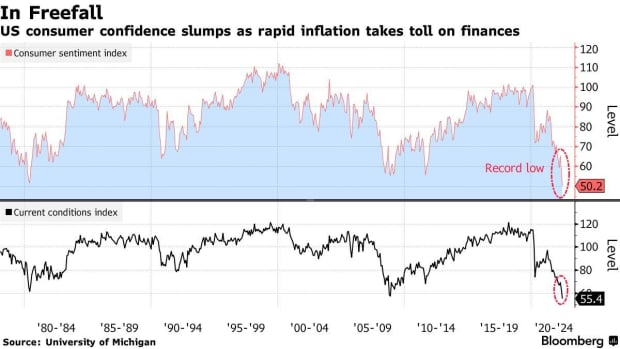
(Source)

Why isn’t bitcoin surging while inflation is running out of control? Although fiat debasement and inflation are correlated, they truly are two different things that can coexist in juxtaposition for periods of time. The narrative that bitcoin is an inflation hedge has been widely talked about, but bitcoin has behaved more as a barometer of monetary policy than of inflation.

Macro analysts and economists are feverishly debating our current inflationary environment, trying to find comparisons and correlations to inflationary periods in history — such as the 1940s and the 1970s — in an effort to forecast where we go from here. While there are certainly similarities to inflationary periods of the past, there is no precedent for bitcoin’s performance under circumstances such as these. Bitcoin was born only 13 years ago from the ashes of the Global Financial Crisis, which itself unleashed one of the greatest monetary expansions in history up until that time. For the last 13 years, bitcoin has seen an environment of easy monetary policy. The Fed has been dovish, and anytime hawkishness raised its ugly head, the markets rolled over and the Fed pivoted quickly to reestablish calm markets. Note that during the same period, bitcoin rose from pennies to $69,000, making it perhaps the greatest-performing asset of all time. The thesis has been that bitcoin is an “up and to the right asset,” but that thesis has never been challenged by a significantly tightening monetary policy environment, which we find ourselves at the present moment.

Sponsored Links

Increase cash flow with up to 51 credit-free days*

American Express

The old saying that “this time is different,” might actually prove to be true. The Fed can’t pivot to quell the markets this time. Inflation is wildly out of control and the Fed is starting from a near-zero rate environment. Here we are with 8.6% inflation and near-zero rates while staring recession straight in the eyes. The Fed is not hiking to cool the economy … It is hiking in the face of a cooling economy, with already one quarter of negative gross domestic product growth behind us in Q1, 2022. Quantitative tightening has only just begun. The Fed does not have the leeway to slow down or ease its tightening. It must, by mandate, continue to raise rates until inflation is under control. Meanwhile, the cost-conditions index already shows the biggest tightening in decades, with almost zero movement from the Fed. The mere hint of the Fed tightening spun the markets out of control.
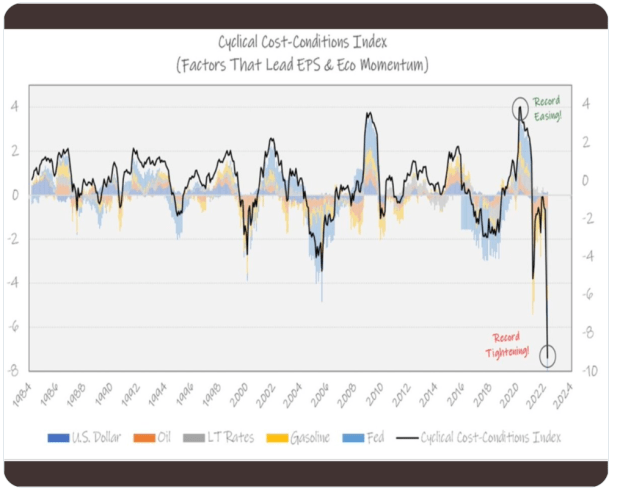
(Source)

There is a big misconception in the market about the Fed and its commitment to raising rates. I often hear people say, “The Fed can’t raise rates because if they do, we won’t be able to afford our debt payments, so the Fed is bluffing and will pivot sooner than later.” That idea is just factually incorrect. The Fed has no limit as to the amount of money it can spend. Why? Because it can print money to make whatever debt payments are necessary to support the government from defaulting. It’s easy to make debt payments when you have a central bank to print your own currency, isn’t it?

I know what you’re thinking: “Wait a minute, you’re saying the Fed needs to kill inflation by raising rates. And if rates go up enough, the Fed can just print more money to pay for its higher interest payments, which is inflationary?”

Does your brain hurt yet?

This is the “debt spiral” and inflation conundrum that folks like Bitcoin legend Greg Foss talks about regularly.

Now let me be clear, the above discussion of that possible outcome is widely and vigorously debated. The Fed is an independent entity, and its mandate is not to print money to pay our debts. However, it is entirely possible that politicians make moves to change the Fed’s mandate given the potential for incredibly pernicious circumstances in the future. This complex topic and set of nuances deserves much more discussion and thought, but I’ll save that for another article in the near future.

Interestingly, when the Fed announced its intent to hike rates to kill inflation, the market didn’t wait for the Fed to do it … The market actually went ahead and did the Fed’s job for it. In the last six months, interest rates have roughly doubled — the fastest rate of change ever in the history of interest rates. Libor has jumped even more.
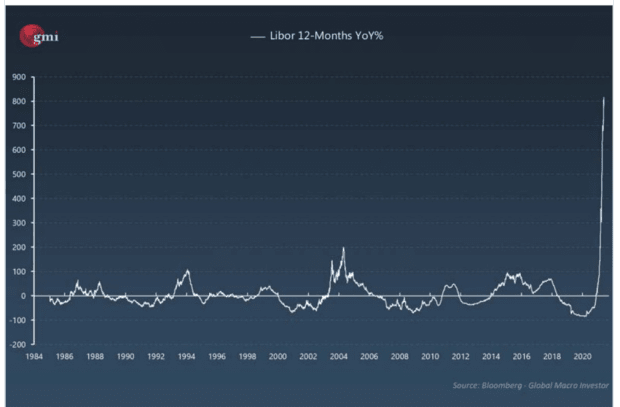
(Source)

This record rate-increase has included mortgage rates, which have also doubled in the last six months, sending shivers through the housing market and crushing home affordability at a rate of change unlike anything we’ve ever seen before.
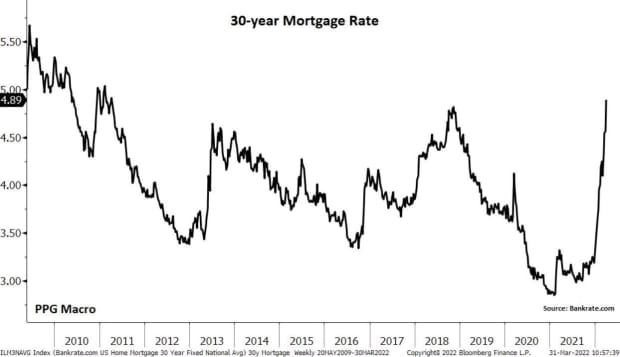
30-year mortgage rates have nearly doubled in the last six months.

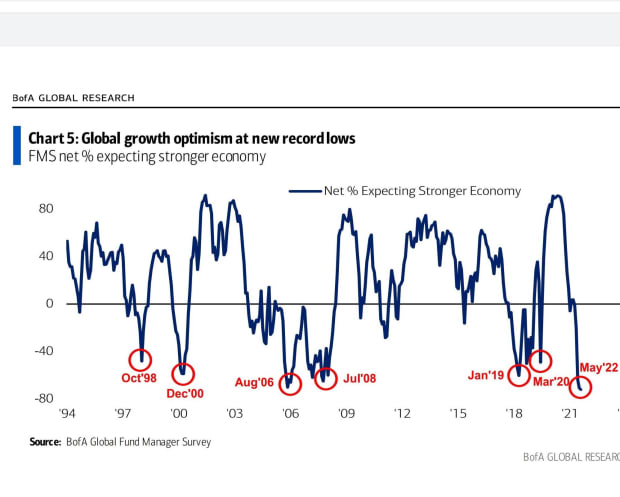
All of this, with only a tiny, minuscule, 50 bps hike by the Fed and the very beginning of their rate hike and balance sheet runoff program, merely started in May! As you can see, the Fed barely moved an inch, while the markets crossed a chasm on their own accord. The Fed’s rhetoric alone sent a chilling effect through the markets that few expected. Look at the global growth optimism at new all-time lows:
(Source)

Despite the current volatility in the markets, the current miscalculation by investors is that the Fed will take its foot off the brake once inflation is under control and slowing. But the Fed can only control the demand side of the inflationary equation, not the supply side of the equation, which is where most of the inflationary pressure is coming from. In essence, the Fed is trying to use a screwdriver to cut a board of lumber. Wrong tool for the job. The result may very well be a cooling economy with persistent core inflation, which is not going to be the “soft landing” that many hope for.

Is the Fed actually hoping for a hard landing? One thought that comes to mind is that we may actually need a hard landing in order to give the Fed a pathway to reduce interest rates again. This would provide the government the possibility of actually servicing its debt with future tax revenue, versus finding a path to print money to pay for our debt service at persistently higher rates.

Although there are macro similarities between the 1940s, 1970s and the present, I think it ultimately provides less insight into the future direction of asset prices than the monetary policy cycles do.

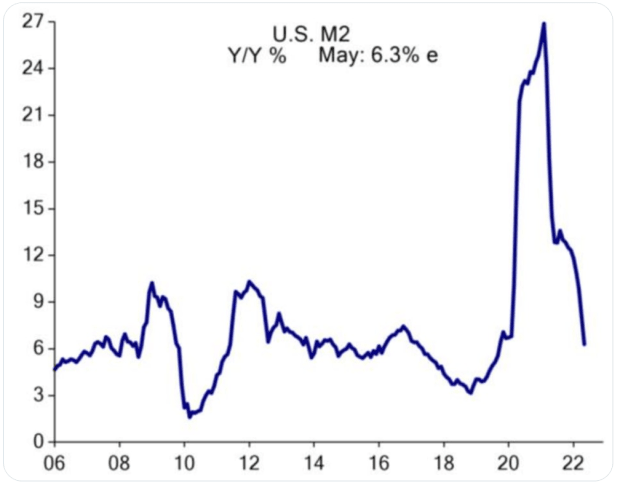
Below is a chart of the rate of change of U.S. M2 money supply. You can see that 2020-2021 saw a record rise from the COVID-19 stimulus, but look at late 2021-present and you see one of the fastest rate-of-change drops in M2 money supply in recent history.
(Source)

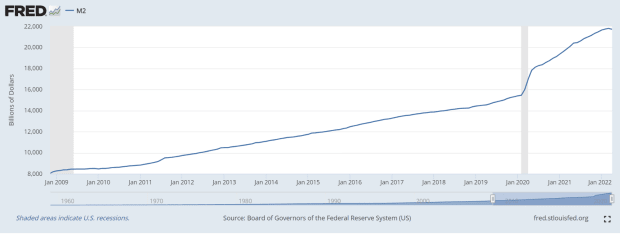
In theory, bitcoin is behaving exactly as it should in this environment. Record-easy monetary policy equals “number go up technology.” Record monetary tightening equals “number go down” price action. It is quite easy to ascertain that bitcoin’s price is tied less to inflation, and more to monetary policy and asset inflation/deflation (as opposed to core inflation). The chart below of the FRED M2 money supply resembles a less volatile bitcoin chart … “number go up” technology — up and to the right.
(Via St. Louis Fed)

Now, consider that for the first time since 2009 — actually the entire history of the FRED M2 chart — the M2 line is potentially making a significant direction turn to the downside (look closely). Bitcoin is only a 13-year-old experiment in correlation analysis that many are still theorizing upon, but if this correlation holds, then it stands to reason that bitcoin will be much more closely tied to monetary policy than it will inflation.

If the Fed finds itself needing to print significantly more money, it would potentially coincide with an uptick in M2. That event could reflect a “monetary policy change” significant enough to start a new bull market in bitcoin, regardless of whether or not the Fed starts easing rates.

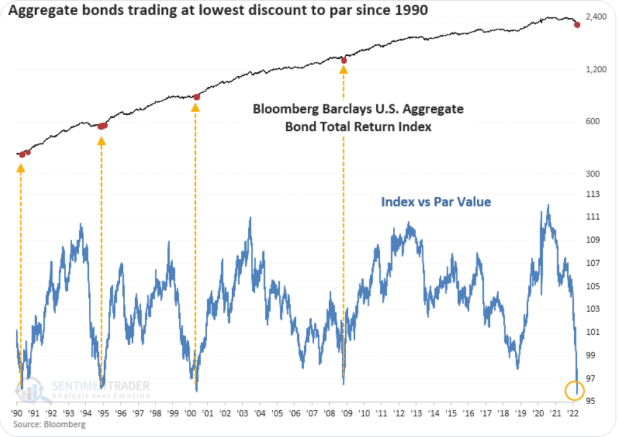
I often think to myself, “What is the catalyst for people to allocate a portion of their portfolio to bitcoin?” I believe we are beginning to see that catalyst unfold right in front of us. Below is a total-bond-return index chart that demonstrates the significant losses bond holders are taking on the chin right now.
(Source)

The “traditional 60/40” portfolio is getting destroyed on both sides simultaneously, for the first time in history. The traditional safe haven isn’t working this time around, which underscores the possibility that “this time is different.” Bonds may be a deadweight allocation for portfolios from now on — or worse.

It seems that most traditional portfolio strategies are broken or breaking. The only strategy that has worked consistently over the course of millennia is to build and secure wealth with the simple ownership of what is valuable. Work has always been valuable and that is why proof-of-work is tied to true forms of value. Bitcoin is the only thing that does this well in the digital world. Gold does it too, but compared to bitcoin, it cannot fulfill the needs of a modern, interconnected, global economy as well as its digital counterpart can. If bitcoin didn’t exist, then gold would be the only answer. Thankfully, bitcoin exists.

Regardless of whether inflation stays high or calms down to more normalized levels, the bottom line is clear: Bitcoin will likely start its next bull market when monetary policy changes, even if ever so slightly or indirectly.

Related Reads

US Government Suddenly Halts Anthropic's Strongest Model, "Quasi-IPO Stock Price" Plunges 3.7% Overnight

U.S. Government Halts Anthropic's Top AI Models, 'Pre-IPO' Price Drops 3.7% On June 12, the U.S. government ordered Anthropic to shut down access to its two most powerful AI models, Claude Fable 5 and Claude Mythos 5, citing national security concerns. The directive, issued by the Department of Commerce, required Anthropic to block access for all foreign nationals, leading the company to disable the models globally for all users. Anthropic strongly opposed the move, arguing the government's basis was a "narrow jailbreak vulnerability" and warning that applying such a standard industry-wide would effectively halt all frontier model deployments. The news impacted Anthropic's implied valuation in speculative markets. The Anthropic perpetual contract on Hyperliquid fell approximately 3.7% to around $1,627, down from highs above $1,800 following the models' release. Unauthorized tokenized products linked to Anthropic on Solana also saw significant declines. The models, launched just days earlier on June 9, represented a major capability leap for Anthropic. Fable 5 was its first public release of a "Mythos"-tier model above its flagship Claude Opus. The shutdown creates an ironic situation for Anthropic, a company founded on "AI safety" principles, and adds uncertainty to its ongoing IPO preparations. The company is actively engaging with regulators to resolve what it calls a "misunderstanding" and restore service.

marsbit5m ago

US Government Suddenly Halts Anthropic's Strongest Model, "Quasi-IPO Stock Price" Plunges 3.7% Overnight

marsbit5m ago

SpaceX IPO Creates Trillion-Dollar Billionaire: Musk's Wealth Equals Half of Crypto Market

SpaceX's record-breaking IPO has propelled Elon Musk to become the first modern billionaire with a personal net worth exceeding $1 trillion, reaching $1.11 trillion according to Bloomberg. This staggering wealth surpasses the total market capitalization of all cryptocurrencies excluding Bitcoin and equals roughly half of the entire crypto market's value. The milestone highlights extreme wealth concentration and the significant devaluation of the altcoin market, whose total cap has nearly halved since late 2025 as capital flows into large tech stocks. SpaceX's Nasdaq debut saw its valuation hit $2.2 trillion, with shares soaring from a $135 offer price to close at $161. Its first-day trading volume of $85 billion set a new global IPO record. Musk owns 42% of the company. Despite his wealth dwarfing the altcoin sector, Musk maintains deep ties to digital assets. He personally holds Bitcoin, Ethereum, and Dogecoin, while his companies, SpaceX and Tesla, collectively hold over 30,000 Bitcoin, ranking among the top corporate BTC holders globally. His acquisition and integration of financial data tools into X (formerly Twitter) further connect his ecosystem to the markets. Ultimately, Musk's trillion-dollar status underscores the immense wealth controlled by tech founders, though this fortune remains largely tied to volatile stock prices rather than liquid assets.

Foresight News13m ago

SpaceX IPO Creates Trillion-Dollar Billionaire: Musk's Wealth Equals Half of Crypto Market

Foresight News13m ago

Hardcore First Look | Ocean Embodied Intelligence Company 'Shihang Intelligence' Secures Record-Breaking 1 Billion in Funding, Zhu Xiaohu, Temasek Place Bets

Breaking News | Ocean Embodied Intelligence company "Shihang Intelligent" secures a record-breaking 1 billion RMB (approximately 10 billion yuan) in Series A financing, with investment from Zhu Xiaohu and Temasek. Author: Qiu Xiaofen | Editor: Yuan Silai Ocean Embodied Intelligence company "Shihang Intelligent" has completed its Series A funding round, raising over 1 billion RMB. This marks the largest single funding round in the global marine robotics field to date. Investors include upstream momentum funds from chip companies "Moore Thread" and "Kunlunxin," Singapore's state-owned investment platform Vertex Growth, and listed company Dyneo, among others. Existing investors like GSR Ventures (whose founder Zhu Xiaohu has invested for the fifth time), Vertex Ventures China, Hua Ying Capital, and Long Capital also significantly increased their investments. Founder and CEO Chen Xiaobo, a 1989-born alumnus of Harbin Engineering University, is a long-time expert in underwater robotics. He received the National Defense Science and Technology Progress Award at age 28 (the youngest recipient) and led the development of China's first commercial underwater cleaning robot. The funds will be used for core technology R&D, global market expansion, and building the industry chain ecosystem to scale the application of marine robots in complex underwater scenarios. The ocean is considered one of the most challenging environments for robotics due to low light, high turbidity, complex currents, limited communication, high pressure, and corrosion. "Shihang Intelligent" focuses on developing core underlying technologies for marine robots, covering six key systems: power, control, sensing, navigation, sealing, and deployment. Its robots are capable of operating at depths from 0 to 10,000 meters with full degrees of freedom, performing complex maneuvers, autonomous navigation, and multi-robot collaboration. Applications include ship cleaning, underwater security, offshore wind power, marine ranching, and seabed inspection. The company's order value for the first half of 2026 alone has exceeded 1 billion RMB. Its "Orca Robot" is used by major shipping companies and has performed maintenance on over a thousand large vessels. In April of this year, the company launched its ocean embodied large model "Cangqiong CEORION." Unlike traditional remote-controlled or pre-programmed robots, this model integrates environmental perception, task understanding, and action generation into a single end-to-end architecture. Trained on millions of hours of commercial operation data and simulation data, it covers 12 major underwater operation scenarios. In simulations, it achieved over 90% task success rate and over 70% zero-shot adaptation capability to unseen environments. A built-in physics reasoning module reduces collision risk by 80%, enabling autonomous operation even with weak or no communication. Recently, "Shihang Intelligent" was selected as a core technology partner for Singapore's Maritime and Port Authority national hull inspection and cleaning program. These advancements indicate marine robotics is moving from pilot projects to scaled applications, with real-world operations generating valuable data to continuously improve robot capabilities. CEO Chen Xiaobo stated the company will continue investing in core marine robotics technology, the embodied intelligence model, and global application scenarios to expand into more high-risk, high-difficulty, and high-value underwater operations.

marsbit38m ago

Hardcore First Look | Ocean Embodied Intelligence Company 'Shihang Intelligence' Secures Record-Breaking 1 Billion in Funding, Zhu Xiaohu, Temasek Place Bets

marsbit38m ago

Three Months, 35 Billion Yuan: Investors Rush to Grab the OpenAI of the Physical World

Investors flock to a physical AI startup as the race for the "OpenAI of the physical world" heats up. Ji Jia Shi Jie (GigaWorld), a company dedicated to developing Artificial General Intelligence (AGI) for the physical world, has raised 3.5 billion RMB (approximately $490 million) in just three months, according to a report from investment media outlet Touzijie. The latest B2 funding round of 1 billion RMB attracted a wide range of top-tier investors, including sovereign wealth funds, industrial capital, and financial institutions. This brings the total funding for the young company, now valued over 10 billion RMB, to 3.5 billion RMB across three recent rounds. The company is led by Huang Guan, a post-90s Tsinghua University PhD with extensive experience in AI, autonomous driving, and entrepreneurship. Its core innovation is a "dual-pyramid" system comprising a five-layer data pyramid (from internet videos to real-world robot data) and a three-layer algorithm pyramid focused on world simulation, action alignment, and reinforcement learning. This system underpins its key models: the "World Action Model" (e.g., GigaBrain series for robot control) and the "World Generation Model" (e.g., GigaWorld series for simulating and understanding the physical world). Its models have reportedly achieved top rankings in global robotics benchmarks. Ji Jia Shi Jie argues that while current digital AGI excels in information processing, the next frontier is physical AGI—systems that can understand and interact with the real world. The company believes the field is approaching its "GPT-3 moment," a key inflection point in capability scaling. To achieve this, the company is pursuing a dual-market strategy. For the consumer (C) market, it launched the "SeeLight" brand and its S1 general-purpose humanoid robot, which has secured initial orders for deployment in real homes. For the business (B) market, it focuses on industrial automation with its Maker series robots, having signed agreements for large-scale deployment in factories, and its DriveDreamer world model for autonomous driving, which is already in use with over 30 automakers and tech companies. The report concludes that by bridging the gap between digital intelligence and physical action, Ji Jia Shi Jie aims to unlock a new wave of productivity, ultimately bringing physical AGI into everyday life.

marsbit1h ago

Three Months, 35 Billion Yuan: Investors Rush to Grab the OpenAI of the Physical World

marsbit1h ago

What's the Connection Between Pinduoduo's Huang Zheng and Blockchain?

This text explores the unexpected connection between Pinduoduo founder Colin Huang and blockchain, as suggested in his article *Turning Capitalism Upside Down*. Huang argues Pinduoduo's core business is about managing "uncertainty." He posits that wealth flows to the rich because they absorb life's uncertainties (e.g., illness, job loss) that devastate the poor, who pay a premium for certainty through insurance or stable prices. Pinduoduo's model attempts a "reverse insurance": by aggregating consumer demand via group-buying and flash sales, it creates a large, predictable order for manufacturers. This certainty allows factories to remove risk premiums, passing savings back as lower prices, thus partially reversing the wealth flow. The key obstacle, Huang notes, is that an individual's buying intent is an unreliable promise. He then asks if blockchain is the natural solution for this "reverse insurance." The text elaborates that blockchain, through smart contracts with binding deposits, could transform casual intent into a costly-to-break, enforceable commitment. This replaces interpersonal trust with coded rules, making promises credible, pricable, and resistant to fraud. Finally, the author draws a parallel to Bitcoin, framing two paths to creating certainty: the "Pinduoduo path" of aggregating decentralized will into scale, and the "Bitcoin path" of locking rules into immutable code. Both sacrifice something—personal freedom or system flexibility—to manufacture trust and predictability.

链捕手2h ago

What's the Connection Between Pinduoduo's Huang Zheng and Blockchain?

链捕手2h ago

Trading

Spot
Futures
活动图片