Must-Read Grok Prediction on Solana Growth Ahead – Here’s Why Investors Are Watching $SNORT

bitcoinistPublished on 2025-08-18Last updated on 2025-08-18

Abstract

After a dip in early 2025, the meme coin market has rebounded sharply, climbing nearly 50% since April to reach...

Trusted Editorial content, reviewed by leading industry experts and seasoned editors. Ad Disclosure

After a dip in early 2025, the meme coin market has rebounded sharply, climbing nearly 50% since April to reach a market cap of about $68B.

As this momentum builds, Grok predicts Solana could be one of the biggest beneficiaries, and for good reason.

According to CoinGecko’s Q1 crypto industry report, Solana dominated decentralized exchange trading in the first quarter, capturing 39.6% of volumes and accounting for 52% of all on-chain trades.

Much of this surge was fueled by the explosive launch of the $TRUMP token, proving that rapid meme coin cycles can funnel massive liquidity into Solana.

Meanwhile, Pump.Fun, Solana’s leading meme coin launchpad, has deployed over 12M tokens to date, with revenues climbing steadily toward 4.6M $SOL.

All in all, with meme trading accelerating, Solana’s network revenue is poised for even greater growth.

That’s why Grok believes $SOL could soon march toward – and potentially break past – the long-awaited $300 milestone in the months ahead.

And for those looking to amplify this trend, one standout presale altcoin – Snorter Token ($SNORT) – may offer the best way to ride Solana’s momentum with its multi-chain sniffing and sniping bot.

Solana ETF Momentum and Institutional Tailwinds

Grok also highlighted that several major investment firms, including Grayscale, Bitwise, 21Shares, and Franklin, have filed for spot Solana ETF registrations with the SEC, with the final decision deadline set for October 10, 2025.

Bloomberg analyst James Seyffart estimates a 95% chance these ETFs will be approved, while prediction market Polymarket is pricing in a staggering >99% probability of approval by year-end.

The launch of Solana ETFs would not only attract fresh retail capital but also significantly strengthen liquidity and cement Solana’s institutional legitimacy.

On top of that, the recent 401(k) retirement plan amendment, which now allows direct crypto allocations, could funnel even more inflows into Solana.

As retirees and long-term investors look beyond Bitcoin and Ethereum, Solana’s growth trajectory and expanding ecosystem make it a natural candidate for diversification, positioning it as one of the most attractive digital assets for steady capital inflow.

Solana Technical Analysis

Solana has been on a steady climb since early April, surging nearly 90% and consistently respecting its upward-sloping trendline.

Recently, $SOL formed a double top at $205, with strong support around $167, which is the base of the trendline.

If it rebounds from this trendline and breaks above the double top, the next key target lies at ~$260.
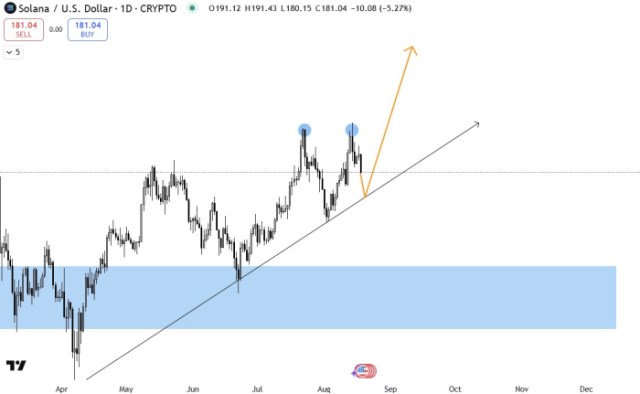
$SOL Double Top & Upward-Sloping Trendline.

And with momentum on its side, $SOL could finally push beyond the long-awaited $300 mark by the end of the year.

When we asked Grok how to best capitalize on this bullish setup, it pointed directly to Snorter Token ($SNORT) as the best altcoin to buy right now.

After all, as Solana’s growth fuels a broader altcoin rally and sparks a new wave of meme coin trading, a Telegram-based trading bot like Snorter becomes invaluable.

What Is the Snorter Token?

The Snorter Token ($SNORT) is the native cryptocurrency of the Snorter Telegram trading bot, a platform built specifically for small meme coin traders.

In the past, most of the liquidity and profits in new meme coins were captured by large volume traders with access to advanced trading tools and algorithms.

That is changing now. With the Snorter bot, you can place buy, sell, stop, and limit orders directly on Telegram, and they’re then executed the moment liquidity becomes available.

Simply put, Snorter levels the playing field and allows regular retail investors to compete with bigger players.

The bot will initially launch with full Solana support, but it will soon expand to other major blockchains, including Ethereum, BNB Chain, Base, and Polygon, ensuring class-leading accessibility and seamless cross-chain compatibility.

Snorter Bot’s Top-Notch Security

Snorter has been built with investor safety at its core, incorporating advanced security measures to protect against the most common crypto scams.

The bot features honeypot detection, rug pull protection, and detection of hidden sell blockers, ensuring you avoid the traps that plague much of the meme coin market.
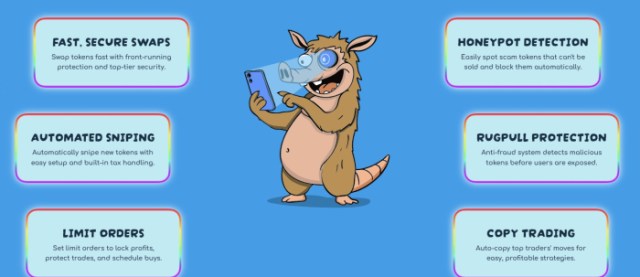
Snorter Bot features.

It’s also designed to counter more sophisticated exploits such as sandwich attacks.

In these attacks, malicious actors front-run a victim’s trade by placing a buy order with a higher gas fee, forcing their transaction to execute first.

This drives up the price, increasing slippage for the victim, before the attacker immediately sells to pocket the difference.

To neutralize this, Snorter uses MEV-resistant relayers and routes buy orders outside of public mempools, preventing attackers from detecting large trades and eliminating the risk of sandwich manipulation.

On top of its security framework, Snorter offers an intuitive dashboard where you can manage your entire portfolio in one place.

It also supports copy trading, allowing you to replicate the strategies of successful traders and potentially earn while you learn.

For beginners, this creates a rare combination of education and profit opportunities.

Should You Buy the $SNORT Token?

Snorter Token ($SNORT) is the backbone of the Snorter trading bot, delivering a powerful set of benefits for its holders.

If you’re after an easy to use trading automation like Snorter’s bot, the token could prove useful in several ways.

To begin with, holders enjoy reduced transaction fees of just 0.85%, compared to 1.5% for non-holders.

Buying $SNORT also lifts daily sniping limits and unlocks advanced trading analytics, giving investors a smoother, more efficient trading experience without unnecessary restrictions.

In addition, holders can stake their tokens and earn dynamic returns, currently yielding an impressive 138% APY.

It’s worth noting that this rate will gradually decline as more investors join the presale, so hop in as early as possible.

Snorter Token ($SNORT) Live Presale Numbers.

Snorter Token is currently in presale, with each token available at just $0.1017.

It has already raised over $3.19M so far, cementing its place as one of the best crypto presales around.

And as per our $SNORT price prediction, the token could hit $0.94 by the end of this year alone, which would translate to a brain-melting 800% ROI.

Visit Snorter Token’s website for more information.

Wrapping Up

Solana is primed for a fresh all-time high, fueled by booming meme coin trading and the strong likelihood of a Solana ETF approval by late 2025.

As meme coin activity accelerates, the demand for a reliable trading tool to capture liquidity opportunities will only grow stronger.

This is where Snorter Token ($SNORT) comes in. It gives investors the speed, security, and edge they need to ride Solana’s next big rally.

However, keep in mind that none of this is financial advice. Crypto is a risky market, so you must always do your own research before investing.

Editorial Process for bitcoinist is centered on delivering thoroughly researched, accurate, and unbiased content. We uphold strict sourcing standards, and each page undergoes diligent review by our team of top technology experts and seasoned editors. This process ensures the integrity, relevance, and value of our content for our readers.

As a crypto writer, Bogdan’s responsibilities are split between researching and writing articles and entertaining the team with his humor bordering on the politically incorrect, an aspiring Bill Burr, if you will. Thanks to his 12+ years of writing experience in just as many fields, including tech, cybersecurity, modelling, fitness, crypto, and other topics-that-shall-not-be-named, he's become a genuine asset to the team. While his position as a senior writer at PrivacyAffairs thought him valuable lessons about the power of self-management, his entire writing career was and is an exercise in self-improvement. Now, he's ready to sink his teeth into crypto and teach people how to take control of their own money on the blockchain. With fiat as an eternally devaluing currency, Bitcoin and altcoins seem like the best-fitting alternative for Bogdan. Bogdan’s biggest professional accomplishment, aside from securing a position as a main writer for Bitcoinist, was his 5-year run as a writing manager at Blackwood Productions, where he coordinated a team of four writers. During that time, he learned the value of teamwork and that of creating a working environment that breeds efficiency, positivity, and friendship.

Trending Cryptos

Related Reads

You Use Claude and Codex Every Day, but Meta Has Restricted Internal Use

In May, Meta imposed internal restrictions on its engineers regarding the use of Claude Code and Codex, two widely used AI programming tools. Despite being a major client, Meta's guidelines, still in effect, prohibit these external models from being used for specific tasks to prevent potential "escalations with partners." The core concern is "distillation"—the risk that outputs from Claude or Codex could inadvertently contaminate the training data and evaluation processes for Meta's in-house AI coding assistant, MetaCode. If MetaCode is trained or evaluated using data generated by these external models, it risks learning their capabilities rather than developing its own, blurring the line of intellectual origin. The restrictions are precise: engineers cannot use the external models to generate test questions, debug source code, or suggest test cases. AI-generated content is also barred from environments accessible to MetaCode. However, AI can still assist with peripheral tasks like workflow setup and code organization, provided all outputs are manually reviewed. This caution reflects a broader industry dilemma. While distillation is a common technique, using a competitor's model output for training raises legal and ethical questions about the ownership of derived capabilities. Contractual terms from companies like OpenAI and Anthropic explicitly forbid using their outputs to build competing products, putting enforcement power in the hands of rivals. The move is also financially motivated, as Meta seeks to reduce its hefty internal AI spending, estimated in the billions this year. Meta's policy illustrates the delicate balance companies must strike: leveraging powerful external AI tools while safeguarding the integrity and independence of their own AI development. As AI systems increasingly help build other AIs, distinguishing the origin of capabilities becomes a fundamental challenge for the entire industry.

marsbit52m ago

You Use Claude and Codex Every Day, but Meta Has Restricted Internal Use

marsbit52m ago

Why Do We Need an AI Content Perspective Today?

The article "Why Do We Need an AI Content Perspective Today?" explores the complex and often contentious integration of AI into the cultural and creative industries, particularly film and television. It begins with the cancellation of Amazon's AI-generated animation "Punky Duck," highlighting the ethical debates surrounding AI content. AI's rapid advancement is transforming video production, enabling cost-effective, full-length AI films (e.g., "RAPHAEL," "Dreams of Violets") while sparking industry resistance over issues like "synthetic actors." The core debate has shifted from whether to use AI to how to use it responsibly. The article analyzes why AI's entry into film is uniquely unsettling. It distinguishes between "cultural fast food" (short-form, fast-paced content like micro-dramas) and "cultural main courses" (traditional, long-form film/TV). AI currently excels at the former, matching its fragmented narratives, shallow emotional needs, and free-to-consumer models. However, venturing into the latter challenges the human-centric essence of storytelling—creativity, emotional depth, and the unique value of human labor and experience. While AI can generate massive volumes of content and lower costs, it risks devaluing human creativity, leading to homogenized output, and creating unfair competition through potential intellectual property infringement. Its efficiency also amplifies content safety risks, making preemptive governance crucial. To counter these risks, the article proposes establishing clear boundaries guided by a human-centered AI content perspective. It outlines four principles: 1) Amplify, rather than displace, human creative space; 2) Respect and protect human creative output; 3) Ensure human creative control and responsibility remain paramount; and 4) Guarantee transparency and traceability in AI creation. The conclusion emphasizes that humans must act as the "helmsmen" of technology, steering AI development to enhance, not replace, the core human values at the heart of cultural expression.

marsbit1h ago

Why Do We Need an AI Content Perspective Today?

marsbit1h ago

Planck Retracted? The Father of Quantum Tripped by an Algorithm

The recent discovery that two articles (published in 1940 and 1942) by Max Planck, the Nobel laureate and founder of quantum theory, are marked as "retracted" on Springer's digital platform highlights a curious clash between historical publishing practices and modern automated systems. An investigation suggests these retractions are algorithmic errors, not due to fraud or misconduct. The papers, philosophical reflections on science published in *Die Naturwissenschaften*, were likely flagged by the platform's systems. One article, a republished lecture, may have been mistaken for duplicate publication. Another, sharing a title with a prior article by a different author (a common practice for continuing debates at the time), may have triggered a similar automated check. The digital versions have even been replaced with blank pages, contrary to normal practice of preserving retracted texts. This incident underscores how contemporary digital infrastructure, built around concepts like "self-plagiarism" and strict copyright, can misclassify and obscure legitimate historical scholarly communication. It serves as a warning that digital archives are not neutral mirrors of the past but are filtered by platform rules, potentially distorting the scientific record. As AI systems increasingly rely on such databases, such erroneous metadata could propagate, affecting how future tools interpret and access historical knowledge.

marsbit1h ago

Planck Retracted? The Father of Quantum Tripped by an Algorithm

marsbit1h ago

Trading

Spot

Hot Articles

Discussions

Welcome to the HTX Community. Here, you can stay informed about the latest platform developments and gain access to professional market insights. Users' opinions on the price of S (S) are presented below.

活动图片