Майкл Сэйлор объясняет, почему MSTR торгуется с премией к NAV биткоина

cryptonews.ruPublished on 2025-01-13Last updated on 2025-08-14

Акции Microstrategy стремительно растут по сравнению с биткоином, поскольку инвесторы рассчитывают на взрывной рост. Майкл Сэйлор отмечает мощные структурные факторы, стимулирующие спрос, который не ограничивается прямым доступом к биткоину.

Превосходя биткоин по NAV, Майкл Сэйлор выделяет 4 фактора, способствующих росту премии MSTR

Акции Microstrategy (Nasdaq: MSTR) торгуются выше стоимости лежащих в их основе биткоинов, что отражает структурные преимущества, недоступные при прямом владении криптовалютой или спотовых биржевых продуктах (ETP). Эта рыночная премия измеряется относительно стоимости чистых активов компании (NAV), которая представляет собой стоимость биткоинов в расчёте на одну акцию после учёта обязательств. Майкл Сэйлор, исполнительный председатель Microstrategy, которая была переименована в Strategy, 13 августа поделился в социальной сети X:

MSTR торгуется с премией к чистой стоимости биткоина из-за кредитного плеча, преимущества опционов, пассивных потоков и более широкого институционального доступа, который обеспечивают долевые и кредитные инструменты по сравнению с сырьевыми товарами.

В совокупности эти элементы дают Microstrategy преимущества в плане кредитного плеча и ликвидности, которых нет у самого биткоина.

Способность компании использовать кредитное плечо от 2x до 4x для биткоина за счёт финансирования на основе акционерного капитала, которое Сэйлор называет «кредитным усилением», обеспечивает рост производительности на бычьих этапах рынка. Это выгодно отличает компанию от спотовых биткоин-ETP и прямых инвестиций в биткоин, которые не имеют таких возможностей кредитного плеча. Microstrategy также извлекает выгоду из открытого интереса на традиционных рынках опционов, превышающего 100 миллиардов долларов, в то время как открытый интерес для спотовых биткоин-ETP составляет около 30 миллиардов долларов, а для фьючерсов на биткоин на Чикагской товарной бирже — 20 миллиардов долларов.
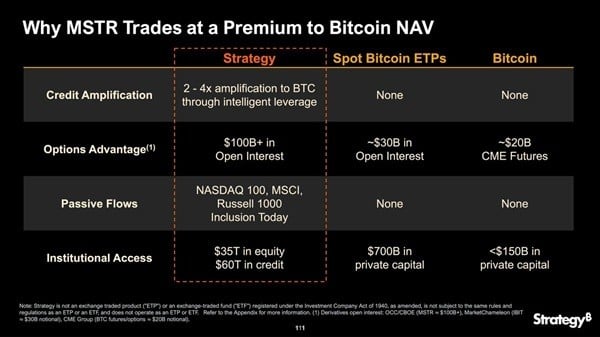
Почему MSTR торгуется с премией к NAV биткоина. Источник: Майкл Сэйлор

Кроме того, являясь компонентом таких индексов, как Nasdaq 100, MSCI и Russell 1000, Microstrategy фиксирует пассивные инвестиционные потоки, которые не распространяются на биткоин или его спотовые ETP.

Институциональный охват — ещё одно важное отличие. Фондовые рынки обеспечивают потенциальный доступ к акциям на сумму 35 триллионов долларов и кредитам на сумму 60 триллионов долларов, что значительно превышает 700 миллиардов долларов частного капитала, доступного для спотовых биткоин-ETP, и менее 150 миллиардов долларов для прямого инвестирования в биткоин. Хотя критики считают разрыв в оценке чрезмерным, сторонники утверждают, что такая динамика рынка оправдывает надбавку, поскольку она позволяет Microstrategy увеличивать прибыль и расширять базу инвесторов за пределы возможностей биткоина как товара.

Компания начала приобретать биткоины в 2020 году, сделав их основным активом своего казначейства. Strategy финансирует свои покупки за счёт долговых обязательств и размещения акций, что делает её крупнейшим корпоративным держателем биткоинов и фактическим доверенным лицом инвесторов. Согласно последней публичной отчётности, у Strategy хранится около 628 946 BTC.
Related Reads

Robinhood Chain Mainnet Goes Live: Can Stocks Finally Be Moved Into Wallets?

Robinhood has officially launched its public mainnet, Robinhood Chain, along with stock-like tokens, the USDG yield product, and a DeFi lending portal. This marks a significant shift where a major online broker is integrating its user interface, regulatory compliance, self-custody wallet, and on-chain protocols into a single, streamlined experience. The goal is to simplify access to stock exposure, stablecoin yields, collateralized lending, and AMM trading for mainstream users. Eligible non-U.S. users can hold these "Stock Tokens"—structured as tokenized debt securities—in the Robinhood Wallet for 24/7 exposure to assets like U.S. stocks or ETFs. U.S. users can access an estimated ~7% APY on dollar-backed USDG through the Robinhood Earn program via self-custody wallets, with lending infrastructure powered by Morpho protocol. Built as a Layer 2 on Arbitrum, Robinhood Chain leverages existing DeFi protocols like Uniswap. The core strategy is not to reinvent DeFi but to channel Robinhood's large traditional finance user base (27.4 million funded customers as of Q1 2026) into on-chain finance, lowering the technical barriers. However, key limitations exist. The stock tokens are not direct equity ownership and are unavailable in the U.S. and some jurisdictions due to regulatory constraints. The ~7% yield is variable and carries inherent DeFi risks, not guaranteed principal protection. Furthermore, while AMMs enable trading, price discovery for major stocks will likely remain anchored in traditional markets like NASDAQ for the foreseeable future. Ultimately, Robinhood Chain is an early experiment in "on-chain brokerage." Its success will depend on real-world metrics like trading volume, sustained user migration to self-custody, stable yield performance, and regulatory feedback, rather than its launch narrative.

marsbit3m ago

Robinhood Chain Mainnet Goes Live: Can Stocks Finally Be Moved Into Wallets?

marsbit3m ago

Circle CEO Responds to OUSD Challenge: Stablecoin Market Is 'Winner-Takes-All', Consortium Model Doomed to Fail

Circle CEO Jeremy Allaire addresses market concerns following the announcement of the Open USD (OUSD) stablecoin project backed by 140 global companies. Allaire argues the stablecoin market exhibits "winner-takes-all" dynamics due to powerful network effects. He cites USDC's near-decade lead in three key areas: 1) **Application Integration & Protocol Development**: Thousands of integrated services and protocols (like CCTP) create utility and lock-in for developers and users. 2) **Liquidity Network Effects**: A deeply embedded, globally distributed liquidity infrastructure across primary and secondary markets, built over years. 3) **Regulatory Integration**: Extensive licensing and compliance groundwork ensuring USDC's acceptance in major markets like Europe and Japan. Allaire challenges OUSD's proposed advantages. He contends that promises of free redemption, while appealing, face market realities where such models can become exit routes for other stablecoins. He also questions the feasibility of fully distributing all revenue to an alliance, stating it would "starve" the critical infrastructure investments needed for scale and utility. Furthermore, he expresses skepticism about large alliance governance models, noting they often lead to slow decision-making and misaligned incentives. While welcoming OUSD to the ecosystem, Allaire reaffirms confidence in USDC's dominant position, backed by its long-term infrastructure investments and strong partnerships, including its ongoing collaboration with Coinbase.

marsbit5m ago

Circle CEO Responds to OUSD Challenge: Stablecoin Market Is 'Winner-Takes-All', Consortium Model Doomed to Fail

marsbit5m ago

Circle CEO Responds to OUSD Challenge: Alliance Model Doomed to Fail, It's a 'Winner-Takes-All' Game

Circle CEO Jeremy Allaire addresses the challenge posed by the new Open USD (OUSD) stablecoin project, backed by 140 global companies. He argues that the stablecoin market exhibits "winner-take-all" characteristics, where USDC's near-decade-long lead in application integrations, global liquidity, and regulatory compliance secures its dominant position. Allaire outlines three key network effects underpinning USDC's strength: 1) Extensive integration as an internet protocol layer, 2) Deep, globally distributed liquidity networks, and 3) Deep integration with global policy and regulatory frameworks. He cites data showing USDC facilitated 80% of on-chain USD stablecoin transaction volume in Q1 2026. He directly counters OUSD's proposed advantages: 1) "Free minting and redemption" may not be sustainable against market realities, which USDC addresses via contractual mechanisms. 2) "Sharing all revenue" risks starving the infrastructure of necessary investment for growth and reliability. 3) A "consortium model" often leads to slow innovation and poor coordination compared to focused, independent operators like Circle. Allaire reaffirms Circle's strong partnership with Coinbase and notes that Circle continues to collaborate with many OUSD founding members. He concludes by welcoming OUSD to the ecosystem while expressing confidence in USDC's entrenched network advantages and continued expansion.

Odaily星球日报8m ago

Circle CEO Responds to OUSD Challenge: Alliance Model Doomed to Fail, It's a 'Winner-Takes-All' Game

Odaily星球日报8m ago

dYdX Changes Tack and Starts Anew, This Time Partnering with Robinhood: Will It Succeed?

On July 1st, dYdX Labs, in partnership with Robinhood Crypto, launched the Beta version of Arcus, a new decentralized exchange (DEX). Deployed on the newly launched Robinhood Chain (an L2 built on Arbitrum), Arcus supports spot trading for 95 tokenized stocks and plans to introduce cross-asset perpetual contracts. This marks a separate, new product line for the dYdX team, distinct from the existing dYdX Chain. Arcus's core features promise 24/7 trading, self-custody, and institutional-grade liquidity. Initial offerings include zero-fee web-based spot trading and a perpetual contracts testnet. Future plans involve using tokenized stocks as collateral and providing access to Pre-IPO investments. The platform is not available to users in the US, Canada, the UK, and other restricted jurisdictions. This move follows dYdX's v4 upgrade, which, while achieving full decentralization, faced criticism over performance and tokenomics, leading to a loss of market share. Arcus represents a strategic pivot, leveraging Robinhood's vast user base to target the RWA (Real World Assets) sector and global 24/7 trading. The dYdX Foundation clarified that Arcus is a parallel product incubated by dYdX Labs, and the original dYdX Chain continues to operate independently. While no official token plans have been announced, market participants speculate about potential new tokens or airdrops from the Arcus project.

Foresight News15m ago

dYdX Changes Tack and Starts Anew, This Time Partnering with Robinhood: Will It Succeed?

Foresight News15m ago

Trading

Spot
活动图片