比特币狂飙 12.4 万美元,华尔街带着钱 “杀疯了”

Foresight NewsPublished on 2025-08-14Last updated on 2026-05-31

Abstract

宽松将至,流动性驱使的水牛来了

撰文:ChandlerZ,Foresight News

8 月 14 日清晨,比特币价格突破 124,000 USDT,高见 124,076.92 USDT,续创历史新高,日内涨幅 0.62%。几乎同时,美国标普 500 和纳斯达克指数连续多日收于纪录高位。全球风险资产的同步走强,背后是降息预期升温与美元走弱的共振。

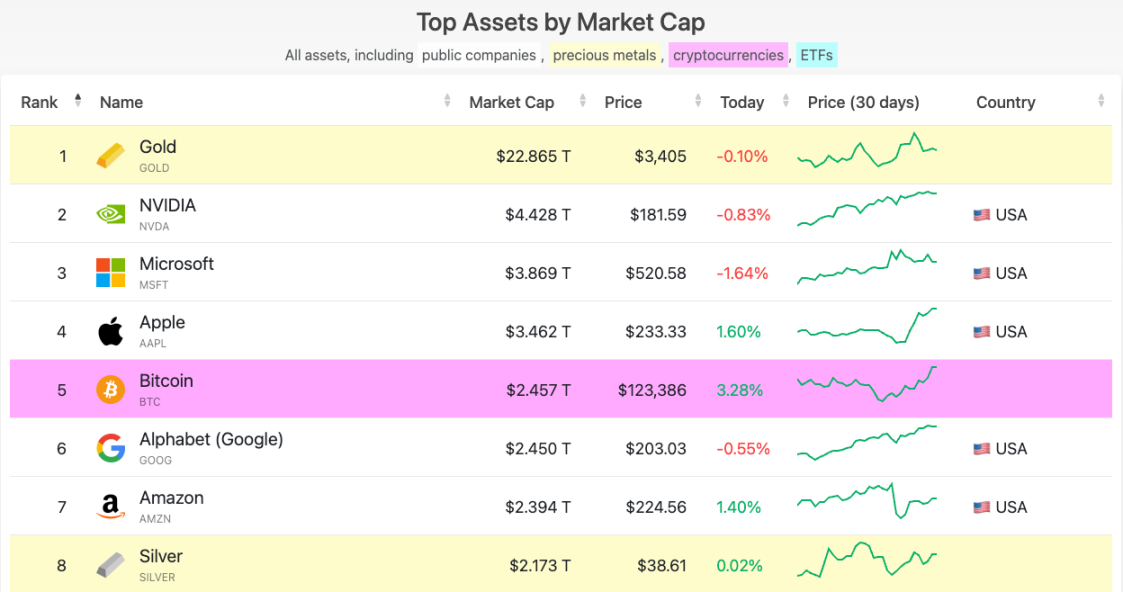
目前,比特币的市值(2.457 万亿美元)已超过谷歌(2.450 万亿美元)和亚马逊(2.394 万亿美元),成为全球第 5 大资产,仅落后于黄金、英伟达、微软和苹果。
宏观共振:降息预期与弱美元叙事

最新美国 7 月通胀数据符合预期,平息了市场对滞胀的担忧。根据 CME FedWatch 数据,美联储在 9 月 16-17 日会议上降息的可能性已从前一日的 95% 升至 100%,全年降息 75 个基点的概率超过 50%。

美国财政部长贝森特表示,考虑到就业数据疲软,他认为 9 月降息 50 个基点的可能性很大,而非传统的 25 个基点。他指出,劳工统计局最新数据将 5 月和 6 月的非农新增人数下修逾 25 万,如果当时就看到这些数字,「我们可能早在 6 月或 7 月就已经降息」。他还批评当前利率水平「过于严格」,建议在未来周期内下调 150-175 个基点,接近联储政策制定者认为的「中性」 水平。

降息预期直接降低现金持有的机会成本,推动资金从避险资产流向高收益品种。资金路径呈现典型扩散:先推高美股蓝筹,再流向小盘股和新兴市场,最终进入加密资产。近期美国罗素 2000 小盘股涨幅已明显领先大型科技股。

美元走势是另一核心变量。若后续数据和政策信号推动美元走弱,名义与实际利率将承压,推高以美元计价的风险资产估值。但这种假设仍需验证,未来的通胀与就业数据、美联储沟通基调、美债长端收益率的变化,都可能重新定价降息节奏与幅度。一旦预期落空,风险资产可能同步回调。

此外,美联储内部也在释放宽松信号。理事库克近期称,招聘放缓令人担忧,显示经济可能接近转折点;监管副主席鲍曼预计今年可能适合三次降息。这些表态叠加市场定价,强化了风险资产的乐观情绪。

外界还在关注美联储主席人选的不确定性。特朗普已将继任鲍威尔的候选名单扩大至 11 人,包括现任联储副主席杰斐逊、鲍曼、理事沃勒等,以及部分私营部门人士。尽管与短期行情关系有限,但这一变动可能影响中长期政策倾向。

机构买盘压过新增供给

在宏观环境为风险资产创造温床的同时,比特币自身的需求面貌也发生了根本改变。市场一度将 2025 年比特币的需求来源比作 ETF、企业与政府三驾马车。现在前两驾马车已全力启动,其力量足以抵消比特币网络自身的产出。

截至目前,比特币现货 ETF 年内合计购入约 183,126 枚比特币;全球上市公司增持约 354,744 枚。两项合计超过 53 万枚,而同期全网产出仅约 100,697 枚。供给被持续吸纳,是价格稳步上行的重要原因。

有意思的是,负责管理哈佛大学 530 亿美元捐赠基金的哈佛管理公司 HMC 在提交给美国 SEC 的文件显示,截至 6 月 30 日,其持有约 190 万股 IBIT,价值约 1.166 亿美元。使其成为该基金同期第五大投资,仅次于微软、亚马逊、旅游科技公司 Booking Holdings 和 Meta,略高于其对谷歌母公司 Alphabet 的投资。而同一时期 HMC 持有的 SPDR 黄金信托基金价值约为 1.02 亿美元,这使得比特币持股首度超越黄金,成为其投资组合中引人注目的配置。

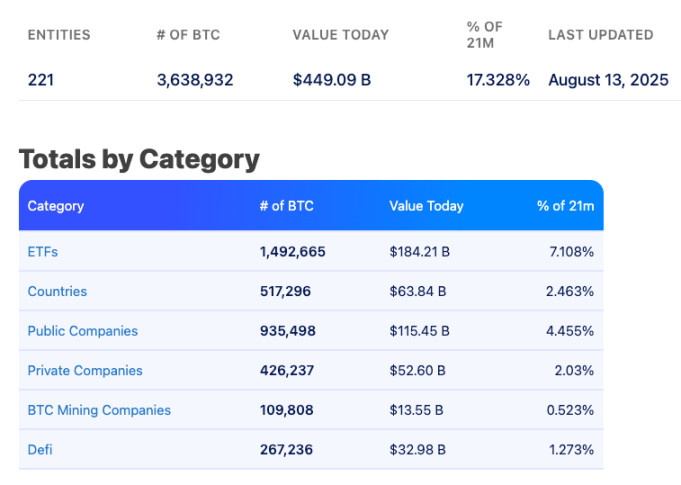
根据 Bitbo Treasuries 统计数据,截至 2025 年 8 月 14 日,共有 221 家机构实体持有比特币,持有数量约为 3,638,932 枚比特币,相当于全部 2100 万枚发行量的 17.328%,总市值约 4490.9 亿美元。其中,ETF 持仓占总量的 7.108%,上市公司占比约 4.455%,国家级机构占比 2.463%。
ETF 的意义在于渠道与机制。申赎体系与托管安排为合规资金提供可操作的载体,折价与溢价扰动收敛,增量资金可以按日净流入的节奏进入标的篮子。企业侧以资产负债表配置为核心,Strategy 的样本降低了会计处理与治理层面的顾虑,更多董事会把数字资产配置列入议程。政府层面的推进较慢,但方向明确:美国把执法没收所得纳入储备框架,海湾与亚洲主权资金在 ETF 披露中出现持仓记录。体量当下有限,却能稳定中长期预期。

逼近新高的 ETH,会带领山寨牛回归吗?

比特币吸引大部分注意力之际,ETH 价格已回升至 4788 美元,逼近 2021 年 11 月的历史高点 4,878 美元。推动这轮上涨的是企业财库增持与现货 ETF 资金流入的合力。

企业端,Tom Lee 的 BitMine 计划通过增发股票筹集至多 200 亿美元用于购入 ETH。该公司目前已持有约 115 万枚 ETH,占流通供应量的 1%,并公开目标是最终持有 5%。SharpLinkGaming 也在加码,目标是将其财库规模提升至 30 亿美元以上。资金端,自 2024 年 7 月上市以来,现货以太坊 ETF 已吸引净流入 94 亿美元,其中逾半数来自过去 30 天。本周一更录得首次单日净流入超 10 亿美元的纪录。Bitwise 估算,自今年 5 月以来,企业财库和 ETF 共吸纳的 ETH 数量是同期新增供应量的 32 倍,对市场供需关系形成显著压力。

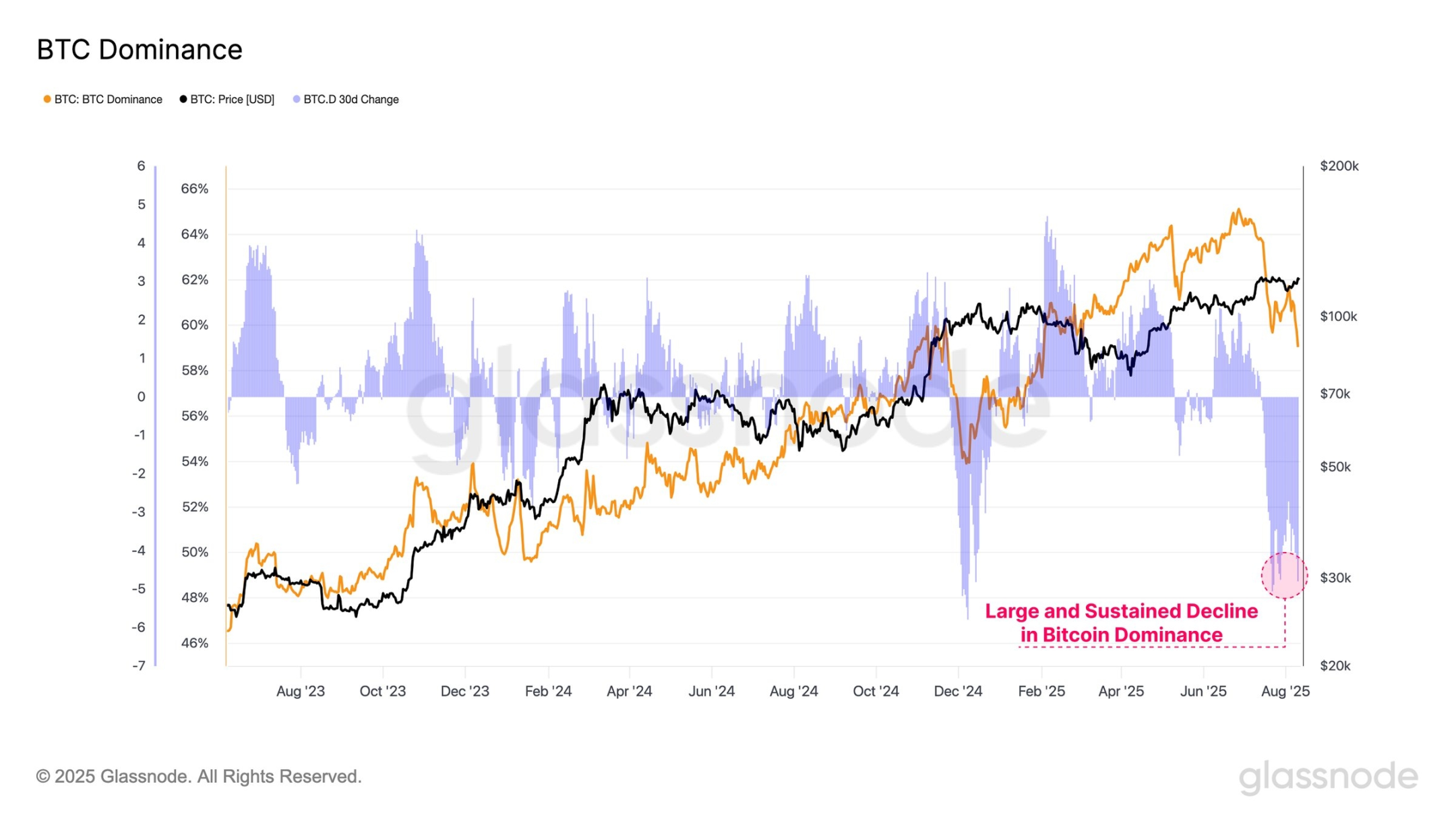
也有数据称,BTC 市值占比已从 65% 降至 59%,这凸显了在广泛的风险偏好行为背景下,山寨币吸引力日益增强。
此外,谷歌趋势图显示,山寨币「altcoin」搜索量创下五年来新高。
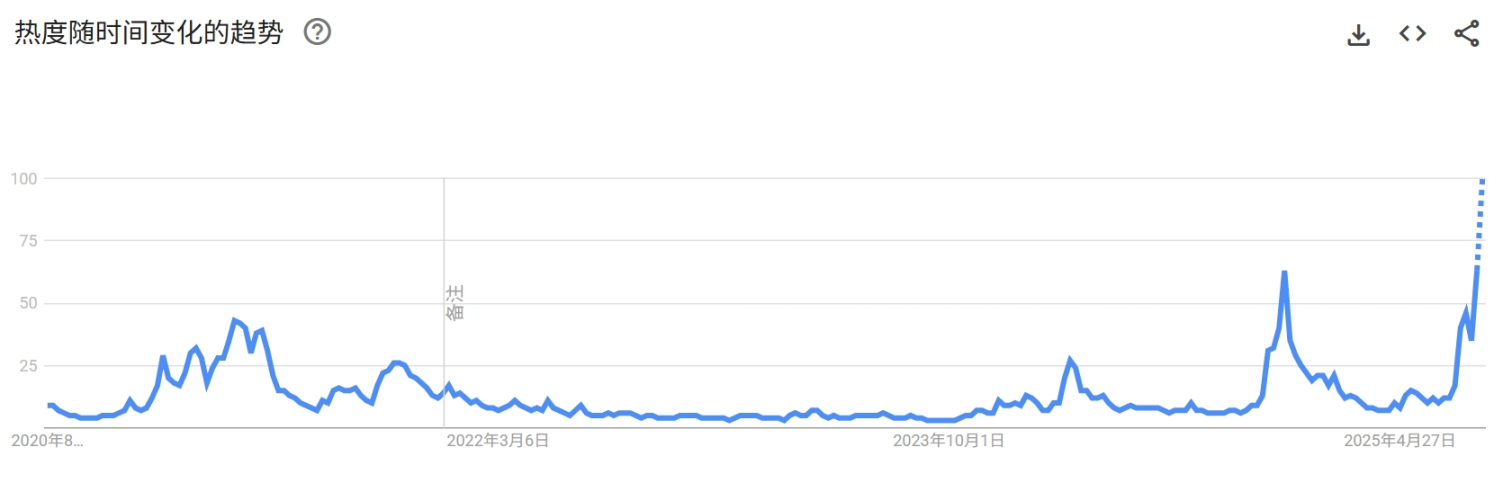
市场中那种对山寨牛市的期待与躁动几乎已无法掩饰。在许多投资者看来,历史的剧本早已写好,比特币冲锋,以太坊接力,随后便是万物复苏的盛宴。他们等待的,只是发令枪响的那一刻。

但很显然,本轮周期出现了显著偏差、BTC 主导地位持续走高,ETH 虽逼近新高,山寨整体表现依然低迷。喧嚣的预期之下,一个不容忽视的现实是,本轮周期的观众席和裁判席上,都坐满了新面孔。

这些手握巨额资金的机构参与者,其投资决策的逻辑与过往的散户截然不同。他们带来的可能不是一场不分你我的狂欢。因此即将到来的,或许并非记忆中的那场盛宴,而是一场需要凭实力入席的晚宴。

Related Reads

Three Years Later: Looking Back at My Predictions About ChatGPT in 2023

Three Years Later: Revisiting My 2023 Predictions on ChatGPT In March 2023, shortly after ChatGPT's launch, I made 20 predictions about its future. Now, in mid-2026, I've used AI agents to fact-check each one against the latest data. Overall, most major directional forecasts were correct, with only one outright error (incorrectly stating GPT-4 had 100 trillion parameters). Key successes included predicting that RAG and retrieval architectures would become the standard for handling knowledge and hallucinations, that natural language interfaces (LUI) would create a massive new industry layer beyond the models themselves, and that China would develop viable large language models, significantly closing the performance gap with Western counterparts within about three years. Predictions about the absence of mass unemployment, the rise of a new "robot network" for agent communication, and ChatGPT not possessing consciousness also held true in their core arguments. However, the "devil was in the details." Errors frequently involved specific numbers, timelines, or overlooking distributional effects. I tended to overestimate the speed of adoption (e.g., for agent networks) while underestimating the ultimate scale of capabilities or costs (e.g., AI winning IMO gold without tools, or the extreme capital required for frontier models). Other misjudgments included: underestimating how AI would reinforce, not dissolve, information filter bubbles; incorrectly assuming AI-generated content would easily circumvent copyright (it has instead triggered record-breaking settlements); and misidentifying where value would be captured (it accrued overwhelmingly to the compute layer, like Nvidia, not just the application or model layers). Key lessons from reviewing these predictions are: 1) Directional and mechanistic insights are far more reliable than precise numbers or absolute statements. 2) There's a consistent bias to overestimate short-term speed but underestimate long-term magnitude. 3) Errors often lie in missing distributional impacts within a generally correct aggregate trend. 4) Predictions phrased with nuance and caveats aged the best. 5) Some fundamental debates (e.g., on machine consciousness or the ultimate value chain) remain unresolved even after three years. This exercise is less about scoring the past and more about establishing rules for clearer thinking about the next three years of AI.

marsbit1h ago

Three Years Later: Looking Back at My Predictions About ChatGPT in 2023

marsbit1h ago

Three Years Later: Looking Back on My 2023 Predictions for ChatGPT

Looking Back After Three Years: Revisiting My 2023 Predictions on ChatGPT In March 2023, shortly after ChatGPT's debut and before GPT-4's release, I made over twenty predictions about AI's future based on limited information and intuition. Now, in May 2026, I revisited those forecasts using an AI-driven analysis with 41 Opus 4.8 agents to cross-reference them with the latest data. The assessment used symbols: ✅ Correct, 🟢 Mostly Correct, 🟡 Partially Correct, ❌ Incorrect. Overall, the directional judgments held up well, with only one major factual error regarding GPT-4's rumored parameter size (incorrectly cited as 100T). However, nuances and degrees of accuracy revealed more. **What Was Largely Correct:** Predictions about mechanisms and directions proved accurate. The rise of RAG (Retrieval-Augmented Generation) as the standard architecture for combating AI hallucination was confirmed, as was the transformative potential of LUI (Language User Interface) in creating a new industry layer atop GUIs. The emergence of "robot networks" (agent-to-agent communication protocols) and China's rapid catch-up in developing capable large models (closing the performance gap with top models to ~2.7%) were also on point. The analysis affirmed that LLMs lack consciousness and that the Turing Test merely measures perceived intelligence. **What Was Off Target:** Errors often involved specific numbers, over-optimistic timelines, or misjudged distributions. The prediction that value would primarily accrue to the application layer was half-right but missed NVIDIA's dominance as the profitable infrastructure layer. Forecasts about AI circumventing copyright issues and fostering a "global common ground" by averaging human viewpoints were incorrect; instead, major copyright settlements occurred and AI personalization is increasing. Estimates for model training costs ("$5-10 billion cap") were significantly off, underestimating frontier costs and overestimating replication costs. The notion that LLMs could never do complex math without tools was disproven by later models winning IMO gold. **Key Patterns from the Review:** 1. **Direction over precision:** Judgments about mechanisms and trends were more reliable than specific numbers or definitive statements. 2. **Timing bias:** There was a tendency to overestimate short-term speed but underestimate long-term magnitude and transformation. 3. **The distribution blind spot:** Aggregate-level correctness often masked uneven impacts (e.g., on young professionals' employment). 4. **The value of qualifiers:** Predictions framed with caution (e.g., "reportedly," "for now," "prototype in 2-3 years") aged better. 5. **Some debates continue:** Issues like the nature of "emergent abilities" or machine consciousness remain unresolved. This three-year review highlights that while seeing the big picture is crucial, humility regarding specifics, timelines, and disparate impacts is essential for future forecasting.

链捕手3h ago

Three Years Later: Looking Back on My 2023 Predictions for ChatGPT

链捕手3h ago

AI Bubble Warning: AI Investments Are Negative Returns for Most Tech Giants

The article issues a stark warning about a potential AI investment bubble. It notes that while the AI boom shares similarities with the TMT bubble of the late 1990s, its scale is vastly larger, currently driving 93% of U.S. GDP growth. Major hyperscale cloud providers like Microsoft, Alphabet, Amazon, Meta, and Oracle are planning to invest trillions in AI data centers over the coming years. However, calculations based on analyst projections for 2025-2030 reveal a concerning math problem: expected capital expenditure growth far outpaces projected revenue growth. Even under an extremely optimistic scenario of zero costs, the implied return on investment for most of these tech giants (except Amazon) is deeply negative. This suggests that the current trajectory could lead to one of history's largest shareholder value destruction events. The piece outlines two potential escapes: AI generating vastly more revenue than currently anticipated—a near-impossible task—or a significant cutback in the planned investment splurge. The latter scenario could trigger a domino effect, severely impacting the entire tech supply chain (from Nvidia to TSMC), potentially pushing the U.S. economy into recession, and causing a major stock market downturn. The author suggests upcoming high-profile IPOs by companies like OpenAI and Anthropic might represent a transfer of risk from early investors to public market participants. While the peak of the hype cycle might sustain investment through 2026, the fundamental financial dilemma remains unresolved, setting the stage for a potential market correction in 2027 or 2028, similar to the years following Alan Greenspan's "irrational exuberance" warning.

marsbit4h ago

AI Bubble Warning: AI Investments Are Negative Returns for Most Tech Giants

marsbit4h ago

From Tokens to Machine Labor: AI is Shifting from Tool to "Worker"

The article "From Token to Machine Labor: AI is Evolving from Tool to 'Worker'" argues that the business model for AI is shifting beyond simply selling computational resources (tokens, GPU hours) or model access. Instead, a new "machine labor market" is emerging, where the core economic transaction is the purchase of economically useful work directly performed by software. The central thesis is that AI pricing will evolve through four stages: 1) raw tokens, 2) standardized LLM capabilities (e.g., text generation), 3) industry-specific labor markets (e.g., legal review, radiology), and finally 4) a programmable results market where tasks like resolving a support ticket are bid on and priced based on outcome. In this future, buyers will care less about *which* model or GPU completes a task and more about whether the work meets specified standards for accuracy, latency, and cost. This transition reframes the impact of AI on human labor. Rather than simple replacement, it suggests a re-coordination where machines handle standardized, verifiable work, freeing humans for roles involving oversight, context management, responsibility, and final judgment. In some cases, this "last 1%" of human input becomes more valuable as it enables the other 99% to be automated. Furthermore, as AI reduces the cost of work, demand may expand, creating larger markets (e.g., 24/7 customer service) rather than just cheaper versions of existing ones. The article concludes that while infrastructure (GPUs, models, tokens) remains crucial upstream, the market is converging on a simpler, tradeable unit: machine labor that can be defined, measured, priced, and procured based on contractible specifications.

marsbit4h ago

From Tokens to Machine Labor: AI is Shifting from Tool to "Worker"

marsbit4h ago

Xiaomi MiMo's 99% Price Cut is Not Marketing! Luo Fuli Posts on X to Refute Critics

The price of Xiaomi's MiMo-V2.5 series API has been permanently reduced by up to 99%, specifically for the "Input (Cache Hit)" cost, which covers users re-reading historical context in long conversations. MiMo's head, Luo Fuli, published a detailed technical blog to clarify that this drastic price cut stems from genuine engineering breakthroughs, not a marketing stunt or a simple price war. The core of the achievement lies in six key engineering optimizations. First, the model architecture adopts a Hybrid Sliding Window Attention (SWA), reducing the memory footprint (KVCache) to 1/7th of a traditional model. Second, a dual-pool memory management system actually utilizes these savings, allowing a single GPU to handle over 5 times more concurrent users. Third, an upgraded prefix caching mechanism achieves a cache hit rate of 93-95% for repeated reads, meaning most such requests bypass GPU computation entirely. Fourth, a self-developed distributed cache (GCache) utilizes idle SSD space on existing GPU servers, eliminating additional storage costs. Fifth, an intelligent scheduling system (LLM-Router) efficiently routes requests to maximize cache reuse and performance. Sixth, Multi-Token Prediction (MTP) accelerates the model's text generation ("output") side. Together, these systemic optimizations dramatically lower the real computational cost per request, enabling the 99% price reduction for cached inputs while reportedly maintaining positive gross margins. Luo Fuli's disclosure aims to shift the narrative from "price war" to a demonstration of substantive AI engineering progress.

marsbit6h ago

Xiaomi MiMo's 99% Price Cut is Not Marketing! Luo Fuli Posts on X to Refute Critics

marsbit6h ago

Trading

Spot
Futures

Hot Articles

What is $BITCOIN

DIGITAL GOLD ($BITCOIN): A Comprehensive Analysis Introduction to DIGITAL GOLD ($BITCOIN) DIGITAL GOLD ($BITCOIN) is a blockchain-based project operating on the Solana network, which aims to combine the characteristics of traditional precious metals with the innovation of decentralized technologies. While it shares a name with Bitcoin, often referred to as “digital gold” due to its perception as a store of value, DIGITAL GOLD is a separate token designed to create a unique ecosystem within the Web3 landscape. Its goal is to position itself as a viable alternative digital asset, although specifics regarding its applications and functionalities are still developing. What is DIGITAL GOLD ($BITCOIN)? DIGITAL GOLD ($BITCOIN) is a cryptocurrency token explicitly designed for use on the Solana blockchain. In contrast to Bitcoin, which provides a widely recognized value storage role, this token appears to focus on broader applications and characteristics. Notable aspects include: Blockchain Infrastructure: The token is built on the Solana blockchain, known for its capacity to handle high-speed and low-cost transactions. Supply Dynamics: DIGITAL GOLD has a maximum supply capped at 100 quadrillion tokens (100P $BITCOIN), although details regarding its circulating supply are currently undisclosed. Utility: While precise functionalities are not explicitly outlined, there are indications that the token could be utilized for various applications, potentially involving decentralized applications (dApps) or asset tokenization strategies. Who is the Creator of DIGITAL GOLD ($BITCOIN)? At present, the identity of the creators and development team behind DIGITAL GOLD ($BITCOIN) remains unknown. This situation is typical among many innovative projects within the blockchain space, particularly those aligning with decentralized finance and meme coin phenomena. While such anonymity may foster a community-driven culture, it intensifies concerns about governance and accountability. Who are the Investors of DIGITAL GOLD ($BITCOIN)? The available information indicates that DIGITAL GOLD ($BITCOIN) does not have any known institutional backers or prominent venture capital investments. The project seems to operate on a peer-to-peer model focused on community support and adoption rather than traditional funding routes. Its activity and liquidity are primarily situated on decentralized exchanges (DEXs), such as PumpSwap, rather than established centralized trading platforms, further highlighting its grassroots approach. How DIGITAL GOLD ($BITCOIN) Works The operational mechanics of DIGITAL GOLD ($BITCOIN) can be elaborated on based on its blockchain design and network attributes: Consensus Mechanism: By leveraging Solana’s unique proof-of-history (PoH) combined with a proof-of-stake (PoS) model, the project ensures efficient transaction validation contributing to the network's high performance. Tokenomics: While specific deflationary mechanisms have not been extensively detailed, the vast maximum token supply implies that it may cater to microtransactions or niche use cases that are still to be defined. Interoperability: There exists the potential for integration with Solana’s broader ecosystem, including various decentralized finance (DeFi) platforms. However, the details regarding specific integrations remain unspecified. Timeline of Key Events Here is a timeline that highlights significant milestones concerning DIGITAL GOLD ($BITCOIN): 2023: The initial deployment of the token occurs on the Solana blockchain, marked by its contract address. 2024: DIGITAL GOLD gains visibility as it becomes available for trading on decentralized exchanges like PumpSwap, allowing users to trade it against SOL. 2025: The project witnesses sporadic trading activity and potential interest in community-led engagements, although no noteworthy partnerships or technical advancements have been documented as of yet. Critical Analysis Strengths Scalability: The underlying Solana infrastructure supports high transaction volumes, which could enhance the utility of $BITCOIN in various transaction scenarios. Accessibility: The potential low trading price per token could attract retail investors, facilitating wider participation due to fractional ownership opportunities. Risks Lack of Transparency: The absence of publicly known backers, developers, or an audit process may yield skepticism regarding the project's sustainability and trustworthiness. Market Volatility: The trading activity is heavily reliant on speculative behavior, which can result in significant price volatility and uncertainty for investors. Conclusion DIGITAL GOLD ($BITCOIN) emerges as an intriguing yet ambiguous project within the rapidly evolving Solana ecosystem. While it attempts to leverage the “digital gold” narrative, its departure from Bitcoin's established role as a store of value underscores the need for a clearer differentiation of its intended utility and governance structure. Future acceptance and adoption will likely depend on addressing the current opacity and defining its operational and economic strategies more explicitly. Note: This report encompasses synthesised information available as of October 2023, and developments may have transpired beyond the research period.

363 Total ViewsPublished 2025.05.13Updated 2025.05.13

What is $BITCOIN

Discussions

Welcome to the HTX Community. Here, you can stay informed about the latest platform developments and gain access to professional market insights. Users' opinions on the price of BTC (BTC) are presented below.

活动图片