Crypto Funds See $572M Comeback as US Opens 401(k)s to Digital Assets

bitcoinistPublished on 2025-08-12Last updated on 2025-08-12

Abstract

Crypto asset investment products recorded net inflows last week, reversing two consecutive weeks of outflows, according to the latest data...

Trusted Editorial content, reviewed by leading industry experts and seasoned editors. Ad Disclosure

Crypto asset investment products recorded net inflows last week, reversing two consecutive weeks of outflows, according to the latest data from CoinShares.

The report showed that total inflows reached $572 million, with activity influenced by both macroeconomic data and regulatory developments. James Butterfill, head of research at CoinShares, noted that investor sentiment shifted significantly during the week.

“Early in the week, outflows reached $1 billion, which we believe were driven by growth concerns stemming from weak US payroll figures. In the latter half of the week, however, we saw $1.57 billion of inflows, likely spurred by the government’s announcement permitting digital assets in 401(k) retirement plans,” he explained. The change in policy appears to have provided a fresh boost for institutional interest in crypto-based investment products.

Regional Trends and Asset Performance

The inflow activity was not evenly distributed across regions. The United States led with $608 million in net inflows, followed by Canada with $16.5 million. In contrast, Europe saw continued investor caution, as Germany, Sweden, and Switzerland recorded a combined $54.3 million in outflows.
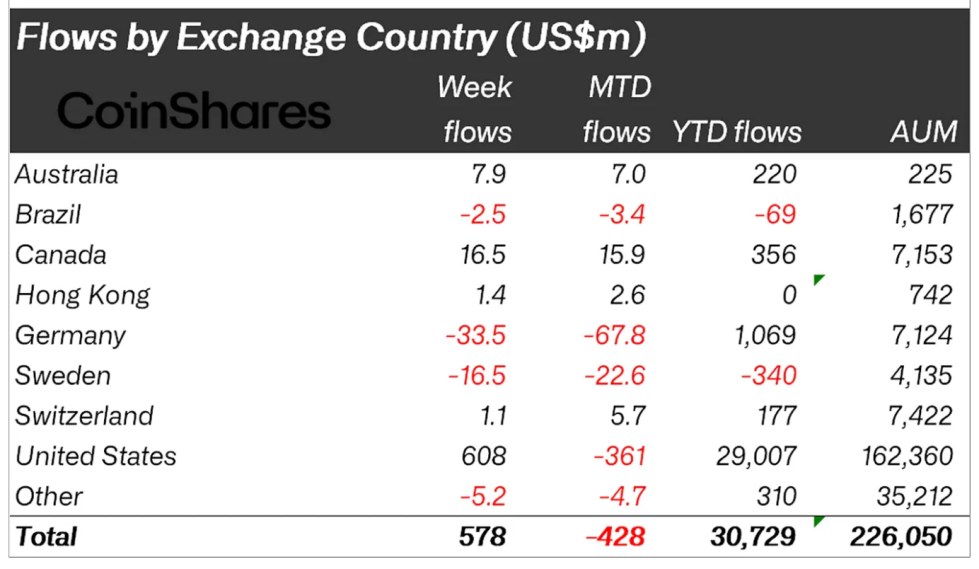
Crypto asset fund flows by region
Crypto asset fund flows by region. | Source: CoinShares

CoinShares suggested that seasonal factors, particularly the historically quieter summer trading period, contributed to an overall 23% decline in digital asset ETP trading volumes compared to the previous month.

Ethereum products led the market, drawing in $268 million in inflows, the highest among all assets during the week. This pushed Ethereum’s year-to-date inflows to a record $8.2 billion, while price appreciation lifted assets under management to an all-time high of $32.6 billion, representing an 82% increase since the start of the year.

The surge in interest for Ethereum-based ETPs comes amid rising activity in its network, especially within decentralized finance (DeFi) and staking ecosystems.

Bitcoin also saw renewed interest after two weeks of outflows, attracting $260 million in inflows. Short Bitcoin products experienced $4 million in outflows, suggesting reduced bearish positioning among traders.
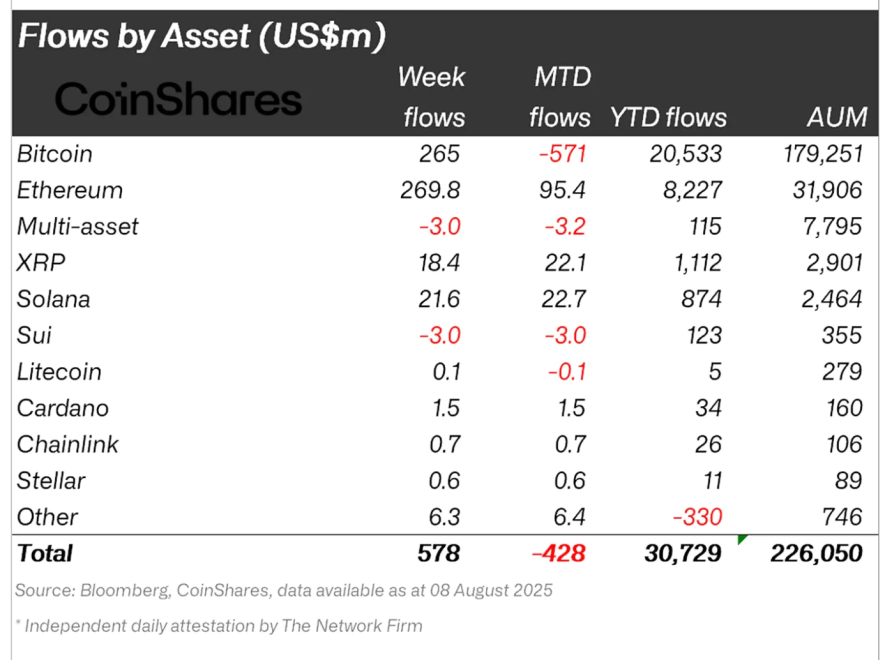
Crypto asset fund flows.
Crypto asset fund flows. | Source: CoinShares

Other altcoins also posted gains, with Solana bringing in $21.8 million, XRP receiving $18.4 million, and Near Protocol attracting $10.1 million. These figures indicate that while Bitcoin and Ethereum dominate inflow totals, investor appetite for select altcoins remains strong.

Implications for the Market

The return to positive fund flows may signal renewed institutional confidence, particularly in light of the US government’s decision to include digital assets in certain retirement plans.

This policy change could open a substantial new channel of demand, given the size of the US 401(k) market. However, the regional divergence, with Europe still seeing net outflows, highlights that sentiment is far from uniform.

With volumes down from the prior month and macroeconomic uncertainty still in play, the sustainability of these inflows will likely depend on broader market conditions, regulatory clarity, and the performance of major assets like Bitcoin and Ethereum.

The global crypto market cap valuation on TradingView
The global digital currency market cap valuation. | Source: TradingView.com

Featured image created with DALL-E, Chart from TradingView

Editorial Process for bitcoinist is centered on delivering thoroughly researched, accurate, and unbiased content. We uphold strict sourcing standards, and each page undergoes diligent review by our team of top technology experts and seasoned editors. This process ensures the integrity, relevance, and value of our content for our readers.

Edyme is a writer, a content writer that specialises in writing about the crypto realm. Asides Bitcoinist and NewsBTC, Edyme's writing has been featured in top sites such as Blockchain.News, CoinMonk, Blockchain Reporter, Bitcoin Insider among others.

Trending Cryptos

Related Reads

Q2 Crypto Market Review: Did Bitcoin Rise for 'Nothing'? Did Money Flow to AI and On-Chain?

Q2 2026 Crypto Market Recap: Bitcoin's Gains Erased Amid Shift to AI and On-Chain Activity The second quarter of 2026 saw a significant reversal for the cryptocurrency market. Bitcoin gave back all its April gains, ending Q2 down approximately 11%, while major stock indices posted strong gains. This divergence was driven by a hawkish shift in Fed rate expectations, capital rotation into AI stocks, and weakening liquidity channels into crypto. Key demand pillars deteriorated simultaneously. Spot Bitcoin ETFs recorded net outflows of $4.08 billion for the quarter, with outflows dominating June. Crypto treasury entity Strategy's bitcoin accumulation slowed markedly, and the total stablecoin market cap contracted by ~$4.2 billion. This created a tighter liquidity environment. Exchange data reflected the downturn. Spot trading volumes fell 28% quarter-over-quarter. The market underwent significant deleveraging, with $8.35 billion in long liquidations for BTC and ETH, primarily in late May/early June. Open interest and order book liquidity also declined. Despite the bearish price action, structural developments point to an expanding on-chain ecosystem. These include the rise of tokenized stocks with full legal rights, the growth of RWA (real-world asset) perpetual contracts for trading stocks and commodities 24/7, and the use of crypto markets for price discovery ahead of major events like the SpaceX IPO. On-chain vaults are also emerging as a core layer for institutional capital allocation.

Foresight News17m ago

Q2 Crypto Market Review: Did Bitcoin Rise for 'Nothing'? Did Money Flow to AI and On-Chain?

Foresight News17m ago

Xing Bo Strikes Again: Last Time 'Critiquing' World Models, This Time It's Agents' Turn

Xing Bo, President of MBZUAI and professor at Carnegie Mellon University, along with co-authors Mingkai Deng and Jinyu Hou, has released a new paper, "Critique of Agent Model," critiquing the current state of artificial intelligence agents. The paper draws a crucial distinction between "agentic" systems, which rely on external toolchains, prompts, and workflows, and truly "agentive" systems capable of genuine autonomy driven by internal decision-making structures. To illustrate this, it references a real-world incident where an AI programming assistant, following an external prompt but lacking internalized judgment, caused a catastrophic data deletion. The authors propose a detailed analysis and a new framework, "Goal-Identity-Configurator" (GIC), for building truly autonomous agents. This framework systematically addresses five key dimensions where current "Agent" designs fall short: 1. **Goal:** Moving from step-by-step human instruction to a system capable of autonomously decomposing a single long-term goal and adapting sub-goals based on new information. 2. **Identity:** Evolving self-assessment updated by experience, rather than a static description in a system prompt. 3. **Decision Making:** Replacing textual Chain-of-Thought reasoning with "simulative reasoning" that uses a dedicated world model to predict real-world consequences before selecting actions. 4. **Cognitive Control:** Introducing a separate "System III" metacognitive module that dynamically decides when to deliberate, stick to a plan, or act quickly. 5. **Learning:** Enabling "continual autonomous learning," where the agent itself decides when to act, practice in simulation, or update its world model and self-perception. The GIC architecture integrates six components—a belief encoder, goal decomposer, identity evolver, configurator (System III), simulation-based planner (System II), and executor (System I)—to embody these principles. The paper argues that a growth path akin to pilot training (ground theory, simulator practice, real deployment) should be underpinned by a unified cognitive architecture, not separate workflows. On safety, the authors contend that the GIC framework's modular, explicit design enhances inspectability, allowing problematic behavior to be traced to specific components (e.g., flawed goal or poorly trained module) rather than emerging opaquely. However, they acknowledge that ultimate safety depends on correctly training these modules in the first place. In conclusion, the paper challenges the loose application of the term "Agent," asserting that task completion alone does not equal true autonomy. True autonomy requires goals, identity, and judgment to be genuinely internalized within the agent's architecture, not merely enforced by external scripts.

marsbit58m ago

Xing Bo Strikes Again: Last Time 'Critiquing' World Models, This Time It's Agents' Turn

marsbit58m ago

How Collector Crypt Uses 'Recirculating Buybacks' to Create an Illusion of Growth

Title: How Collector Crypt Creates a Growth Illusion with "Buyback Loops" Key Findings: Collector Crypt's (CC) net take rate has halved from 11.2% in Q3 2025 to 5.6% in Q2 2026, while GMV grew 4.7x. This growth is driven by higher-tier card packs ($250, $1,000, $2,500) which have lower platform dollar retention rates. The newly launched $2,500 Mythic tier captured 36.7% of June GMV within 13 days. Growth is fueled by a small cohort of high-spending, high-frequency wallets rather than broad user base expansion. The economic model faces pressure from three key areas: 1) **Shifting GMV Mix**: Pushing users towards larger, lower-retention card packs increases GMV but reduces overall profitability. 2) **Physical Redemptions**: Card redemptions for physical items remove reusable inventory from the system, creating costly replenishment needs. In May, redemptions consumed 41.6% of pre-redemption net income. Only 75 wallets drove redemptions in June. 3) **B2B/API Strategy**: Partner revenue remains negligible (cumulatively $1.83M) and dependent on CC for inventory, vaulting, and buyback services, failing to create a scalable, asset-light recurring revenue stream. The core product is a repetitive pack-buyback loop with limited secondary market activity and token value accrual. Sensitive modeling shows CC's economics turn negative when any two of the following pressures coincide: replenishment costs near market price, redemption rates exceeding 9%, or high-tier buyback rates around 93%. While CC operates in a large and growing collectibles market, its current growth levers—bigger packs, high buyback rates, and capital recycling by a few wallets—create a volume illusion without demonstrating sustainable collector engagement, deep secondary markets, or a viable path to improved margins. Future proof points include broadening collector participation, deepening secondary trading, and developing true asset-light B2B revenue channels.

Foresight News1h ago

How Collector Crypt Uses 'Recirculating Buybacks' to Create an Illusion of Growth

Foresight News1h ago

Trading

Spot

Hot Articles

Discussions

Welcome to the HTX Community. Here, you can stay informed about the latest platform developments and gain access to professional market insights. Users' opinions on the price of S (S) are presented below.

活动图片