NFT Sales Drop 26% Following Bullish Week, CryptoPunks Dominant

ccn.comPublished on 2025-08-07Last updated on 2025-08-11

Key Takeaways
  • NFT sales volumes have surpassed $165 million in the past 7 days.
  • A CryptoPunk NFT was sold for more than $2.5 million last week.
  • NFTs have recorded over $71.5 billion in lifetime sales volumes since 2017.

The non-fungible token (NFT) market has seen a steep decline in sales volumes following a bullish uptick in interest in crypto’s digital collectibles.

With CryptoPunks and others drawing in millions over the past month, are NFTs finally back in action?

NFTs Trade

NFT sales volumes have shrunk 26% in the past 24 hours after a weeklong bull run saw a week-on-week increase of 20% (roughly $33 million) for the digital collectibles market.
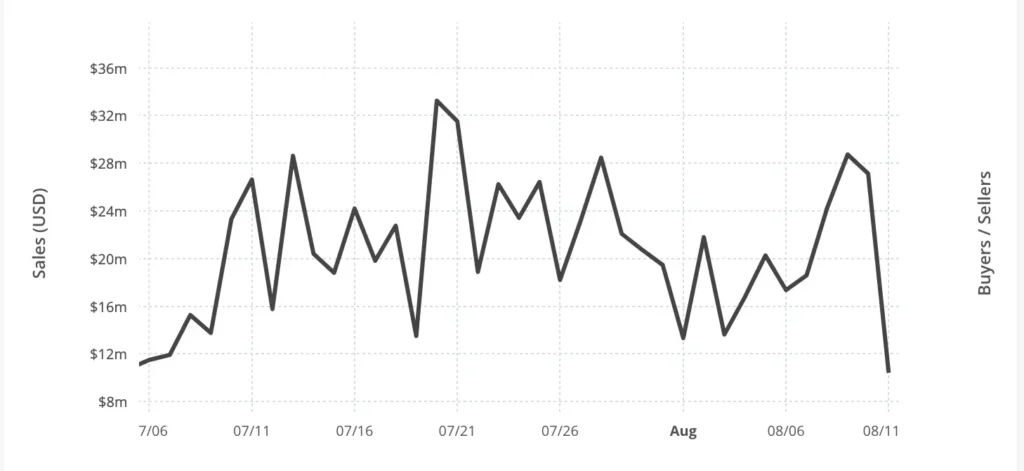
NFT sales volumes drop. | Source: CryptoSlam.

The CryptoPunks collection, which some believe will outperform Ethereum (ETH) this cycle, relished a sturdy 9.94% increase in sales volumes over the past week, amounting to $20.36 million with a 43% increase in buyers.

Courtyard, a platform that tokenizes physical, graded copies of cards from various trading card games (TCGs) such as Pokémon and Magic: The Gathering (MTG), tallied a massive 24% gain over the past week, recording $14.8 million in sales across 11,203 buyers and 178,456 transactions.

The Bored Ape Yacht Club (BAYC) also relished in sturdy gains last week, jumping a modest 1.17% to just over $6 million, a 52% increase in transactions, and a 47% increase in buyers.

In Recovery?

Looking at the bigger picture, NFT sales volumes, buyers, and sellers have continued on a sustained downward slope following their 2021/2022 highs, which reinforces the bearish narrative that NFTs are “dead”.
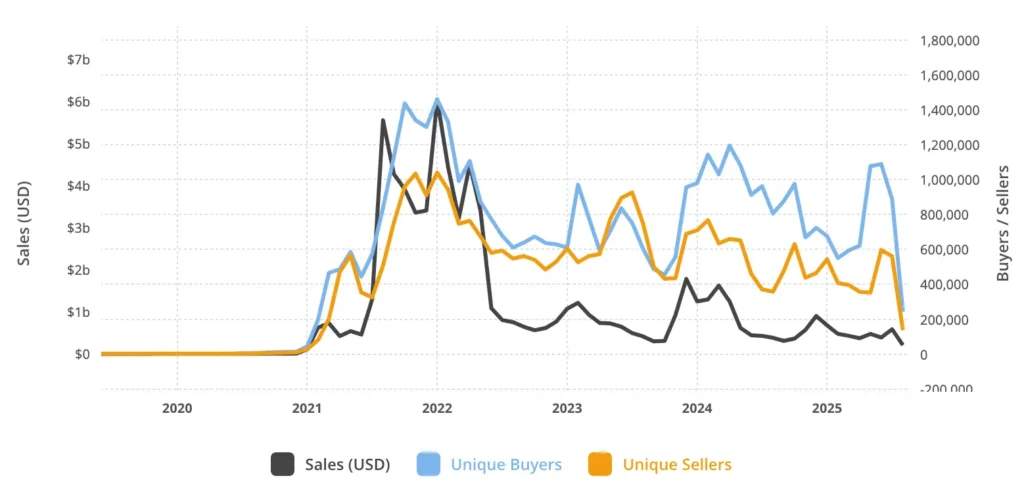
NFT markets over the years. | Source: CryptoSlam.

However, with the recent uptick in crypto markets, namely Ethereum (ETH), digital collectibles have seen a modest 1.56% increase in sales volumes in the past 30 days, which is coupled with a 35% increase in trade profit at $5.7 million.

Looking a little deeper, the average NFT sale price has also increased in the past 30 days. In fact, it’s jumped 99.96% to $105, suggesting that floor prices are also on the up.

That said, CryptoPunks sales are disproportionately affecting these figures with a $2.5 million sale last week, and more than a dozen others selling for anywhere between $250,000 and $500,000.

Was this Article helpful? Yes No

Related Reads

Solana Expands Validator Power With Launch of On-Chain Governance

Solana has formally launched its on-chain governance system, empowering token holders and validators with a more open and decentralized way to influence major protocol decisions. Governance debates and voting are now conducted entirely on-chain using the new Solana Governance Proposals (SGP) framework, supported by stake-weighted voting and cryptographic verification. Validators with at least 100,000 SOL in delegated stake can submit an SGP. To proceed to a formal vote, a proposal must first gain support from at least 15% of the network's total staked SOL, ensuring only ideas with significant backing move forward. SGPs serve a distinct purpose from the technical Solana Improvement Documents (SIMDs). While SIMDs focus on *how* to implement protocol upgrades, SGPs determine *whether* the broader ecosystem believes a proposal should proceed, via an on-chain, stake-weighted vote. This separation allows core developers to continue building effectively while reserving community-wide votes for impactful decisions. A key feature grants delegators greater control: they can now override their validator's governance vote. If a validator votes against a delegator's preference or abstains, the delegator can cast a vote directly using their own stake weight through Solana's governance portal. The voting process is secured using Merkle proofs to verify participant stakes against an on-chain consensus snapshot. With this implementation, Solana aims to broaden community participation in governance without hindering development, combining decentralized decision-making with efficient protocol evolution.

TheNewsCrypto19m ago

Solana Expands Validator Power With Launch of On-Chain Governance

TheNewsCrypto19m ago

Trillion-Won Bet on Semiconductors: Is South Korea Really Panicking This Time?

**Summary:** South Korea, traditionally adept at "counter-cyclical" investments during industry downturns, has launched an unprecedented trillion-dollar (approximately 6.4 trillion RMB) semiconductor investment plan during a current AI-driven boom. This shift signals deep strategic anxiety, driven by the rapid rise of China's memory chip challengers. The article traces this dynamic through the history of East Asian semiconductor competition. In the 1980s, Japan used a "national system + industrial capital" model to surpass the US in DRAM, only to be overtaken in the 1990s by South Korea employing the same aggressive, efficiency-focused tactics—most notably massive, loss-tolerant investments during downturns to crush competitors like Japan's Elpida. Now, China's memory giants, Yangtze Memory (YMTC) and ChangXin Memory Technologies (CXMT), are employing a strikingly similar playbook. Starting from near-zero a decade ago, they've used a combination of government-backed capital, strategic technology acquisition (e.g., CXMT leveraging Qimonda's legacy), and innovative architectural leaps (e.g., YMTC's Xtacking) to achieve rapid technological catch-up. Crucially, during the severe industry downturn of 2023, while Korean and US giants cut production, the Chinese firms expanded capacity and competed on price, rapidly gaining global market share (reaching ~11% in NAND and ~7.67% in DRAM by 2025). South Korea's current massive investment, therefore, is a defensive move born of fear. The historical pattern suggests that once a technological gap closes, scale and integrated supply chain advantages—areas where China holds significant potential—can determine the leader. Having used counter-cyclical strategies to become the incumbent, South Korea now faces the prospect of a formidable challenger using those very same tactics. This investment marks not just a bet on the AI cycle, but the opening chapter in a new battle for dominance in the memory industry.

marsbit29m ago

Trillion-Won Bet on Semiconductors: Is South Korea Really Panicking This Time?

marsbit29m ago

Trading

Spot
活动图片