Crypto Industry Split Between Congress’s Versions Of Market Structure Bill – Here’s Why

bitcoinistPublished on 2025-08-08Last updated on 2025-08-08

Abstract

As the US Congress continues to work on crypto-related legislation, some industry leaders disagree on which version of the market...

Trusted Editorial content, reviewed by leading industry experts and seasoned editors. Ad Disclosure

As the US Congress continues to work on crypto-related legislation, some industry leaders disagree on which version of the market structure bill will provide the much-needed clarity to the sector.

Paradigm Champions Senate’s Crypto Bill

On Thursday, several industry players discussed the differences between the US Congress’s versions of one of the landmark crypto bills. Following the passage of the GENIUS Act, the sector is now focused on the key market structure legislation, which is expected to offer the long-awaited clarity and protection for the industry.

Notably, the House of Representatives introduced and already passed the Digital Asset Market Clarity (CLARITY) Act of 2025, which seeks to establish a regulatory framework for crypto assets in the US, facilitate the growth of crypto projects, and protect customers.

In June, the US Senate started working on principles for its version of the market structure legislation, looking to draft a comprehensive set of rules. As reported by Bitcoinist, the Senate Banking Committee released a draft of its “framework of principles,” outlining six key principles for the upcoming crypto bill, which were allegedly “very well received” by the Decentralized Finance (DeFi) sector.

Today, Paradigm’s General Partner, Dan Robinson, shared the firm’s response to the Senate Banking Committee’s discussion draft on the bill, suggesting that this version is the best approach. Chainlink Labs, Galaxy Digital, Tribe Capital, Multicoin Capital, Electric Capital, and Ribbit Capital co-signed the letter.

Robinson argued that while both bills are an “improvement on the Howey-based regime (…), the Senate draft is significantly simpler, and avoids forcing decentralized tokens and protocols to fit themselves into an inflexible legislative framework.”

The lawyer explained that the Senate’s draft focuses on the concept of ancillary assets, which “distinguishes the typical crypto asset from securities due to its innate nature.” To the firms, this is the “cleanest test” that protects decentralized crypto assets while preventing traditional securities issuers from improperly exploiting this framework.

Paradigm’s VP of Regulatory Affairs added that if regulatory clarity involves replacing the current “inscrutable regime that no one can register under or operate in with another complex regime that requires a phalanx of lawyers & millions of dollars to comprehend, this exercise will have failed.”

Industry Players Divided Over Legislation

In an X post, journalist Eleanor Terret noted that most of the major crypto Venture Capital (VC) firms, except a16z crypto, “aligned on market structure and token classification for the first time.”

Nonetheless, a16z crypto’s Head of Policy and General Counsel, Miles Jennings, disagreed, stating “most major crypto hedge funds is more accurate. Most major crypto VCs supported CLARITY’s token maturity framework.”

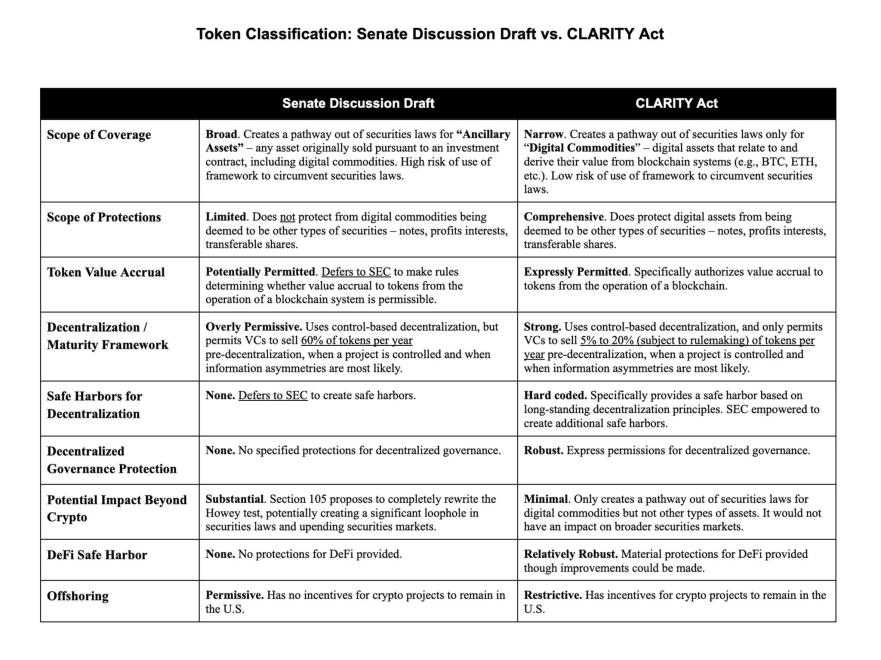
Jennings highlighted the Decentralization Research Center’s (DRC) summary chart comparing the Senate and House’s versions, arguing that “the undermining of CLARITY’s transfer restriction framework creates short-term incentives to circumvent decentralization and dump on retail. That’s not good for innovation.”
crypto

Difference between the Senate's discussion draft and the House's CLARITY Act. Source: The DRC on X

Earlier this week, the DCR also submitted its response to the Senate Banking Committee’s discussion draft, underscoring the importance of “building on the strong foundation established by the CLARITY Act.” The non-profit organization considers that while the Senate’s version is still evolving, the House’s “robust, control-based decentralization test” is the better approach.

Last month, the DCR and 50 other leading industry players sent a joint letter to Congress leaders supporting the CLARITY Act, the largest coalition of organizations in agreement on a particular test for decentralization, as the post noted.

Additionally, the non-profit affirmed that “sound market structure legislation must be grounded in control” and regulatory attention must focus on where it is warranted, while “preserving space for innovation and open systems.”

Similarly, attorney Gabriel Shapiro concurred that “the House approach is far superior.” To him, the Senate’s test is a “pure race to the bottom” with “stuff that makes no sense from a policy perspective.”

The fewer rights people have, the less regulated something is? it should be the opposite–if they have more rights, they are more protected under general contract law and there is less need for regulation. . . this is how you get pure memecoin mania forever, equity/token conflict of interest forever, etc. . .
crypto, Bitcoin, btc, btcusdt

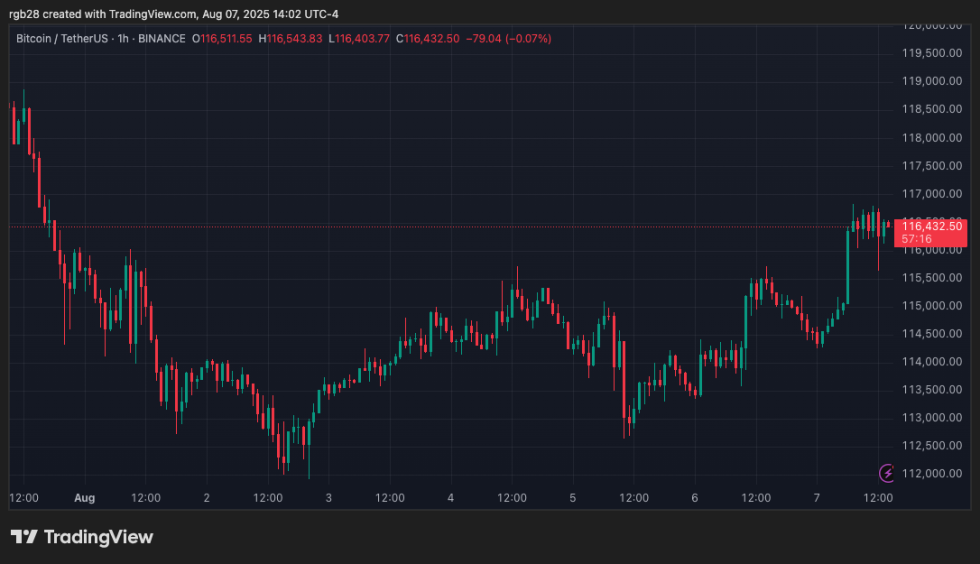
Bitcoin (BTC) traders at $116,432 in the one-week chart. Source: BTCUSDT on TradingView
Featured Image from Unsplash.com, Chart from TradingView.com
Editorial Process for bitcoinist is centered on delivering thoroughly researched, accurate, and unbiased content. We uphold strict sourcing standards, and each page undergoes diligent review by our team of top technology experts and seasoned editors. This process ensures the integrity, relevance, and value of our content for our readers.

Rubmar is a crypto enthusiast who likes learning and improving constantly. She enjoys reporting on the latest news and developments in the crypto industry. Rubmar also enjoys scrapbooking, crafting, simulation games, and watching football.

Related Reads

Robinhood Chain Mainnet Goes Live: Can Stocks Finally Be Moved Into Wallets?

Robinhood has officially launched its public mainnet, Robinhood Chain, along with stock-like tokens, the USDG yield product, and a DeFi lending portal. This marks a significant shift where a major online broker is integrating its user interface, regulatory compliance, self-custody wallet, and on-chain protocols into a single, streamlined experience. The goal is to simplify access to stock exposure, stablecoin yields, collateralized lending, and AMM trading for mainstream users. Eligible non-U.S. users can hold these "Stock Tokens"—structured as tokenized debt securities—in the Robinhood Wallet for 24/7 exposure to assets like U.S. stocks or ETFs. U.S. users can access an estimated ~7% APY on dollar-backed USDG through the Robinhood Earn program via self-custody wallets, with lending infrastructure powered by Morpho protocol. Built as a Layer 2 on Arbitrum, Robinhood Chain leverages existing DeFi protocols like Uniswap. The core strategy is not to reinvent DeFi but to channel Robinhood's large traditional finance user base (27.4 million funded customers as of Q1 2026) into on-chain finance, lowering the technical barriers. However, key limitations exist. The stock tokens are not direct equity ownership and are unavailable in the U.S. and some jurisdictions due to regulatory constraints. The ~7% yield is variable and carries inherent DeFi risks, not guaranteed principal protection. Furthermore, while AMMs enable trading, price discovery for major stocks will likely remain anchored in traditional markets like NASDAQ for the foreseeable future. Ultimately, Robinhood Chain is an early experiment in "on-chain brokerage." Its success will depend on real-world metrics like trading volume, sustained user migration to self-custody, stable yield performance, and regulatory feedback, rather than its launch narrative.

marsbit3m ago

Robinhood Chain Mainnet Goes Live: Can Stocks Finally Be Moved Into Wallets?

marsbit3m ago

Circle CEO Responds to OUSD Challenge: Stablecoin Market Is 'Winner-Takes-All', Consortium Model Doomed to Fail

Circle CEO Jeremy Allaire addresses market concerns following the announcement of the Open USD (OUSD) stablecoin project backed by 140 global companies. Allaire argues the stablecoin market exhibits "winner-takes-all" dynamics due to powerful network effects. He cites USDC's near-decade lead in three key areas: 1) **Application Integration & Protocol Development**: Thousands of integrated services and protocols (like CCTP) create utility and lock-in for developers and users. 2) **Liquidity Network Effects**: A deeply embedded, globally distributed liquidity infrastructure across primary and secondary markets, built over years. 3) **Regulatory Integration**: Extensive licensing and compliance groundwork ensuring USDC's acceptance in major markets like Europe and Japan. Allaire challenges OUSD's proposed advantages. He contends that promises of free redemption, while appealing, face market realities where such models can become exit routes for other stablecoins. He also questions the feasibility of fully distributing all revenue to an alliance, stating it would "starve" the critical infrastructure investments needed for scale and utility. Furthermore, he expresses skepticism about large alliance governance models, noting they often lead to slow decision-making and misaligned incentives. While welcoming OUSD to the ecosystem, Allaire reaffirms confidence in USDC's dominant position, backed by its long-term infrastructure investments and strong partnerships, including its ongoing collaboration with Coinbase.

marsbit5m ago

Circle CEO Responds to OUSD Challenge: Stablecoin Market Is 'Winner-Takes-All', Consortium Model Doomed to Fail

marsbit5m ago

Circle CEO Responds to OUSD Challenge: Alliance Model Doomed to Fail, It's a 'Winner-Takes-All' Game

Circle CEO Jeremy Allaire addresses the challenge posed by the new Open USD (OUSD) stablecoin project, backed by 140 global companies. He argues that the stablecoin market exhibits "winner-take-all" characteristics, where USDC's near-decade-long lead in application integrations, global liquidity, and regulatory compliance secures its dominant position. Allaire outlines three key network effects underpinning USDC's strength: 1) Extensive integration as an internet protocol layer, 2) Deep, globally distributed liquidity networks, and 3) Deep integration with global policy and regulatory frameworks. He cites data showing USDC facilitated 80% of on-chain USD stablecoin transaction volume in Q1 2026. He directly counters OUSD's proposed advantages: 1) "Free minting and redemption" may not be sustainable against market realities, which USDC addresses via contractual mechanisms. 2) "Sharing all revenue" risks starving the infrastructure of necessary investment for growth and reliability. 3) A "consortium model" often leads to slow innovation and poor coordination compared to focused, independent operators like Circle. Allaire reaffirms Circle's strong partnership with Coinbase and notes that Circle continues to collaborate with many OUSD founding members. He concludes by welcoming OUSD to the ecosystem while expressing confidence in USDC's entrenched network advantages and continued expansion.

Odaily星球日报8m ago

Circle CEO Responds to OUSD Challenge: Alliance Model Doomed to Fail, It's a 'Winner-Takes-All' Game

Odaily星球日报8m ago

dYdX Changes Tack and Starts Anew, This Time Partnering with Robinhood: Will It Succeed?

On July 1st, dYdX Labs, in partnership with Robinhood Crypto, launched the Beta version of Arcus, a new decentralized exchange (DEX). Deployed on the newly launched Robinhood Chain (an L2 built on Arbitrum), Arcus supports spot trading for 95 tokenized stocks and plans to introduce cross-asset perpetual contracts. This marks a separate, new product line for the dYdX team, distinct from the existing dYdX Chain. Arcus's core features promise 24/7 trading, self-custody, and institutional-grade liquidity. Initial offerings include zero-fee web-based spot trading and a perpetual contracts testnet. Future plans involve using tokenized stocks as collateral and providing access to Pre-IPO investments. The platform is not available to users in the US, Canada, the UK, and other restricted jurisdictions. This move follows dYdX's v4 upgrade, which, while achieving full decentralization, faced criticism over performance and tokenomics, leading to a loss of market share. Arcus represents a strategic pivot, leveraging Robinhood's vast user base to target the RWA (Real World Assets) sector and global 24/7 trading. The dYdX Foundation clarified that Arcus is a parallel product incubated by dYdX Labs, and the original dYdX Chain continues to operate independently. While no official token plans have been announced, market participants speculate about potential new tokens or airdrops from the Arcus project.

Foresight News15m ago

dYdX Changes Tack and Starts Anew, This Time Partnering with Robinhood: Will It Succeed?

Foresight News15m ago

Trading

Spot
活动图片