Introduction
In July 2025 Congress will hold a dedicated “Crypto Week” (July 14–18) to consider sweeping cryptocurrency legislation. Republican leaders on the House Financial Services and Agriculture committees have dubbed this special session “Crypto Week,” pledging to fast-track three landmark bills: the CLARITY Act, the Anti-CBDC Surveillance State Act, and the Senate’s GENIUS Act.
During Crypto Week, the House will debate and (in many cases) vote on each measure. All three bills have already cleared relevant committees with bipartisan support. For example, the CLARITY Act was reported favorably by the House Financial Services and Agriculture committees, and Anti-CBDC Act passed the House Financial Services Committee. The Senate has already approved the GENIUS Act, and will await action by the House.
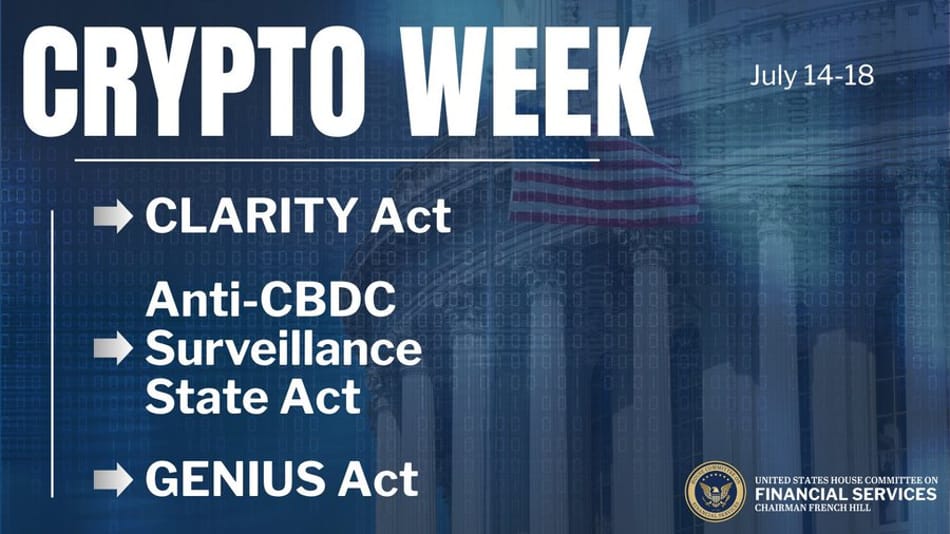
Collectively, these measures aim to define roles for regulators, protect consumers, and prevent government overreach in cryptocurrency, addressing issues from crypto market structure to privacy and stablecoin rules.
The CLARITY Act: Crypto Market Structure
The CLARITY Act, formally the Digital Asset Market Clarity Act of 2025, is a bipartisan bill to create a unified regulatory framework for digital assets. Its core goal is to end confusion over which agency – the SEC or the CFTC – oversees various cryptocurrencies. In effect, the CLARITY Act codifies what assets are “securities” (under the SEC) versus “commodities” (under the CFTC), and sets ground rules for exchanges and trading platforms.
Key features of the CLARITY Act include:
- Three-tier taxonomy: It classifies tokens as (1) digital commodities (e.g. Bitcoin), (2) stablecoins, and (3) excluded digital assets. Importantly, commodities fall under the CFTC’s exclusive jurisdiction, while securities (“investment contracts”) remain under the SEC.
- Defined CFTC role: The bill makes the CFTC the primary regulator for spot and derivatives trading of most cryptocurrencies, a notable expansion of its traditional mandate. Under the Act, the CFTC would oversee the regulation of crypto exchanges, requiring them to register with the CFTC instead of SEC
- Capital-raising exemption: Issuers could conduct token sales (capital raises) up to $75 million per year under a new registration exemption, promoting smaller fundraising rounds.
- Consumer safeguards: Crypto trading platforms would be subject to anti-fraud, AML/KYC, and reporting rules similar to banks or securities exchanges. Custody and disclosure requirements would ensure customer funds are segregated and reserves are transparent.
The act also introduces a "bright-line test" to determine whether a digital asset qualifies as a commodity. This test assesses whether a network is decentralized and functional enough for the asset to be treated as a commodity rather than a security.
The CLARITY Act establishes specific criteria for when a blockchain system qualifies as “commodity”:
- Time-Based Maturity — Four years since first token sale
- Capital Constraints — No more than $75M raised in the past 12 months
- Distribution Requirements — No single entity controls >10% of tokens
- Governance Decentralization — No unilateral control over protocol upgrades

Source: https://tylermalin.medium.com/the-clarity-acts-bright-line-test-how-america-s-new-crypto-rules-compare-and-what-it-means-for-10fec26614b5
On the legislative front, the CLARITY Act has successfully passed both the House Financial Services and Agriculture Committees and is currently listed on the Union Calendar, awaiting a vote by the full House. If approved by the House, the bill would then move to the Senate for further consideration.
If enacted, the CLARITY Act would represent the first comprehensive federal crypto market-structure law in the U.S. It would sharply reduce SEC enforcement of crypto and give the CFTC new authority over spot trading platforms. Proponents say this will bring innovation in the open with clear consumer protections. Critics caution it could hollow out some securities protections and leave complex legal loopholes. Either way, passing the CLARITY Act would significantly reshape how crypto businesses operate in America.
Anti-CBDC Surveillance State Act: Banning a Digital Dollar
In July, the U.S. House of Representatives is set to debate the "Anti-CBDC Surveillance State Act", which is a bill to forbid the creation of a U.S. central bank digital currency (CBDC). In practice, it would codify a ban on any digital-dollar CBDC by the Federal Reserve. While this bill seems irrelevant to crypto market, it actually have significant implications for the future of crypto markets in the United States.
The bill explicitly bars the government from launching a retail-facing digital dollar, citing concerns over privacy, government overreach, and surveillance. It also prevents intermediated models, such as through commercial banks.
- No Fed retail banking: Federal Reserve Banks would be barred from offering any products or services directly to individuals, or maintaining accounts for the general public.
- No Fed-issued CBDC: It prohibits a CBDC in any form. Under the bill, the Fed could not issue or circulate a CBDC directly, nor through intermediaries like banks.
- No Fed development: The Fed’s Board of Governors would be forbidden from studying, testing, developing, creating or implementing a CBDC. It also forbids using any such digital currency for monetary policy.
- Congressional authority: The bill affirms Congress’s sense that the Fed currently lacks authority to issue digital money without new legislation
In short, the act would cement a permanent prohibition on a government-run digital dollar. The bill’s champions frame it as a way to preserve financial privacy and American liberty.
The Only Major Economies to Ban CBDC
The United States is poised to become one of the few major economies to explicitly ban the development of a central bank digital currency (CBDC) for retail use. This stance stands in sharp contrast to other global jurisdictions, most notably the European Union, which is actively advancing plans for a digital euro. The European Central Bank is currently exploring technical prototypes and legal frameworks, with the intention of launching a CBDC that can function alongside cash and private-sector digital payments. Similarly, other major economies such as China, Japan, and the United Kingdom are moving forward with pilots or consultations on their own CBDC initiatives.
This represents a distinctive policy direction for the U.S., one that favors private-sector solutions over government-issued digital money. This has significant implications for the future of stablecoins in the United States. A retail CBDC, had it been developed, could have become a dominant competitor in the digital payments landscape, offering a government-backed, dollar-denominated alternative that might have gained rapid adoption, especially for domestic and low-cost international transactions. This could have potentially crowded out stablecoins in mainstream commerce by undermining their core value proposition: a stable, digital representation of the U.S. dollar for global use.
By contrast, the absence of a U.S. CBDC would allow crypto-based stablecoins, such as USDC, USDT, and future regulated entrants, to retain their first-mover advantage. With the GENIUS Act also under consideration—offering a tiered regulatory framework for stablecoin issuers—the U.S. is signaling a preference to formalize and supervise stablecoins rather than replace them with a government alternative.
The GENIUS Act: Federal Stablecoin Framework
The Senate’s GENIUS Act (Guiding and Establishing National Innovation for U.S. Stablecoins) is a landmark bipartisan bill to regulate stablecoins. It passed the Senate on June 17, 2025 and now awaits House consideration. The Act establishes the first comprehensive federal rules for payment stablecoins (crypto tokens pegged to fiat currency). In essence, it would treat large stablecoins much like banks or money market funds to protect consumers and the financial systemt.
Major provisions of the GENIUS Act include:
- Reserve backing: Issuers of “permitted payment stablecoins” must hold 100% reserves in high-quality liquid assets (U.S. dollars or short-term Treasuries). This ensures each stablecoin token is fully backed and can be redeemed at face value.
- Disclosure and audit: Issuers must publicly disclose their reserves on at least a monthly basis. Annual financial audits and frequent independent attestations would verify that backing remains full.
- Licensing regime: Stablecoin issuers would be classified as “financial institutions” under existing law. Those above a $10 billion market cap would need a federal charter (dual federal-state licensing), while smaller issuers could choose qualified state licensing if they meet federal standards.
- Consumer protections and AML: Issuers would be subject to Bank Secrecy Act (AML/CFT) requirements and investor protections similar to traditional finance. The Act includes “ethical guardrails” against market abuse, and gives holders the right to redeem coins on demand.
- Limits on algorithmic and yield-bearing coins: Notably, the GENIUS Act prohibits so-called algorithmic stablecoins (which lack full backing) and bans payment stablecoins that pay interest or dividends.
If enacted, the GENIUS Act would usher in a new era of stablecoins with clear, enforceable rules. Stablecoins meeting the law’s criteria would gain legitimacy as safe, dollar-equivalent payment tools, likely increasing confidence for consumer and institutional use. Issuers would have to run transparent, conservative businesses with no risky leverage. This could broaden stablecoin adoption for payments, remittances, and as on-ramps to crypto.