Deaton Fights For The XRP Army—Again: New Legal Battle Begins

bitcoinistPublished on 2025-07-10Last updated on 2025-07-10

Abstract

XRP investors are at the centre of a securities-fraud class action that accuses former Linqto chief executive William Sarris of...

Trusted Editorial content, reviewed by leading industry experts and seasoned editors. Ad Disclosure

XRP investors are at the centre of a securities-fraud class action that accuses former Linqto chief executive William Sarris of secretly imposing mark-ups of up to 60 percent on pre-IPO Ripple shares and other highly sought-after private-company equity like Uphold and Kraken sold through special-purpose vehicles on the fintech’s platform.

The 61-page complaint—Maxwell v. Sarris, filed on 9 July 2025 in the US District Court for the Southern District of New York—alleges that Sarris and unnamed accomplices acted as unregistered broker-dealers, used misleading offering exemptions and failed to deliver legal title to any of the underlying shares.

XRP Army’s Legal Champion Is Back

According to the filing, would-be purchasers were told the SPVs “held the same equity that insiders owned,” yet Linqto neither transferred the stock nor disclosed the hefty mark-ups baked into the purchase price—conduct the plaintiffs say violates Section 10(b) of the Securities Exchange Act and FINRA Rule 2040. Linqto’s own bankruptcy papers, lodged a day earlier in the Southern District of Texas, concede “historical failures to follow US laws governing the sale and marketing of private-company interests.”

Lead counsel John E. Deaton—best known for representing XRP holders in SEC v. Ripple—contends that Sarris “damaged the mission of democratising access to Silicon Valley” and misled ordinary investors: “People believed they were buying shares of Ripple, shares of SpaceX, but that’s not what they were buying.”

Because Sarris is sued in his personal capacity, Deaton argues the litigation is not stayed by Linqto’s Chapter 11 petition of 8 July 2025. The company, now led by chief executive Dan Siciliano, has secured up to $60 million in debtor-in-possession financing and says court oversight is “the only way forward” to emerge as “a profitable, law-abiding organisation” while it cooperates with SEC and FINRA investigations.

Investor outreach has proved challenging. Deaton scheduled an X Spaces session for 7:30 p.m. EST on 9 July, but abandoned the effort after repeated crashes, posting instead: “The spaces keeps crashing. We will set up a conference call early next week via phone line. I won’t do a Zoom link again because it got bombed last time.” He also reassured international users: “Anything I do includes ALL Linqto customers, regardless of where you live.”

Meanwhile, restructuring jockeying has begun. Shareholder Sapien Group says it has marshalled a majority bloc of equity and may seek to dismiss the Chapter 11 case, while Deaton has signalled plans to engage the creditors’ committee—a move endorsed by forensic accountant Rob Loh, who wrote that the panel “will have real power in the bankruptcy process.” Deaton confirmed: “Rob is correct. We will have a real say in what happens in the bankruptcy.”

Regulatory pressure is mounting on multiple fronts: Linqto disclosed parallel probes by the SEC and FINRA, and former chief revenue officer Gene Zawrotny is pursuing a wrongful-termination claim in California state court, alleging retaliation for flagging compliance failures. Deaton is now also turning up the pressure on behalf of the XRP community—particularly those who believed they were purchasing legitimate pre-IPO shares of Ripple.

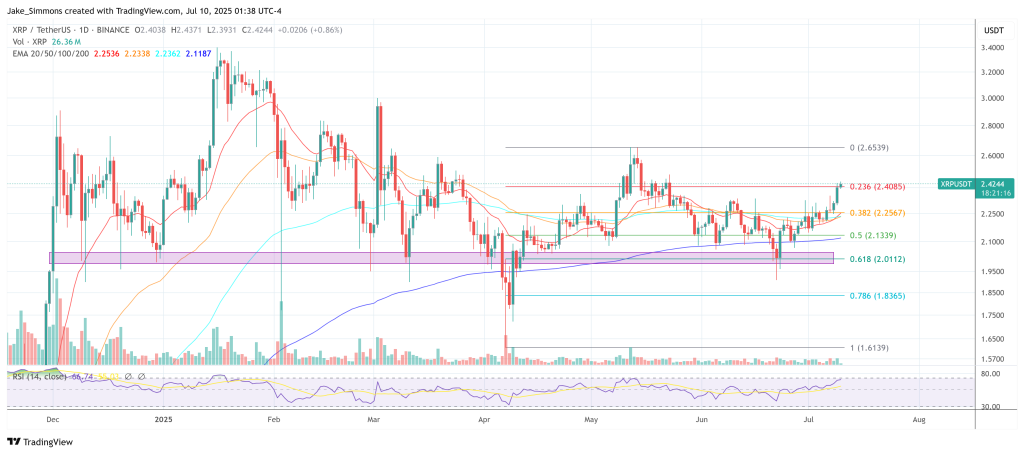
At press time, XRP traded at $2.42.
XRP price
XRP rises above the 0.236 Fib, 1-day chart | Source: XRPUSDT on TradingView.com
Featured image from YouTube, chart from TradingView.com
Editorial Process for bitcoinist is centered on delivering thoroughly researched, accurate, and unbiased content. We uphold strict sourcing standards, and each page undergoes diligent review by our team of top technology experts and seasoned editors. This process ensures the integrity, relevance, and value of our content for our readers.

Jake Simmons has been a Bitcoin enthusiast since 2016. Ever since he heard about Bitcoin, he has been studying the topic every day and trying to share his knowledge with others. His goal is to contribute to Bitcoin's financial revolution, which will replace the fiat money system. Besides BTC and crypto, Jake studied Business Informatics at a university. After graduation in 2017, he has been working in the blockchain and crypto sector. You can follow Jake on Twitter at @realJakeSimmons.

Related Reads

MSTR Discloses Sale of 3,588 Bitcoins, Stock Price Drops Over 5% at One Point During Trading

MicroStrategy, the world's largest corporate holder of Bitcoin, has significantly shifted its business model. Between June 29 and July 5, the company sold 3,588 bitcoins for approximately $216 million to fund quarterly dividends for its preferred stock. This marks its largest-ever Bitcoin sale and signals a strategic pivot: Bitcoin is transitioning from a "buy-and-hold" reserve asset to a liquidity management tool for the company. This move follows a recent authorization allowing Bitcoin sales when equity fundraising is less attractive. The announcement contributed to a more than 5% intraday drop in MicroStrategy's stock price, while Bitcoin fell to around $61,800—below the company's average holding cost of roughly $75,700. The sale represents a major departure from MicroStrategy's long-standing "never sell" commitment, which saw its first minor breach in May with a $2.5 million sale. The latest, hundred-times-larger transaction underscores growing financial pressures. Analysts note the company faces about $1.5 billion in annual preferred dividend obligations, far exceeding cash flow from its software business. As of July 5, MicroStrategy holds 843,775 bitcoins. Its current operational logic involves buying Bitcoin during favorable financing conditions and selling portions to cover dividends when needed, creating a flexible capital management cycle amidst a challenging market environment.

华尔街日报14m ago

MSTR Discloses Sale of 3,588 Bitcoins, Stock Price Drops Over 5% at One Point During Trading

华尔街日报14m ago

Q-Day Countdown: Will Quantum Computing End Cryptocurrencies?

Quantum Computing's Threat to Cryptocurrency: A Countdown to Q-Day Quantum computing, specifically Shor's algorithm, poses a fundamental threat to the public-key cryptography (e.g., ECDSA, RSA) that secures blockchain networks like Bitcoin and Ethereum. This critical juncture, known as Q-Day, is estimated to occur potentially within the next 5-15 years. The core vulnerability stems from the public and immutable nature of blockchains. Assets in addresses where the public key is already exposed on-chain (e.g., spent outputs) are at direct risk, as a sufficiently powerful quantum computer could derive the private key. This threatens the very trust model of cryptocurrencies. The response lies in Post-Quantum Cryptography (PQC)—algorithms like lattice-based ML-DSA and hash-based SLH-DSA, which are resistant to quantum attacks. NIST has standardized key PQC algorithms (FIPS 203, 204, 205), providing a migration path. However, the primary challenge is not technical but socio-economic and involves complex governance: * **Bitcoin's** path is constrained by its conservative ethos. Migrating requires a soft-fork to new address types, facing hurdles like significantly larger signature sizes and, most critically, the divisive governance question of how to handle at-risk legacy UTXOs without violating core principles. * **Ethereum** is pursuing a "cryptographic agility" strategy, with a multi-layered roadmap. It leverages account abstraction for user accounts and is developing compressed hash-based signatures (e.g., leanXMSS) for its consensus layer, aiming for a full-stack upgrade over time. In conclusion, quantum computing does not spell an instant end for cryptocurrency but initiates a critical countdown. The industry has a limited "engineering comfort window" to orchestrate a coordinated, ecosystem-wide migration to PQC. The ultimate bottlenecks are the immense coordination efforts and governance decisions required for this foundational transition.

marsbit1h ago

Q-Day Countdown: Will Quantum Computing End Cryptocurrencies?

marsbit1h ago

Trump, the President Who Knows Best How to 'Trade Stocks'

Former US President Donald Trump reported a record-breaking $2.2 billion in personal income for 2025, the highest annual income ever disclosed by a sitting president. This figure, from a 927-page government ethics filing, represented a 3.5-fold increase from his $600 million income in 2024 and boosted his net worth to $6.5 billion. The primary drivers were cryptocurrency (64% of income, approximately $1.4 billion) and real estate (26%, approximately $575 million). His crypto earnings stemmed largely from the launch of his personal meme coin, $TRUMP, generating over $600 million in licensing fees, and substantial profits from the WLFI token and its parent company. Despite a sluggish property market, his Mar-a-Lago resort and associated golf clubs saw revenue surges of 50% and 27%, respectively, attributed to their use as venues for presidential events. Trump's financial disclosure also revealed an unprecedented level of stock market activity, with over 22,000 trades executed in 2025, averaging 87 trades per market day. Media analyses noted several instances where significant trading coincided with major policy announcements, such as proposed tariffs, raising questions about potential conflicts of interest. While the White House stated these trades were handled by a family-managed trust fund and not Trump directly, critics highlighted this as a departure from the blind trusts traditionally used by presidents post-Watergate. The report has intensified debate over the commercialization of the presidency. Supporters view it as a success story of a businessman-president, while critics argue it demonstrates an unprecedented conversion of public influence into private wealth, with policy decisions potentially linked to personal financial gains. The controversy centers on whether Trump's earnings represent innovative entrepreneurship or a fundamental conflict of interest, sparking renewed calls for stricter ethics reforms in US governance.

marsbit1h ago

Trump, the President Who Knows Best How to 'Trade Stocks'

marsbit1h ago

Countdown to Q-Day: Will Quantum Computing End Cryptocurrencies?

The article explores the existential threat quantum computing poses to cryptocurrencies and the urgent need for "post-quantum" migration. It outlines that quantum computers, through Shor's algorithm, could break the elliptic-curve cryptography (ECC) underlying blockchain security, potentially allowing private keys to be derived from public keys. The core challenge is not a lack of post-quantum cryptography (PQC) standards—like NIST's ML-KEM and ML-DSA—but the immense complexity of upgrading entire ecosystems before "Q-Day" (when quantum computers become capable of such attacks, estimated around 2035-2045). Key points include: * **Bitcoin's** risk is concentrated in legacy UTXOs with exposed public keys (e.g., early P2PK outputs). Migration faces massive hurdles: PQC signatures are much larger, increasing transaction size and cost, and the governance dilemma of handling un-migrated assets threatens its "code is law" ethos. * **Ethereum's** strategy focuses on "cryptographic agility," using Account Abstraction for user accounts and developing compressed hash-based signatures (like leanXMSS with SNARK aggregation) for consensus. Its migration is a complex, full-stack overhaul of execution, consensus, and data layers. * The "security debt" is enormous. The comfortable engineering window for a coordinated, ecosystem-wide upgrade is only 5-8 years. High-value infrastructure (exchanges, bridges) may face pressure before mainnet protocols. In conclusion, quantum computing is not an instant "doomsday" event but a forcing function for systemic change. Bitcoin's ultimate test is social consensus and property rights governance, while Ethereum's is technical complexity. Failure to migrate in time could lead to a fundamental re-pricing of crypto assets.

链捕手1h ago

Countdown to Q-Day: Will Quantum Computing End Cryptocurrencies?

链捕手1h ago

Trading

Spot
活动图片