BlackRock Wants Bitcoin Higher—IBIT Now Out-Earns Their S&P 500 Fund

bitcoinistPublished on 2025-07-03Last updated on 2025-07-03

Abstract

BlackRock’s iShares Bitcoin Trust (IBIT) has surpassed the firm’s long-established iShares Core S&P 500 ETF (IVV) in annual revenue generation....

Trusted Editorial content, reviewed by leading industry experts and seasoned editors. Ad Disclosure

BlackRock’s iShares Bitcoin Trust (IBIT) has surpassed the firm’s long-established iShares Core S&P 500 ETF (IVV) in annual revenue generation. The development, first highlighted in a June 2 report by Bloomberg, marks a milestone moment for institutional adoption and exposes a growing financial incentive among traditional giants to see BTC’s price rise.

BlackRock’s New Game: Pump Bitcoin, Print Cash

Despite being a fraction of IVV’s size in terms of assets under management, IBIT has now overtaken it in fee revenue. IBIT currently manages approximately $75 billion in assets and charges a 0.25% fee, generating around $187.2 million in estimated annual fees. In contrast, IVV, BlackRock’s flagship S&P 500 tracker, holds $624 billion but charges just 0.03%, netting about $187.1 million in fees. As Bloomberg’s Isabelle Lee put it, “a Bitcoin exchange-traded fund now generates more revenue than [BlackRock’s] signature tracker of the S&P 500 Index.”

This revenue discrepancy, despite IVV’s immense asset base, stems from the sheer profitability of managing BTC exposure in an ETF wrapper, particularly given IBIT’s higher fee structure and the velocity of capital inflows it has witnessed. The fund has recorded inflows in all but one of the past 18 months and now holds over 55% of all US spot Bitcoin ETF assets.

The explosive growth of IBIT is closely tied to the January 2024 decision by US regulators to approve spot ETFs, a watershed moment that brought Bitcoin further into the financial mainstream. This regulatory opening has unleashed a torrent of institutional capital, with hedge funds, pensions, family offices, and banks now actively allocating to Bitcoin in SEC-compliant vehicles.

Market commentators were quick to highlight the implications. Anthony Pompliano noted succinctly on X: “BlackRock’s Bitcoin ETF drives more revenue than its S&P 500 fund. Bitcoin has Wall Street’s full, undivided attention now.”

Crypto analyst Jacob Canfield provided a more detailed financial interpretation, posting: “Blackrock makes more money the higher the price of Bitcoin goes, just an FYI. (not financial advice)”

He elaborated further: “Some people don’t seem to understand my meaning. Blackrock makes 0.25% fees on their IBIT ETF. That currently translates to $184 million in annual revenue (just for custody) and it’s based on AUM (assets under management). That means if the price of Bitcoin goes to $1,000,000 (a 10X from here), they will make $1.84 billion per year in fees. This is why Blackrock is incentivized by higher prices in Bitcoin.”

Canfield’s logic lays bare the core economic engine at work: BlackRock’s revenue from IBIT is a direct function of the BTC market price. Since ETF fees are derived as a percentage of AUM, any appreciation in price amplifies the dollar-denominated value of the assets under custody—and, by extension, BlackRock’s fee income. At current rates, each doubling of the BTC price could potentially yield nearly double the revenue for IBIT, assuming static inflows.

The broader implication is profound: BlackRock, the world’s largest asset manager with nearly $10 trillion under management, is now structurally aligned with Bitcoin’s success. That alignment goes beyond product strategy or public messaging—it is embedded in fee economics.

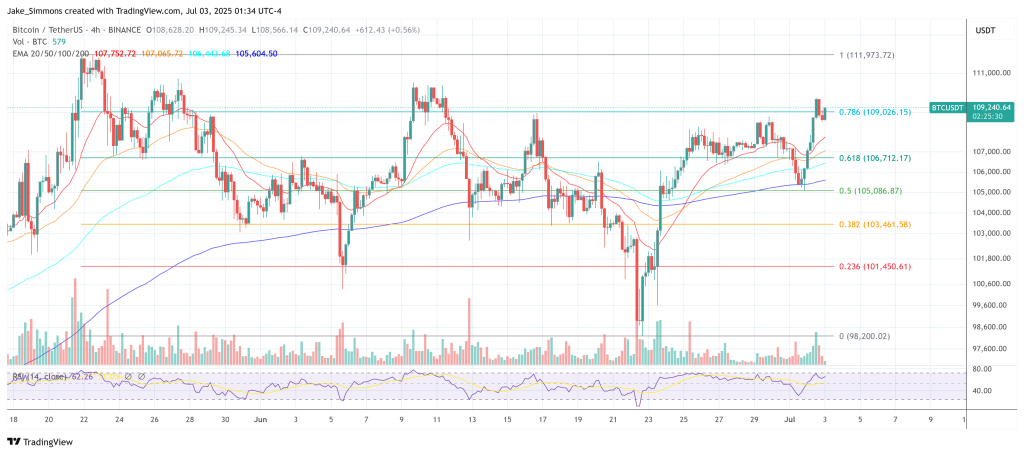
At press time, BTC traded at $109,240.
Bitcoin price
BTC price, 4-hour chart | Source: BTCUSDT on TradingView.com
Featured image created with DALL.E, chart from TradingView.com
Editorial Process for bitcoinist is centered on delivering thoroughly researched, accurate, and unbiased content. We uphold strict sourcing standards, and each page undergoes diligent review by our team of top technology experts and seasoned editors. This process ensures the integrity, relevance, and value of our content for our readers.

Jake Simmons has been a Bitcoin enthusiast since 2016. Ever since he heard about Bitcoin, he has been studying the topic every day and trying to share his knowledge with others. His goal is to contribute to Bitcoin's financial revolution, which will replace the fiat money system. Besides BTC and crypto, Jake studied Business Informatics at a university. After graduation in 2017, he has been working in the blockchain and crypto sector. You can follow Jake on Twitter at @realJakeSimmons.

Trending Cryptos

Related Reads

Unitree's IPO Frenzy: The Real Mystery is How It Will Spend the 42 Billion Raised

Unitree, a Chinese robotics company, is set for a public listing after its IPO registration was approved by regulators. The company, which started with quadruped robots and has expanded into humanoids, plans to raise approximately 4.2 billion yuan through its offering. The article traces Unitree's rapid growth from its founding in 2016 to its current status. It highlights key milestones like the 2021 CCTV Spring Festival Gala performance, the 2023 launch of its affordable Go2 robot dog and the H1 humanoid robot, and a series of subsequent product launches. By 2025, the company reported revenue of 1.71 billion yuan, profitability, and sales exceeding 5,500 humanoid robots. As the first publicly-listed humanoid robot company on China's STAR Market, Unitree's main challenges are sustaining growth and deploying its newly raised capital effectively. The humanoid robot sector in China is crowded, with over 140 companies. Competitors include UBTech (focusing on industrial and consumer markets), Fourier, and international players like Tesla Optimus and 1X NEO. The article outlines three critical challenges for Unitree: establishing a strong second product line beyond its quadruped robots, maintaining its price advantage while ensuring quality, and successfully advancing its embodied AI capabilities through partnerships like the one with NVIDIA for the H2 Plus platform. Unitree's likely strategy involves a "developer tools + industry benchmarks" approach: using low-cost models like the R1 and G1 to build developer adoption and volume, leveraging high-end platforms for AI training, and securing pilot projects in sectors like logistics and manufacturing to build case studies. The company's future success hinges on converting its current momentum in shipments and pilot programs into sustainable, large-scale commercial contracts as the broader market evolves.

marsbit34m ago

Unitree's IPO Frenzy: The Real Mystery is How It Will Spend the 42 Billion Raised

marsbit34m ago

Examining the Open USD Partner Lineup: Follow Who's Joining to See Where the Money Flows

**Title: Deciphering the Open USD Partner Roster: Following the Money** The launch of Open USD is notable less for the stablecoin itself and more for its expansive list of over 140 founding partners, which reads like a "who's who" of global finance and tech. This coalition, including asset managers like BlackRock, card networks Visa and Mastercard, banks (BNY Mellon, Standard Chartered, etc.), tech giants (Google, IBM), merchants (Shopify), and crypto firms (Coinbase, Ripple, Aave, MetaMask), signals a strategic shift. The diverse membership reveals that stablecoins are increasingly viewed not as products to compete over, but as shared infrastructure too critical to be left to any single entity. Each partner category has distinct motives. Asset managers like BlackRock seek to manage the large, sticky cash reserves, a lucrative fee-generating opportunity. Merchants like Shopify aim for lower-cost settlement and potential yield on balances. Banks join defensively to retain custody and settlement roles, fearing deposit outflows to stablecoins. Tech companies bet on programmable money for future machine-to-machine commerce. Crypto firms gain mainstream legitimacy and distribution channels. Remarkably, the consortium includes direct competitors (Visa vs. Mastercard, Coinbase vs. Ripple), indicating that the fear of exclusion from this emerging financial layer outweighs competitive rivalries. However, this shared governance could also lead to slow decision-making. The roster's composition is the real message: it represents a collective bet that a widely accepted, consortium-owned stablecoin is preferable to proprietary versions or having none at all. For incumbents like Circle and Tether, this alliance poses a significant threat, as potential clients have collectively chosen to build their own alternative. The absence of major U.S. retail banks (busy with their own tokenized deposit networks) is equally telling. In essence, the partner list maps where the industry believes value and risk will flow in a tokenized dollar future, marking stablecoin's evolution from a product to a utility.

Foresight News57m ago

Examining the Open USD Partner Lineup: Follow Who's Joining to See Where the Money Flows

Foresight News57m ago

Trading

Spot

Hot Articles

Discussions

Welcome to the HTX Community. Here, you can stay informed about the latest platform developments and gain access to professional market insights. Users' opinions on the price of S (S) are presented below.

活动图片