继 Spark 后,Sky 押注 Grove,RWA 新贵登场?

marsbitPublished on 2025-06-27Last updated on 2025-06-28

Sky 生态(前身为 MakerDAO)于 6 月 25 日推出了全新的去中心化金融协议 Grove Finance,并得到了 Sky 生态 10 亿美元的首发资金拨款,用于推动代币化信贷资产(主要是担保贷款凭证 CLO)的投资。

收益


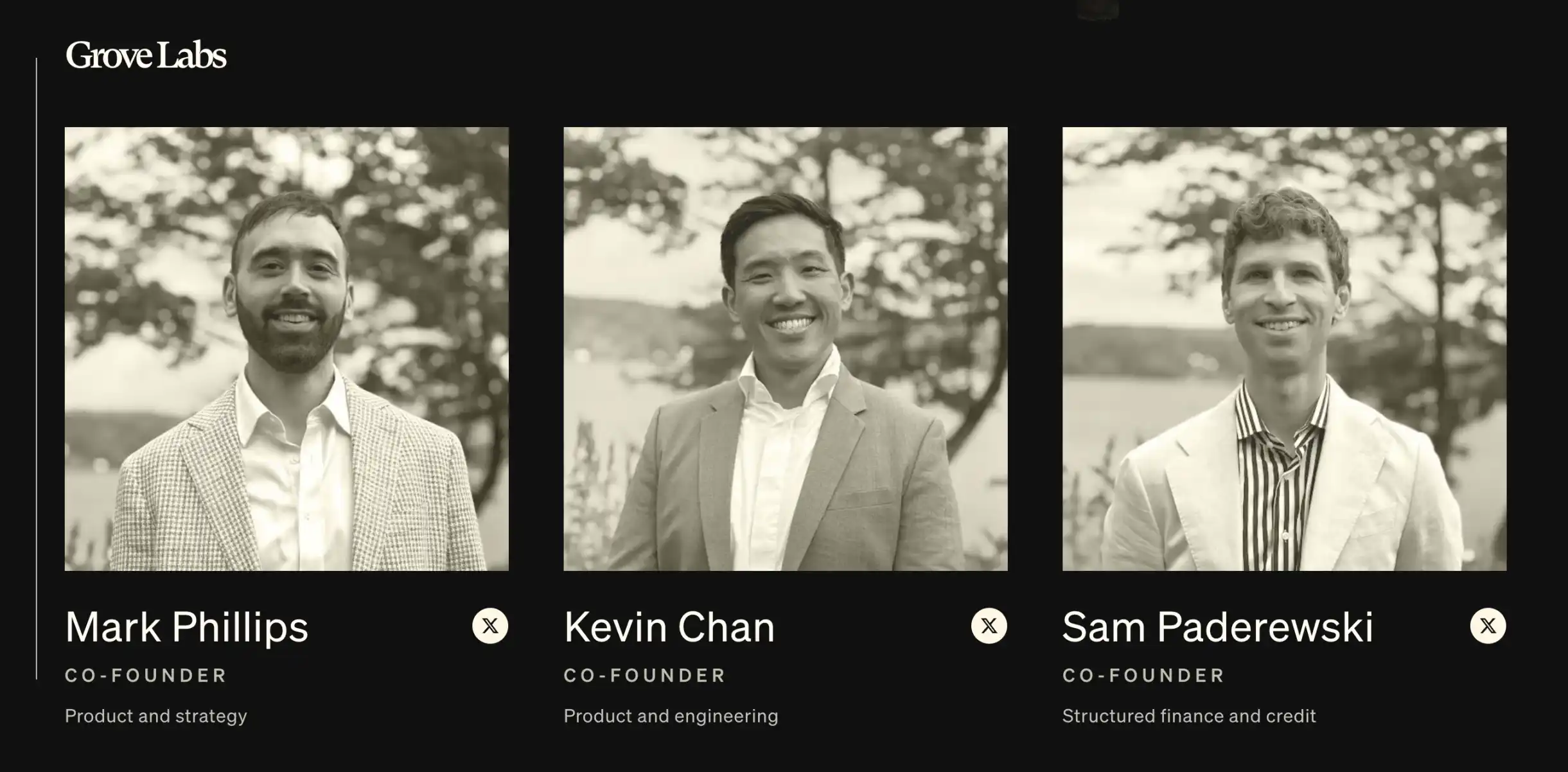
Grove 由区块链机构 Steakhouse Financial 旗下的 Grove Labs 孵化,联合创始人包括 Mark Phillips、Kevin Chan 和 Sam Paderewski 等人。核心团队拥有丰富的传统金融和 DeFi 背景,曾就职于德勤(Deloitte)、花旗、BlockTower、Hildene 等机构。

收益


Steakhouse Financial 此前曾在将真实世界资产(RWA)引入 Sky 生态方面发挥过关键作用,因此 Grove 的登场被视为 Sky 将更多传统信贷市场连接到 DeFi 的又一重要尝试。


Grove 的产品定位与技术架构

Grove 致力于构建「机构级信贷基础设施」,在功能上将去中心化金融与受监管的传统信贷资产市场对接。协议允许 DeFi 项目和资产管理机构通过链上治理路由闲置资金,投资于经过严格合规的信贷产品(目前重点是 AAA 级 CLO 策略),以获取独立于加密市场波动的收益。


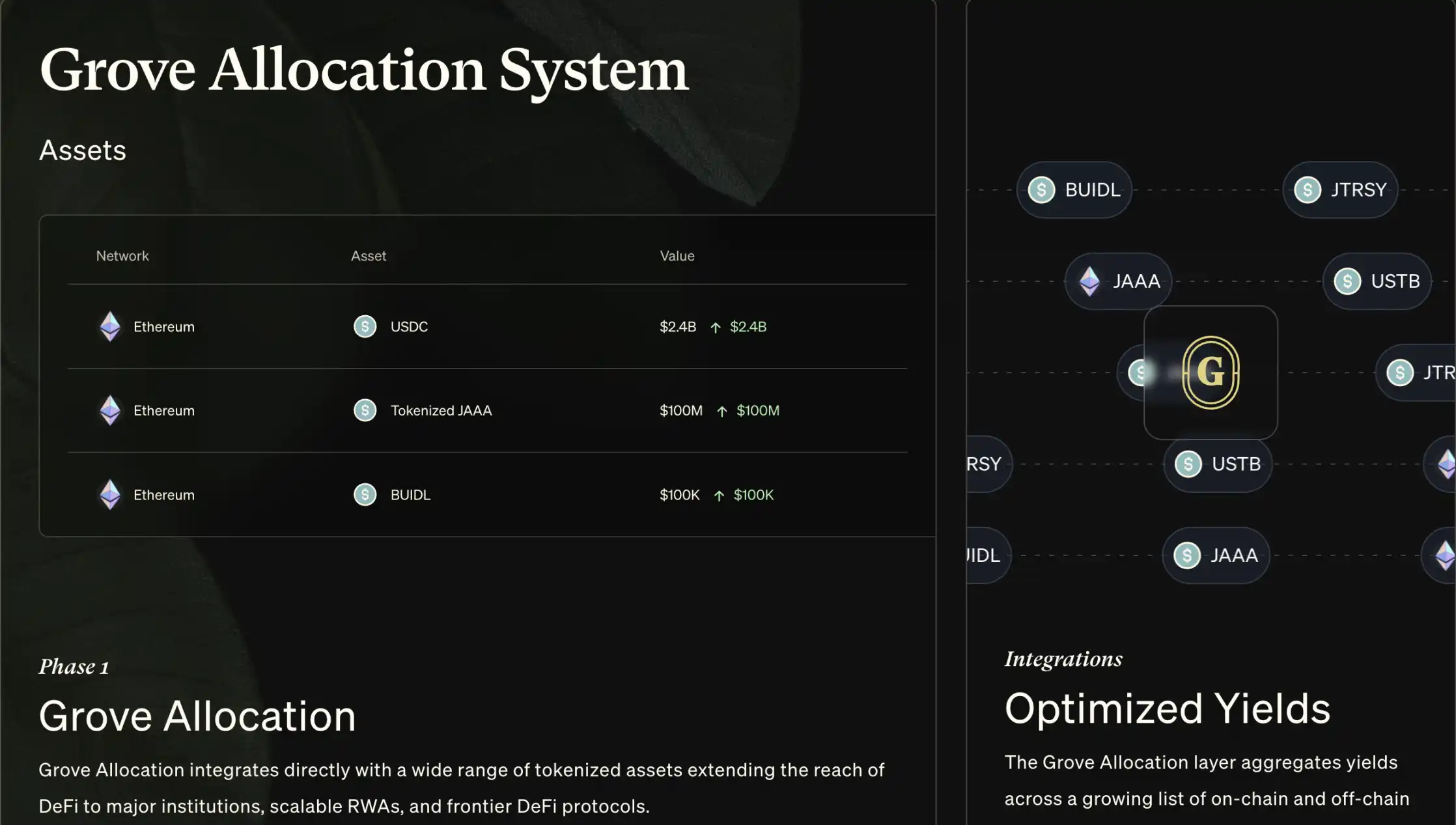
据报道,Sky 生态将启动资金投入由 Janus Henderson(安本标准投资)管理的 Anemoy AAA 级 CLO 策略基金(JAAA),该基金与 Centrifuge 平台合作推出,是首个可在链上交易的 AAA 级 CLO 策略。

收益


Grove 协议采用开源、非托管的形式运行,旨在构建一条「DeFi–传统金融资本通道」,提高资本效率、降低交易摩擦,为资产管理者和 DeFi 协议提供编程化、多样化的资金分配能力。官方资料显示,Grove 可为资产管理公司建立新的全球分销渠道,为各协议 /DAO 提供高端链上资本伙伴关系,并为整个 DeFi 生态提升可信度和可持续性。


简言之,Grove 的技术架构围绕链上治理和自动化资金路由展开,将加密协议持有的稳定币或其他闲置的资本转化为机构级信贷资产投资,从而实现收益与风险的优化。


Grove 与 Spark 的异同

Grove 与 Sky 生态中的 Spark 协议同属于 MakerDAO(Sky)的「Endgame」改造计划下的自治子单元(subDAO,又被称为「Star」),但两者定位和机制有明显区别。


Spark 于 2023 年推出,是 Sky 生态首个 Star,主打「稳定币 +RWAs」的收益引擎。Spark 依托 Sky 发行的 DAI/USDS 稳定币储备,推出了 SparkLend、Spark Savings 和 Spark 流动性层(SLL)等产品。用户可存入 USDS、USDC 或 DAI,参与借贷或 Farm 收益,并通过动态风险引擎将资金分配到 DeFi 借贷、CeFi 借贷以及代币化国债等资产池中,从而获取相对稳定的收益。


Spark 在多链部署,目前管理稳定币流动性超过 35 亿美元,并已推出原生治理代币 SPK(并空投给社区),用户可通过质押 SPK、参与治理和社区激励(Community Boost)等获得额外奖励。Spark 团队强调透明化和审计性,目标收益水平略高于美债,以迎合风险调整后回报的需求


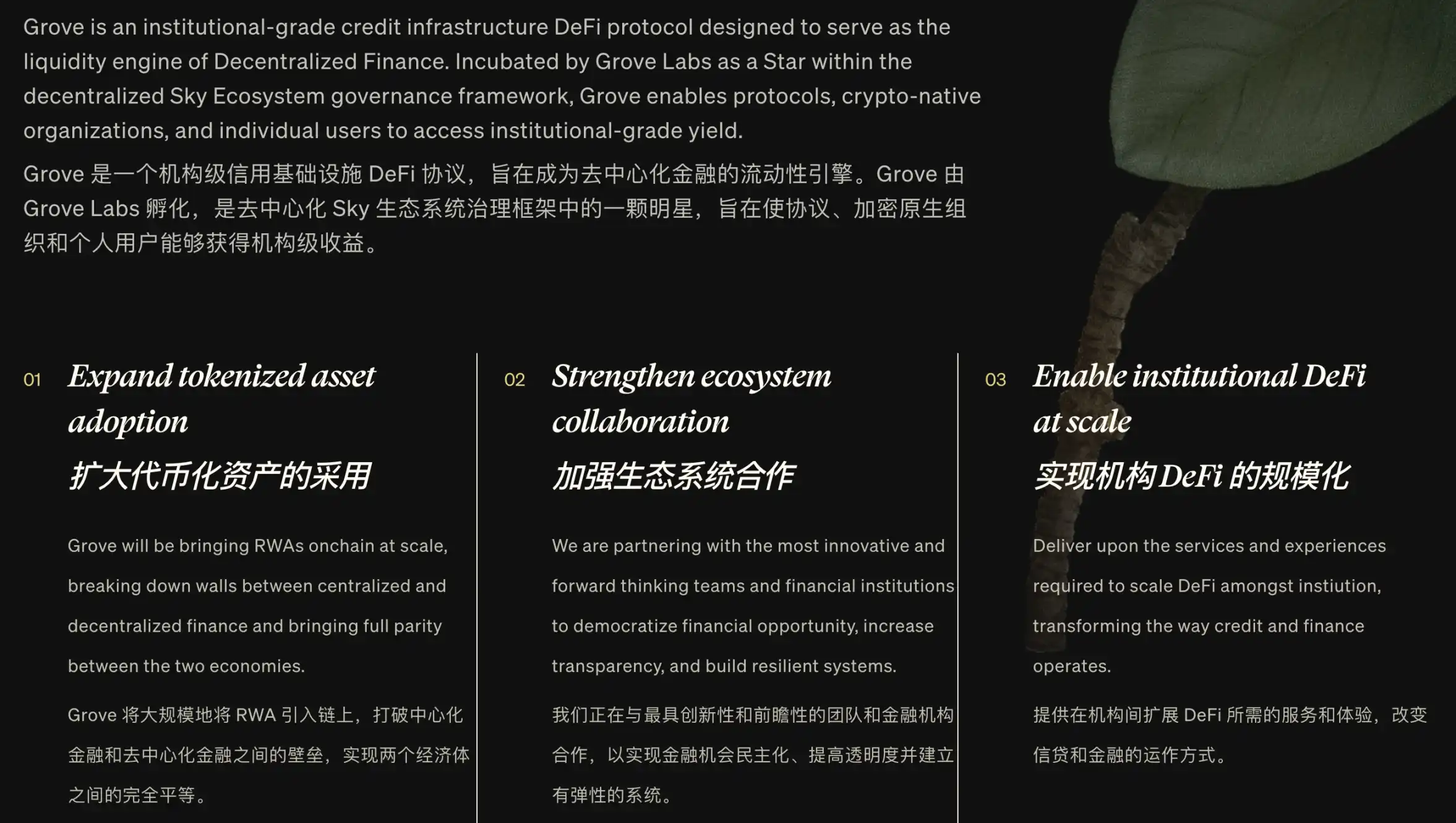
相比之下,Grove 更加专注于大额机构级信贷。其首次部署的 10 亿美元用于对接安本的 AAA 级 CLO 基金,表明 Grove 面向资金规模更大、对收益稳定性要求更高的用户(如资管公司和 DeFi 协议)。目前 Grove 刚刚上线,推出治理代币为时尚早,其激励机制主要体现在让 DeFi 项目能够「盘活闲置储备金、获得更高质量资产的收益」上。

收益


简单来说,Spark 可视为 Sky 生态面向普通稳定币持有者的收益产品,而 Grove 则是为大型项目和机构搭建链上信贷通道的基础设施协议。两者都是 Sky 生态「Endgame」战略的一部分,着眼点皆为链上引入真实资产:Spark 以国债等 RWA 丰富稳定币收益,Grove 以担保贷款等信贷资产丰富 DeFi 资产配置。


由此可见,Grove 是在 RWA 赛道上,重点补齐 Spark 体系之外的机构信贷拼图。

Related Reads

Jensen Huang: Prompts are Becoming Obsolete, Loops are the New Paradigm

Jensen Huang, alongside AI leaders like Peter Norvig, Boris Cherny, and Andrew Ng, is advocating for a shift from "prompt engineering" to "loop engineering" as the new paradigm for AI development. Instead of manually crafting individual prompts, the focus is now on designing autonomous loops—systems where AI agents execute tasks, self-validate results, and iterate until completion without constant human oversight. A loop is a management framework that enables agents to operate independently. Key implementations are seen in Claude Code (with features like /loop, /goal, and /schedule) and OpenAI Codex, which employ multiple agents working in parallel within isolated environments. A core principle is the separation of roles: one agent (or model) performs the task, while an independent agent (or a smaller, separate model) validates the output to ensure objectivity. The article outlines a practical roadmap for implementing loops, starting with a "four-condition test" to assess suitability, building a minimal viable loop, and emphasizing critical pitfalls to avoid, such as lacking hard stop conditions or allowing loops to handle tasks requiring human judgment. This evolution is framed as the fourth major shift in AI interaction: from Prompt Engineering (crafting instructions) to Context Engineering (providing background information), then to Harness Engineering (building tool-enabled environments), and finally to Loop Engineering (creating self-sustaining systems). This progression reflects a consistent trend of increasing abstraction, moving human involvement from direct instruction to system design and rule-setting. The concept has academic roots in frameworks like ReAct, which formalized the "reason-act-observe" cycle. While loop engineering promises greater automation, experts caution about managing token costs and warn against outsourcing understanding—AI can assist, but deep problem comprehension remains essential.

marsbit7m ago

Jensen Huang: Prompts are Becoming Obsolete, Loops are the New Paradigm

marsbit7m ago

GPT Designs GPT

OpenAI has unveiled its first custom AI chip, Jalapeño, a move signaling a strategic shift beyond being a mere model company. While many see it as a challenge to NVIDIA, its core aim is to control the entire intelligent production pipeline—from models and chips to data centers and energy. The key driver is the evolving competitive landscape: model advantages are shrinking, while the computational gap in areas like cost-per-token, system throughput, and energy efficiency is becoming the true long-term barrier. Jalapeño is primarily an inference chip, targeting the massive and growing "inference tax"—the daily operational cost of generating tokens for services like ChatGPT and APIs. By designing its own hardware optimized for its specific workloads and future product roadmaps (even using AI to aid the chip design process), OpenAI aims to drastically reduce token generation costs and improve system efficiency. This creates a potential flywheel: better models help design better chips, which lower costs for running next-generation models, supporting more users and products, which in turn provides more data to refine future chips. The strategy mirrors Apple’s integrated approach, building a closed loop where hardware, software, and applications are co-optimized. In the long term, OpenAI is not trying to become the next NVIDIA (a supplier of "shovels" to all AI companies) but to own and operate the entire "mine"—selling the end product of intelligence itself. This move marks OpenAI's ambition to evolve from creating the smartest models to controlling the foundational infrastructure of AI production.

marsbit32m ago

GPT Designs GPT

marsbit32m ago

Ethereum Foundation Interim Executive Director Speaks Out: What Is Our Mission?

The Ethereum Foundation's core mission is to ensure Ethereum remains a truly permissionless, censorship-resistant, private, and open infrastructure for large-scale, sovereign coordination. The article clarifies the EF's focus and dismisses irrelevant objectives, such as pursuing institutional popularity or short-term speculation. Its core work centers on eliminating systemic weaknesses. This involves fortifying Ethereum across multiple layers—protocol, access, user, and institutional—against exploitation, control, or surveillance. Key initiatives include minimizing harmful MEV and preventing privileged control over transaction flow, making unconditional privacy a foundational default, ensuring staking remains permissionless and decentralized, and strengthening user-facing access points to uphold autonomy. Concurrently, the EF aims to seize strategic opportunities. These include leading the transition to post-quantum cryptography, achieving a fully verifiable protocol stack, establishing Ethereum as private digital cash, integrating user-owned AI agents with personal wallets, and demonstrating that trusted-neutral infrastructure can competitively handle disintermediated coordination at an institutional scale. The article also addresses recent organizational changes, stating that personnel departures were due to strategic realignment, role fit, or natural evolution. It clarifies the approach to spin-outs, emphasizing that external funding will be provided only for work critical to the EF's mission that reduces Ethereum's dependency without creating new risks or mission drift. Ultimately, the EF is committed to building an enduring, neutral system that reshapes global coordination, focusing relentlessly on the principles of censorship resistance, openness, privacy, and sovereignty (CROP).

链捕手1h ago

Ethereum Foundation Interim Executive Director Speaks Out: What Is Our Mission?

链捕手1h ago

Trading

Spot
Futures
活动图片