Stablecoin Adoption Is Exploding – This Is the Best Wallet to Ride the Wave

bitcoinistPublished on 2025-06-11Last updated on 2025-06-11

Abstract

The world can’t get enough of stablecoins. Central banks are taking action, regulators are scrambling, and crypto fans are quietly...

Trusted Editorial content, reviewed by leading industry experts and seasoned editors. Ad Disclosure

The world can’t get enough of stablecoins. Central banks are taking action, regulators are scrambling, and crypto fans are quietly stocking up for what’s coming next.

In South Korea, the Bank of Korea’s governor has called a high-level meeting with top banks to discuss how won-backed stablecoins should be handled.

Over in the US, Ripple’s Brad Garlinghouse pointed to Circle’s initial public offering (IPO) as a sign that long-awaited stablecoin regulation could soon pass – with the GENIUS Act potentially becoming law by August.

Across the pond, the UK’s Financial Conduct Authority appointed Sarah Pritchard as deputy CEO to bolster its oversight of stablecoins and digital assets.

In the digital dollar age, every investor needs a secure, user-friendly wallet built for stablecoins.

Powered by the Best Wallet Token ($BEST), Best Wallet delivers the tools, rewards, and security investors need to thrive in the next phase of crypto adoption.

Everyone’s Talking About Stablecoins

Stablecoins, cryptocurrencies pegged to a stable asset like a national currency, have gone from background buzz to front-page news.

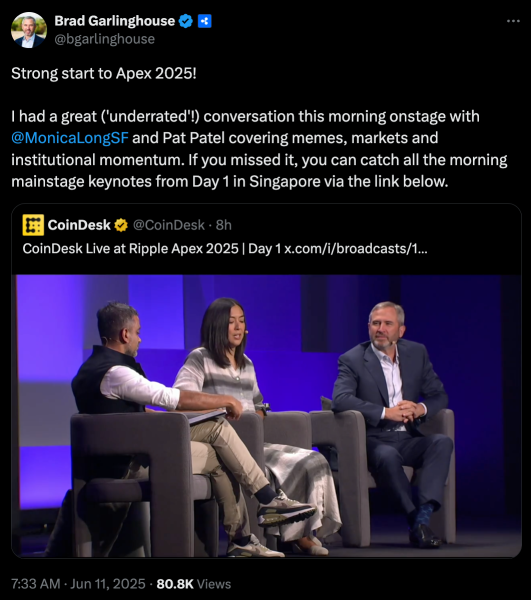
Just this week, South Korea’s central bank scheduled a meeting with the country’s largest commercial banks to address stablecoin issuance, as political support grows for won-pegged tokens. The move reflects increasing pressure to balance innovation with monetary sovereignty.Brad Garlinghouse at Apex 2025.Meanwhile, Ripple’s CEO Brad Garlinghouse, speaking at the Apex 2025 summit, called Circle’s IPO a wake-up call for American lawmakers — saying it signals real momentum behind stablecoin regulation and the likely passage of the GENIUS Act this summer.
Over in the UK, the Financial Conduct Authority appointed Sarah Pritchard as its first-ever deputy CEO to oversee the stablecoin push.

Translation? Governments no longer ban or ignore stablecoins – they’re gearing up to control them.

The fact is, stablecoins like $USDC and $USDT are now the lifeblood of crypto. They let people move money across borders, earn yield, and escape inflation – all without relying on traditional banks.

But as adoption grows, so do the risks.

Hacks, scams, rug pulls – you name it. In a space that’s moving this fast, holding your stablecoins in the wrong wallet is like carrying water in a hemp sack.

Enter Best Wallet & $BEST: Two Power Players in One Ecosystem

Best Wallet happens when you toss everything frustrating about MetaMask and build something smarter, faster, and even fun.

The first of a new generation of non-custodial crypto wallets, Best Wallet combines cutting-edge tech, sleek usability, and industry-first tools to help you trade in and store everything from stablecoins to meme coins.
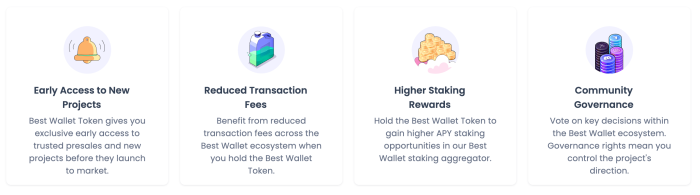
Best Wallet benefits.

Fireblocks’ MPC-CMP technology provides military-grade security, without the military-grade complexity.

But what sets this wallet apart is Best Wallet’s exclusive Upcoming Tokens feature, which gives you exclusive access to new token launches – all within the app.

The wallet aims to capture 40% of the burgeoning crypto wallet market, and to do so, it has launched Best Wallet Token ($BEST). The token is now in presale, and available through the Best Wallet app or the official presale website.

Holding $BEST unlocks early access to new crypto projects, reduced fees, ecosystem governance, and even bonus perks through Best Wallet’s fast-growing iGaming partnerships.

You can buy $BEST at the early bird price of $0.025165. So far, investors have poured in over $13.2M, hoping to capitalize on Best Wallet’s anticipated meteoric rise.

Why $BEST Might Be 2025’s Smartest Buy

At the current price of $0.025165, $BEST is still in the early innings, but forecasts suggest it could reach $0.072 by the end of 2025 if the wallet continues to see 50% month-on-month growth.
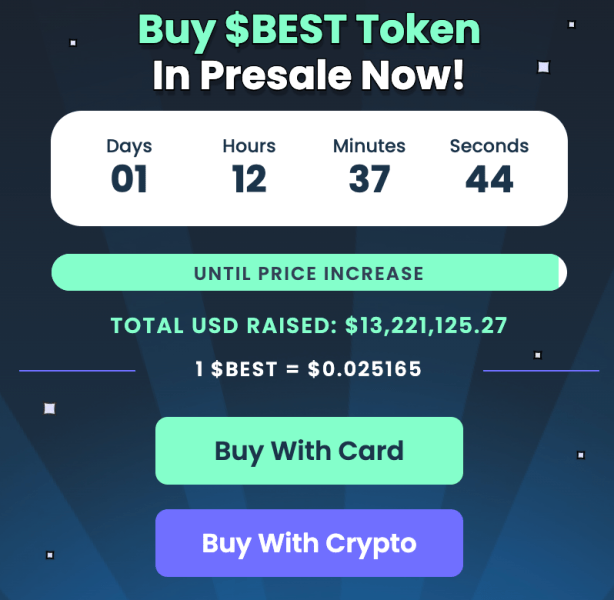
Buy $BEST in the presale phase.

That’s a 186% increase. And if you’re more patient? Predictions for 2026 hit $0.62, which is over 2,360% of today’s price.

Let’s say you grab 10K $BEST at the current price – a $251.65 investment. $BEST offers a 20% APY through staking, so after one year, you’d have 12,000 $BEST.

Even if the price stayed flat, that’s already more tokens in your bag. But if that price hits $0.072 in 2025, your stack would be worth $864 – that’s more than 3x your money in less than a year.

Fast forward to 2026. At $0.62, your 12K tokens could be worth $7,440. That’s from a $250 starting point. You didn’t find a golden goose – you just downloaded a wallet and made a smart play.

Presales come and go, but when a token powers a fast-growing product and delivers real utility, the upside isn’t just hype – it’s structural.

A Smart Time to Get In

The stablecoin era is just getting beginning. Regulation is coming, adoption is rising, and the tools we use today will shape the future of finance.

If you’re looking for a safe bet in a wild market, Best Wallet and $BEST are worth your attention.

Remember that this is not financial advice. Always do your research before investing in crypto.

Editorial Process for bitcoinist is centered on delivering thoroughly researched, accurate, and unbiased content. We uphold strict sourcing standards, and each page undergoes diligent review by our team of top technology experts and seasoned editors. This process ensures the integrity, relevance, and value of our content for our readers.

As a crypto writer, Bogdan’s responsibilities are split between researching and writing articles and entertaining the team with his humor bordering on the politically incorrect, an aspiring Bill Burr, if you will. Thanks to his 12+ years of writing experience in just as many fields, including tech, cybersecurity, modelling, fitness, crypto, and other topics-that-shall-not-be-named, he's become a genuine asset to the team. While his position as a senior writer at PrivacyAffairs thought him valuable lessons about the power of self-management, his entire writing career was and is an exercise in self-improvement. Now, he's ready to sink his teeth into crypto and teach people how to take control of their own money on the blockchain. With fiat as an eternally devaluing currency, Bitcoin and altcoins seem like the best-fitting alternative for Bogdan. Bogdan’s biggest professional accomplishment, aside from securing a position as a main writer for Bitcoinist, was his 5-year run as a writing manager at Blackwood Productions, where he coordinated a team of four writers. During that time, he learned the value of teamwork and that of creating a working environment that breeds efficiency, positivity, and friendship.

Related Reads

Pantera Capital: As Perpetual Contracts Move Towards the Financial Center, Hyperliquid Aims to Be All-Encompassing

Perpetual futures ("perps"), once a crypto-native phenomenon, are becoming a dominant global financial instrument, evolving into a fundamental market structure shift that traditional finance can no longer ignore. This article outlines the advantages of perpetual contracts over traditional futures, highlighting their simplicity (no expiry/rollover), easier risk management, and native 24/7 operation. While the concept is not new, digital assets provided the ideal environment for its explosive growth. Initially dominated by centralized exchanges (CEX), perps have recently migrated significantly to decentralized exchanges (DEX), with Hyperliquid emerging as the leading DEX for perps, capturing ~40% of the on-chain volume. Hyperliquid, built on its own purpose-built L1 blockchain, has successfully expanded beyond crypto into traditional assets like stocks, commodities, and indices, driven by its permissionless listing framework (HIP-3) and 24/7 availability. It has become a crucial price discovery venue during off-hours and for pre-IPO companies, attracting attention from traditional hedge funds and major exchanges like ICE, which now views it as serious competition. The investment thesis for Hyperliquid's token, HYPE, rests on its large and growing total addressable market (TAM) across all finance, strong execution, superior user experience, and direct value accrual via aggressive token buybacks using 99% of protocol revenue. Key risks remain, primarily regulatory uncertainty in the U.S., though recent CFTC actions approving certain regulated crypto perp contracts signal a potential shift toward broader acceptance. The core question is no longer if perpetuals matter beyond crypto, but whether blockchain-based infrastructure like Hyperliquid can become the primary venue for pricing, trading, and discovering risk across all financial domains.

marsbit12m ago

Pantera Capital: As Perpetual Contracts Move Towards the Financial Center, Hyperliquid Aims to Be All-Encompassing

marsbit12m ago

Tiger Research: Zuckerberg Begins Betting on Prediction Markets, While Asian Nations Still View Them as Gambling

This article examines the rise of prediction markets, contrasting their growing institutional acceptance in the West with their restrictive regulation in Asia. It details how prediction markets, which originated from informal political betting and academic experiments like the Iowa Electronic Market, aggregate crowd wisdom into probabilistic prices through binary contracts. Their growth accelerated around 2020, reaching over $14 billion in monthly volume. A key driver is the "skin in the game" principle, where users risk their own capital, leading to high accuracy in predicting events like Fed rate decisions and elections, as demonstrated by platforms like Polymarket. Meta's entry, with Mark Zuckerberg reportedly leading the development of the Arena app, signals the market's maturation. In the U.S., court rulings have distinguished prediction markets from gambling, facilitating entry by traditional financial institutions. However, most Asian jurisdictions still classify them as gambling, focusing on social control rather than financial innovation. The article argues this stance creates three problems for Asia: 1) regulatory arbitrage pushes users to riskier offshore platforms, 2) loss of sovereign information infrastructure as valuable social sentiment data accumulates abroad, and 3) abandonment of user protection. It concludes that Asia needs a policy shift from prohibition to constructive regulation, integrating these markets into the formal system to harness their data as a national asset, as initiatives like Limitless Research are beginning to do.

marsbit2h ago

Tiger Research: Zuckerberg Begins Betting on Prediction Markets, While Asian Nations Still View Them as Gambling

marsbit2h ago

Ethereum's Next Decade in the Eyes of Vitalik

"Lean Ethereum" Long-Term Roadmap Unveiled by Vitalik Buterin On July 5, 2026, Vitalik Buterin published the "Lean Ethereum" roadmap, positioning it as Ethereum's third major evolution following the Merge. This multi-year, multi-phase upgrade aims to fundamentally transform Ethereum's core protocol through staged network upgrades extending to 2029. Key goals include achieving 1 gigagas per second L1 throughput (a massive increase from the current ~32 TPS), near-instant finality, and quantum-resistant cryptography. The plan involves transitioning Ethereum's security model from full transaction re-execution by all nodes to native verification via recursive STARK proofs. A major proposed change is replacing the EVM with a proof-friendly architecture like RISC-V or leanISA, though this remains a point of contention, especially with L2s like Arbitrum favoring alternatives like WASM. Other planned upgrades include a restructured state model with a large, cheap "warehouse" storage layer to drastically reduce fees for migrated applications, multi-dimensional gas pricing, and a new focus on making privacy a first-class, native protocol feature. While the roadmap significantly raises Ethereum's long-term technical ceiling, analysts note it does not directly address ETH's mid-term token economics or value capture. The plan's multi-year timeline means near-term price impact will likely depend on observable progress milestones, such as the successful deployment of the upcoming Glamsterdam gas limit increase, growth in L2 activity and blob usage, and trends in L1 fee revenue and ETH burn.

链捕手4h ago

Ethereum's Next Decade in the Eyes of Vitalik

链捕手4h ago

Trading

Spot
活动图片