Solana whale offloads $10.7M in SOL from $192M vault – Are investors on edge?

AmbcryptoPublished on 2025-04-11Last updated on 2025-04-11

Abstract

SOL has surged 11% amid Trump’s tariff pause and SEC shakeup.

Solana [SOL] is back in the spotlight. In a week marked by shifting regulatory winds and a surprising pause in global trade tensions, SOL has surged 11%, catching the attention of traders and analysts alike.

But beneath the surface of this rally, a major whale move has raised a few eyebrows – and questions.

SOL giant exits

One of Solana’s largest whales — who recently unstaked 1.32 million SOL — has begun offloading. Roughly 100,000 SOL worth $10.7 million was sent to Binance just a day ago.

This move appears to be linked to repaying a $20 million USDC loan, secured after depositing 1.2 million SOL into Kamino.

The whale’s action coincides with SOL’s ongoing rally, intensifying investor scrutiny for possible exit signals. This development could significantly influence market sentiment in the near term.

Macro tailwinds — A breather for risk assets?

President Donald Trump’s 90-day tariff pause and Paul Atkins’ confirmation as SEC Chair have delivered a one-two punch of relief for risk markets.

The tariff rollback offers a break from trade tensions, historically a bullish signal for crypto. Major cryptocurrencies have surged in the hours since the announcement.

Meanwhile, Atkins’ pro-market stance and rollback of enforcement-driven SEC policies signal a friendlier regulatory environment.

Together, these developments are reigniting appetite for higher-beta assets like Solana, with investors interpreting the moment as a green light for capital rotation into crypto.

Technical setup post tariff pause
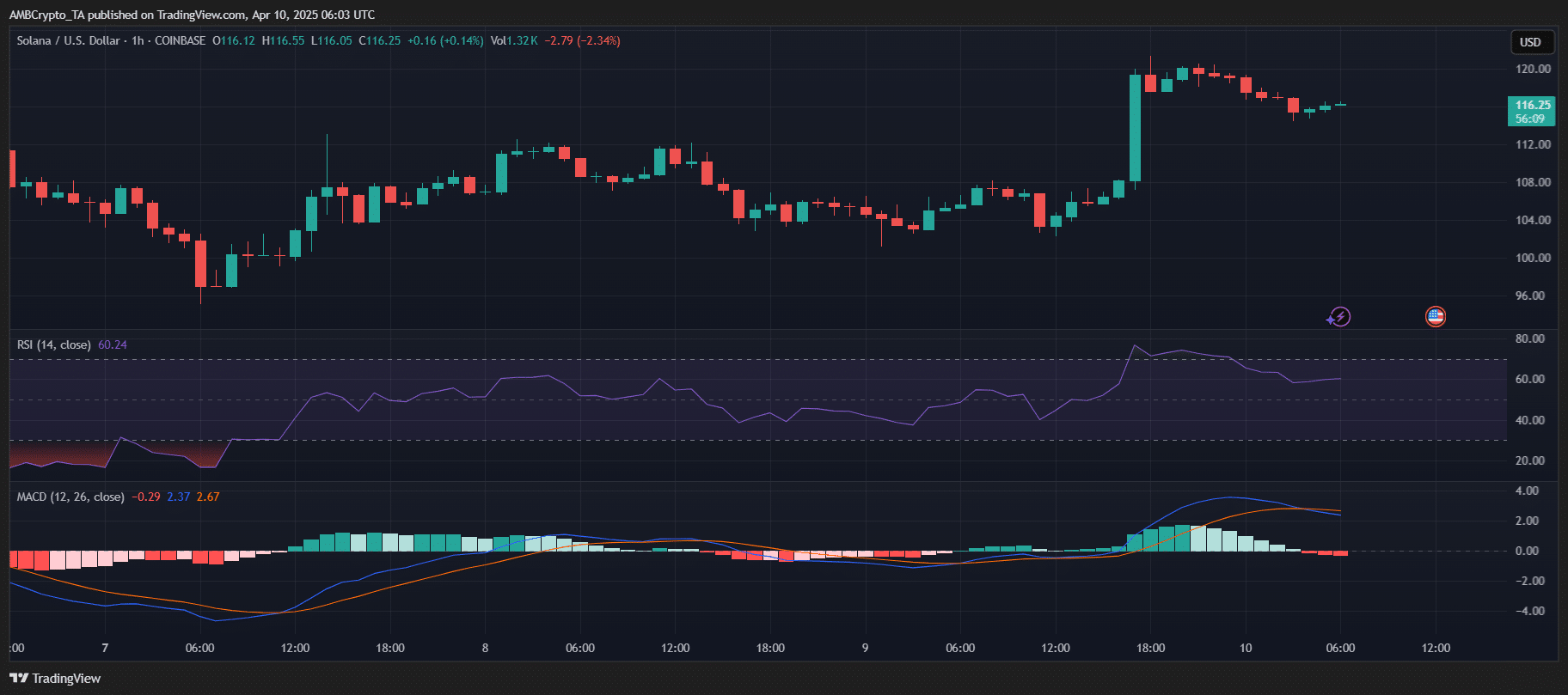
Following President Trump’s tariff pause on the 9th of April, Solana is showing resilience — holding above $160 support with decreasing the selling pressure.

The daily chart suggests a symmetrical triangle forming, hinting at a potential breakout above $180.
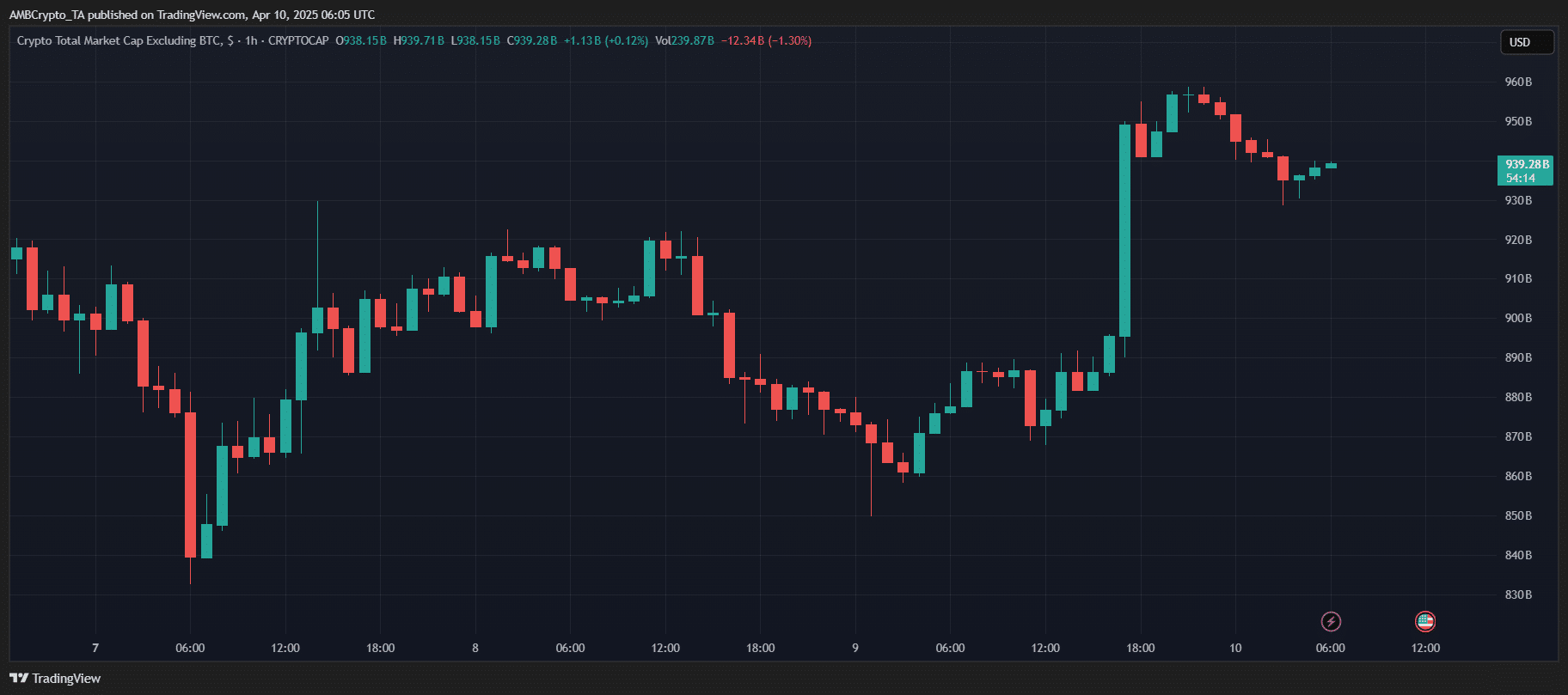
Altcoin market cap has steadily climbed post-announcement, pressing against resistance near $1.17 trillion, signaling renewed investor risk appetite.

This aligns with the macro relief sparked by the tariff delay.
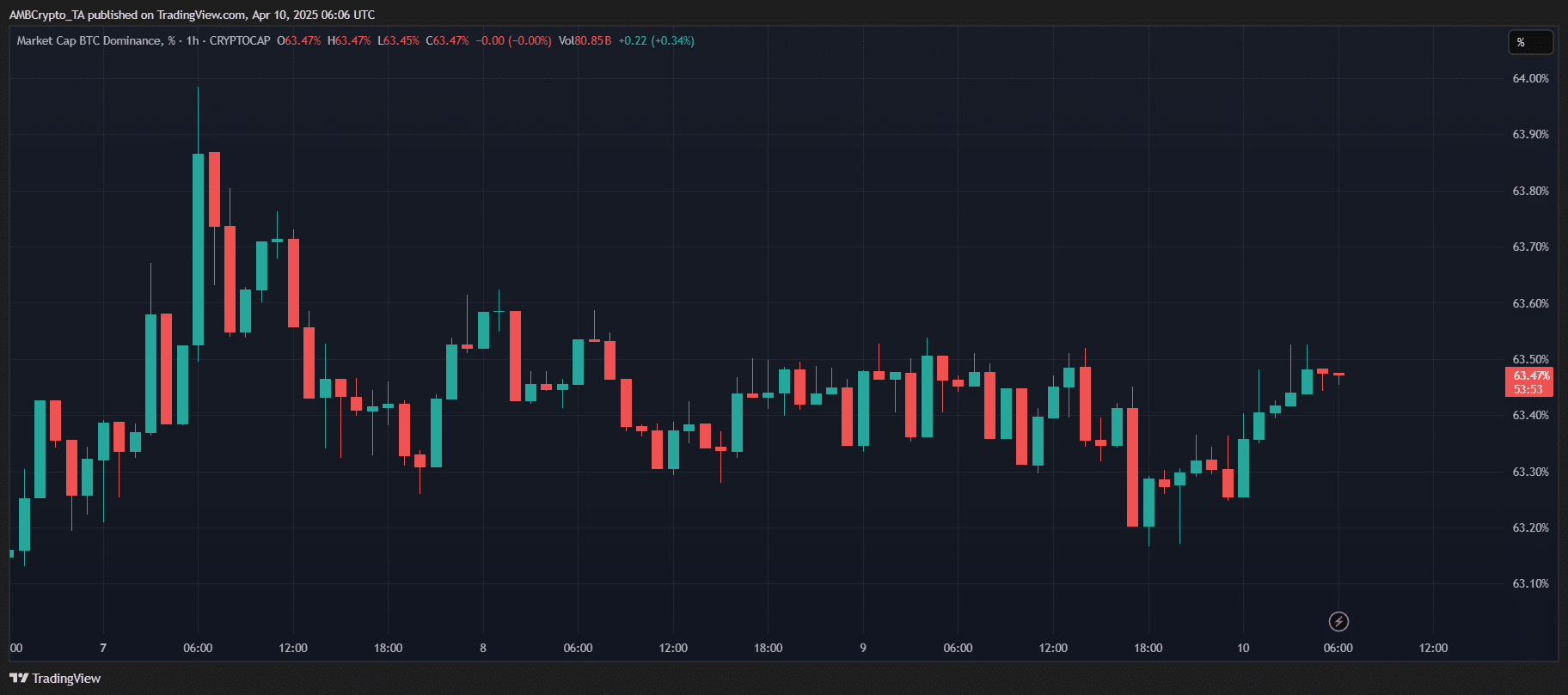
Additionally, at the time of writing, BTC.D was stalling near 55%, with signs of a potential double top formation. A decline below 54.5% could confirm a shift in capital toward altcoins.

Overall, the charts indicate a cautiously optimistic outlook, suggesting an early-stage altcoin resurgence fueled by geopolitical relief.

What could deter SOL’s rally?

Solana’s upward momentum is facing several macroeconomic and market risks. The U.S. CPI report on the 11th of April could heighten concerns about persistent inflation, potentially delaying Federal Reserve rate cuts.

Additionally, President Trump’s tariff policies—such as a universal 10% levy and up to 125% on Chinese goods—may further fuel inflation and unsettle markets over time.

On-chain, the altcoin market cap has slightly cooled since the tariff pause rally. If Bitcoin dominance continues to rise, investors’ risk appetite may shift back to BTC, weakening Solana’s relative strength.


Related Reads

Consumer Confidence Hits Bottom, Macro Correlations Simultaneously Break Down: How Much Longer Can the U.S. Stock Market's Solo Rally Last?

The U.S. stock market is exhibiting a rare divergence: while consumer confidence hits historic lows and traditional macro asset correlations break down, major indices like the Nasdaq 100 and S&P 500 continue reaching record highs, fueled primarily by AI and semiconductor momentum. The rally is now highly concentrated, with strength rotating from giants like Nvidia to higher-beta plays within semiconductors, particularly memory chips. This surge occurs despite a significant split between pessimistic consumer sentiment and still-resilient actual spending behavior, partially supported by fiscal stimulus. Goldman Sachs traders highlight a critical structural fissure: correlations between the S&P 500 and key macro assets (rates, gold, VIX, oil) have deviated extremely from long-term historical norms. Concurrently, the market is in a negative Gamma regime, making it more sensitive to price moves, and hedge fund positioning in momentum and semiconductors is at crowded levels. The sustainability of this "solo rally" faces three main constraints: 1) Oil price volatility linked to Middle East geopolitical risks, 2) Extreme crowding in semiconductor and momentum trades, increasing vulnerability to disappointments, and 3) The breakdown of traditional macro correlations, suggesting the rally reflects a specific mix of factors rather than broad-based risk appetite. The key question is not if indices can rise further, but which variable—oil, rates, or semiconductor momentum—might trigger a repricing of the current fragile logic.

marsbit25m ago

Consumer Confidence Hits Bottom, Macro Correlations Simultaneously Break Down: How Much Longer Can the U.S. Stock Market's Solo Rally Last?

marsbit25m ago

Will OpenAI Swallow the Application Layer? a16z Says Real Opportunities Lie Outside General Models

As large language models (LLMs) from companies like OpenAI and Anthropic become more powerful, many fear they will dominate the AI application layer, leaving no room for startups. However, this article argues that the real opportunity lies not on the "Yellow Brick Road"—the high-profile, general-purpose tasks like code and text generation that model labs are directly pursuing—but in the "rest of Oz": complex, vertical-specific applications. On the Yellow Brick Road, model companies have inherent advantages: control over the model, better margins, pricing power, and strong distribution. Startups building generic, horizontal "co-pilot" tools for standard tasks are competing directly on this path and are vulnerable. True defensibility and value are found in specialized, vertical applications. These involve deep integration into messy, multi-step business workflows (e.g., sales, insurance, legal), handling legacy systems, data quality issues, compliance, and governance. The "scaffolding" around the model—the specialized tools, automations, workflows, and industry knowledge—becomes more critical than the raw model power itself. Vertical AI companies can build defensible moats through: * **Data & Learning Flywheels:** Capturing unwritten industry practices and specific customer feedback not found in public training data. * **Managing Model Complexity:** Routinely evaluating and routing queries across multiple models (including open-source) to optimize for performance and cost, and absorbing the migration burden of model upgrades for clients. * **Cost Optimization:** Using cheaper, fine-tuned models for specific sub-tasks instead of always calling the most expensive, general-purpose model. * **Governance & Compliance:** Providing the control plane for permissions, auditing, and ensuring compliance with industry-specific regulations (e.g., HIPAA, FINRA). Examples from sales (11x) and insurance (FurtherAI) illustrate that clients pay for systems that drive specific business outcomes (e.g., sales pipeline, policy underwriting), not for generic intelligence. These systems become the "operational memory" of a business, a layer that is hard to replace, even as the underlying LLMs commoditize and improve. To test if a startup is building in the "rest of Oz," it should pass checks like the **Tool & Steps Test** (requires complex, multi-step workflows), the **System Test** (owns the end-to-end workflow, not just a tool on top), and the **Hedge Fund / P&L Test** (measured by client business outcomes, not benchmark scores). Both model labs and vertical application companies will win. The next generation of enterprise software will be built in the specialized, complex, and high-value territory beyond the Yellow Brick Road.

marsbit53m ago

Will OpenAI Swallow the Application Layer? a16z Says Real Opportunities Lie Outside General Models

marsbit53m ago

'ASIC Giant' Marvell Sets Record Quarterly Revenue, Raises Guidance Again, CEO Says Data Center Business Is 'On Fire'

Marvell Technology, a leading player in custom AI chips and data center connectivity, reported record revenue for its fiscal Q1 2027, driven by explosive demand in its data center business. Revenue reached $2.418 billion, slightly surpassing expectations, though GAAP net income fell year-over-year due to acquisition-related costs. Crucially, data center revenue hit $1.83 billion, making up 76% of the total and growing 27% YoY. The company significantly raised its full-year and next-year guidance, citing "exceptionally strong AI-related orders." Revenue is now projected at ~$11.5 billion for FY2027 and ~$16.5 billion for FY2028. CEO Matt Murphy emphasized that growth in the data center segment is accelerating. The AI Interconnect business, now expected to grow over 70% annually, saw its forecast lifted again due to rising network demands in complex AI models. Additionally, Marvell's custom chip (XPU) business is on a steep growth path, with FY2028 revenue anticipated to double and a target of over $10 billion by FY2029. The company also expanded its strategic collaboration with NVIDIA, focusing on silicon photonics, system integration, and AI-RAN solutions. To secure supply for surging demand, Marvell plans about $1 billion in supplier prepayments this fiscal year, highlighting its long-term capacity planning. Despite the strong results, the stock dipped slightly in after-hours trading.

marsbit1h ago

'ASIC Giant' Marvell Sets Record Quarterly Revenue, Raises Guidance Again, CEO Says Data Center Business Is 'On Fire'

marsbit1h ago

Trading

Spot
Futures

Hot Articles

Discussions

Welcome to the HTX Community. Here, you can stay informed about the latest platform developments and gain access to professional market insights. Users' opinions on the price of SOL (SOL) are presented below.

活动图片