Что происходит с XRP? Судебные странности, подача фьючерсов на Coinbase, микс из сброса поставок

cryptonews.ruPublished on 2024-02-04Last updated on 2025-04-04

  • Странная «экстренная» подача документов оштрафованными отдельными сторонами в деле Ripple против SEC
  • Coinbase Derivatives подает в CFTC заявку на самостоятельную сертификацию фьючерсов XRP (запуск 21 апреля)
  • Эскроу-счет Ripple выпускает 1 миллиард XRP, усиливая давление продаж по и без того слабой цене

Длительная судебная тяжба между SEC и Ripple Labs получила необычное развитие в четверг, когда всплыло неожиданное судебное заявление, дополнившее череду недавних новостей, влияющих на XRP.

🚨NEW: An odd filing just now in the @SECGov vs. @Ripple docket — an emergency request to “present decisive evidence in favor of the defendants and in favor of liberty for the American people.”

The letter, from a man named Justin W. Keener, doesn’t make clear what the so-called… pic.twitter.com/AQSDFIW6gi

— Eleanor Terrett (@EleanorTerrett) April 3, 2025

В деле SEC против Ripple появились странные судебные иски

Элеанор Терретт, ведущая CryptoAmerica и бывший журналист FOX Business, обратила внимание на необычную запись в судебном досье: письмо с «чрезвычайным запросом», поданное Джастином У. Кинером. В иске утверждается, что он представляет «решающие доказательства в пользу ответчиков [Ripple] и в пользу свободы американского народа», хотя суть остается неясной.

У Кинера сложилась сложная ситуация с SEC: недавно против него был возбужден иск за деятельность в качестве незарегистрированного дилера дешевых акций, в результате чего суд вынес постановление о штрафе в размере более 10 миллионов долларов.

Он утверждает, что обладает конфиденциальными знаниями относительно физических инвестиционных контрактов и теста Хауи, имеющих отношение к делу Ripple, что потенциально может принести пользу Ripple, криптоиндустрии и Конгрессу.

По теме: XRP против BTC: данные Glassnode сопоставляют пути роста розничных и институциональных активов

Файлы деривативов Coinbase для фьючерсов XRP

В качестве отдельной, потенциально позитивной новости для доступа к XRP, компания Coinbase Derivatives объявила о подаче в Комиссию по торговле товарными фьючерсами (CFTC) заявки на самосертификацию фьючерсных контрактов XRP.

Ожидается, что запуск продукта, который описывается как «регулируемый, капиталоэффективный способ» инвестирования в XRP, состоится 21 апреля 2025 года.

We're excited to announce that Coinbase Derivatives has filed with the CFTC to self-certify $XRP futures — bringing a regulated, capital-efficient way to gain exposure to one of the most liquid digital assets.

We anticipate the contract going live on April 21, 2025.

Stay tuned… pic.twitter.com/nKUPjjnMKW

— Coinbase Institutional 🛡️ (@CoinbaseInsto) April 3, 2025

Массовый выпуск XRP Escrow усиливает давление на рынок

Блокчейн-трекер Whale Alert обнаружил значительное движение XRP со счетов условного депонирования Ripple. Около 1 млрд XRP было перемещено в трех крупных транзакциях (500 млн, 200 млн и 300 млн XRP).
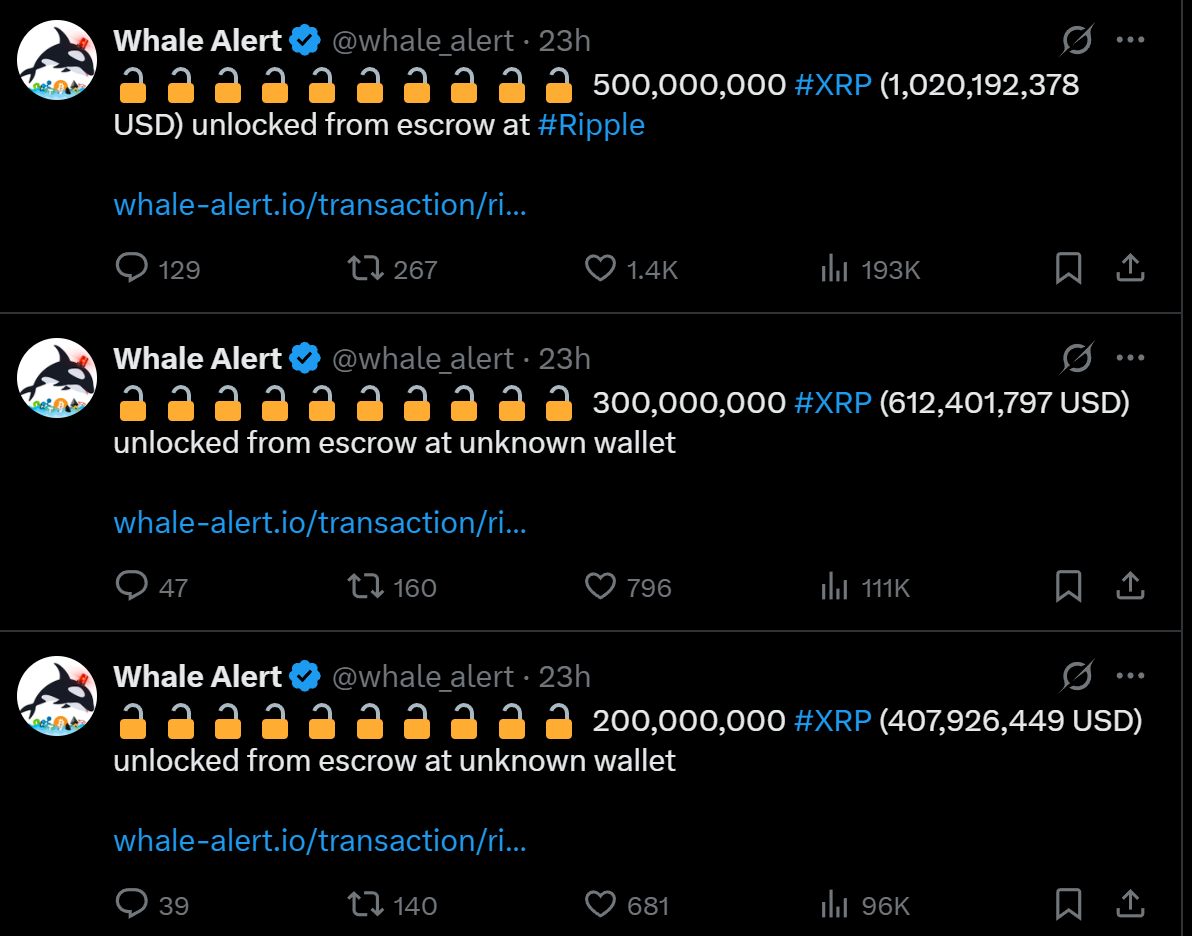
Такие крупные выпуски эскроу-токенов обычно вызывают обеспокоенность рынка относительно потенциального увеличения оборотного предложения, оказывая понижательное давление на и без того слабую цену XRP.

Цена XRP остается под давлением

Подтверждая это давление, XRP торговался значительно ниже своей 20-дневной экспоненциальной скользящей средней (EMA), которая на момент составления отчета представляла собой заметный уровень сопротивления для альткоина.

Связанный: Enterprise Focus: Ripple интегрирует стейблкоин RLUSD в основные платежи

Последние переводы средств со счетов условного депонирования также могут усилить существующий медвежий технический прогноз.

Trending Cryptos

Related Reads

A Year Consumes a Solid-State Drive: Codex Log Bug Slammed as 'Slopware'

OpenAI's flagship AI coding tool, Codex, was found to have a critical bug causing its feedback logging system to silently and rapidly wear out users' SSDs. A developer reported that Codex was writing approximately 640 TB of data per year to a local SQLite database (`logs_2.sqlite`) through a constant cycle of inserting and immediately deleting log entries, primarily at the verbose TRACE level. While the database file itself remained around 1 GB, the underlying write-amplification from SQLite's WAL mechanism meant the physical SSD endured the full write load. This was enough to exceed the typical 600 TBW endurance rating of a consumer SSD within a year. The root cause was a hardcoded default logging level (`Level::TRACE`) in the configuration, which overrode any user attempts to reduce logging via environment variables. Analysis showed that over 96% of the logged data—including noisy WebSocket packet dumps and repeated system file events—was useless debug information. The issue, which had at least nine related bug reports in the Codex repository, remained latent because it didn't visibly consume disk space, only silently accumulated write cycles. After the report gained traction on Hacker News, OpenAI merged fixes estimated to reduce writes by about 85%. However, even post-fix, the tool would still write an estimated 96 TB annually. The incident sparked broader criticism of "slopware" in AI-assisted development tools, highlighting a lack of resource budgeting for disk, CPU, and memory in always-on agent software, and a reliance on modern hardware to mask inefficient code. Competing tools like Claude Code were noted to have similar issues.

marsbit7m ago

A Year Consumes a Solid-State Drive: Codex Log Bug Slammed as 'Slopware'

marsbit7m ago

Robinhood Chain Mainnet Launch Ignites Industry Shockwaves: Rally of Top Protocols, but Leaves dYdX in a Deep Pit

Robinhood's launch of its Layer 2 blockchain, Robinhood Chain, and a suite of new crypto products has significantly impacted the market. The announcement, made ahead of its Q2 earnings, caused the company's stock to rise 8.35%. The chain, built on Arbitrum Orbit, aims to be an institutional-grade, AI-native infrastructure optimized for Real World Assets (RWA). Key product launches include tokenized stocks available globally via various DEXs, perpetual contracts with fee incentives, and a decentralized lending product called Robinhood Earn offering yields on USDG stablecoin. The company is also expanding its AI trading tools to crypto. The move has attracted major protocols like Uniswap and Chainlink to its ecosystem. However, a partnership with dYdX to launch a new DEX called Arcus on Robinhood Chain sparked controversy. The dYdX community expressed concerns that the core team's focus on this new, independent platform could divert resources and liquidity away from the existing dYdX Chain, potentially diluting the value of the DYDX token. Despite assurances from dYdX's founder about shared interests and potential future token allocations for the dYdX community, the DYDX token price dropped roughly 40.7% following the news. Amidst slowing crypto revenue growth, Robinhood is leveraging its large user base and financial expertise to expand globally and transform from an internet broker into a broader financial gateway through its new blockchain initiative.

链捕手8m ago

Robinhood Chain Mainnet Launch Ignites Industry Shockwaves: Rally of Top Protocols, but Leaves dYdX in a Deep Pit

链捕手8m ago

The Trillion-Dollar Credit Market Leveraged by Stablecoins, Stuck in Off-Chain Risk Control

**Stablecoins Fueling Trillion-Dollar Private Credit Market, Hampered by Off-Chain Risk Management** This article examines how interest-bearing stablecoins are replicating the business model of money market funds to democratize access to the $2 trillion private credit market, while highlighting the significant risks posed by inadequate off-chain risk controls. Historically, private credit investments had high minimums (e.g., $1 million+) due to costly due diligence and loan servicing. Stablecoins like Apollo's ACRED and Figure's YLDS are bridging this gap. They tokenize institutional credit funds, allowing small investors to gain exposure and enabling new functionalities like using these tokens as collateral in DeFi for leveraged yield. The on-chain private credit market has grown 15x in a year to $5.87 billion, yet remains a tiny fraction of the global total. However, the core challenge is not blockchain technology but managing the inherent risks of lending, which occur off-chain. The failure of Goldfinch, a pioneer in on-chain private credit, serves as a stark warning. It raised funds in crypto (USDC) to lend to small businesses in markets like Kenya and Nigeria. While smart contracts handled fund distribution, critical functions—local due diligence, monitoring loan use, and debt collection—relied on off-chain partners. A major breach, where a local partner misappropriated nearly 40% of funds, went undetected for months. When borrowers defaulted, crypto depositors had no effective legal recourse or means to seize assets, leaving $56 million trapped in non-performing loans with a projected 8-15 year recovery timeline. The article concludes that tokenization addresses only 10% of the credit business—the distribution. The remaining 90%—rigorous risk assessment and collection infrastructure—is expensive and localization-dependent. Without solving these fundamental off-chain challenges, the sector risks repeating Goldfinch's collapse.

Foresight News51m ago

The Trillion-Dollar Credit Market Leveraged by Stablecoins, Stuck in Off-Chain Risk Control

Foresight News51m ago

Solana Expands Validator Power With Launch of On-Chain Governance

Solana has formally launched its on-chain governance system, empowering token holders and validators with a more open and decentralized way to influence major protocol decisions. Governance debates and voting are now conducted entirely on-chain using the new Solana Governance Proposals (SGP) framework, supported by stake-weighted voting and cryptographic verification. Validators with at least 100,000 SOL in delegated stake can submit an SGP. To proceed to a formal vote, a proposal must first gain support from at least 15% of the network's total staked SOL, ensuring only ideas with significant backing move forward. SGPs serve a distinct purpose from the technical Solana Improvement Documents (SIMDs). While SIMDs focus on *how* to implement protocol upgrades, SGPs determine *whether* the broader ecosystem believes a proposal should proceed, via an on-chain, stake-weighted vote. This separation allows core developers to continue building effectively while reserving community-wide votes for impactful decisions. A key feature grants delegators greater control: they can now override their validator's governance vote. If a validator votes against a delegator's preference or abstains, the delegator can cast a vote directly using their own stake weight through Solana's governance portal. The voting process is secured using Merkle proofs to verify participant stakes against an on-chain consensus snapshot. With this implementation, Solana aims to broaden community participation in governance without hindering development, combining decentralized decision-making with efficient protocol evolution.

TheNewsCrypto1h ago

Solana Expands Validator Power With Launch of On-Chain Governance

TheNewsCrypto1h ago

Trading

Spot

Hot Articles

What is XRP 2.0

XRP 2.0: A New Frontier in the Cryptocurrency Landscape Introduction to XRP 2.0 In the ever-evolving realm of cryptocurrency, new projects continuously emerge, vying for attention and adoption. One such promising initiative is XRP 2.0, a novel cryptocurrency project designed to leverage advanced blockchain technology and robust encryption methodologies. While the name draws parallels with Ripple’s XRP, it’s crucial to note that XRP 2.0 operates independently, focusing on enhancing transaction security, privacy, and scalability. As the digital financial landscape increasingly embraces decentralized solutions, XRP 2.0 aims to contribute meaningfully to web3 and the overall expansion of crypto projects. What is XRP 2.0? At its core, XRP 2.0 is a cryptocurrency project that aims to create a secure and decentralized digital currency ecosystem. Its foundational technology integrates sophisticated blockchain principles with cutting-edge encryption techniques. The overarching goal of XRP 2.0 is to establish itself as a reliable and efficient platform enabling swift transaction execution while prioritizing enhanced privacy protections for its users. The project is promoted as a solution to many limitations faced by existing cryptocurrencies, proposing a system that can handle a higher volume of transactions with improved speed and privacy. This versatility positions XRP 2.0 as a significant contender in a marketplace riddled with various digital currencies. Who is the Creator of XRP 2.0? The identity of the creator behind XRP 2.0 has been flagged as ‘Wilbur.’ However, comprehensive details regarding Wilbur or their associated entity remain elusive. The anonymity of many cryptocurrency creators is not an uncommon phenomenon in the industry, often designed to maintain a degree of privacy and security. Who are the Investors of XRP 2.0? As of now, specific information related to the investment foundations or organizations supporting XRP 2.0 is not publicly available. In the cryptocurrency sector, the backing by reputed investors can significantly influence a project's credibility and success, yet the transparency regarding the financial supporters of XRP 2.0 has not been established. How Does XRP 2.0 Work? XRP 2.0 stands out by employing a combination of blockchain technology and advanced encryption algorithms that ensures secure and decentralized transactions. Its innovative structure includes unique features designed to foster user engagement and broaden functionalities beyond conventional cryptocurrency transactions. Among these features, XRP 2.0 incorporates AI-powered capabilities, such as text-to-image and text-to-speech functionalities. These additions are designed to enhance the interactive experience for users, promoting broader applicability across various sectors. By bridging technological advancements with user-centered design, XRP 2.0 aims to capture the attention of a diverse range of individuals and enterprises looking to integrate cryptocurrency solutions into their operational frameworks. Timeline of XRP 2.0 Understanding XRP 2.0 requires examining the milestones that have defined its journey thus far: July 23, 2023: XRP 2.0 is introduced as a novel cryptocurrency project, aiming to revolutionize secure and decentralized transaction capabilities in the blockchain domain. September 8, 2023: The launching of another project, XRP20, occurs, marking the emergence of an ERC-20 token on the Ethereum blockchain that remains unrelated to XRP 2.0. November 13, 2023: The XRP Ledger undergoes a significant update with the release of rippled server software version 2.0.0. It is essential to note that this development is disconnected from the XRP 2.0 cryptocurrency project. Key Points About XRP 2.0 To distill the essence of XRP 2.0, several critical factors emerge: Unique Features: The inclusion of features like AI-powered text-to-image and text-to-speech further diversifies the potential applications of XRP 2.0. Blockchain Technology: The framework utilizes advanced blockchain mechanisms and encryption protocols, ensuring a secure and decentralized environment for transactions. Scalability and Privacy: XRP 2.0 prioritizes enhanced privacy protections in transaction processes and the scalability necessary to accommodate a growing user base. No Affiliation with Ripple: Importantly, despite its name, XRP 2.0 does not have any allegiance or collaboration with Ripple’s XRP, distinguishing its operational framework and objectives within the cryptocurrency ecosystem. Conclusion XRP 2.0 represents an ambitious venture into the cryptocurrency sphere, aiming to offer a combination of security, privacy, and efficiency in digital transactions. By integrating sophisticated technologies and user-friendly features, the project sets out to broaden the horizons of what cryptocurrency can achieve in today's digital economy. While the anonymity of its creator and lack of disclosed investors might raise questions for some, XRP 2.0's focus on advanced functionalities and decentralisation enhances its appeal amidst an increasingly crowded crypto market. As the cryptocurrency landscape continues to evolve, XRP 2.0 may yet emerge as a pivotal player in the expansion of secure and scalable blockchain solutions.

1.0k Total ViewsPublished 2024.04.01Updated 2024.12.03

What is XRP 2.0

Discussions

Welcome to the HTX Community. Here, you can stay informed about the latest platform developments and gain access to professional market insights. Users' opinions on the price of XRP (XRP) are presented below.

活动图片