За сутки секторы спотовых биткоин- и Ethereum-ETF потеряли более $161 млн

cryptonews.ruPublished on 2021-07-02Last updated on 2025-04-02

  • В секторе спотовых биткоин-ETF наблюдался отток капитала в размере $157,64 млн.
  • Из спотовых Ethereum-ETF инвесторы изъяли $3,58 млн.

1 апреля 2025 года спотовые биткоин-ETF зафиксировали отток средств на сумму $157,64 млн, согласно данным SoSoValue. Негативная динамика наблюдается третий день подряд.
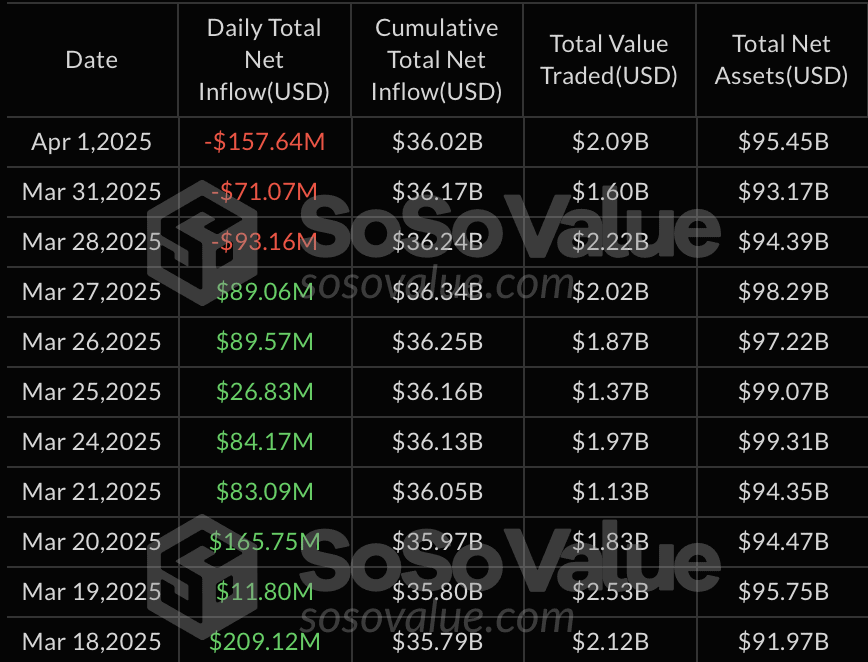
Динамика притока капитала в спотовые биткоин-ETF США. Данные: SoSoValue.

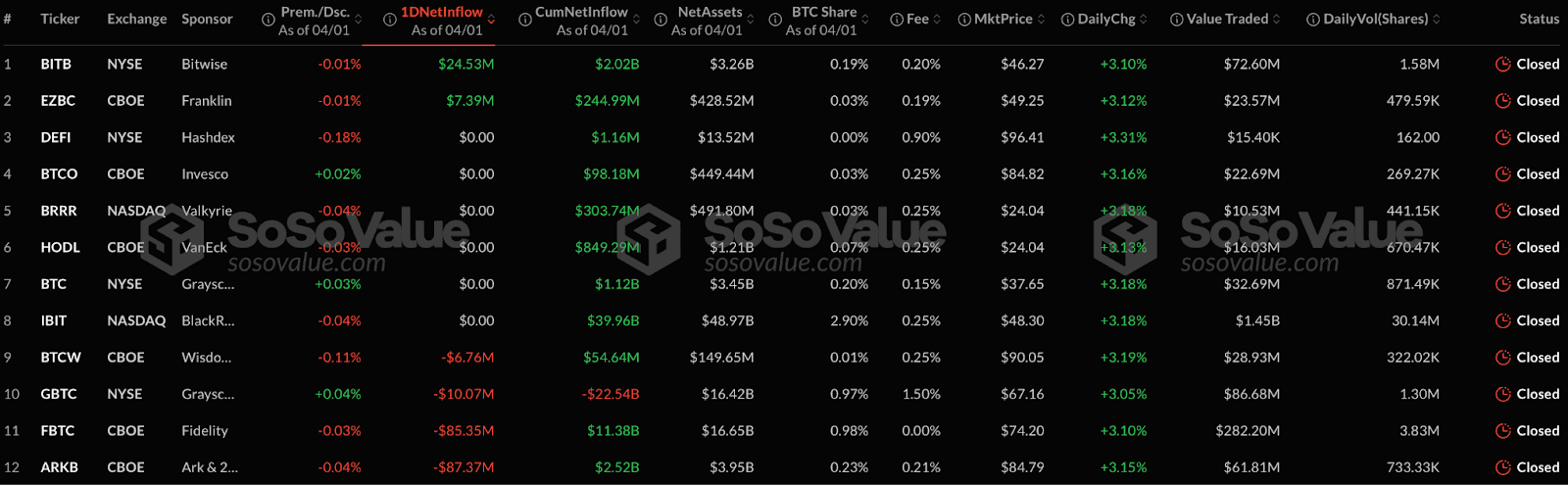
По данным платформы, только BITB от Bitwise и EZBC от Franklin Templeton имели приток капитала в размере $24,53 млн и $7,39 млн, тогда как в шести биржевых фондах движение средств отсутствует.

Из четырех спотовых биткоин-ETF, распределение которых выглядит следующим образом, изъяли капитал:

  • ARKB — $87,37 млн;
  • FBTC — $85,35 млн;
  • GBTC — $10,07 млн;
  • BTCW — $6,76 млн.
Приток/отток капитала в секторе спотовых биткоин-ETF США. Источник: SoSoValue.

Спотовые Ethereum-ETF также имели отток капитала в размере $3,58 млн. В то же время два предыдущих торговых дня были для второй по капитализации криптовалюты «в плюсе».

Динамика притока капитала в спотовые Ethereum-ETF США. Данные: SoSoValue.

Из ETHW от Bitwise и ETH от Grayscale изъяли по $2,6 млн и $2,7 млн соответственно, а CETH от 21Share, напротив, привлек инвестиций на сумму $1,72 млн. Остальные фонды не получали средства под управление.
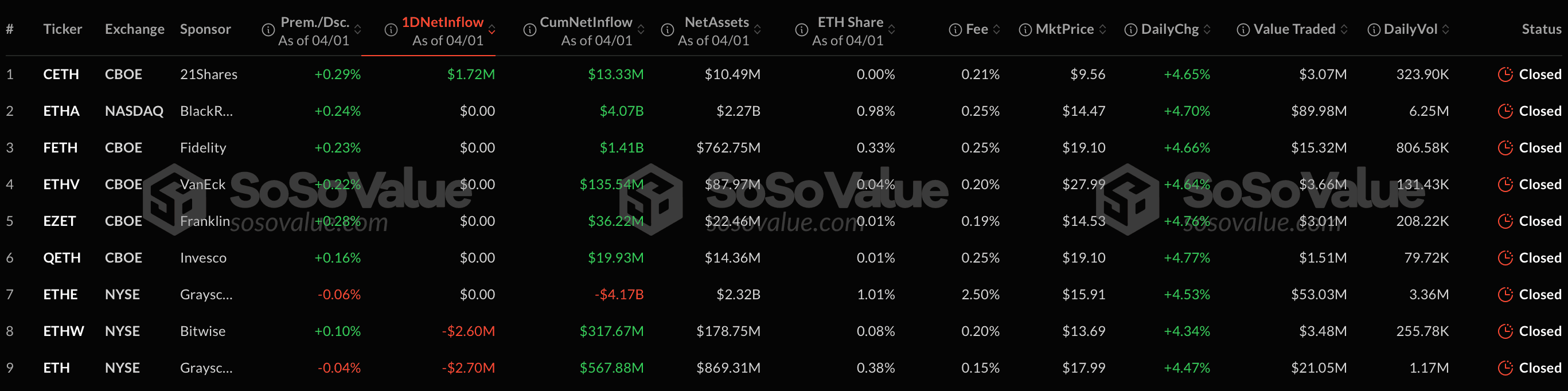
Приток/отток капитала в секторе спотовых Ethereum-ETF США. Источник: SoSoValue.

О том, что такое Ethereum-ETF, мы рассказывали в отдельном материале:

Напомним, что за март 2025 года биржевые фонды на базе биткоина потеряли $767,91 млн, а на базе Ethereum — $403,37 млн.


Trending Cryptos

Related Reads

U.S. Stock Market Trend (August 11): Oil Prices Surge, Treasury Yields Rise, Tech Stocks Under Pressure, Optical Communication Plummets

U.S. Stock Market Trends (August 11): Oil Surge and Rising Bond Yields Pressure Tech; Optical Communication Stocks Plunge. U.S. stock indices closed slightly lower on Monday, with the S&P 500 and Dow Jones retreating from recent record highs. The primary market pressures were a significant oil price jump of over 5% amid unresolved negotiations to reopen the Strait of Hormuz and a consequent rise in U.S. Treasury yields, which weighed on growth stock valuations. The technology sector faced pressure, with Nvidia falling nearly 3% despite news of its pursuit of a $500 billion AI infrastructure financing consortium with major Wall Street firms. The optical communication sector saw a sharp sell-off, with Coherent dropping over 14%. In contrast, Chinese stocks listed in the U.S. were a notable bright spot, as the Nasdaq Golden Dragon China Index rose nearly 2%. Gold prices advanced for a second consecutive session on inflation hedging demand, while Bitcoin fell below $64,000. Key market movers included surging oil prices (WTI and Brent up ~5%) due to stalled Strait of Hormuz talks and heightened supply concerns, pushing the 10-year Treasury yield near 4.71%. Major tech stocks were mixed. Beyond Nvidia's decline, Intel fell over 4% on a new share offering plan. The Philadelphia Semiconductor Index dropped approximately 1.2%. Market attention remains on oil price dynamics, the impact of rising yields, and the forthcoming U.S. CPI data.

marsbit4m ago

U.S. Stock Market Trend (August 11): Oil Prices Surge, Treasury Yields Rise, Tech Stocks Under Pressure, Optical Communication Plummets

marsbit4m ago

JP Morgan Research Report Analysis: SK Hynix Fell 15% Last Week, Concerns Over HBM Pricing Overblown and Shareholder Returns to Land Ahead of Schedule

JPMorgan Research Report Interpretation: Addressing Concerns on SK Hynix's Recent Share Price Decline SK Hynix's stock fell 15% last week, underperforming the KOSPI (-5%) and Samsung (-9%). Key investor concerns centered on HBM pricing uncertainty, unclear shareholder return timelines, and a recently disclosed ₩54 trillion capital expenditure plan. JPMorgan's August 9 report addresses each point. Regarding HBM, JPMorgan refutes inaccurate media reports suggesting potential 50% price discounts for HBM4 in 2027. The firm's conservative model assumes <40% average HBM price growth by 2027, based on factors including memory suppliers prioritizing high-margin DDR5/LPDDR5/NAND in LTA allocations and the long-term partnership with key customer NVIDIA. The most significant near-term catalyst is shareholder returns. SK Hynix has committed to announcing additional shareholder return measures before the end of Q3 (September), earlier than its prior "year-end" guidance. JPMorgan anticipates a progressive policy, supported by an estimated cumulative free cash flow exceeding ₩800 trillion over three years and proceeds from the Kioxia stake sale. The substantial ₩54 trillion capex plan is for two new memory fabs to support its 2030 roadmap, not short-term aggressive expansion. The Yongin Y2 DRAM fab (₩35.2tn) and Cheongju M17 NAND fab (₩19.1tn) have construction starts scheduled for 2027, with clean room completion and investments stretching to 2028-2031. JPMorgan sees limited strategic value in a potential IPO for subsidiary Solidigm, noting SK Hynix's strong internal cash flow can fund capex without dilution, and an IPO might trigger dual-listing rule constraints in Korea. The report concludes last week's sell-off was an overreaction. JPMorgan maintains its Overweight rating and ₩2.75 million price target (~7x avg. 2026-2027 EPS), asserting the memory super-cycle thesis and SK Hynix's fundamentals remain intact.

marsbit7m ago

JP Morgan Research Report Analysis: SK Hynix Fell 15% Last Week, Concerns Over HBM Pricing Overblown and Shareholder Returns to Land Ahead of Schedule

marsbit7m ago

The Post-Crypto Era Outlook: Asset Valuation Returns to Fundamentals, What to Watch for the Next Decade?

Cryptoeconomy at a Turning Point: Valuations Reset, Focus Shifts to Real Value The cryptoeconomy is undergoing its most significant transformation yet, moving from speculative excess to a focus on sustainable, value-generating applications. After the 2021 hype cycle, which saw unsustainable valuations, the market has experienced a prolonged "reversion to the mean." Structural issues like cyclical revenues, regulatory uncertainty, and misaligned incentives between equity and token holders led to widespread fatigue. However, these problems are now widely recognized and are being addressed. A key shift is the emergence of applications demonstrating real, compounding growth independent of token prices. These include peer-to-peer internet platforms, global digital dollars, permissionless exchanges, novel derivatives, global collateral markets, and open financing platforms. Leading blockchains like Ethereum and Solana are solidifying their positions as foundational monetary and financial layers for the internet. Simultaneously, traditional financial and tech institutions are accelerating their blockchain integration with production-grade products, moving beyond mere experiments. Clearer regulations are enabling a shift from compliance concerns to exploring new business models. While the broader cryptoeconomy's emergence appears inevitable—driven by declining institutional trust, monetary devaluation, and a desire for fairer systems—intense competition means only a few native projects will become the dominant winners. The current phase offers a unique opportunity for investors, as leading projects are potentially undervalued after years of consolidation. The task is no longer to debate the technology's viability but to identify and capitalize on the real value being built for the next decade.

marsbit7m ago

The Post-Crypto Era Outlook: Asset Valuation Returns to Fundamentals, What to Watch for the Next Decade?

marsbit7m ago

Outlook for the Post-Encryption Era: Asset Valuation Returns, What to Watch in the Next Decade?

The crypto economy is undergoing its most significant transformation in eight years, characterized by a shift from speculative frenzy to fundamental-driven growth. After the extreme overvaluation and unrealistic expectations of 2021, asset prices, including Bitcoin relative to gold, have corrected significantly. This reset has exposed structural industry weaknesses such as cyclical revenues, regulatory uncertainty, misaligned incentives between equity and token holders, poor disclosure, and a lack of common valuation frameworks, leading to widespread investor fatigue. However, this correction is healthy and has set the stage for a more mature phase. Numerous real-world use cases have emerged and are exhibiting compound growth, independent of token prices. These include peer-to-peer internet platforms, global digital dollars, permissionless exchanges, novel derivatives, global collateral markets, democratized asset creation, open fundraising platforms, and decentralized physical infrastructure networks. Key issues like dual-token models are being resolved, disclosure is improving, and a consensus is forming that most assets must generate cash flow. The leading blockchains (e.g., Ethereum, Solana) are becoming the monetary and financial base layer of the internet, with entrenched network effects. Established Wall Street and Silicon Valley institutions are now launching production-grade products on public chains, a shift accelerated by clearer regulations. While valuations have reset and growth models remain conservative, the potential for exponential growth remains. The broader macro environment—declining institutional trust, unsustainable sovereign debt, currency debasement, deglobalization, and a generational wealth transfer—is uniquely favorable for crypto's adoption. The market is not uniformly maturing; it consists of various products at different adoption stages where speculation will persist in cycles. The core opportunity lies in identifying the few native projects that will become foundational winners as the world rebuilds its economic systems. The current period of disillusionment conceals a generational opportunity for those betting on the new paradigm rather than mourning the old one.

Odaily星球日报41m ago

Outlook for the Post-Encryption Era: Asset Valuation Returns, What to Watch in the Next Decade?

Odaily星球日报41m ago

Cache hit rate reaches 99.93%, the best Harness for DeepSeek is here, GitHub pulls in 86k Stars

The open-source programming agent "Pi" has surged in popularity on GitHub, amassing around 86,000 stars, largely due to its exceptional efficiency when paired with DeepSeek's models. A key highlight is its remarkably high cache hit rate of approximately 99.93% for input tokens when using DeepSeek. This minimal cache miss rate of 0.07% means most repeated context is reused, drastically reducing computational costs. In a benchmark test by Composio comparing eight major agent harnesses running DeepSeek V4 Flash, Pi achieved the lowest average cost per successful task at about $0.028, significantly outperforming others like Claude Code, which was nearly seven times more expensive. Pi functions as a streamlined "harness" or workspace for AI models, providing core tools like file read/write and command execution while allowing users to add extensions. Its simplicity and specific adaptation for DeepSeek's API—handling its unique reasoning content and tool call formats—make it highly compatible. This design maximizes the efficiency of DeepSeek's low-cost tokens and powerful caching mechanism, as the agent's linear workflow avoids unnecessary changes to earlier prompt sections. While DeepSeek has officially announced its own harness project targeting Claude Code, Pi remains a versatile, user-customizable platform supporting multiple AI providers. It offers developers a cost-effective and flexible alternative, setting a high bar for future official solutions.

marsbit1h ago

Cache hit rate reaches 99.93%, the best Harness for DeepSeek is here, GitHub pulls in 86k Stars

marsbit1h ago

Trading

Spot

Hot Articles

Discussions

Welcome to the HTX Community. Here, you can stay informed about the latest platform developments and gain access to professional market insights. Users' opinions on the price of ETH (ETH) are presented below.

活动图片