Сбудется ли обещание Altseason? Сопротивление биткоина и тревожное ожидание альткоинов

cryptonews.ruPublished on 2022-01-22Last updated on 2025-03-22

  • Сокращение притока биткоинов и ослабление импульса могут задержать сезон альткоинов до 2026 года.
  • Капитализация рынка криптовалют сталкивается с сопротивлением в $2,74 трлн на фоне ухудшения настроений инвесторов.
  • Эфириум и основные альткоины испытывают трудности, что вызывает сомнения относительно прорыва сезона альткоинов в ближайшем будущем.

Аналитики в настоящее время отслеживают рынок криптовалют, пытаясь оценить, когда может начаться следующий «альтернативный сезон». CryptoBullet указывает на типичный четырехлетний рыночный цикл, ожидая, что он завершится где-то в октябре или ноябре 2025 года.

Эта временная шкала предполагает, что альткоины могут увидеть всплеск в течение следующих восьми месяцев. Однако текущий рынок демонстрирует некоторую нерешительность, особенно с учетом того, что Ethereum и другие альткоины не демонстрируют сильного импульса, что приводит к вопросам о возможной задержке до 2026 года.

According to the 4-year cycle theory, this cycle should end in October-November 2025. So we basically have 8 months to see #Altseason ⌛️

Given the poor performance of $ETH & $ALTs that we have seen so far, do you believe this cycle can break the classic 4-year cycle and last… pic.twitter.com/kbElQBHZIB

— CryptoBullet (@CryptoBullet1) March 20, 2025

Ожидаемые сроки Altseason и какие рыночные сигналы указывают на обратное?

Али Мартинес проанализировал индикатор Altseason Bitcoin. Он отметил пик Bitcoin в $96 715,57 10 декабря 2024 года, когда Bitcoin привлек $0,13 млн капитала, Ethereum $0,06 млн и стейблкоины $0,10 млн. К 16 марта 2025 года Bitcoin упал до $82 599,04. Приток также упал: Bitcoin получил всего $0,007 млн, Ethereum $0,024 млн и стейблкоины $0,020 млн.

Родственный: Altseason приближается? Уровни прорыва для крупного ралли альткоинов — аналитик

Индикатор альтсезона снизился с 1 до 0,33, сигнализируя об ослаблении импульса. Это говорит о том, что альтсезон может застопориться, если биткоин не начнет значительное восстановление. Мартинес предупреждает, что если биткоин пробьется ниже 80 000 долларов, это может указывать на дальнейшее снижение. И наоборот, подъем выше $90 000 может возродить доверие инвесторов.

No signs of altseason yet! pic.twitter.com/RYkeIoYaRm

— Ali (@ali_charts) March 20, 2025

По теме: Altseason Watch: XRP, ADA, SUI лидируют в ценовом скачке плюс еще пять, за которыми стоит следить

Какие инсайты дают индикатор Bitcoin Alt Season?
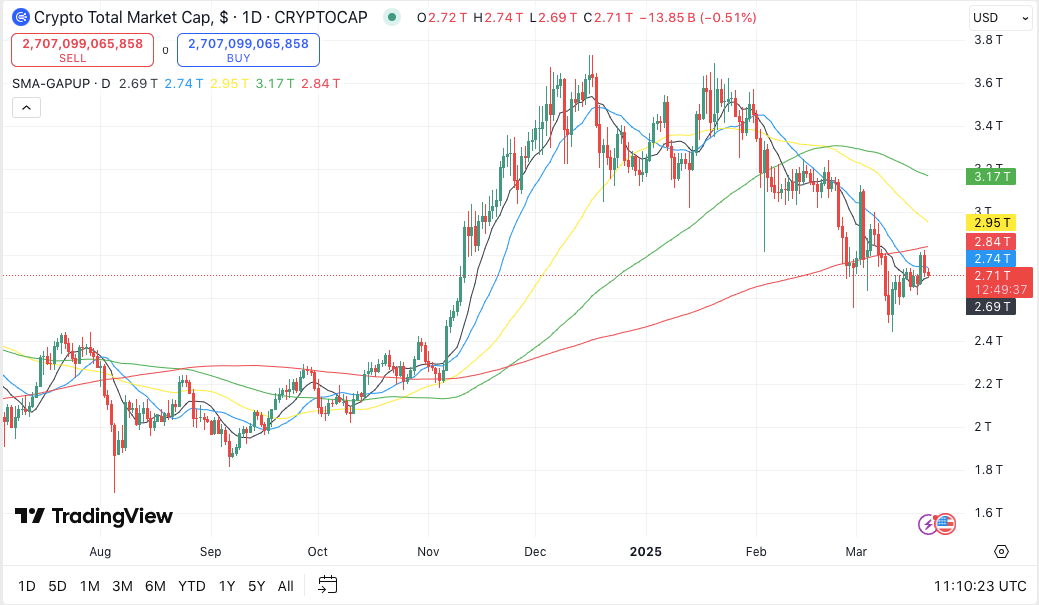
Общая рыночная капитализация криптовалют Источник: TradingView

Общая капитализация рынка криптовалют в середине 2024 года имела тенденцию к росту, достигнув пика выше $3,6 трлн. Затем коррекция отбросила ее до $2,69 трлн. Пока рынок пытается восстановиться, уровни сопротивления ограничивают его прогресс.

Отметка в $2,69 трлн теперь выступает в качестве немедленной поддержки. Краткосрочная поддержка находится на уровне $2,71 трлн, в то время как более сильная зона спроса находится между $2,6 трлн и $2,55 трлн. Следующее ключевое сопротивление находится на уровне $2,74 трлн, что соответствует 50-дневной скользящей средней. Более существенный потолок существует на уровне $2,84 трлн, около 200-дневной скользящей средней.

Ключевые уровни поддержки и сопротивления альткоинов

В настоящее время Ethereum торгуется на уровне $1 967,74, снизившись на 0,86% за последние 24 часа. Avalanche находится на уровне $18,58, снизившись на 1,22%, а Solana оценивается в $126,61, потеряв 3,02% за тот же период. Это снижение отражает более широкую тенденцию борьбы альткоинов за восходящее движение, что усиливает неопределенность вокруг ближайшего альтернативного сезона.


Related Reads

Insurance Industry Faces Its Biggest Competitor: Are Prediction Markets the 'Barbarians at the Gate'?

"Insurance Industry Faces New Rival: Are Prediction Markets the 'Barbarians at the Gate'?" Prediction markets, exemplified by platforms like Kalshi and Polymarket, are emerging as potential disruptors to the traditional insurance industry by offering alternative risk-hedging mechanisms. These markets allow users to bet on specific event outcomes, effectively creating a form of customizable, on-demand insurance. Key examples highlight this shift. In sports, Kalshi partnered with insurance broker Game Point Capital to provide NBA teams with more affordable options to hedge performance bonuses compared to traditional insurers. In real estate, Polymarket's collaboration with Parcl lets users speculate on city-specific housing price indices, allowing homeowners to hedge against price drops or buyers against price increases. Furthermore, businesses like a New York bar have used Kalshi to hedge marketing promotions (e.g., offering free drinks if a team wins), framing the transaction explicitly as placing a "hedge." The article argues prediction markets offer advantages over traditional insurance and even sports betting in transparency, liquidity, and flexibility. They provide a wider range of event coverage, act as neutral platforms rather than counterparties, and offer clearer pricing. The piece cites historical precedents like large "refund promotion" hedges by businesses using sportsbooks but notes prediction markets modernize the concept. However, challenges remain for widespread adoption as an insurance alternative, including limited liquidity in some markets, unclear regulatory status, and potential vulnerabilities in event resolution mechanisms. Despite these hurdles, prediction markets are positioning themselves as new tools for risk management, directly challenging certain segments of the conventional insurance landscape.

Odaily星球日报8m ago

Insurance Industry Faces Its Biggest Competitor: Are Prediction Markets the 'Barbarians at the Gate'?

Odaily星球日报8m ago

Which Crypto Sectors Have Been 'Eaten' by AI Agents?

The article examines the transformative impact of AI Agents on the cryptocurrency landscape, highlighting how specific sectors are becoming increasingly dominated by automated systems. Key "agent-eaten" sectors include derivatives trading (perpetuals), where AI agents demonstrate significantly higher survival and performance rates than human traders; MEV and arbitrage trading, which are almost entirely automated; yield optimization, with over two-thirds of new DeFi protocols incorporating AI agents; and spot trading/portfolio management, where agents drive a growing share of DEX volume. "Battleground" sectors like prediction markets and DeFi lending show a mix, with agents excelling in short-term/arbitrage activities but humans retaining an edge in longer-term, nuanced decisions. Sectors still primarily "human-led" include stablecoin payments/remittances (driven by real-world economic activity) and wallets, where human oversight for approvals and security remains critical. As AI agent activity grows, the article emphasizes the rising importance of human-agent verification layers (e.g., World/AgentKit, t54, Self Protocol) to ensure trust, accountability, and control in an increasingly agentic economy. The conclusion is that while AI agents dominate in speed and optimization-focused areas, human judgment, trust, and real-world context remain essential in value-creating layers like payments and identity.

marsbit9m ago

Which Crypto Sectors Have Been 'Eaten' by AI Agents?

marsbit9m ago

AC Exits Sonic Board, 'DeFi Godfather' Pulls Off Another Strategic Retreat

Andre Cronje, known as the "DeFi Godfather," and two other founding directors have stepped down from the Sonic Labs board. The S token, once valued at $1.03, has plummeted 97% to $0.028, and the chain's TVL has evaporated 98% from its peak. In his exit statement, Cronje clarified he was a technical architect, not a founder, and distanced himself from token economics and migration decisions behind the token's crash. Cronje revealed his focus for the past 18 months has been his new project, Flying Tulip. This project raised $200 million privately last year at a $10 billion valuation. Its token design includes a perpetual put option (ftPUT NFT) for early investors, allowing them to redeem their initial investment at any time—a protection not extended to public market buyers. This pattern mirrors Cronje's past exits from projects like Yearn Finance and Fantom, where he departed near peak hype, leaving later holders to bear significant losses. Sonic itself has seen a complete management overhaul in recent months. The article frames this as a microcosm of the broader crypto bear market, where Layer-1 chains are bleeding value. It highlights a harsh reality: a project's valuation is often tied to a founder's reputation rather than fundamentals. Ironically, Flying Tulip is set to launch first on the Sonic chain Cronje just left, underscoring a disconnect between the person and the platform.

marsbit30m ago

AC Exits Sonic Board, 'DeFi Godfather' Pulls Off Another Strategic Retreat

marsbit30m ago

Trading

Spot
Futures
活动图片