关于以太坊Pectra升级,你需要知道的一切

marsbitPublished on 2025-02-28Last updated on 2025-03-01

编者按:本文介绍了 Pectra 升级,它是以太坊的重大改进,分为三个主要领域:改进以太坊账户、提升验证者体验和扩展数据块。文章详细介绍了多个 EIP(以太坊改进提案),包括 EIP-7702、EIP-7251 等,提升账户功能、减少验证者操作复杂度以及提高网络效率。此外还探讨了如何通过增加数据块容量来扩展网络,并逐步实现无状态客户端的目标,推进以太坊网络的安全性和可扩展性。

以下为原文内容(为便于阅读理解,原内容有所整编):

以太坊正在改进账户功能,简化网络验证,并提升数据块的效率。本文将介绍 Pectra,这一备受期待的升级,带来了许多新的以太坊改进提案(EIPs),第一阶段已经上线。

数据


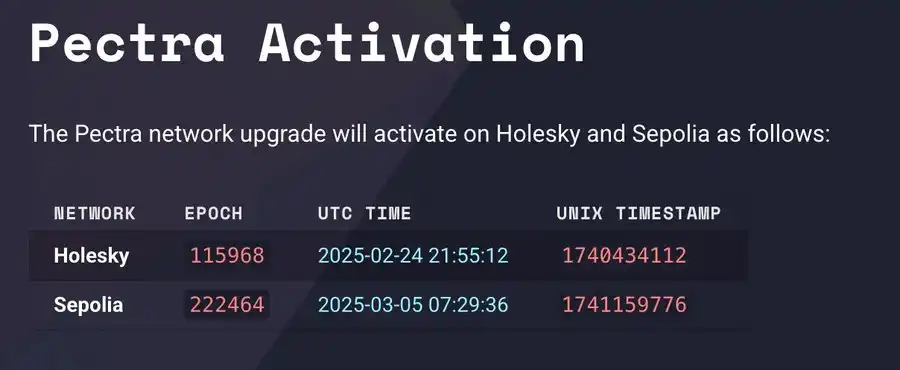
2 月 24 日在 Holesky 上线

3 月 5 日在 Sepolia 上线

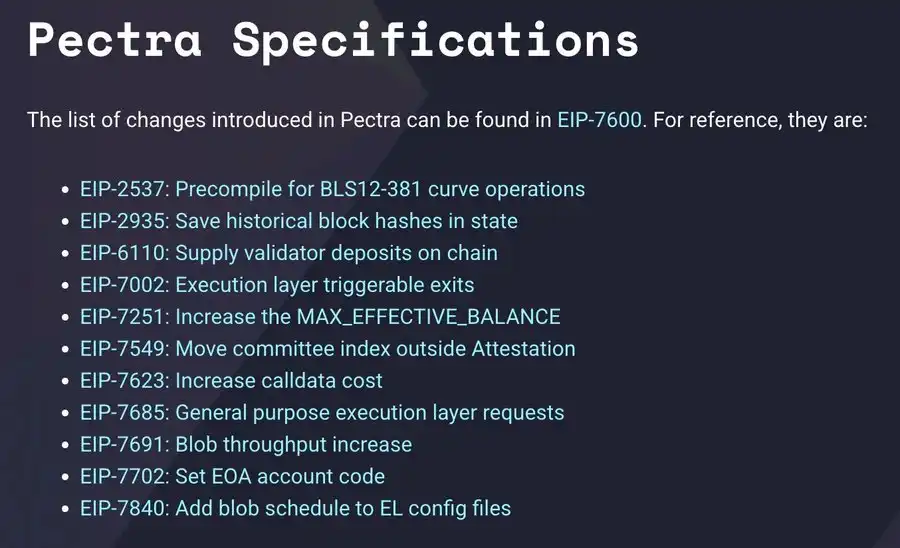
一旦该实施成功,主网更新日期将会确定。我们可以预计在测试网实施后 3 到 9 个月之间进行主网更新。Pectra 是一次相当重要的升级,带来了多个 EIP 的改进:

数据


我们可以将这些改进分为三个关键领域:

·改进以太坊账户

·改进以太坊验证者的用户体验

·扩展数据块的能力

让我们深入了解一些即将推出的 EIP,以及它们如何提升以太坊协议和用户的体验。


改进以太坊账户:EIP-7702

数据


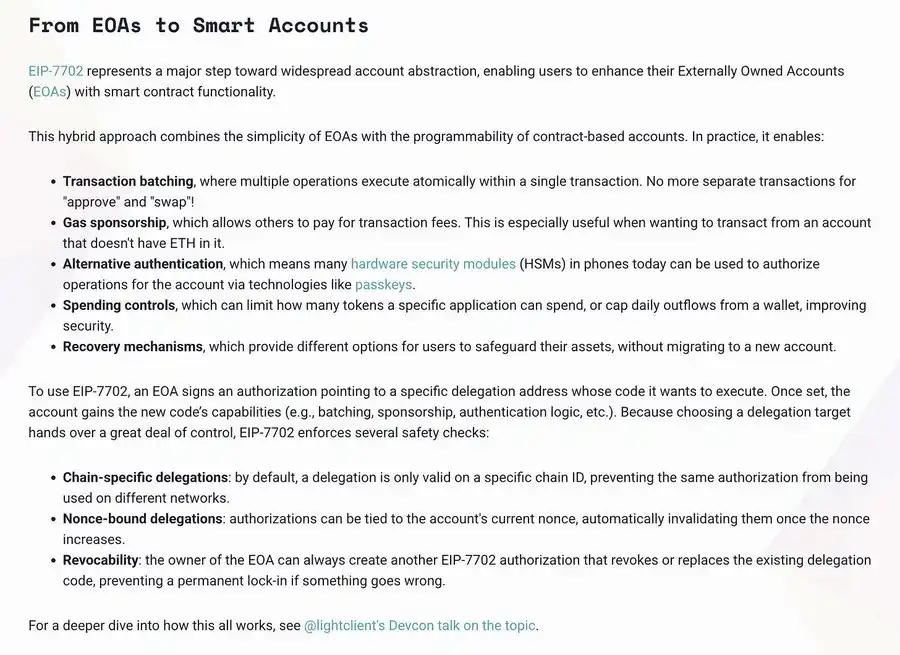
EIP-7702 将以太坊的协议层推进至账户抽象。它通过扩展以太坊的外部拥有账户(EOA)功能,加入智能合约功能,包括:

·交易批量处理:在一笔交易中执行多个操作

·燃气赞助:允许没有 ETH 的账户由他人支付交易费用

·更多的身份验证和恢复机制


改进以太坊验证者的用户体验:EIP-7251/7002/6110

数据


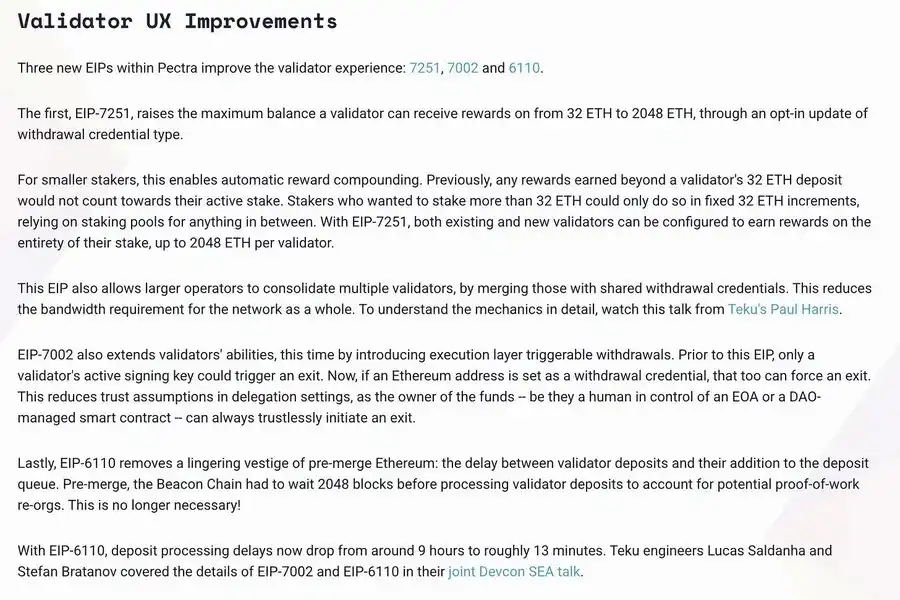
· EIP-7251:将验证者的最大余额提升至 2048 ETH,并允许他们在更大的活跃质押上自动复利奖励。此前,奖励仅考虑 32 ETH 的余额。此外,较大的验证者现在可以将多个 32 ETH 的验证者合并为一个。

·️ EIP-7002:通过允许执行层地址触发提款(只要它被设置为「可提款凭证」),减少了信任假设。之前,只有验证者才能触发退出。

· EIP-6110:取消了验证者存款和它们被添加到排队中的 2048 块延迟。预计这一时间将从 9 小时减少到 13 分钟。


扩展数据块:EIP-7691

数据


随着数据块的成本上升,扩展数据块的需求也随之出现。

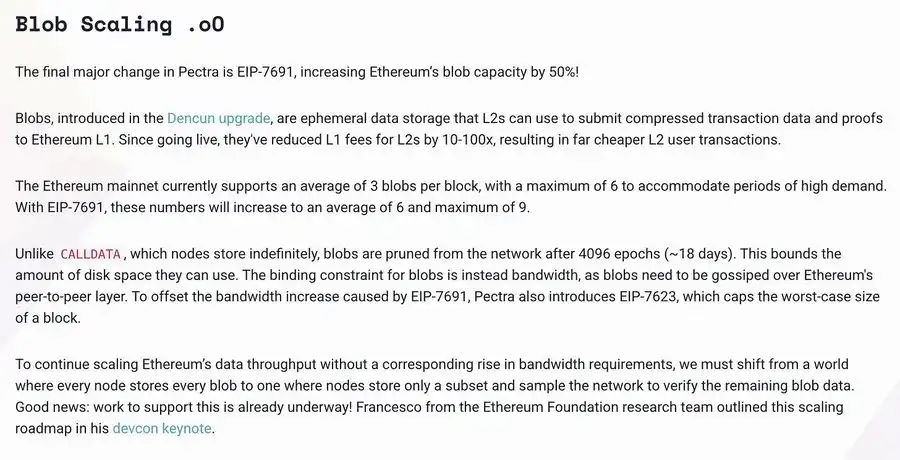
通过 EIP-7691,数据块的容量将增加 50%:目前,每个以太坊区块大约可以容纳 3 个数据块(在需求高峰期最多可达 6 个)。实施 EIP-7691 后,平均将支持 6 个数据块,在高需求时可达 9 个。

进一步扩展数据块的下一步是减少存储所有数据块的需求,并转向子网,这仍然可以用来验证数据块数据。


Pectra 中的其他 EIP 包括:

·EIP-2537:将操作的安全位数提高到 120 位以上,当前为 80 位以上。

·EIP-2935:为无状态客户端做准备,该 EIP 建议将历史区块哈希存储在状态中,作为区块处理逻辑的一部分。通过合约存储实现,EIP 允许平滑过渡,不影响区块哈希逻辑。Rollup 将能够从更长的历史中受益,并直接查询存储合约。

·EIP-7549:该 AIP 专注于提高 Casper 客户端的效率。通过减少验证共识所需的配对数量来实现,尤其是去除 Casper 客户端认证消息中的三个元素之一:委员会索引。通过将其移出认证消息,达成共识的投票现在可以更高效地聚合到区块中,将每个区块的投票数量从 2 个插槽提高到 8 个。

·EIP-7623:EIP-7623 提议增加 calldata 成本,是对 L2 影响较大的开发之一。该提案旨在调整调用数据成本,以应对平均(100KB)和最大区块大小(7.15 MB)之间的差异。这不会影响普通用户,仅涉及主要用于发布数据的交易。

这一增加将通过一个基础费用引入,该费用取决于在调用数据操作上消耗的燃气比率:减小区块大小以容纳更多数据块,或增加燃气限制。

·EIP-7685:引入一个框架来存储由智能合约触发的请求。这允许由智能合约控制的验证者将管理操作委托给后者,从而减少中介的需求。

·EIP-2935:为无状态客户端做准备,该 EIP 建议将历史区块哈希存储在状态中,作为区块处理逻辑的一部分。通过合约存储实现,EIP 允许平滑过渡,不影响区块哈希逻辑。Rollup 将能够从更长的历史中受益,并直接查询存储合约。

此次升级的重点是以太坊的一个重要信号;我们知道这些改进早在很久以前就已开始,并不是对近期批评的回应。然而,专注于简化网络安全、改善以太坊账户功能和扩展数据块的能力,正是实现以太坊所需的关键发展方向之一。


Trending Cryptos

Related Reads

A Decade of Change: The Demise of Crypto Startups

"The Decade-Long Transformation: The Demise of Crypto Startups" The article traces the dramatic evolution of the cryptocurrency industry from its anarchic beginnings to its current highly regulated and institutionalized state. In the early days (circa 2017), launching a crypto startup was remarkably simple: a whitepaper, a GitHub repository, and a Telegram group could attract thousands of retail investors via an Initial Coin Offering (ICO). Founders operated anonymously with near-zero regulatory and financial barriers, enabling rapid, global innovation but also widespread fraud. By 2026, the landscape is fundamentally different. To operate in major markets like the US, EU, and Asia, crypto businesses must now navigate a complex web of regulations akin to traditional finance. Compliance costs are prohibitive: estimates for a US multi-state operation range from $750,000 to $1.2 million in the first three years, with annual costs exceeding $2 million thereafter. Regulations like MiCA in the EU and New York's BitLicense have created high capital and operational hurdles that act as barriers to entry. Simultaneously, venture capital investment has shifted dramatically. Following the collapses of Terra and FTX, funding has concentrated in later-stage, established companies, creating a "barbell market." Early-stage and seed funding has shrunk significantly, while mega-funds like Andreessen Horowitz's $15 billion pool dominate. Most capital now flows to trading platforms, lending infrastructure, and B2B services. This environment favors mergers and acquisitions as the primary path for growth. Companies like Coinbase and Ripple are acquiring firms like Deribit and Hidden Road not for their technology, but for their licenses, banking relationships, and institutional trust—assets far more valuable than code. Distribution channels, compliance, and brand reputation have become the new moats, overshadowing pure technical innovation. The industry's maturation brings benefits: reduced scams, increased institutional participation, and clearer regulatory frameworks. However, it comes at a cost. The low-barrier, experimental ethos that defined crypto's first decade is fading. Entrepreneurs without substantial capital, pre-existing licenses, or institutional connections face immense challenges. Funding for exploratory fields like decentralized social media or novel governance models is drying up. Ultimately, the crypto industry is replicating the consolidation pattern seen in banking and tech after the 2008 financial crisis. While this brings stability and legitimacy, it raises a critical question: in this new, resource-intensive reality, is there still room for the disruptive, from-scratch innovation that gave birth to the sector?

Foresight News18m ago

A Decade of Change: The Demise of Crypto Startups

Foresight News18m ago

Trading

Spot

Hot Articles

Discussions

Welcome to the HTX Community. Here, you can stay informed about the latest platform developments and gain access to professional market insights. Users' opinions on the price of ETH (ETH) are presented below.

活动图片