Solana Is Quantum Secure, Great for Solaxy, 2025’s Biggest Presale Listing Yet

bitcoinistPublished on 2025-01-07Last updated on 2025-01-07

Abstract

Solana (arguably the most forward-thinking blockchain) recently made huge waves in the crypto world. It developed a quantum-resistant vault to...

Solana (arguably the most forward-thinking blockchain) recently made huge waves in the crypto world.

It developed a quantum-resistant vault to protect user funds against quantum-computing threats. You know the rumors – these next gen computers could derive your private key from just your public key.

I know, terrifying to think about.

Last month, Google’s quantum Willow chips could perform 5-minute calculations that would take the fastest supercomputer today seven septillion years (that’s seven followed by 24 zeros) to finish.

Clearly, quantum computing is on a different playing field that most of us didn’t even know existed. And Solana already built a vault that can resist that? When, how?

We’re here to discuss Solana’s Quantum security, and tell you about one of the most innovative crypto presales today that might benefit from it — Solaxy ($SOLX), the first Solana Layer-2 chain in the world.

You Can’t Touch This! Solana vs. Quantum Computers, Technical KO

First, let me explain what prompted Solana to develop the anti-quantum vault.

Quantum computers can manipulate a documented blockchain vulnerability – deriving your crypto wallet’s private key from your public one (the one you sign public transactions with).

Dubbed the ‘Winternitz Vault’ and built by Dean Little, Solana’s solution is deceptively ‘simple.’

For every transaction, the vault generates new keys, and only shows a hash of the public key, instead of the actual one.

That’s because, technically, quantum computers have a 50–50 chance of compromising signatures in future transactions. Unless new keys are generated for every transaction.

Here’s a somewhat accurate analogy to help you understand — it’s like a secure app that generates a unique, self-destructing code locally for any payment. Nothing to intercept, nothing to reuse next time.

If this sounds dangerously close to one-time passwords (OTPs), it’s not.

Solana’s system is cryptographically secured, which offers protection orders of magnitude higher than classic OTPs.

Together with Solana’s new ‘lattice’ system proposal that fixes scalability issues (acknowledged by Solana co-founder Anatoly Yakovenko on May 11), the Winternitz Vault emphasizes the blockchain’s forward-thinking culture and widespread industry impact.

And that brings us to the kicker – Solaxy ($SOLX), a new crypto presale and the first Solana Layer-2 in the world, stands to benefit the most from these developments. And so will any new crypto projects on the Solana blockchain.

Solaxy to Reinvent Blockchain Technology by Scaling Solana

Solaxy is a fresh crypto project in presale ($8.9M raised so far) that makes big promises:

  • Offers infinite scalability to Solana
  • Ensures zero failed transactions, even during peak times
  • Builds a future-proof network redefining Solana’s capabilities
  • Bridges to Ethereum and Solana seamlessly
  • Brings transaction bundling for high-volume trading
  • Reduces network congestion to a minimum with off-chain transaction execution

$SOLX also has a first-mover advantage.

As the first-ever Solana Layer-2 project, it could redefine the blockchain industry and trailblaze a new path forward, let me explain.

Fueled by Solana’s two-pronged advancement discussed above, Solaxy stands to receive increasing investor attention in the near future because of its utility and the issues it fixes with $SOL.

Let’s also not forget $SOL’s 129% year-over-year climb from $97.81 to $214.71. That’s a 2.2x increase from the second-biggest DeFi blockchain in the world.
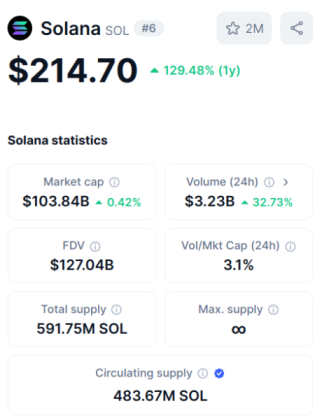
Solana price

Currently priced at $0.001592 per token and offering a 391% staking APY, Solaxy is a clear contender for 2025’s best meme coins.

Solana Is a Beast – What Else Is New?

The blockchain that never sits still is well-known for its constant advancement. Firedancer’s complete rebuilding went live on a testnet in 2023, optimizing runtime, networking, and consensus components.

In early 2024, it launched token extensions, making token creation more flexible. And now, quantum-proof security and scalability fixes.

It’s no wonder $SOL grew wings toward the end of 2023, and then soared to a new all-time high in November 2024.

Solaxy’s presale is looking better than ever but remember, this is not financial advice, so do your due diligence, read the project’s whitepaper, and make smart investment decisions.

Alex Popa

Alex Popa

Alex is a junior editor who’s passionate about data privacy, cybersecurity, and the ever-evolving world of crypto. Whether he’s exploring the latest security keys, testing password managers, or scouting the next big crypto presale, Alex is always chasing the future of tech. With over six years of content writing experience, Alex has mastered the art of turning complex ideas into engaging stories. He loves diving deep—whether it’s comparing cryptocurrency whitepapers, analyzing roadmaps, or brainstorming fresh topics. And yes, he’s doing it all from behind an ultrawide monitor he loves dearly.

Trending Cryptos

Related Reads

BIS Report Compliance Observations: The True Risks of Stablecoins Go Beyond 'De-pegging'

The BIS report, "Anchoring trust in money: innovation beyond stablecoins," highlights that the primary risks of stablecoins extend beyond potential de-pegging. It argues that the core challenge is whether stablecoins can be integrated into a financial system that is identifiable, monitorable, accountable, and regulatable. While acknowledging efficiency gains like faster payments and programmability, BIS emphasizes that money requires an institutional framework—including legal certainty, liquidity support, and financial integrity controls—which many stablecoins currently lack. The report details compliance risks, noting that while blockchain transactions are transparent, address visibility does not equate to identity or purpose clarity. This creates a systemic risk as pseudonymity, non-custodial wallets, and cross-chain bridges can undermine AML/CFT controls. Furthermore, these risks can spill over into the traditional financial system through on- and off-ramps. The future direction, per BIS, is not to prohibit innovation but to embed regulatory rules—such as identity verification and transaction screening—directly into the technological infrastructure of tokenized finance. The key takeaway for compliance is that any new financial instrument must clearly address questions of customer identification, transaction monitoring, accountability, and cross-border rule consistency to be viable as a mainstream payment tool.

marsbit1h ago

BIS Report Compliance Observations: The True Risks of Stablecoins Go Beyond 'De-pegging'

marsbit1h ago

When US Giants Collectively "Defect" to Chinese AI Models

When Silicon Valley Giants Turn to Chinese AI Models to Cut Costs A surprising trend is emerging: major U.S. tech companies are significantly reducing AI costs by switching to Chinese models. Coinbase, the largest U.S. cryptocurrency exchange, reportedly halved its AI spending after migrating to China's GLM-5.2 and Kimi 2.7 models, despite increasing usage. They achieved this through a sophisticated three-part strategy: implementing an automatic routing system to select the most cost-effective model per task, boosting cache hit rates from 5% to 60% to reuse computations, and employing "context engineering" to provide AI with more precise, less cluttered information. They are not alone. AI startup Lindy switched from Claude to DeepSeek, saving millions, while Snowflake's tests found GLM-5.2 solved 66% of coding tasks compared to Claude Opus's 67%—but at a fraction of the cost (output pricing is 5-7 times lower). While the top Western models may offer slightly better stability, the massive price differential is leading many businesses to reconsider their value proposition. This shift signals a deeper change in the AI industry, moving beyond pure performance benchmarks to a fierce cost competition. As pressure mounts, even OpenAI and Anthropic have begun slashing prices. For users, this means more choices, lower costs, and a crucial lesson: using multiple models based on task complexity, optimizing with caching, and keeping contexts lean are now key to leveraging AI efficiently and affordably.

marsbit1h ago

When US Giants Collectively "Defect" to Chinese AI Models

marsbit1h ago

Trading

Spot

Hot Articles

Discussions

Welcome to the HTX Community. Here, you can stay informed about the latest platform developments and gain access to professional market insights. Users' opinions on the price of SOL (SOL) are presented below.

活动图片