Why Are Spot Ethereum ETFs Underperforming? Bitwise CEO Reveals

bitcoinistPublished on 2024-10-21Last updated on 2024-10-21

Abstract

The launch of spot Ethereum exchange-traded funds (ETFs) has not met the high expectations set by their Bitcoin counterparts, leading...

The launch of spot Ethereum exchange-traded funds (ETFs) has not met the high expectations set by their Bitcoin counterparts, leading industry experts to analyze the underlying reasons. Since their inception on July 23, all spot ETH ETFs have seen outflows of $463 million, according to Farside Investors data. The main culprit is Grayscale’s ETHE with $2.996 billion in outflows, while BlackRock has $1.258 billion and Bitwise $321 million in inflows.

Why Are Spot Ethereum ETFs Not Doing Better?

Hunter Horsley, CEO of Bitwise Asset Management, took to X to shed light on the factors affecting the performance of the US spot Ether ETFs. “Why didn’t the Ethereum ETFs do better? A question I got at an event last week,” Horsley began. “First, how do you judge success? The ETPs from iShares, Fidelity, and Bitwise are all in the top 25 fastest growing new ETPs this year,” he added.

Despite their position among the fastest-growing exchange-traded products (ETPs), Horsley identified several factors that worked against the successful launch of spot Ethereum ETFs. He noted that the timing of the launch during summer, a typically slow period for investors who “monitor but don’t take on a lot of new projects,” may have dampened immediate interest.

Additionally, the market conditions played a role: “Bull markets always draw focus. Bitcoin ETPs launched amid a rising Bitcoin. Ether ETPs launched in a sideways market.” The lack of bullish momentum in Ethereum’s price may have contributed to the tepid response.

Furthermore, the sequential launch of Ethereum ETFs following Bitcoin ETFs may have overwhelmed investors still acclimating to cryptocurrency assets. “For many traditional investors, some time has been and continues to be needed to figure out how to incorporate Bitcoin after the launch of the ETPs. Ethereum arriving before that was solved made it hard to turn attention to it,” Horsley explained.

Nate Geraci, President of The ETF Store and co-founder of the ETF Institute, highlighted the broader success of crypto-related ETFs in 2024. “Update… Out of 525 ETFs launched in 2024, 13 of top 25 are either bitcoin or ether-related. 14 if you include MSTR Option Strategy ETF. Top 4 ETFs all spot btc. 5 of top 7 crypto-related. I call this masterpiece ‘no demand’.”

Related Reading: Ethereum Founder Buterin Lays Out Possible Futures For ETH Protocol

In response, Christopher Perkins, President of CoinFund, suggested that yield-generating products could enhance appeal. “Yield would help. Total return ETH is the killer product,” he stated. Horsley acknowledged the value of staking but downplayed its immediate impact on ETF performance. “Agree, ET32 has been growing rapidly in our Europe franchise,” he replied.

However, Horsley also added, “I don’t think lack of staking yield is a huge issue. Most of ETH today is owned directly so could be staked, yet ~2/3 don’t. But agree it’s valuable. We have an ETH ETP with staking in Europe that’s growing nicely.”

Industry veteran Dan Tapiero, founder and CEO of 10T Holdings, remained optimistic about the future of spot Ethereum ETFs. “Just wait. They’re gonna do just fine,” he asserted. Horsley concurred, simply stating, “Agree.”

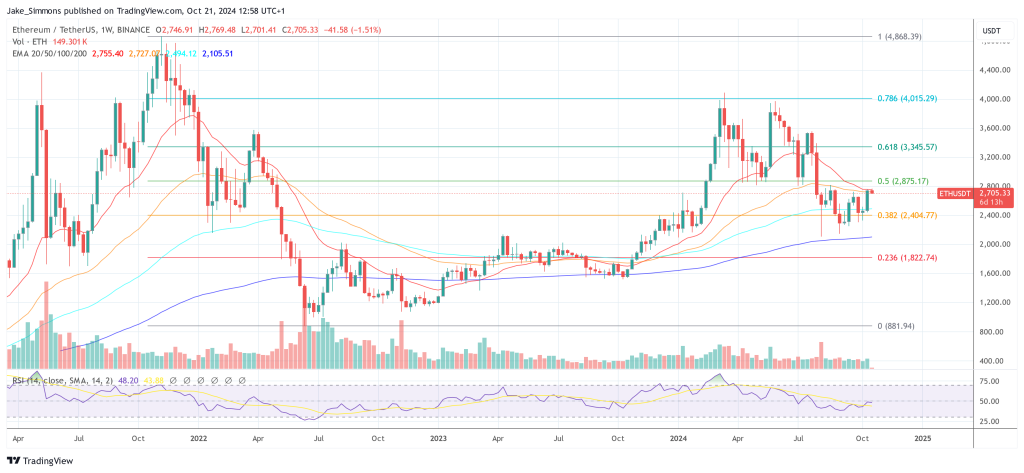
At press time, ETH traded at $2,705.
Ethereum price
ETH price trades below the 20-week EMA , 1-week chart | Source: ETHUSDT on TradingView.com
Featured image created with DALL.E, chart from TradingView.com
Jake Simmons

Jake Simmons

Jake Simmons has been a Bitcoin enthusiast since 2016. Ever since he heard about Bitcoin, he has been studying the topic every day and trying to share his knowledge with others. His goal is to contribute to Bitcoin's financial revolution, which will replace the fiat money system. Besides BTC and crypto, Jake studied Business Informatics at a university. After graduation in 2017, he has been working in the blockchain and crypto sector. You can follow Jake on Twitter at @realJakeSimmons.

Trending Cryptos

Related Reads

How Collector Crypt Uses 'Recirculating Buybacks' to Create an Illusion of Growth

Title: How Collector Crypt Creates a Growth Illusion with "Buyback Loops" Key Findings: Collector Crypt's (CC) net take rate has halved from 11.2% in Q3 2025 to 5.6% in Q2 2026, while GMV grew 4.7x. This growth is driven by higher-tier card packs ($250, $1,000, $2,500) which have lower platform dollar retention rates. The newly launched $2,500 Mythic tier captured 36.7% of June GMV within 13 days. Growth is fueled by a small cohort of high-spending, high-frequency wallets rather than broad user base expansion. The economic model faces pressure from three key areas: 1) **Shifting GMV Mix**: Pushing users towards larger, lower-retention card packs increases GMV but reduces overall profitability. 2) **Physical Redemptions**: Card redemptions for physical items remove reusable inventory from the system, creating costly replenishment needs. In May, redemptions consumed 41.6% of pre-redemption net income. Only 75 wallets drove redemptions in June. 3) **B2B/API Strategy**: Partner revenue remains negligible (cumulatively $1.83M) and dependent on CC for inventory, vaulting, and buyback services, failing to create a scalable, asset-light recurring revenue stream. The core product is a repetitive pack-buyback loop with limited secondary market activity and token value accrual. Sensitive modeling shows CC's economics turn negative when any two of the following pressures coincide: replenishment costs near market price, redemption rates exceeding 9%, or high-tier buyback rates around 93%. While CC operates in a large and growing collectibles market, its current growth levers—bigger packs, high buyback rates, and capital recycling by a few wallets—create a volume illusion without demonstrating sustainable collector engagement, deep secondary markets, or a viable path to improved margins. Future proof points include broadening collector participation, deepening secondary trading, and developing true asset-light B2B revenue channels.

Foresight News22m ago

How Collector Crypt Uses 'Recirculating Buybacks' to Create an Illusion of Growth

Foresight News22m ago

Grayscale's Latest Research: What is Solana's Next Growth Engine?

Grayscale's latest report, "Solana: Crypto's Financial Bazaar," signals a shift in how the market views Solana, moving beyond its high-performance and meme-centric reputation. The report frames Solana as an evolving application platform for large-scale economic activity, akin to a bustling digital marketplace. The analysis highlights that public chain competition has moved past raw throughput (TPS) to focus on genuine economic activity—daily users, transaction volume, and real revenue. Solana's metrics, such as over 1,000 dApps, 100M+ daily transactions, and ~4.3M daily active users, showcase this shift toward application-layer prosperity. The report identifies three key growth drivers: 1. **Jupiter**: Evolving from a DEX aggregator to a core liquidity hub and comprehensive financial platform for Solana's DeFi. 2. **Pump.fun**: Demonstrates Solana's capacity for consumer-scale applications, attracting millions of users and generating significant, sustainable revenue, validating network stability under high load. 3. **Helium & DePIN**: Represents expansion into real-world infrastructure, connecting blockchain to physical resources like wireless networks and positioning services, opening new long-term use cases. Solana Foundation's recent focus aligns with this broader vision, emphasizing AI Agents (for machine-to-machine transactions), payments, stablecoins, and Real-World Assets (RWA) to build a sustainable growth model beyond cyclical trends. While challenges remain—such as value capture for SOL and maintaining ecosystem sustainability beyond hot trends—institutional interest is growing due to Solana's maturing application business models, expanding payment/stablecoin ecosystem, and persistent developer activity. The competition is no longer about speed alone, but about which network can foster the most vibrant and valuable digital economy.

marsbit44m ago

Grayscale's Latest Research: What is Solana's Next Growth Engine?

marsbit44m ago

They Waited 7 Years for This Money

The article discusses the significant drop in share price of Circle, known as the "first stablecoin stock," triggered by the announcement of a new alliance including Visa, Stripe, Mastercard, Coinbase, BlackRock, Google, IBM, and Ripple. This alliance plans to launch Open USD, a USD stablecoin, later this year. Key to the market reaction is Open USD's plan to distribute reserve-generated profits to its adopters, directly challenging Circle's core revenue model from USDC's reserve interest. The piece draws a parallel to Facebook's 2019 Libra (later Diem) project, which involved many of the same companies. Libra failed due to regulatory pressure, its association with Facebook's controversial reputation, and overly ambitious global currency narratives. However, the underlying desire of these major financial and tech firms to create a new digital payment infrastructure persisted. Over seven years, the landscape changed: clearer US stablecoin regulations (GENIUS Act), mature blockchain infrastructure, and companies gaining practical experience with crypto payments. Open USD presents a more modest, compliance-focused narrative—a settlement tool and enterprise payment rail rather than a revolutionary global currency. While the new alliance poses a serious threat to Circle's profitability and exclusivity, it faces challenges typical of large consortia: slow decision-making and complex profit-sharing. USDC's established liquidity, trust, and integrations provide Circle with significant defenses. The market's reaction is seen partly as an emotional overreaction but also a necessary reevaluation of Circle's business model from a unique "stablecoin era ticket" to a "strong issuer" in a competitive commodity market. Ultimately, the core ambition from the Libra era remains: to digitize the movement of dollar value on the internet and capture the adjacent commercial opportunities. The lesson learned is to pursue this goal not as a high-profile, platform-led revolution, but as a quiet, utility-focused infrastructure play.

marsbit44m ago

They Waited 7 Years for This Money

marsbit44m ago

Trading

Spot

Hot Articles

Discussions

Welcome to the HTX Community. Here, you can stay informed about the latest platform developments and gain access to professional market insights. Users' opinions on the price of ETH (ETH) are presented below.

活动图片