Ethereum Founder Vitalik Buterin Clarifies Latest 190 ETH Sale Amid Concerns

bitcoinistPublished on 2024-09-13Last updated on 2024-09-13

Abstract

Ethereum co-founder Vitalik Buterin has been in the spotlight for the last few weeks for the 950 ETH selloff from...

Ethereum co-founder Vitalik Buterin has been in the spotlight for the last few weeks for the 950 ETH selloff from an address associated with him.

The sales have sparked concerns among investors who found the transactions suspicious despite Buterin’s previous explanations. Following the latest sale, Buterin clarified the selling details and offered some relief to the community.

Ethereum Founder’s Moves Raise Concerns

In August, Vitalik Buterin made large-scale ETH transfers to a multisig wallet linked to him. The transfers raised concerns among investors who worried a selloff could add further selling pressure to the second-largest cryptocurrency by market capitalization in an already volatile market.

As reported by Bitcoinist, Ethereum’s co-founder initially sent 3,000 ETH, worth around $8.04 million at the time, to the multisig wallet on August 9. 20 days later, Buterin sent another 800 ETH, valued at $2.01 million, to the same address. The multisig then swapped 190 ETH for 477,000 USDC.

After the news, the crypto community heavily criticized Buterin, claiming that the project’s founder was “bullposting while dumping” on the community. Others shared a pessimistic outlook about the future of ETH’s price since developers were “dumping on us.”

However, a few investors considered the backlash unwarranted and that there’s “nothing wrong with taking profits once in a while.” Buterin replied to these claims, affirming that he does not sell tokens for personal profit.

In an X post, Ethereum’s founder explained that all sales since 2018 have been done to support various projects he considers valuable. These include projects within the Ethereum ecosystem or broader charity, like biomedical research and development.

A week later, he clarified that the same principle applied to Layer-2 tokens or any other project tokens he held, and all sales from those tokens would be donated to public goods.
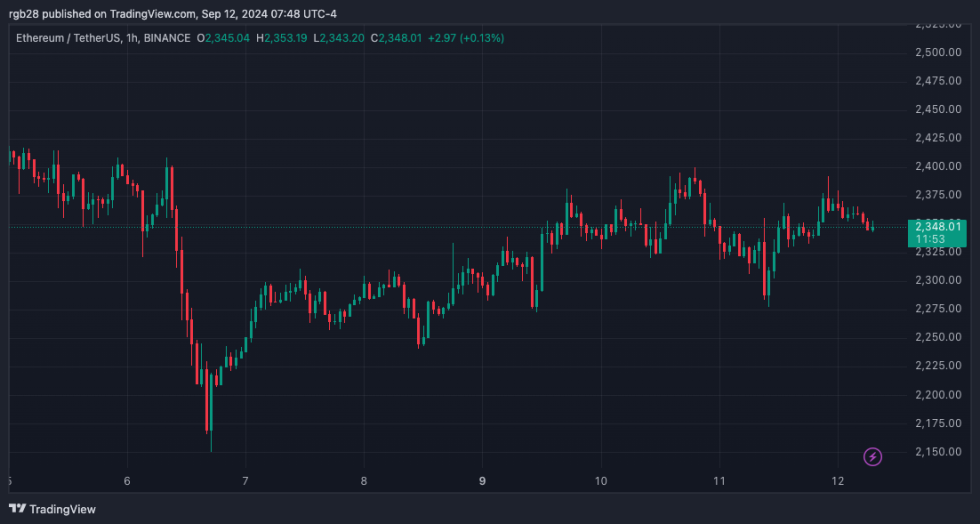
Ethereum, ETH, ETHUSDT

Ethereum's performance in the weekly chart. Source: ETHUSDT on TradingView

Is Vitalik Done Selling?

Despite clarifying the nature of these sales, the crypto community worried again when news of another sale was shared. On-chain data analysis firm Lookonchain reported on September 11 that the multisig associated with Buterin had sold another 190 ETH on Wednesday morning.

The report revealed that the transaction, valued at 441,971 USDC, was the latest in a series of sales. Since August 30, Ethereum’s founder, multisig has sold 950 ETH, worth $2.27 million, at an average price of $2,396.

The 950 ETH selloff was divided into five smaller transactions of 190 ETH each, every three days. After the latest transaction, Buterin deposited the proceedings from the 950 ETH to the decentralized protocol Aave.

The news alarmed some users, who, once again, criticized Buterin for selling while simultaneously bullposting. Moreover, some questioned his previous explanation, suggesting it might not be 100% true.

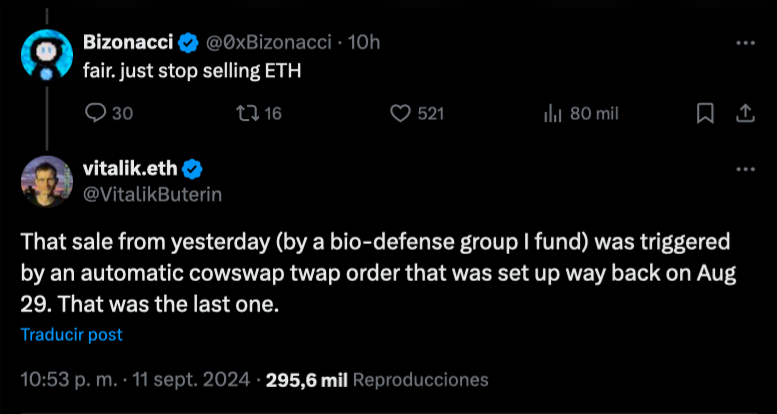
In another X post, he addressed investors’ concern, detailing the reason behind the latest move. According to Ethereum’s founder, Wednesday’s transaction was triggered by an “automatic cowswap twap order” made by a bio-defense group he funds.
Ethereum

Buterin clarifies his recent moves. Source: Vitalik Buterin on X

The order was set up on August 29 but was executed on Wednesday, implying that the other four sales had a similar setup. Additionally, Buterin stated that it “was the last one,” hinting that, for the time being, investors should not worry about further dumping related to the orders.

As of this writing, the second-largest cryptocurrency by market cap trades at $2,348, a modest 0.2% surge in the last 24 hours.

Featured Image from Unsplash.com, Chart from TradingView.com
Rubmar Garcia

Rubmar Garcia

Rubmar is a crypto enthusiast who likes learning and improving constantly. She enjoys reporting on the latest news and developments in the crypto industry. Rubmar also enjoys scrapbooking, crafting, simulation games, and watching football.

Trending Cryptos

Related Reads

Introduction to the Concept of World Models: A Story from Psychology to the Main Battlefield of AI

**World Models: From Psychology to AI's Core Concept** "World model" is a trending but often confusing term in AI, describing a system that allows machines to internally simulate, predict, and rehearse potential outcomes before taking real-world action—like a mental "sandbox." While definitions vary—Yann LeCun emphasizes physical understanding, OpenAI's Sora is a video-based "world simulator," Google DeepMind's Genie 3 creates interactive 3D environments, and companies like Alibaba and Tesla focus on practical applications—the core goal is consistent: reduce reliance on vast real-world data by creating an internal, predictive model for safer and more efficient AI. The concept has deep roots, tracing back to psychologist Kenneth Craik (1943). In AI, it was revitalized by researchers like David Ha and Jürgen Schmidhuber (2018). Major technical approaches include: 1) generative video models (e.g., Sora) for visual realism; 2) abstract predictive models (e.g., LeCun's JEPA) for efficiency and physical reasoning; and 3) explicit 3D simulators (e.g., NVIDIA Omniverse) for precision. Fei-Fei Li proposes a classification based on the AI action loop: renderers (output observations), simulators (output world states), and planners (output actions). The emerging "World Action Model" (WAM) paradigm aims to unify future prediction and action generation. An industry framework is forming: upstream (data, compute, sensors), midstream (general and vertical platforms), and downstream applications (autonomous driving, robotics, gaming, etc.). Autonomous driving is currently the most mature use case. The current lack of a unified definition reflects the field's early, dynamic stage, similar to past tech revolutions. Different approaches—focusing on pixels, physics, or behavior—represent parallel explorations of how best to compress and understand the world. This diversity, while seemingly chaotic, signals that world models have moved from an academic idea to a critical industrial battleground, ultimately aiming to give machines the ability to understand, imagine, and reason about the world.

marsbit26m ago

Introduction to the Concept of World Models: A Story from Psychology to the Main Battlefield of AI

marsbit26m ago

Building the Bright Path While Secretly Crossing Chencang: Is Walsh Paving the Way for a September "Rate Cut"?

The title "Building the Plank Road Openly While Secretly Crossing at Chencang: Is Walsh Paving the Way for a September 'Rate Cut'?" suggests Federal Reserve Chair Kevin Walsh's hawkish stance may be a deliberate smokescreen. Academy Securities analyst Peter Tchir argues in a report that markets, currently pricing a 75% chance of a September hike, are missing a potential path to a September rate cut that Walsh himself might be quietly preparing. Tchir posits that Walsh's hawkish rhetoric aims to suppress long-term yield risks (with the 10-year Treasury yield falling recently) while creating room for a narrative shift based on upcoming data. The potential political endgame, according to this view, could be rate cuts in September and October, ahead of the midterm elections. This hinges on a political logic where the Trump administration's preference for lower rates remains unchanged. A core part of Tchir's argument involves redefining inflation metrics. He contends the Fed under Walsh may deprioritize the PCE index, criticizing its lagging components like Owners' Equivalent Rent (OER). Instead, he points to alternative, more real-time indicators like the New Tenant Repeat Rent Index (NTRR) and the Truflation daily index, which shows core inflation around 1.45%. He suggests the Fed could shift its data narrative to justify policy easing. Furthermore, Tchir downplays AI-driven inflation fears. He argues that consumer price sensitivity, evidenced by negative market reactions to price hikes (e.g., Apple), contradicts persistent inflation narratives. He also separates AI/data center spending—which he sees as relatively rate-insensitive—from broader consumer affordability issues, implying rate hikes are misdirected. Based on this analysis, Tchir sees a re-pricing of rate cut expectations as likely, creating opportunities in short-duration Treasuries. He maintains a neutral-to-slightly-bullish view on the long end of the yield curve. For equities, he recommends a significant overweight in energy (especially global nuclear assets) and, within defense/security themes, an overweight in biotech/pharma versus an underweight in semiconductors, expressing caution on AI/data center valuations.

marsbit52m ago

Building the Bright Path While Secretly Crossing Chencang: Is Walsh Paving the Way for a September "Rate Cut"?

marsbit52m ago

"King of Shilling" Hayes Strikes Again, This Time Setting His Sights on Deribit

On June 29, BitMEX co-founder Arthur Hayes acquired approximately 6.16 million SYN tokens via OTC platform Flowdesk, valued at around $2.2 million. Subsequently, Hayes publicly endorsed SYN on X, calling it one of the most asymmetric investments he's seen since HYPE and declaring it time for an on-chain options DEX to challenge industry leader Deribit, naming Hypercall as that challenger. The article details the evolution of the Synapse Protocol, originally launched in 2021 as a cross-chain messaging and liquidity network. While its TVL peaked above $1 billion during the last bull market, it has since declined. The protocol's team has since built Hypercall, an on-chain options trading platform on Hyperliquid's HyperEVM, which supports trading options on "any asset" with features like 24/7 trading and defined risk limited to the premium paid. Deribit, founded in 2016, is highlighted as the dominant centralized crypto options exchange, commanding roughly 85% market share in BTC and ETH options. Its strengths include deep liquidity and professional tools, though it faces critiques over custody risk, KYC requirements, and regulatory uncertainty. The analysis suggests Hypercall's potential lies in decentralization, permissionless access, and transparency, potentially carving a niche in DeFi-native and emerging asset options. However, it faces significant challenges competing with Deribit's established network effect and liquidity depth. The piece concludes by noting Hayes's recent and mixed "call" history, referencing his previous promotion and subsequent sale of HYPE, as well as a controversial price target report for CARDS from his family office, Maelstrom, which was followed by a significant price drop for the asset. This activity has drawn criticism, with some accusing Hayes of creating exit liquidity for his followers.

Foresight News1h ago

"King of Shilling" Hayes Strikes Again, This Time Setting His Sights on Deribit

Foresight News1h ago

Trading

Spot

Hot Articles

Discussions

Welcome to the HTX Community. Here, you can stay informed about the latest platform developments and gain access to professional market insights. Users' opinions on the price of ETH (ETH) are presented below.

活动图片