By AI Alphabet
$26 billion is the latest price tag the capital market has placed on AI programming company Cognition.
Just last September, Cognition AI had barely crossed the $10 billion valuation threshold, and at that time, it was already enough of a Silicon Valley legend.
Three young Chinese co-founders, collectively winners of 5 International Olympiad in Informatics gold medals, built the prototype of "the world's first AI software engineer" Devin from a short-term rental apartment. In just over two years since its founding, the company's valuation had surged to $10 billion.
Chinese, Olympiad, Harvard, MIT, dropping out to start a business, AI Agent... each label is attention-grabbing enough. Cognition is undoubtedly one of the most story-rich companies in the AI programming track.
Now, this story has been pushed a significant step forward by the capital market.
According to a Bloomberg report, Cognition AI, the company behind Devin, has secured over $1 billion in new funding, with a post-money valuation reaching $26 billion. This round was co-led by Lux Capital, General Catalyst, and 8VC, with participation from Ribbit Capital, Atreides Management, Founders Fund, and others. Cognition has officially confirmed this funding round and its latest valuation.

This means that in just over eight months since its previous valuation of $10.2 billion, Cognition's valuation has grown to 2.5 times its original value.
01 What Capital is Buying is More Than Just an AI Programmer
The leading capital in this round is quite representative.
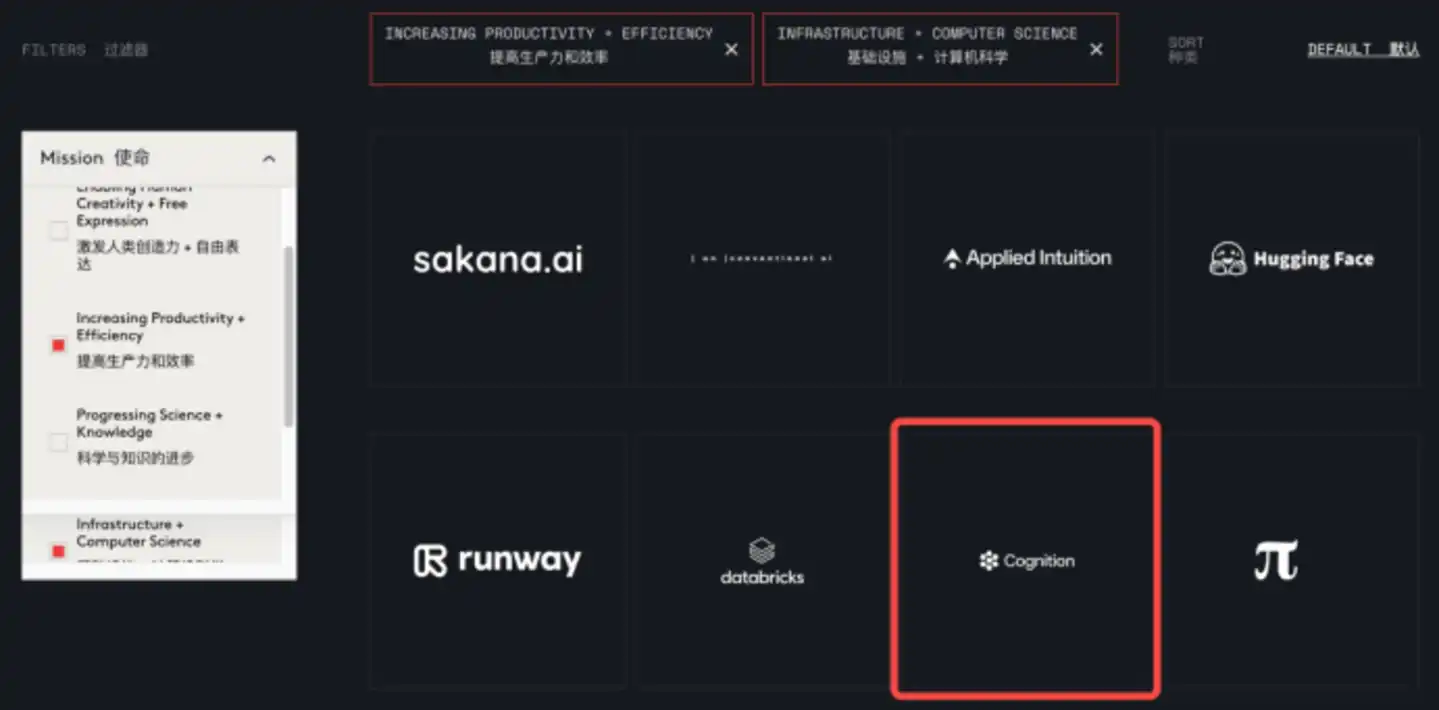
Lux Capital is a highly recognizable hard-tech fund in Silicon Valley, with long-term investments in frontier science, deep tech, AI, robotics, aerospace, defense, and computing infrastructure—projects that are "relatively hardcore." On its own investment page, Cognition is categorized under "Productivity Enhancement + Infrastructure + Computer Science."
It can be said that Lux Capital's investment in Cognition focuses on Cognition's potential to turn AI Agents into software engineering infrastructure.
General Catalyst, on the other hand, focuses on the opportunity for enterprise processes to be transformed by AI. This firm is not just a traditional VC; it calls itself a "global investment and transformation company" on its website, emphasizing 'transformation' in recent years—using capital, operations, and corporate relationships to drive the transformation of traditional industries and large institutions.
Besides Cognition, General Catalyst is also doubling down on Anthropic. Over the past year, it has participated in multiple massive funding rounds for Anthropic.
As a co-leading firm, 8VC brings imagination for government and large enterprise deployments. This firm has long bet on "enterprise software infrastructure within complex organizations," and Cognition's client list already includes government or public-sector clients like the US Army, US Navy, and NASA. 8VC's participation as a lead investor affirms Cognition's narrative.
In addition to the three leading firms, existing shareholder Founders Fund continues to increase its stake. The approximately $400 million funding round in 2025, which valued the company at around $10.2 billion post-money, was led by Founders Fund. This firm, co-founded by Peter Thiel, has always had an aggressive investment style, preferring technology companies that can reshape industrial structures, such as SpaceX, Palantir, Anduril, Stripe, OpenAI, etc.
Lux Capital long bets on hard tech and frontier computing, General Catalyst excels at enterprise software and large institution transformation, 8VC carries enterprise software and government market genes, and Founders Fund is one of Cognition's early shareholders. The simultaneous presence of these types of capital in Cognition's funding round is enough to indicate that investors no longer see Cognition merely as a developer tools company, but as a candidate for the next generation of software engineering infrastructure.
The $26 billion post-money valuation fully proves market confidence, and the most direct reason capital is willing to continue driving up the price is growth.
Cognition has presented very solid commercialization data: enterprise usage has grown over 10-fold since the beginning of this year, revenue run-rate has jumped from $37 million in May last year to the current $492 million, and enterprise-side Devin usage has maintained a 50% month-over-month growth for the past six months.
Although $492 million is not confirmed annual revenue but an annualized run-rate calculated based on the current income pace, this growth curve is still astonishing. Investors can already see enterprise clients genuinely paying, genuinely using, and usage is still rapidly climbing—this is nothing short of legendary for a company founded in 2023.
The AI programming track is indeed thriving. Code, issues, tests, PRs, documentation are inherently highly digital work objects; whether a task is completed can be verified through tests, code reviews, and deployment results.
And for enterprises, software teams always have an endless list of tasks, each time-consuming and expensive (at least, senior engineers' hourly rates are expensive). If an AI Agent can reliably take over a portion of clear, repetitive, and verifiable software engineering tasks, it becomes engineering capacity that enterprises are willing to pay for.
Behind the $26 billion, what capital is truly buying is a judgment: software development is becoming the earliest work scenario where AI Agents are being procured on a large scale by enterprises.
02 After Devin's Explosive Popularity, Reality Poured Cold Water
Cognition first gained widespread attention through what, at the time, seemed an extremely bold vision.
Before Devin, AI programming tools mostly remained in "assistant" roles. GitHub Copilot helps programmers complete code, ChatGPT and Claude can explain errors and generate functions, while Cursor integrates AI into the editor, allowing developers to write and edit simultaneously.
But Devin took a significant step forward. It was directly defined by Cognition as an "AI Software Engineer." Users only need to describe requirements in natural language, such as developing a website, building an application feature, or fixing an issue in a codebase, and Devin would independently break down the task, write the code, fix bugs, until the project runs.
When Cognition released the Devin demo in March 2024, the entire developer community was ignited. It was promoted as the world's first AI programmer, and to some extent, became one of the landmark products that truly brought the vibe coding wave into the mainstream.
The founders themselves also came with a story. All three—Scott Wu, Steve Hao, and Walden Yan—are Chinese and hail from the informatics Olympiad circle, collectively holding 5 IOI gold medals. They are not traditional business-oriented founders but resemble a group of young people exceptionally skilled at coding, trying to train another entity that can code.

After Devin's launch, the company quickly secured support from top-tier VCs like Founders Fund, Khosla Ventures, and Bain Capital Ventures, forming a strong capital lineup. Enterprise clients also began to emerge, with names like Goldman Sachs, Citi, and Ramp being linked to Devin.
In July 2025, when Goldman Sachs introduced Devin, a Fast Company headline even directly stated, "Goldman Sachs's New AI Software Engineer Never Sleeps." This highlighted one of the most compelling aspects of Agents for enterprises: they can operate 24/7, no shifts needed, never stopping due to nights, weekends, or time zones.
That was Cognition's earliest moment in the spotlight. A young team, Chinese founders with informatics competition backgrounds, an AI Agent claiming to handle software development end-to-end, plus top-tier VC and major client endorsements. All these elements together formed almost the standard opening of a Silicon Valley AI legend.
However, a tall tree attracts the wind. When the story is told too beautifully, problems inevitably follow.
Initially, Devin's breakout success was largely built on the company's demos. When external developers began scrutinizing frame-by-frame and testing in real environments, doubts emerged. Some believed Devin's demos were carefully edited, omitting processes that made it appear less perfect. For instance, one segment was questioned for potentially showing Devin creating a bug and then fixing it, presenting the illusion of smoothly completing the task.
Devin thus became embroiled in a "fakery" controversy for a period—its promotional tone leaned too heavily towards AI being fully autonomous, but real engineering environments are far more complex than demos.
Software development is never just about writing code; it involves requirement understanding, architectural judgment, contextual memory, team conventions, and a host of implicit constraints not written into issues. An Agent running doesn't mean it always runs in the right direction; it can generate code, but that doesn't mean the code is merge-worthy.
When Devin officially launched, the gap became even more apparent.
Its initial price was very high, starting at $500 per month. But its performance didn't seem to justify such a high price: Answer.AI continuously tested Devin for a month, assigning it 20 real engineering tasks. The result was only 3 successes, 14 failures, and 3 uncertain outcomes.
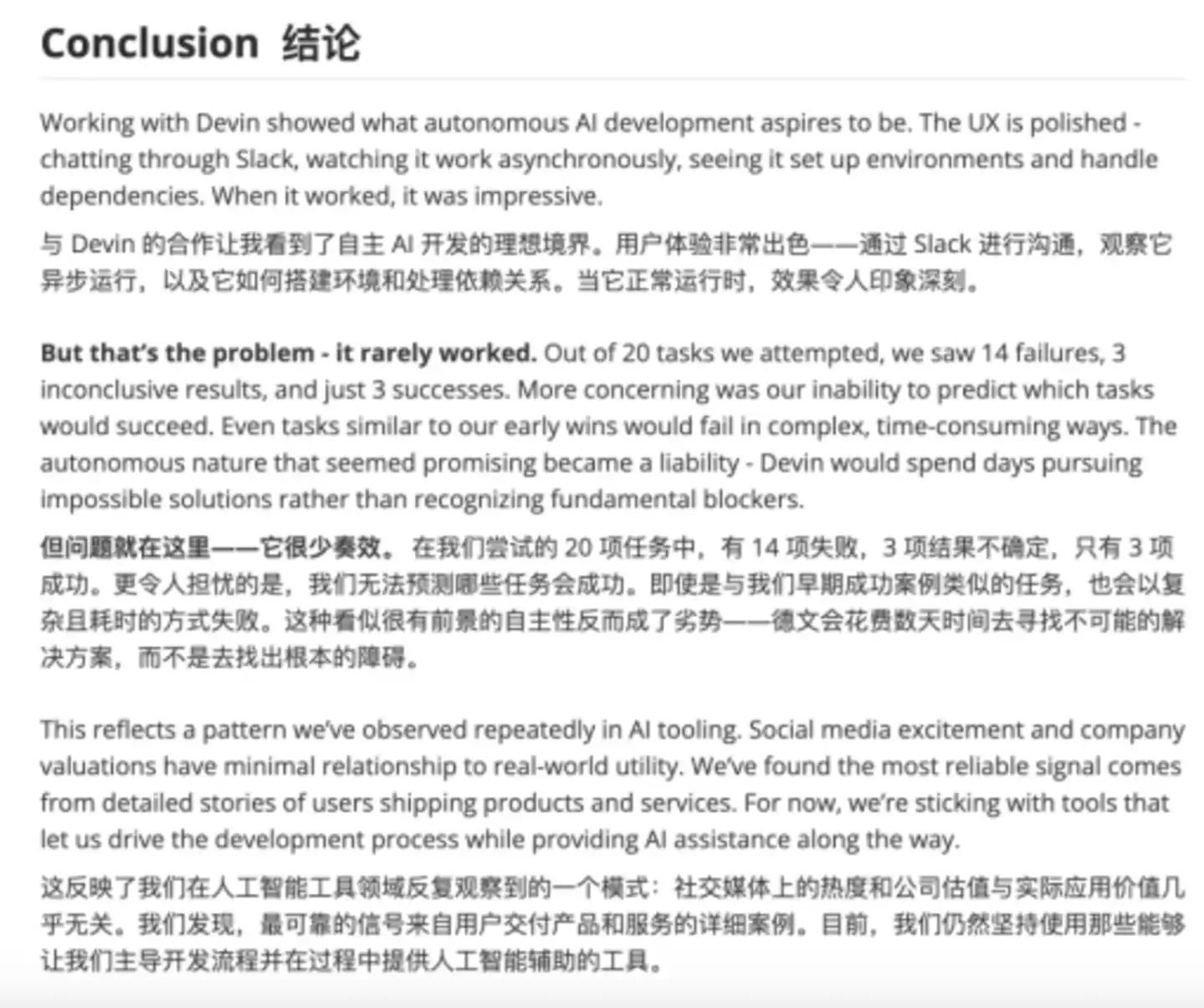
The biggest issue wasn't just the high failure rate, but the unpredictability of failures.
Some tasks that didn't seem complex would lead Devin into dead ends; some tasks themselves were infeasible, yet it would keep trying; sometimes it would generate overly complex, hard-to-maintain code, ultimately forcing engineers to spend more time reviewing and cleaning up.
And all this at such a high price.
Cognition also realized the $500/month threshold was too high. In April 2025, Cognition launched Devin 2.0, reducing the starting price from $500 per month to $20 and introducing a more flexible pay-as-you-go model.
But price reduction isn't a panacea. A tool designed to enhance efficiency ending up wasting more time and energy is hard to justify.
This is the core early-stage contradiction of autonomous Agents: the more AI resembles an independent engineer, the more users need to trust it, but the more it operates like a black box, the more troublesome deviations become.
Devin promised "give me the task," but many real engineering tasks aren't suitable to be handed over completely so early. An Agent running on its own for a long time and finally delivering a PR sounds advanced; but if PR quality is unstable, the engineer's review cost becomes even higher.
Interestingly, amidst this contrast, it was Cursor that captured the first wave of genuine developer dividends.
Because Cursor didn't initially promise to replace programmers. Its logic was gentler and more aligned with real workflows: AI helps modify code, explain errors, refactor files, generate tests on the side, but the developer remains in the editor. It's like a driving school car—you can at least hit the brakes when things seem off.
If Cognition's story ended here, it might have become another "hype" company lifted by the AI boom and then pulled back to earth by real user experience. But as mentioned earlier, reality is often more complex, and the AI programming track itself didn't stand still.
After Devin ignited the imagination of an "AI Software Engineer" and Cursor proved developers still needed a sense of control, foundation model giants like OpenAI, Google, and Anthropic also accelerated integrating coding capabilities into their own products and platforms.
On one side, the more controllable IDE route was rapidly expanding; on the other, model giants were moving down to the application layer. For Cognition to survive, it had to change.
And it was at this time that it "picked up" the treasure left by Windsurf.

03 Grasp Both Sides Firmly
The battle for Windsurf was arguably one of the most dramatic events in the AI coding tools sector in 2025.
At that time, Windsurf was already a highly regarded company in the AI IDE track. It was initially courted by OpenAI, with both sides engaged in lengthy acquisition talks, and the outside world once thought the deal was sealed.
However, the transaction ultimately didn't materialize, with one key reason being the complex partnership between OpenAI and Microsoft. At that time, Microsoft held broad licensing rights to OpenAI's technology and products, and Microsoft-owned GitHub Copilot was a major competitor in the AI programming space. Windsurf was concerned that if acquired by OpenAI, its technology and products might become entangled in the licensing framework between OpenAI and Microsoft, indirectly flowing to a potential competitor.
Just as OpenAI retreated, Google swiftly stepped in.
Google secured a non-exclusive license to Windsurf's technology for $2.4 billion, while bringing Windsurf CEO Varun Mohan, co-founder Douglas Chen, and several key R&D personnel to Google DeepMind.
It happened on a Friday, very quickly. Google took the founders and some core technology licenses. OpenAI failed to complete the acquisition. Windsurf's original corporate entity, product, brand, clients, and 250 employees were left in an awkward position.
It was at this moment that Cognition made its grand entrance.
The incident occurred on a Friday; by Monday, Cognition announced its acquisition of Windsurf's remaining assets, including the Windsurf IDE product itself, intellectual property, trademarks, brand, enterprise customer base, user data, and most of the remaining team's employees.
This move was almost crucial for Cognition's later return to the game, as it addressed exactly what Devin lacked most: a developer entry point.
Following the Windsurf acquisition, Cognition's commercialization pace noticeably accelerated. Windsurf itself already had $82 million in Annual Recurring Revenue (ARR) and over 350 enterprise clients at the time of acquisition. Cognition later disclosed that this acquisition more than doubled the company's ARR, and within seven weeks post-acquisition, the combined enterprise ARR grew over 30%.
Previously, Devin represented a more radical route. It wanted users to hand tasks to a cloud-based Agent, letting it plan, execute, debug, and deliver results autonomously. But Cursor's rise proved developers weren't necessarily willing to hand over tasks completely from the start. They were more accustomed to staying in the editor, watching AI modify code step-by-step, taking over and correcting course at any time.
Windsurf's addition gave Cognition an IDE, finally providing Cognition with more than just the "hand the task to AI" product form.
It began walking on two legs: one is Devin, responsible for asynchronous cloud-based task execution, suitable for handling engineering work that can be broken down, verified, and delivered as PRs; the other is Windsurf, responsible for the IDE entry point, allowing developers to work alongside AI in the coding environment, covering daily development scenarios similar to Cursor's domain.
If users are uncomfortable handing the steering wheel entirely to AI, then bring AI back into the editor as a controllable assistant. If enterprises indeed have a large volume of clear, repetitive, verifiable engineering tasks, let Devin act as a "formal employee" and take over part of the work in the background.
Cognition is no longer solely pursuing an all-powerful, autonomous AI programmer that can independently complete all tasks. It now covers two real needs within software engineering.
This coincidentally forms a contrast with the recently controversial Antigravity 2.0: Google initially focused on an IDE, but after the Antigravity update, it shifted directly towards a more Agent Manager-like interface, jumping from controllable IDE collaboration to black-box Agent scheduling. The direction is ambitious but also more prone to encountering Devin's early problems again.
Individual developers buying tools often consider feel, efficiency, price, and experience. If a tool isn't user-friendly, it's quickly abandoned. But enterprises buy processes and capacity. As long as an Agent can integrate into existing engineering systems and stably produce results for a portion of tasks, it has a chance to become a budget line item.
The most noticeable change in Cognition's narrative later lies here.
Early Devin was like an AI programmer in the spotlight, trying to prove it could code like a human programmer (without needing rest). Later Cognition seemed more like selling a suite of enterprise engineering automation systems: Devin handles asynchronous execution, Windsurf handles the development entry point, and enterprise clients embed them into their own software development workflows.
According to a May 29 TechCrunch interview, CEO Scott Wu clearly pulled Devin back from the "replace programmers" narrative. When asked if Devin could replace a mid-level programmer, his response was "Yes and no."
He emphasized that Cognition never shaped Devin towards "replacing humans." The team members themselves are programmers and don't wish for programmers to lose jobs. He stated Devin's capability varies with tasks, roughly between junior and mid-level engineers; it's more suited for handling the long-tail maintenance tasks many programmers dislike, such as legacy software upgrades, platform migrations, etc., freeing engineers from such grunt work to focus on more creative endeavors.
The two-legged combination precisely avoids the shortcomings of a single product. With only Devin, it appears too radical, and users worry about autonomous Agents being uncontrollable. With only Windsurf, it easily falls into direct competition with products like Cursor, Copilot, Claude Code, Codex. But Devin plus Windsurf gives Cognition a more complete story: serving developers' daily coding scenarios and serving enterprises needing to delegate tasks to Agents.
The data presented in the latest funding round also indicates its story is being validated by the market.
The company states enterprise usage has grown over 10-fold since the beginning of this year, revenue run-rate has reached $492 million, and enterprise-side Devin usage has maintained a 50% month-over-month growth for the past six months.
Clients like Goldman Sachs, Mercedes-Benz, Citi, Dell, Cisco, NASA, US Army, and US Navy also make its enterprise narrative no longer just a demo story.
The $26 billion valuation isn't capital buying a perfect programmer-replacing Devin, but the potential following Cognition's pivot: in the earliest landing sector for AI Agents, it could become the new entry point for enterprise software engineering.
Future software development will likely not completely revert to the era of human engineers coding alone, nor will it immediately transform into AI Agents taking over everything automatically. A more foreseeable scenario is a hybrid system: humans determine direction within the IDE, with AI assisting; some tasks are broken out and handled asynchronously by cloud-based Agents; code is still tested, reviewed, merged, and humans ultimately bear responsibility.
Cognition is betting on this middle ground.