Sky协议上线在即,MKR代币价格上涨超4%

marsbitPublished on 2024-08-26Last updated on 2024-08-27

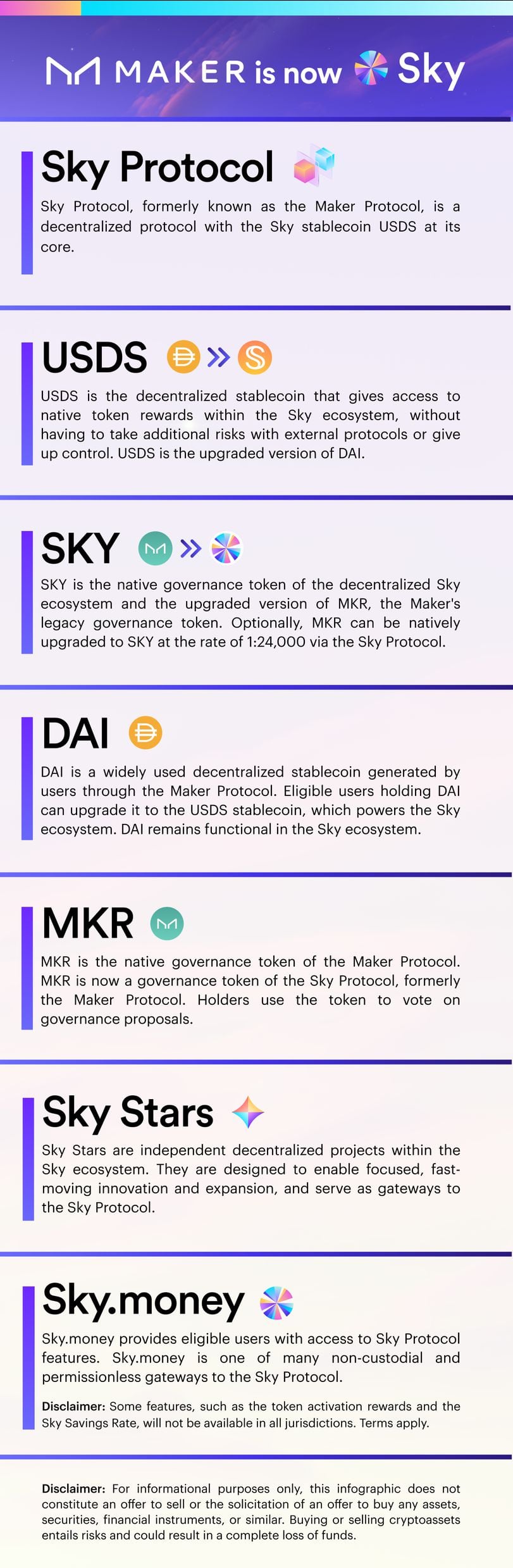
MakerDAO现已更名为“Sky”,这家市值70亿美元的加密借贷平台推出了新的稳定币和治理代币

  • 推动这一变化的动机是“如何将去中心化金融(DeFi)扩展到巨大的规模”,以及发展去中心化的稳定币,Rune Christensen在接受CoinDesk采访时表示。
  • 新的USDS稳定币和SKY治理代币将于9月18日上线,同时推出一个新的DeFi应用程序,用于与协议进行交互。协议现有的DAI和MKR代币将继续流通,用户可以自愿选择是否进行兑换。
  • 在消息发布后,MKR价格立即上涨了4%以上。
  • 这些变化是协议正在进行的名为“终局”(Endgame)的全面改革的一部分。

MakerDAO是最早和最大的去中心化金融借贷平台之一,作为其正在进行的重塑的一部分,该平台更名为“Sky”,并推出了新的代币。

根据周二发布的新闻稿,拥有70亿美元资产的协议还将推出其50亿美元稳定币(DAI)和治理代币(MKR)的新版本,分别命名为USDS稳定币和SKY治理代币。

DAI和MKR将继续不变地流通,而新代币将并行存在。代币持有者将能够以1:1的比例兑换DAI代币为USDS,而每个MKR代币可以兑换28,000个SKY代币。新代币将于9月18日发行,持有者可以自愿选择保留旧代币或兑换新代币。

消息发布后,MKR的价格立即上涨了4%以上,并在过去24小时内上涨了2%,表现优于比特币(BTC)和更广泛的市场加密货币基准CoinDesk 20指数(CD20)。
代币

Sky及其代币将与旧代币并行存在(Sky)

MakerDAO联合创始人Rune Christensen在接受CoinDesk采访时表示,“根本因素是如何将DeFi发展到巨大的规模,像Tether一样大,甚至更大。”

Tether发行了市值1160亿美元的USDT,这是市场上最大的稳定币。

Christensen主导了这一协议的重大、多年改革,称为“终局”(Endgame)。作为这一过程的一部分,他于2023年5月在治理论坛帖子中首次提出了引入“升级”版本的稳定币和治理代币的计划。

协议的增长目标依赖于通过协议的新用户界面Sky.money应用程序为USDS和SKY持有者提供本地代币奖励,Christensen表示。

然而,奖励累积功能将在包括美国和英国在内的某些司法管辖区受到限制。

改革还包括将平台分解为较小的、独立的实体,并赋予它们各自的代币。这些组织早前被称为SubDAOs,作为品牌重塑的一部分,它们将被命名为Stars。

其中第一个实体将是Spark,这是一个建立在Maker/Sky之上的借贷平台。

但这次转型将在“几个月后整个体验经过测试和提升后”才会发生,Christensen在采访中表示。

Related Reads

Solana Expands Validator Power With Launch of On-Chain Governance

Solana has formally launched its on-chain governance system, empowering token holders and validators with a more open and decentralized way to influence major protocol decisions. Governance debates and voting are now conducted entirely on-chain using the new Solana Governance Proposals (SGP) framework, supported by stake-weighted voting and cryptographic verification. Validators with at least 100,000 SOL in delegated stake can submit an SGP. To proceed to a formal vote, a proposal must first gain support from at least 15% of the network's total staked SOL, ensuring only ideas with significant backing move forward. SGPs serve a distinct purpose from the technical Solana Improvement Documents (SIMDs). While SIMDs focus on *how* to implement protocol upgrades, SGPs determine *whether* the broader ecosystem believes a proposal should proceed, via an on-chain, stake-weighted vote. This separation allows core developers to continue building effectively while reserving community-wide votes for impactful decisions. A key feature grants delegators greater control: they can now override their validator's governance vote. If a validator votes against a delegator's preference or abstains, the delegator can cast a vote directly using their own stake weight through Solana's governance portal. The voting process is secured using Merkle proofs to verify participant stakes against an on-chain consensus snapshot. With this implementation, Solana aims to broaden community participation in governance without hindering development, combining decentralized decision-making with efficient protocol evolution.

TheNewsCrypto20m ago

Solana Expands Validator Power With Launch of On-Chain Governance

TheNewsCrypto20m ago

Trillion-Won Bet on Semiconductors: Is South Korea Really Panicking This Time?

**Summary:** South Korea, traditionally adept at "counter-cyclical" investments during industry downturns, has launched an unprecedented trillion-dollar (approximately 6.4 trillion RMB) semiconductor investment plan during a current AI-driven boom. This shift signals deep strategic anxiety, driven by the rapid rise of China's memory chip challengers. The article traces this dynamic through the history of East Asian semiconductor competition. In the 1980s, Japan used a "national system + industrial capital" model to surpass the US in DRAM, only to be overtaken in the 1990s by South Korea employing the same aggressive, efficiency-focused tactics—most notably massive, loss-tolerant investments during downturns to crush competitors like Japan's Elpida. Now, China's memory giants, Yangtze Memory (YMTC) and ChangXin Memory Technologies (CXMT), are employing a strikingly similar playbook. Starting from near-zero a decade ago, they've used a combination of government-backed capital, strategic technology acquisition (e.g., CXMT leveraging Qimonda's legacy), and innovative architectural leaps (e.g., YMTC's Xtacking) to achieve rapid technological catch-up. Crucially, during the severe industry downturn of 2023, while Korean and US giants cut production, the Chinese firms expanded capacity and competed on price, rapidly gaining global market share (reaching ~11% in NAND and ~7.67% in DRAM by 2025). South Korea's current massive investment, therefore, is a defensive move born of fear. The historical pattern suggests that once a technological gap closes, scale and integrated supply chain advantages—areas where China holds significant potential—can determine the leader. Having used counter-cyclical strategies to become the incumbent, South Korea now faces the prospect of a formidable challenger using those very same tactics. This investment marks not just a bet on the AI cycle, but the opening chapter in a new battle for dominance in the memory industry.

marsbit29m ago

Trillion-Won Bet on Semiconductors: Is South Korea Really Panicking This Time?

marsbit29m ago

Trading

Spot
活动图片