鲸鱼动向引领市场 , PEPE 价格能反弹吗

币界网Published on 2024-08-15Last updated on 2024-08-15

币界网报道:

大量鲸鱼活动表明 Pepe 币价格可能出现反弹,大型投资者以较低的价格积累 PEPE。

v2-b81631313a564b3a128eb1859a2f88ec_720w.webp

Pepe Coin 的价格在过去一天经历了下行抛售压力,可能是因为有消息称美国政府从 Silk Road 钱包中转移了 10,000 BTC。由于加密货币恐惧和贪婪指数在过去 24 小时内从 30 降至 29,市场陷入恐慌。尽管 PEPE 价格下跌,但鲸鱼和交易员的行为表明该资产可能很快就会反弹。

PEPE币价格分析

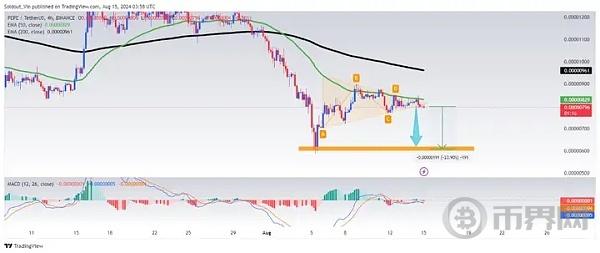
PEPE 价格在过去 24 小时内下跌 4.9%,交易价格为 0.00000778 美元,突破了价格图上的对称三角形模式。

展望未来,PEPE 的价格明显处于下降趋势,如较低的高点和较低的低点形成对称三角形所示。价格低于 50 天移动平均线 (EMA) 的 0.00000829 美元和 200 天 EMA 的 0.00000961 美元,强化了看跌趋势。

价格最近跌破三角形模式,表明下行趋势可能延续。Pepe Coin 价格可能在 0.00000700 美元附近获得支撑,之前的低点为 0.00000600 美元。

移动平均线收敛散度 (MACD) 柱状图呈看跌趋势,表明下行势头增强。MACD 线在信号线下方的趋势强化了这种情绪,进一步表明看跌情绪强烈。
v2-6ca3aa9fb9fb3fdccd5589d5d73c1886_720w.webp

PEPE币价格分析图

如果 PEPE 多头卷土重来,价格可能会突破对称三角形,使当前的看跌市场结构失效。PEPE 价格将瞄准 200 日 EMA 的下一个主要阻力位。

鲸鱼正在购买 PEPE

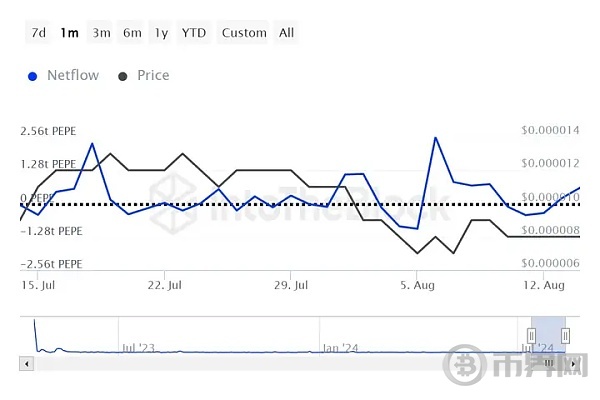
PEPE 鲸鱼的活动在过去 48 小时内增加,IntoTheBlock报告称,8 月 13 日至 14 日期间大持有者流入量增加了 192%,表明对该资产的看涨情绪。
v2-6e922a680317aa343e8535014bbcd5b7_720w.webp

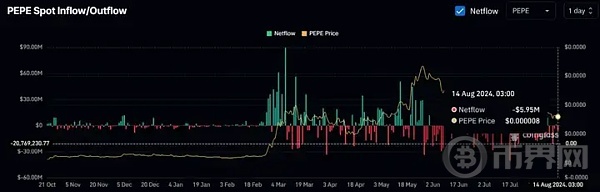
此外,根据Coinglass的数据,8 月 14 日 PEPE 现货净流出为负。昨天,交易所储备中约有价值 595 万美元的 PEPE,较前一天 127 万美元的正净流出有所增加。再加上鲸鱼增加了他们的余额,这表明大型投资者正在以折扣价抢购 Pepe Coin,以期看涨趋势逆转。
v2-63cef2d0e051cf5a3755535e43a0a3ec_720w.webp

对 PEPE 大订单簿的进一步分析显示,鲸鱼订单价值 260 万美元,约为 0.00000579 美元和 0.00000670 美元。这些订单已经等待了 9 天,表明鲸鱼准备以更低的价格购买更多的 PEPE 代币,这可能会推高 Pepe 币的价格。

简单来说

Pepe Coin 价格分析和指标指向看跌阶段,最近对称三角形的突破表明未来还有进一步下跌的潜力。然而,Pepe 鲸鱼处于增持模式,大额持有者集中度增加 192%的活动讲述了一个不同的故事。我认为尽管下跌趋势占主导地位,但一旦价格达到 0.00000575 美元的低点,反弹就有可能。


Trending Cryptos

Related Reads

STRC 跌破面值,比特币财库实验进入下半场

The price of STRC, Strategy's dividend-paying preferred stock, has fallen below its $100 face value, triggering a re-evaluation of the "bitcoin treasury" corporate model. This highlights a critical tension: the company's asset base consists of high-volatility, non-cash-flow-generating Bitcoin, while its capital structure requires continuous cash payouts for dividends and interest. The decline of STRC signals that market pressure is shifting from asset price volatility to the pricing of the company's financing tools. Strategy's core model involves a three-step conversion: turning equity into Bitcoin exposure, converting Bitcoin holdings into capital market credit, and packaging non-yielding BTC into cash-paying securities like STRC. While Strategy holds a massive 847,363 BTC, the focus is now on cash flow mismatches. The company faces annual preferred stock dividend obligations of approximately $1.7 billion, far exceeding the cash flow from its legacy software business. Its ability to meet these obligations relies on continued access to capital markets. The market is now scrutinizing which of three potential costs becomes untenable first: rising dividend costs to attract investors, dilution costs from issuing more common stock, or the reputational cost of selling BTC—a move contrary to its "hodl" narrative. For the broader crypto market, a constrained Strategy means the potential loss of a predictable, narrative-driven marginal buyer for Bitcoin. The STRC discount serves as a reminder that the longevity of such models depends not just on Bitcoin's price, but also on financing windows, cash reserves, and investor willingness to pay a "trust premium" for the structure.

marsbit23m ago

STRC 跌破面值,比特币财库实验进入下半场

marsbit23m ago

Standard Chartered Bank’s 50-Fold Fantasy: Predicting AAVE to Reach $3,500

Standard Chartered Bank has issued an optimistic research report predicting that the AAVE token could surge 50-fold to $3,500 by 2030. This forecast is based on the projection that the total value locked (TVL) in DeFi will grow 37x to approximately $2.7 trillion, driven by stablecoin expansion and the tokenization of real-world assets (RWA). The bank's model links Aave's potential valuation directly to its protocol revenue, which is primarily driven by net interest margins. The report highlights Aave's current dominant position, noting it captures over 80% of the net earnings ("protocol retained earnings") in the lending sector while holding only about half of its TVL. It also points to the recent launch of the Aave V4 architecture and a healthy revenue stream of $142 million in 2025 as positive fundamentals. Grayscale's separate analysis, applying traditional valuation metrics like DCF, concluded AAVE is currently undervalued. However, the article notes significant challenges. Aave's peer-to-pool lending model suffers from inherent capital inefficiency, with an estimated $52 million annual "deadweight loss" due to idle funds needed for liquidity buffers. This structural flaw was exposed during the April KelpDAO exploit, which locked a WETH pool at 100% utilization for days. Emerging protocols like Morpho, with more efficient point-to-point models, are cited as growing competitive threats. In summary, while institutional forecasts paint a macro picture of massive growth fueled by RWA adoption, Aave's path forward hinges on addressing its core structural limitations and competitive pressures within the evolving DeFi lending landscape.

链捕手1h ago

Standard Chartered Bank’s 50-Fold Fantasy: Predicting AAVE to Reach $3,500

链捕手1h ago

Tidal Investment: We Remain Bullish on the AI Industry Chain, But the Reasons Have Changed

Tidal Investment remains optimistic about the AI industry chain, but the rationale has shifted. The market narrative has changed. While recent large-scale IPOs (e.g., SpaceX) and major fundraising plans by tech giants like Alphabet and Meta have caused some nervousness, this isn't a sign of an AI peak. The focus has moved from the initial question of AI's viability to the sustainability of massive investment cycles. The key players—primarily the major cloud providers—are not slowing down; their capital expenditure (Capex) guidance for 2026 has been increased across the board (e.g., Alphabet to $180B, Amazon to $200B). This investment cycle is proving resilient and difficult to stop. Unlike traditional hardware cycles, current AI Capex is distributed across multiple physical layers—computing, memory, networking, and critically, power infrastructure. Bottlenecks are shifting from chips to elements like electricity, transformers, and cooling systems, which have much longer lead times and cannot be easily pre-built like fiber optics during the dot-com bubble. Supply chain data (e.g., Eaton's 240% YoY data center orders) confirms this broad-based, project-driven expansion. Market concerns are acknowledged but viewed differently. First, while Capex growth currently outpaces revenue growth, raising ROI questions, this mirrors the early scaling phase of cloud computing itself. A change in view would require concrete signals like downward Capex revisions or missed AI product targets, which haven't materialized by mid-2026. Second, comparisons to the 2000 dot-com bust are flawed. That crash was driven by a massive, parallel oversupply of cheap capacity (fiber). The current cycle faces *supply constraints* in critical, capital-intensive physical infrastructure that cannot be overbuilt as easily. In conclusion, the wave of fundraising reflects the next, more complex act of the AI story. Physical bottlenecks and sustained high Capex plans suggest this is not the finale but an ongoing, capital-intensive build-out phase. The script has changed, but the play is far from over.

marsbit2h ago

Tidal Investment: We Remain Bullish on the AI Industry Chain, But the Reasons Have Changed

marsbit2h ago

Tidal Investment: We Remain Bullish on the AI Industry Chain, But for Different Reasons Now

Tidal Investments remains optimistic about the AI industry chain, but the rationale has shifted. The market is concerned about massive concurrent fundraising by tech giants like SpaceX, OpenAI, Alphabet, and Meta, fearing an AI peak. However, the authors argue this signals the next act of AI development, not its end. Capital expenditure (Capex) from major cloud providers (Alphabet, Amazon, Meta, Microsoft, Oracle) continues to surge aggressively into 2026. This investment cycle is more resilient than past hardware cycles due to its scale and complexity. Bottlenecks have shifted from chips to critical physical infrastructure like power grids, transformers, cooling, and data center construction—areas with long lead times and limited capacity for rapid expansion. Supply chain data (e.g., Eaton's orders) confirms substantial, tangible progress. Key market concerns are addressed: 1. **ROI vs. Capex Growth**: While Capex growth outpaces revenue, the authors note cloud giants have historically overcome similar phases through scale. The cycle will only be in danger if Capex guidance is cut, orders are canceled, or AI product demand falters—none of which are currently observed. 2. **Comparison to the 2000 Dot-com Bubble**: Unlike the telecom bubble, where cheap, oversupplied fiber crashed prices, AI infrastructure (especially power) is constrained, customized, and subject to lengthy approvals, making a similar supply glut and crash unlikely. In conclusion, the wave of fundraising reflects the immense, ongoing capital needs for AI's next phase, constrained by slow-moving physical bottlenecks. The AI cycle is not over; the script has simply changed.

链捕手2h ago

Tidal Investment: We Remain Bullish on the AI Industry Chain, But for Different Reasons Now

链捕手2h ago

Trading

Spot
Futures
活动图片