Камала Харрис опередила Трампа на Polymarket с 50% шансом на победу в выборах

cryptonews.ruPublished on 2021-12-08Last updated on 2024-08-08

  • Вице-президент Камала Харрис оставила позади Дональда Трампа на платформе Polymarket.
  • Пользователи площадки оценили вероятность победы Харрис на президентских выборах в 50%.
  • Трамп на Polymarket отстает от главного конкурента на политической арене по этой позиции всего на 1%.

Кандидат в президенты США Камала Харрис обошла своего политического визави в лице Дональда Трампа на платформе для ставок Polymarket. Пользователи площадки оценили ее шансы на победу в президентских выборах в 50%. В успех Трампа, в свою очередь, верят 49% людей, сделавших ставку по этой позиции.
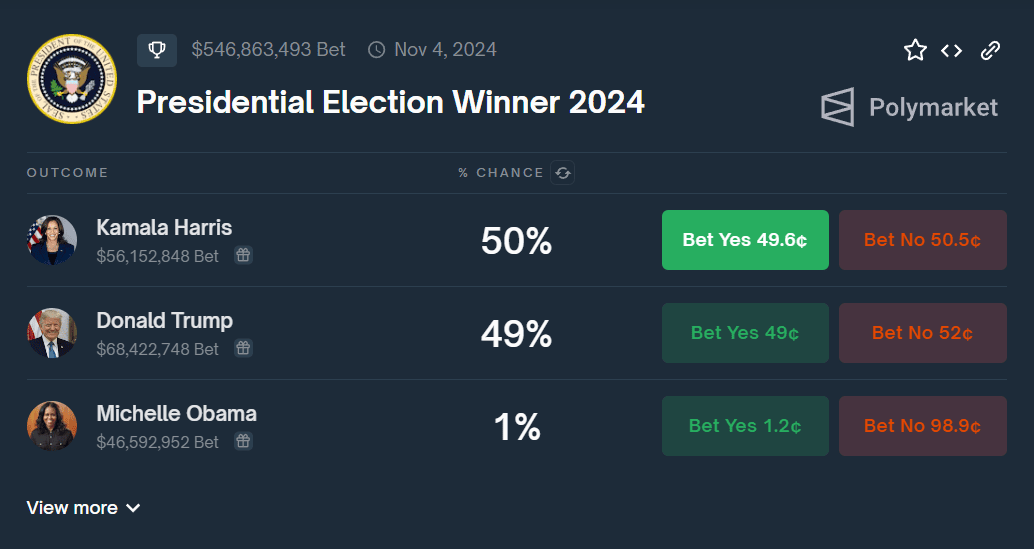
Ставки на победителя президентских выборов в США. Источник: Polymarket.

Впервые за долгое время представитель республиканцев уступил на платформе лидерство кандидату от Демократической партии по данному вопросу. До этого Трамп опережал как снявшегося с предвыборной гонки Джозефа Байдена, так и пришедшую ему на смену Камалу Харрис.

Общий объем ставок на упомянутый прогноз превышает $546 млн. Суммарный размер средств, который фигурирует в политическом разделе на платформе преодолел отметку в $1,1 млрд. Количество ставок на события этой категории на Polymarket исчисляются сотнями.

Отметим, что ранее представители Конгресса США потребовали от Комиссии по торговле товарными фьючерсами (CFTC) ввести запрет на политические ставки. Законотворцы считают, что они могут оказать влияние на исход президентских выборов в Соединенных Штатах.

Тем временем пользователи Polymarket оценили вероятность снижения процентной ставки в сентябре 2024 года в 57%.

Эксперты компании QCP Capital не разделяют оптимизм участников платформы и считают, что ФРС, вероятно, не будет снижать процентную ставку в следующем месяце. По их мнению, ведомство также воздержится от внепланового заседания в октябре с той же целью.

Напомним, мы писали, что Polymarket добавит поддержку банковских карт на фоне растущих объемов ставок.


Related Reads

OpenAI's "Most Open" Move: Codex No Longer Exclusively Favors GPT

OpenAI has significantly opened up its Codex programming agent by introducing a "model provider" configuration layer that allows users to connect it with various open-source models, not just its proprietary GPT. Through a configuration file or a simple `--oss` command-line flag, Codex can now route requests to local services like Ollama or LM Studio, or to third-party APIs such as Mistral or DeepSeek. This move is seen as one of OpenAI's most "open" steps, potentially lowering costs and enhancing privacy for developers who can run code generation offline. However, integration isn't seamless for all models. Codex primarily uses OpenAI's newer Responses API, while many open-source models rely on the older Chat Completions interface. This creates compatibility issues, especially for advanced features like function calling. The developer community is already building "routing" or adapter layers (e.g., CC Switch, LiteLLM) to translate between these protocols, enabling hybrid setups where GPT handles planning and open-source models handle execution. Analysts interpret this as a strategic shift for OpenAI: from competing solely on model superiority to controlling the platform and interface standards. By making Codex a flexible, pluggable entry point for AI-assisted programming, OpenAI aims to become the central hub in the developer toolchain ecosystem, even as users gain the freedom to switch underlying models.

marsbit35m ago

OpenAI's "Most Open" Move: Codex No Longer Exclusively Favors GPT

marsbit35m ago

When 500 Million People Abandon ChatGPT

ChatGPT's Global AI Assistant Market Share Drops Below 50% Three and a half years after its groundbreaking launch, ChatGPT faces a pivotal moment. While it remains the largest AI assistant globally, its market share has fallen below 50% for the first time, reaching 46.4% as of May, according to Sensor Tower's 2026 AI landscape report. Google's Gemini (27.7%) and Anthropic's Claude (10.3%) are now its main competitors, with Grok, Perplexity, and others also gaining ground. The market has evolved from awe and initial adoption into a phase of product comparison, ecosystem integration, and commercialization. User behavior has matured significantly. Loyalty is low; users readily switch between assistants for specific tasks. Gemini benefits from deep integration within Google's ecosystem (Search, Gmail, Android), while Claude has carved a niche among productivity-focused users with strong retention, nearly matching ChatGPT's. User choice is now influenced by a complex mix of capability, ecosystem, price, use case, and even brand trust. Commercialization is accelerating. AI app downloads continue but growth is slowing, while user spending is rising. Over $4.2 billion was spent in-app during H1 2026. Claude leads in premium subscription conversion rates (13%). OpenAI is expanding its revenue streams, testing ads shown to 17% of ChatGPT users daily by May. This shift highlights the immense financial pressure of model training and inference costs. Despite revenue growth, OpenAI's cash burn is intense, reaching $3.7 billion in Q1 2026. The company projects this could rise to $25-57 billion in the coming years, underscoring the industry-wide challenge of scaling profitably. The symbolism is clear: ChatGPT no longer defines the AI assistant market alone. The era of a single dominant product is over. Gemini, Claude, and specialized tools are collectively shaping user habits and business models. As AI assistants move from novelty to utility—judged on accuracy, efficiency, and value—they are becoming embedded in everyday digital life. ChatGPT may have lost its majority, but AI as a whole is winning, entering a mature, competitive, and diverse new phase.

marsbit37m ago

When 500 Million People Abandon ChatGPT

marsbit37m ago

Trading

Spot
Futures
活动图片