Ethereum Bears Keep Control As ETH Rejects Trendline Resistance

bitcoinistPublished on 2026-06-21Last updated on 2026-06-21

Abstract

Ethereum's (ETH) recent price rebound is still viewed as unconvincing by some analysts, with technical analysis indicating continued bearish control. ETH has failed to break above a key falling trendline and a horizontal resistance zone, forming a pattern of lower highs and lower lows. This rejection at a confluence of resistances strengthens the bearish case. The critical support zone to watch is between $1,350 and $1,500. A breakdown below this area would signal significant weakness. Currently, ETH is trapped between this support and the dominant falling resistance, keeping the market in a compressed technical state. Ethereum's struggle is also significant for the broader altcoin market, as it often sets the tone for risk appetite. The analysis concludes that bulls require a decisive break above the identified resistance before any talk of a sustained reversal is warranted.

Ethereum’s latest rebound has not yet convinced all analysts that the downtrend is over. A June 20 TradingView idea from TheSignalyst argued that ETH remains bearish after continuing to trade below a falling red trendline and printing a sequence of lower highs and lower lows.
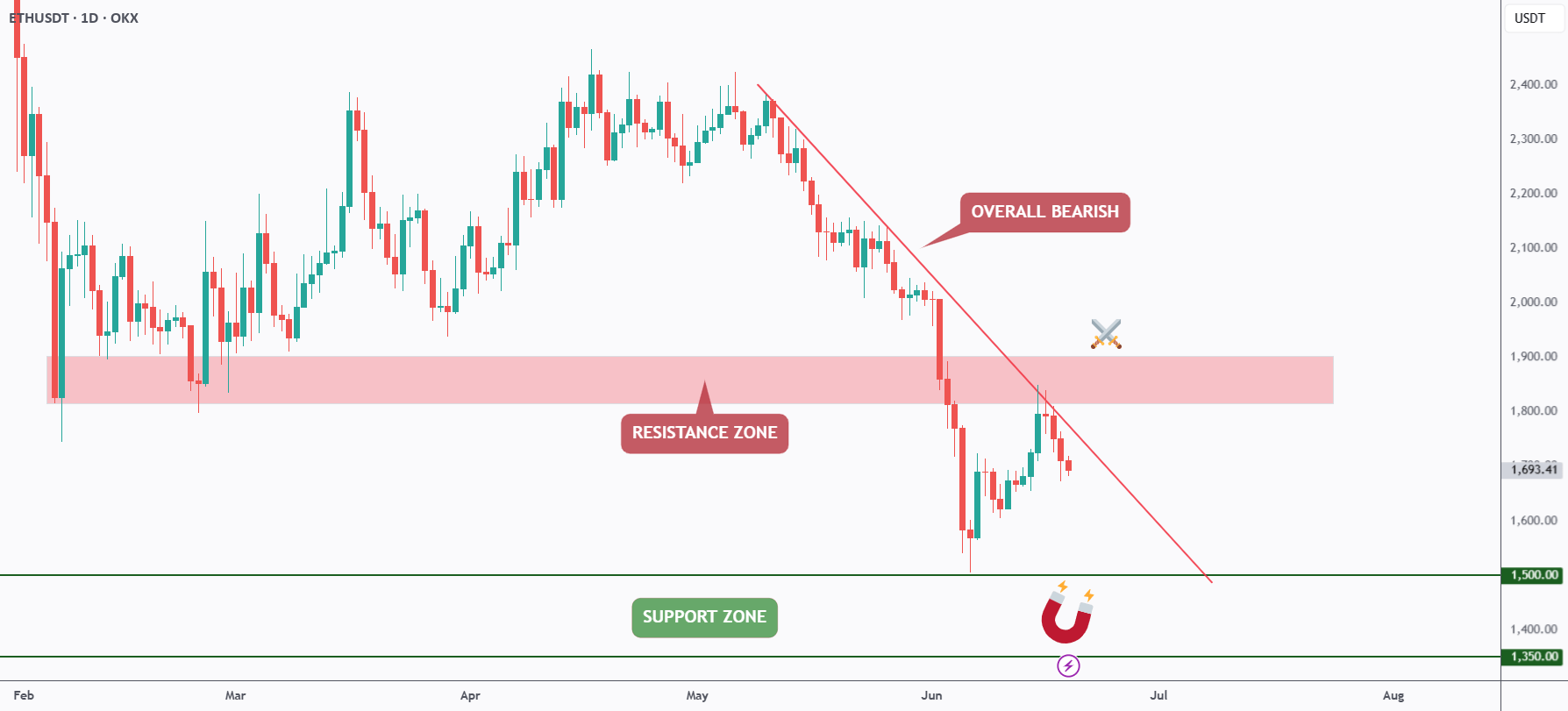
TradingView chart referenced in this analysis

The analyst’s chart shows ETH rejecting a confluence area made up of the falling trendline and a horizontal structure zone. That matters because confluence resistance can attract sellers more aggressively than a single isolated level. When price fails at both diagonal and structural resistance, traders often treat the move as confirmation that bears are still defending control.

Support Zone Still Defines The Downside Risk

The important support area, according to the idea, sits between $1,350 and $1,500. That gives traders a clear zone to watch if the rejection continues. A controlled pullback into that range could produce another reaction, but a decisive break below it would make the broader ETH structure look much weaker.

For now, ETH is caught between a support zone that has mattered before and a falling trendline that keeps capping rebounds. Until one of those areas gives way, the market remains technically compressed.

Why This Setup Matters Beyond ETH

Ethereum’s chart also matters for the wider altcoin market. When ETH struggles against the dollar, risk appetite across DeFi and smaller-cap crypto assets often weakens with it. That does not mean every altcoin follows ETH tick-for-tick, but Ethereum remains the benchmark for much of the smart-contract market.

TheSignalyst’s setup is therefore a warning that the recent rebound still has work to do. Bulls need a clean break above resistance before the market can talk seriously about a stronger reversal.

This report is based on information from TradingView TheSignalyst.

This article was written by the News Desk and edited by Samuel Rae.

Trending Cryptos

Related Questions

QAccording to the TradingView idea from TheSignalyst, why is Ethereum (ETH) considered to remain bearish?

AETH is considered bearish because it continues to trade below a falling red trendline and has printed a sequence of lower highs and lower lows, failing to break above a confluence area of resistance.

QWhat key support zone for ETH is identified in the analysis, and what would a break below it signify?

AThe key support zone identified is between $1,350 and $1,500. A decisive break below this support range would make the broader ETH price structure look much weaker, indicating increased downside risk.

QWhat is the significance of the confluence resistance area mentioned in the article?

AThe confluence resistance area, formed by the falling trendline and a horizontal structure zone, is significant because such combined resistance can attract sellers more aggressively than a single level. Price failing there confirms that bears are still defending control of the market.

QWhy does Ethereum's price action matter for the broader altcoin market according to the article?

AEthereum's price action matters for the broader altcoin market because when ETH struggles against the dollar, risk appetite across DeFi and smaller-cap crypto assets often weakens alongside it. Ethereum serves as a key benchmark for much of the smart-contract market.

QWhat do bulls need to achieve for the market to consider a stronger reversal, based on the analyst's conclusion?

ABased on the analyst's conclusion, bulls need to achieve a clean break above the identified resistance (the confluence of the falling trendline and horizontal structure zone) before the market can talk seriously about a stronger reversal.

Related Reads

Citi's Interpretation: Why Does Citi Still Give SanDisk a Target Price of $2500 After Earnings Report Despite a Significant Stock Price Drop?

Citi maintains a "Buy" rating on SanDisk with a $2500 price target despite a post-earnings stock drop. This target, implying an 85.1% upside from the August 5th close of $1350.50, hinges on the firm's view that SanDisk merits a higher valuation than traditional NAND cyclical stocks. Although SanDisk reported strong Q4 FY26 results with revenue up 51% sequentially and robust full-year data center growth (+437%), its stock fell sharply on August 6th. Investors are concerned about potential NAND price growth moderation and guidance that failed to meet elevated market expectations. Citi's bullish thesis centers on SanDisk's new long-term "New Business Model" (NBM) agreements. These contracts, covering a significant portion of its NAND bit output for FY27 and FY28, represent minimum revenue commitments of approximately $94 billion backed by financial guarantees. This structure aims to increase revenue and cash flow predictability. The report links this visibility to AI data center demand, driven by the expansion of inference workloads requiring more storage. Citi estimates data center storage capacity demand will grow about 35% in CY27. However, the analysis notes long-term contracts cannot eliminate the NAND cycle. Risks include potential oversupply from industry capacity expansion, competition, and macroeconomic headwinds. The $2500 target essentially bets that AI demand and these contracts can reduce earnings volatility enough to support a premium valuation (~11x CY27E EPS). Key factors to watch are the execution of the $94B commitments, pricing mechanisms, actual data center demand, and industry supply dynamics.

marsbit4m ago

Citi's Interpretation: Why Does Citi Still Give SanDisk a Target Price of $2500 After Earnings Report Despite a Significant Stock Price Drop?

marsbit4m ago

Dark Pools Prevail, Whales Vanish: How Credible Are Public Market Signals?

Institutional cryptocurrency trading is increasingly shifting towards dark pools and over-the-counter (OTC) desks, with data from sFOX showing such venues accounted for 15% of total monthly volume by June, up from negligible levels in April. In July, 77.7% of institutional capital on sFOX's platform was routed through OTC desks, while only 18.4% went to public exchanges. A key driver is institutions' need to conceal large orders to avoid revealing trading patterns, preventing front-running and minimizing price impact. Firms like Jane Street and Citadel use dark pools and order-splitting across multiple venues to execute trades discreetly. This structural shift mirrors earlier developments in equities and forex markets. As a result, public order books now reflect only a fraction of actual market activity, eroding the once-significant advantage retail traders had in tracking large wallets and exchange flows. The proliferation of prime brokers and aggregation platforms is also rapidly closing simple arbitrage opportunities. The market may evolve toward a brokerage model for retail, similar to traditional stocks. Two scenarios emerge: an optimistic one where retail gains from narrower spreads and better order routing, and a pessimistic one where transparency declines faster than benefits trickle down, leaving smaller investors in the dark. Regardless, traders must adapt by not relying solely on exchange volume, comparing total execution costs, and using limit orders in thin markets. While reduced volatility from hidden large trades may seem positive, it comes at the cost of obscured market signals and institutional intent.

marsbit10m ago

Dark Pools Prevail, Whales Vanish: How Credible Are Public Market Signals?

marsbit10m ago

Trading

Spot

Hot Articles

Discussions

Welcome to the HTX Community. Here, you can stay informed about the latest platform developments and gain access to professional market insights. Users' opinions on the price of ETH (ETH) are presented below.

活动图片