Original | Odaily Planet Daily (@OdailyChina)
Author | Golem (@web3_golem)
The current Meme market is quite fragmented. Whether in terms of blockchain ecosystems or the trading tools used, overseas users and the Chinese user community have almost no intersection. This fragmentation not only diverts global Meme capital to various ecosystems but also makes it difficult to fully understand the "gossip."
On August 8th, a piece of gossip about "Pump.fun spending huge sums to poach users from its competitor" went viral in overseas Meme communities.
It was initially disclosed by overseas user CLR, who stated that Pump.fun is using incentive plans to attract users to migrate from the FOMO platform to Pump.fun. According to the disclosed agreement document, Pump.fun plans to offer eligible users a one-time $20,000 signing bonus and a fixed monthly payment of $30,000. The agreement requires the signed users to transfer their funds and trading positions from the FOMO platform to Pump.fun; use a new wallet not previously used on other platforms as their exclusive wallet; bind their X account to the Pump.fun wallet; publicly declare on their X profile that this wallet is their only public wallet; and permanently delete and close their FOMO platform account.
Additionally, users must meet real trading requirements, including completing at least $25,000 in monthly trading volume on Pump.fun (or 25% of their average monthly trading volume on the FOMO platform). It can be seen that Pump.fun is determined to go all out to compete for FOMO platform users.
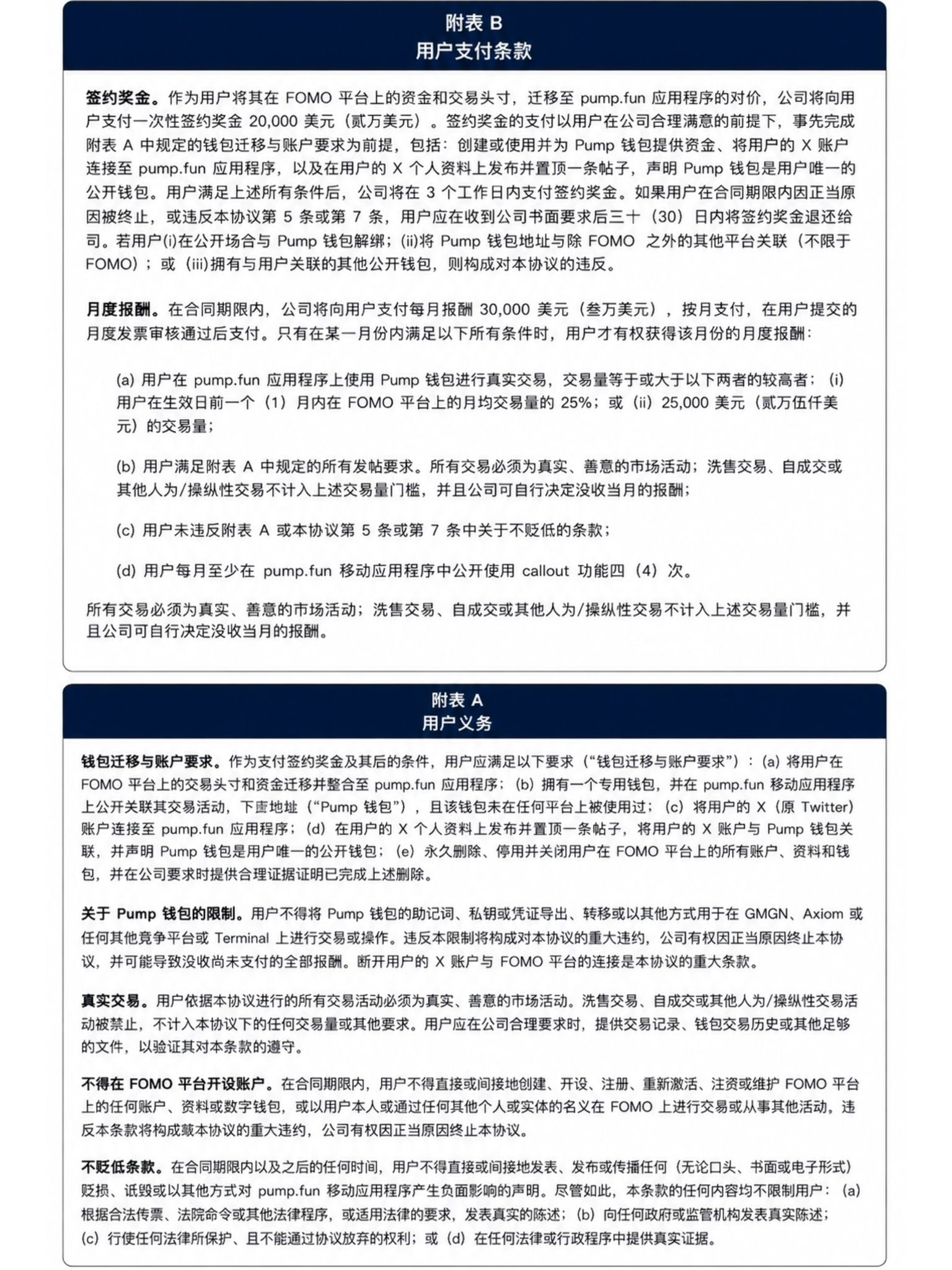
Full content of the agreement, Chinese translated version (Source: 0xAA)
From a business perspective, this is a normal corporate competitive behavior and is legally sound. In entertainment platforms or user-centric business models, companies often pay KOLs or users with significant fan influence to leave competitor platforms and maintain exclusivity on their own platform. This competition model is quite common in China as well, for example, the exorbitant exclusive contracts for internet celebrities by early short-video live streaming platforms like Douyin, Kuaishou, Bilibili, and Huya.
But the first slightly confusing question for onlookers in this whole event is: Who is FOMO?
Pump.fun is the largest token issuance platform overseas, with fee revenue consistently ranking in the top five of on-chain protocol lists. What prompted it to try to poach users from the FOMO platform? What magic does the FOMO platform possess to become a commercial rival that makes Pump.fun nervous? Odaily Planet Daily will analyze the undercurrents and massive changes in the current overseas Meme market through this "gossip."
FOMO Has Become a Primary Meme Trading Platform for Users
FOMO is a multi-chain Meme trading platform, with business and services similar to GMGN. The platform launched in May 2025, and has been officially operating for just over a year. However, according to RootData, FOMO has completed 3 rounds of financing, with a total funding amount of $94 million and a valuation exceeding $550 million.
FOMO primarily serves overseas Meme communities and mainly promotes mobile terminal trading. Most users in the Chinese community may not have even heard of FOMO. More astonishingly, this platform you may have never heard of or used has already surpassed Uniswap and Phantom in revenue over the past 30 days, and its Trading Bot market share has surpassed GMGN to become number one in the market.
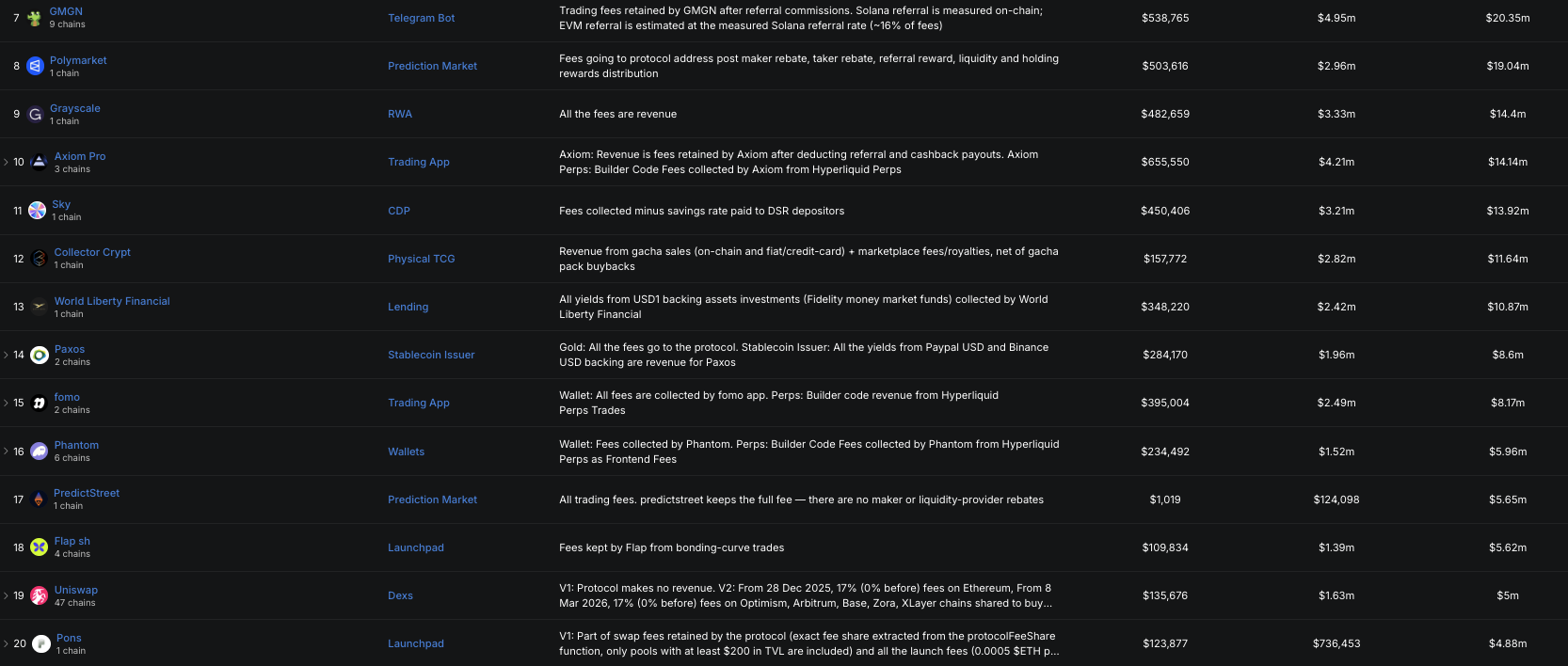
According to DeFiLama data, FOMO's revenue over the past 30 days is $8.17 million. Although it still falls short of GMGN and Axiom, it has already surpassed Phantom, Uniswap, and mainstream Launchpads (Flap and Pons) on Robinhood.
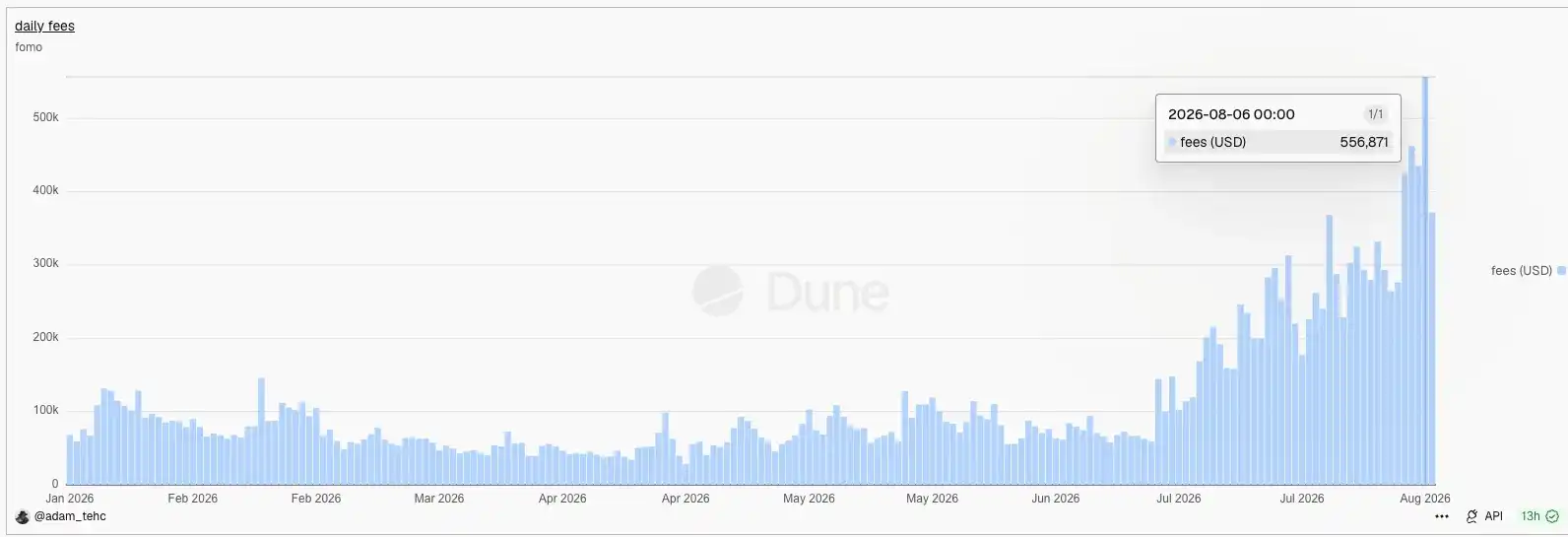
Simultaneously, according to Dune data, as of the time of writing, the total fees on the FOMO platform have reached $30.39 million. As shown in the chart below, looking at daily fees, the FOMO platform began experiencing rapid growth starting in July, with daily fees averaging over $200,000, whereas they previously maintained an average of around $100,000. As of the time of writing, the FOMO platform set a new daily fee record on August 6th, reaching $556,000.
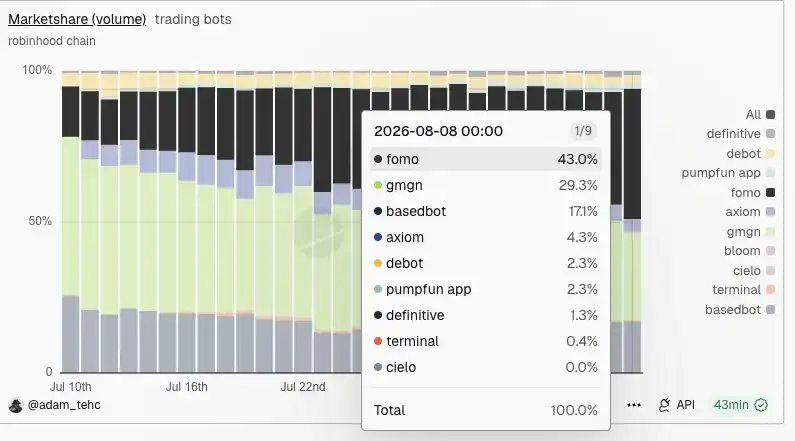
Entering August, the FOMO platform continued its high growth. As of August 8th, the FOMO platform's market share in Trading Bots has risen to 43%, surpassing GMGN to become the market leader. Previously, GMGN consistently held the top spot.
Just how influential is FOMO now? One recent example will make it clear. On August 4th, the Solana Meme coin CATE experienced a flash crash of 65% in one minute, its market cap plummeting from over $80 million to about $20 million. The community summarized two reasons: first, CATE's X account was suspended, and second, FOMO went down, preventing users from trading during the outage. Of course, this incident still has many controversies; interested readers can explore further. (Related reading:$CATE Flash Crashes 65% in One Minute, FOMO Platform's "Coincidental" Outage Sparks Harvesting Suspicions Again)
Regardless of the truth, this incident is enough to demonstrate the current influence of the FOMO platform within the Meme ecosystem. So, from a product perspective, what has allowed FOMO to stand out among numerous competitors?
The answer lies in FOMO's product design. The core services FOMO provides are similar to most Meme trading platforms, but its slogan is "the only trading app that is social-first." This is reflected in the product through the introduction of a profit leaderboard (Leader board) and a feed (Feed) providing real-time alerts on top traders' activities.
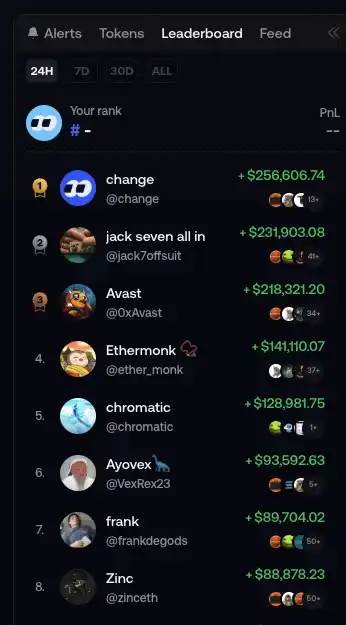
LEADERBOARD and FEED on the FOMO platform
The Meme market inherently has a "money is king" worship of strength. Anyone who makes enough money can be called "smart money" and gain a large following and copy-trading accounts. The FOMO platform leverages this group characteristic, artificially "creating idols" by using pages like the leaderboard to specifically push high-profit users to the forefront, helping them gain influence. On August 9th, FOMO team member @villagebythexyz posted on X, stating that compared to previous cycles, anyone with any influence in the cryptocurrency space now must be a good trader, emphasizing that "it's your trades that shape your followers, not your followers that shape your trades."
This model has achieved great success. For example, the reason the Solana Meme coin CATE was able to surge was not because of any sexy narrative, but due to the traffic and open support from the person known as "Little Ansem," Poorgoat. Poorgoat is a member of the FOMO Hall of Fame (recognized and included in FOMO's official hall of fame list for achieving large profits on FOMO). Therefore, with the support of fans, even though CATE had no sexy narrative, it could still create a "myth."
Pump.fun also saw the enormous potential of this model for platform growth. So, on August 7th, the Pump.fun APP announced a social feature upgrade. The core of the upgrade was replicating FOMO's social features. Now, entering the Pump.fun homepage, users no longer see a flood of new Meme coin information but a feed of Meme traders/KOLs and monitoring alerts for their operations.
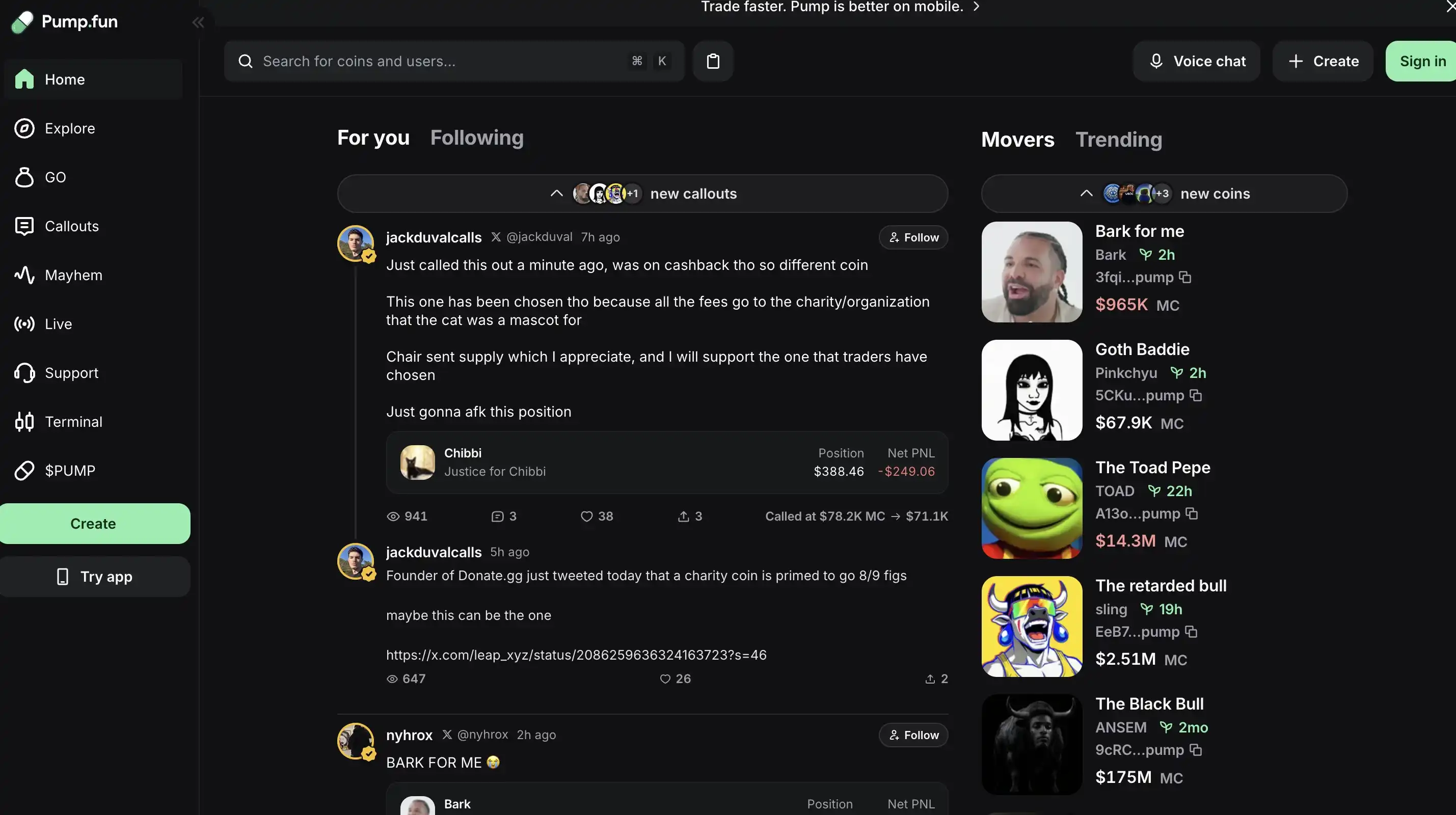
Pump.fun homepage
Pump.fun founder alon has also been posting intensively recently, welcoming numerous overseas Meme traders/KOLs to join the Pump.fun app. To attract more well-known overseas Meme traders to the Pump.fun platform, Pump.fun has even resorted to poaching FOMO's corner and requiring Meme traders to sign "exclusivity agreements."
This commercial competitive behavior by Pump.fun essentially reflects that the overseas Meme market has entered an "internet celebrity带货 model" (live-streaming e-commerce model). Whoever signs the most KOLs with strong ability to drive orders captures the market.
The Overseas Meme Market Enters the Internet Celebrity Live-Streaming E-commerce Model
From the rise of FOMO to Pump.fun's poaching behavior, we can see an important shift occurring in the overseas Meme market: the core of market competition is no longer about issuance tools, trading speed, or on-chain liquidity, but rather the competition for "attention resource subjects."
When the cultural consensus and celebrity coin narratives that the early Meme coin market relied on begin to lose effectiveness, the Meme market shifts its attention from the Meme coins themselves to the people trading Meme coins. FOMO's rapid growth logic is precisely based on this change in market dynamics. In this model, traders replace Memes as the new content subjects. Through leaderboards, trading activity feeds, and copy-trading mechanisms, platforms package originally decentralized on-chain trading behavior into a content stream similar to entertainment consumption. People become the new carriers of consensus.
For the vast number of retail investors lacking professional analytical skills, following a trader who has previously made millions in profits is clearly simpler than researching a newly born Meme project with no historical record.
However, this trend also means the Meme market is entering a more intense stage of involution. When trading traffic and market attention concentrate on a few top traders, competition between platforms naturally shifts from competing for users to competing for the "super nodes" that can bring users, i.e., the Meme internet celebrities.
This is extremely similar to the early anchor competition in China's short-video live streaming industry. Back then, platforms like Douyin, Kuaishou, Huya, and Douyu competed for top anchors through high signing fees, essentially competing for attention entry points. The difference is that the competition for top anchors in the short-video live streaming industry occurred in a rapidly expanding emerging market where user scale and commercial value were still growing, ultimately pushing the live streaming industry towards maturity.
The emergence of a similar competition model in the Meme market today reflects a completely different signal.
When platforms start competing for the same batch of "trading celebrities," the winner might gain short-term growth, but it also means that the entire Meme track is losing the vitality formed initially through community culture and spontaneous dissemination. For Memes, this is the biggest risk.