Author: Primitive Ventures Co-founder Dovey Wan
Original Title: Who Pays for the Bull Market

It has been almost six years since "The Clear Long Bull from the West." After two cycles, crypto has largely fulfilled many of the "wish lists" from the past decade. The events mentioned in the article are rapidly unfolding: various allocation institutions are entering the market to allocate Bitcoin, products linking with TradFi are fully connected, Circle is going public with high profile, and the U.S. President is openly endorsing it and even posting memes. According to the old script, this should be the standard opening of a "high-beta bull market." However, what we have seen in this cycle is a collapse in volatility, market catalytic events being front-run, and an industry that should be full of "surprises" becoming less exciting as assets become fully financialized and mainstream.
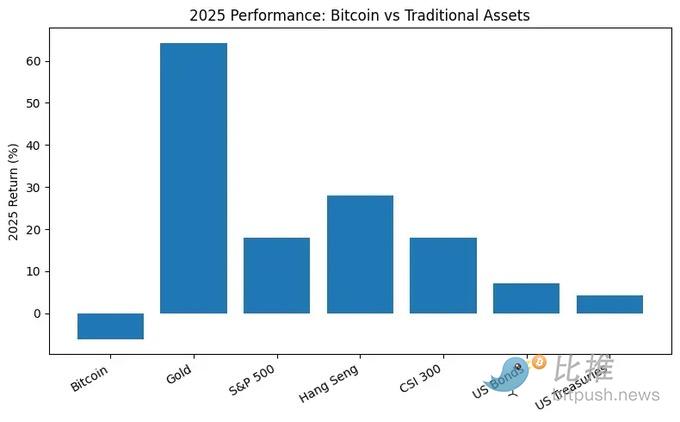
On a cross-asset level, even against a backdrop of policy friendliness and institutional红利释放, BTC明显 underperformed gold, U.S. stocks, Hong Kong stocks, A-shares, and other major TradFi assets in 2025, making it one of the few assets that failed to同步创出 new highs alongside global risk assets.
Since the beginning of 2024, I have多次 on English Twitter @DoveyWan从不同角度拆解 the structural changes in the liquidity supply chain caused by asset mainstreaming. To name a few representative points:
-
CME's BTC OI surpassed Binance's as early as the beginning of 2024.
-
The launch of ETFs provided the best ground for Wall Street's professional arbitrageurs, leading to a significant收敛 of volatility.
-
Binance and OKX's attempts to promote triparty banking agreements have been struggling.
-
The launch of CME's ETF options and future spot products will further squeeze the market of offshore exchanges.
-
CBOE and CME's acceptance of crypto in-kind collateral this year will greatly increase collateral mobility.
-
DTCC will directly connect to several public chains this year,打通 the on-chain access to stock assets from the source.
As the participant structure and liquidity supply chain of Crypto have undergone substantial changes: Who is buying? Who is selling? And who is quietly leaving?
The Great Divergence Between Offshore and Onshore Funds
To understand the fund structure of this cycle, we first need to拆解 the three key highs of BTC in this cycle:
-
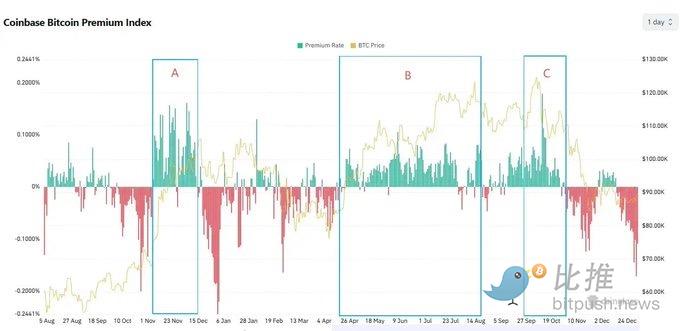
Phase A (Nov 2024 – Jan 2025): Trump's election and improved regulatory expectations triggered FOMO across both onshore and offshore markets, with BTC首次突破 $100,000.
-
Phase B (Apr 2025 – Mid-Aug 2025): After a deleveraging回调, BTC surged again,首次突破 $120,000.
-
Phase C (Early Oct 2025): BTC recorded the local ATH of this cycle so far, soon followed by the 10·10 flash crash, entering an adjustment period.
From the combination of spot and derivatives, the three phases share several common characteristics:
Spot: Onshore is the main buyer, Offshore is more inclined to reduce positions on rallies
Coinbase Premium maintained a positive premium during the three rally phases A/B/C, indicating that buying at high levels mainly came from onshore spot funds represented by Coinbase.
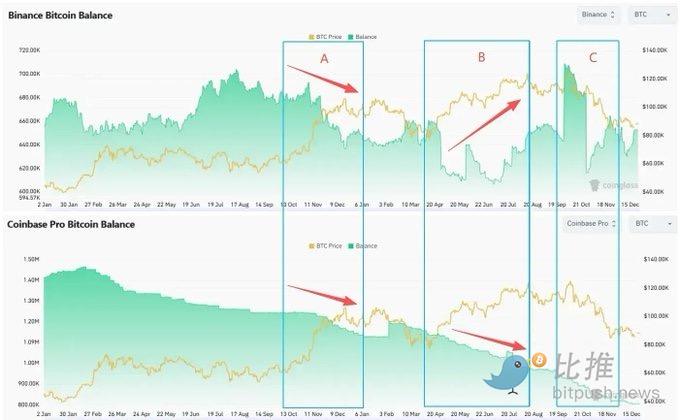
Coinbase BTC Balance continued to decline during the cycle, reducing the available selling筹码 on the CEX side. In contrast, Binance Balance significantly increased during phases B and C as prices rebounded, corresponding to increased potential selling pressure from offshore spot.
-
Futures: Offshore leverage is active, Onshore institutions持续降仓
-
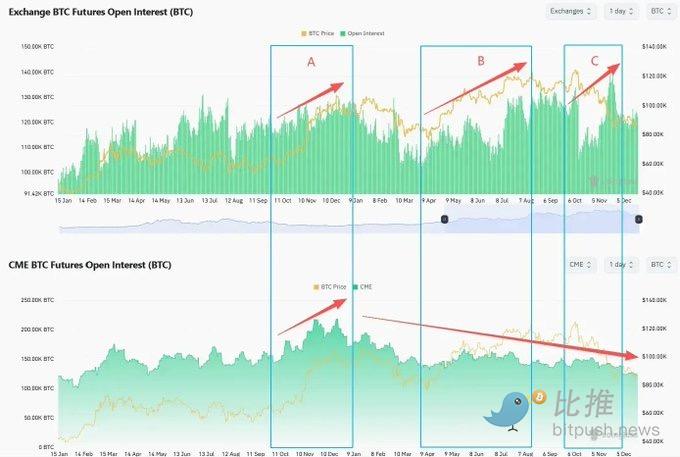
Offshore OI denominated in BTC (e.g., Binance BTC OI) continued to rise during phases B and C, with increasing leverage. Even after the 10·10 deleveraging crash, it quickly recovered to high levels and even hit new highs. In contrast, onshore futures OI represented by CME has been declining since early 2025 and did not同步回升 when prices hit new highs.
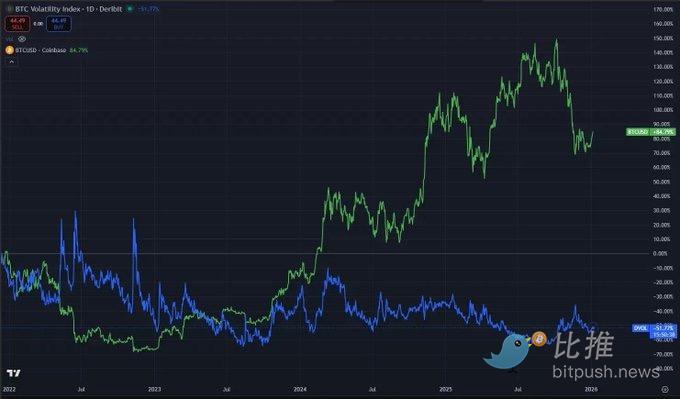
Meanwhile, BTC volatility diverged from price, especially when BTC first broke $120,000 in Aug 2025, Deribit DVOL was at a阶段性低位, and implied volatility did not price in a premium for the new high, indicating cautious pricing for trend continuation in the options market.
-
-
-
Spot is about portfolio rebalancing for major asset allocation. The behavioral divergence between the two sides reflects a disagreement on long-term confidence in the asset. The players in CME and options are the smart money most sensitive to the smell of blood, with extremely sharp instincts. The trading setups and timing control between the two sides are clearly different.
The "Institutions" with More Money Than Sense?
In early 2025, two key policies laid the foundation for the structural entry of onshore buying:
-
Repeal of SAB 121: Banks no longer need to count BTC held in custody as liabilities on their balance sheets, enabling large custody banks like BNY Mellon and JPM to feasibly conduct BTC custody business.
-
FASB Fair Value Accounting生效 (Jan 2025): Corporate holdings of BTC are no longer "impairment-only, no gains," but can be measured at fair market value. For CFOs, this transforms BTC from a "high-volatility intangible asset" into a "reserve asset option" that can truly reflect value in financial reports.
These two changes provided the accounting and compliance prerequisites for subsequent配置行为 by DATs, corporate treasuries, and some institutional funds. This is also why we started receiving大量融资 pitches from new DAT players in Q1 2025. The core capability of DAT sponsoring teams is only one: fundraising ability. So-called institutions are not smarter than retail; they just have lower funding costs and more financial tools for continuous fundraising.
According to Glassnode, the amount of BTC held by DAT companies rose from about 197k coins in early 2023 to about 1.08 million coins by the end of 2025, a net increase of about 890k coins over two years. DATs have become one of the most important structural buyers this cycle. The operating logic of DATs can be summarized as NAV premium arbitrage:
-
When the stock price trades at a premium to the net value of its held crypto assets, the company can raise capital through ATM offerings or convertible bond issuances at high valuations;
-
The raised funds are used to buy BTC and other crypto assets, pushing up the per-share coin value and further supporting the stock price premium;
-
During the rising phase, the larger the premium and the easier the fundraising, the more incentive the company has to "buy more as it rises."
Taking MSTR as an example, its large增仓 in 2024–2025 and its largest convertible bond issuance were highly concentrated during periods when BTC was强势上行,接近 or刷新历史高位:
-
Nov-Dec 2024, as BTC was冲击 $100k, MSTR completed a historic $3 billion 0% convertible bond issuance;
-
Subsequently, it bought over 120k BTC at an average cost above $90k, forming significant structural buy-side pressure around ~$98k.
Therefore, for DATs, adding positions at high levels is not chasing the rally but an inevitable result of maintaining stock price premiums and balance sheet structure.
Another common misconception is about ETF flows. The investor structure of ETFs has the following characteristics:
-
Institutions (narrowly defined 13F-filers) hold less than a quarter, so the overall ETF AUM is still dominated by non-institutional funds;
-
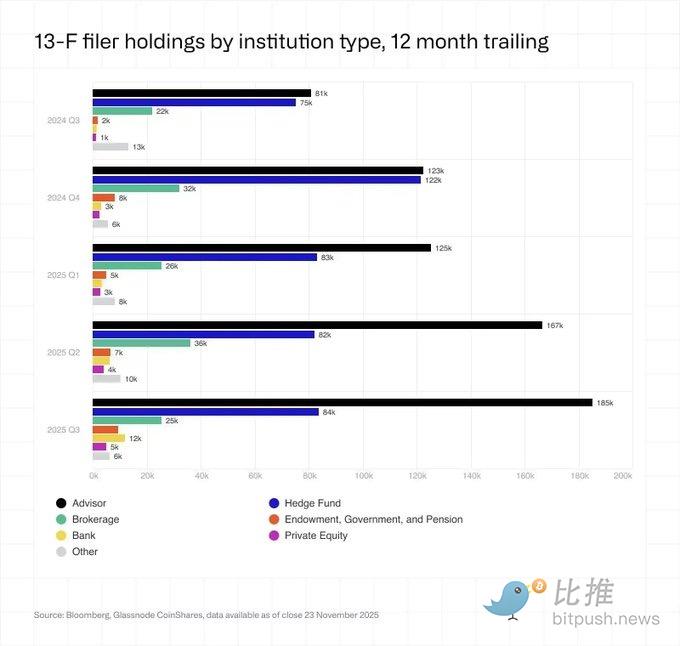
Among institutions, the main types are financial advisors (Advisors, including wrap accounts and RIAs) and hedge funds: Advisors focus on medium-term asset allocation with smooth accumulation节奏 (passive funds);
Hedge funds are more price-sensitive,偏向套利和中高频交易. They overall reduced positions after Q4 2024,高度一致 with the downward trend in CME OI (active funds).
Just by slightly breaking down the fund structure of ETFs, one can see that institutions are not the majority. These institutions are not using their own balance sheet money; wealth management and hedge funds are certainly not traditional "diamond hands."
As for other types of institutions, they are not smarter than retail either. The business model of institutions无非两种: earning management fees and earning carry. Our industry's top-tier VC from the 2016 vintage has a DPI of only 2.4x (meaning $100 invested in 2014 returned $2.4 million in 2024), far underperforming Bitcoin's gains over the past 10 years. Retail's advantage is always顺势而为, able to quickly turn around after understanding market structure changes without path dependency. Most institutional investors die from path dependency and declining self-iteration ability; most exchanges die from misusing user assets and security vulnerabilities.
The Absent Retail Investors
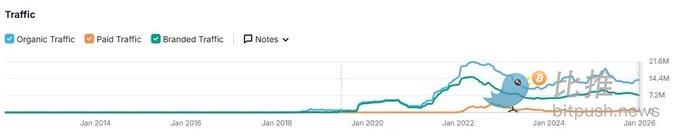
Looking at the site traffic of leading CEXs like Binance and Coinbase: Overall traffic has continued to decline since the peak of the 2021 bull market, even as BTC hit new highs, it did not significantly recover. This is in stark contrast to the火爆 scene at隔壁Robinhood. For more, read our last year's article "Where are the marginal buyers."
The "wealth effect" in 2025 was more concentrated outside of crypto. S&P 500 (+18%), Nasdaq (+22%), Nikkei (+27%), Hang Seng (+30%), KOSPI (+75%), and even A-shares rose nearly 20%, not to mention Gold (+70%) and silver (+144%). Additionally, Crypto encountered a 'kill' in this cycle: AI stocks provided a stronger wealth effect narrative, while美股0DTE Zero-Day Options provided an even more casino-like experience than perps, and new retail speculators were搏杀 on Polymarket and Kalshi against various macro-political events.
Furthermore, even the high-frequency speculators from South Korea retreated from Upbit this cycle and turned to梭哈 KOSPI and U.S. stocks. Upbit's average daily volume in 2025 fell ~80% compared to the same period in 2024, while during the same period, the South Korean stock market KOSPI index rose over 70%–75% for the year.
And South Korean retail's net purchases of U.S. stocks reached a record $31 billion.
The Emerging Sellers
At a time when BTC's movement is increasingly synchronized with U.S. tech stocks, a clear断层 appeared in August 2025: After following ARKK and NVDA to the August top, BTC subsequently fell behind and experienced the 1011 crash, from which it has not recovered. Coincidentally, at the end of July 2025, Galaxy disclosed in its earnings report and press release that it had completed the batch sale of over 80k BTC on behalf of an early BTC holder within 7–9 days. These signs indicate that Crypto native funds are undergoing massive换手 with institutions.
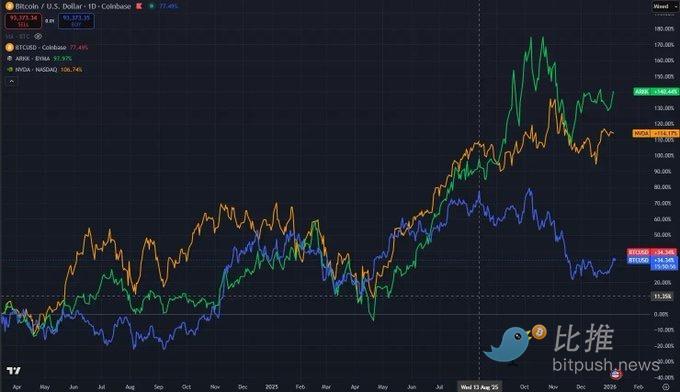
With the maturation of BTC wrapper products (like IBIT, etc.),完善的金融设施 provide the best channel for BTC OG whales to exit liquidity. The behavior of OGs has upgraded from "selling directly on exchanges at market price" to using BTC structured products for exit or asset rotation into the broader Tradfi asset world. Galaxy's biggest business growth in 2025 came from helping BTC whales换仓 from BTC to iBit. The collateral mobility of iBit is far better than native BTC, and it is safer and easier to custody. As assets become mainstream, the high capital efficiency of paper Bitcoin far exceeds that of real Bitcoin, which is the inevitable path for the financialization of other precious metals.
Miners: From "Paying Electricity Bills" to "Raising CAPEX for AI"
From around the 2024 halving to the end of 2025, this has been the most sustained and significant downward cycle for miner reserves since 2021: As of the end of 2025, miner reserves were approximately 1.806 million BTC, and the hash rate fell by about 15% year-on-year, showing signs of industry clearing and structural transformation.
More importantly, the motivation for miners to sell coins this cycle has gone beyond the traditional "covering electricity costs":
-
Under the so-called "AI escape plan" framework, some mining companies transferred approximately $5.6 billion worth of BTC to exchanges to raise capital expenditure for building AI data centers;
-
Companies like Bitfarms, Hut 8, Cipher, Iren are converting existing mining facilities into AI/HPC data centers and signing 10–15 year long-term compute leasing agreements, treating power and land as "gold resources in the AI era";
-
Riot, which一直坚持 a "long-term holding" strategy, also announced a strategy adjustment in April 2025 to start selling BTC produced monthly.
-
It is estimated that by the end of 2027, about 20% of Bitcoin miners' power capacity will be diverted to run AI.
Financialized Paper Bitcoin
Bitcoin and the crypto-digital assets it represents are undergoing a slow migration from the inside out: from value-discovery active trading dominated by crypto native funds to passive allocation and balance sheet management represented by ETFs, DATs, sovereign and long-term funds, and the managed positions are often financialized paper bitcoin. The underlying asset Bitcoin is gradually becoming a risk asset component stuffed into various portfolios and bought by weight. The mainstreaming of Bitcoin is complete, but随之而来的是 leverage cycles and systemic fragility similar to traditional finance.
-
Fund structure level: Incremental buying comes more from passive funds, long-term asset allocation, and corporate/sovereign balance sheet management. Crypto native funds' marginal role in price formation has declined, becoming net sellers reducing positions on rallies in most phases.
-
Asset attribute level: Correlation with U.S. stocks (especially high-beta tech and AI themes) has significantly increased, but due to the lack of a valuation system, it becomes an amplifier of macro liquidity.
-
Credit risk level: Using DAT stocks, spot ETFs, structured products, and other proxies, cryptocurrency is further highly financialized, asset流转效率 significantly improved, but also more exposed to risks of DAT unwind, collateral haircuts, and cross-market credit crunches.
Where is the Path Forward
Under the new liquidity structure, the traditional narrative of "four-year halving = one complete cycle" is no longer sufficient to explain BTC's price behavior. The dominant variables for the next few years will come more from two axes:
-
Vertical axis: Macro liquidity and credit environment (interest rates, fiscal policy, AI investment cycle);
-
Horizontal axis: The premium and valuation levels of DATs, ETFs, and related BTC proxies.
Within these four quadrants:
-
Loose + High Premium: High FOMO phase, similar to the environment from late 2024 to early 2025;
-
Loose + Discount: Macro relatively friendly, but DAT/ETF premiums are squeezed out, suitable for crypto native funds to conduct structural rebuilding;
-
Tight + High Premium: Highest risk, DAT and related leverage structures are most prone to剧烈 unwind;
-
Tight + Discount: A true cycle reset.
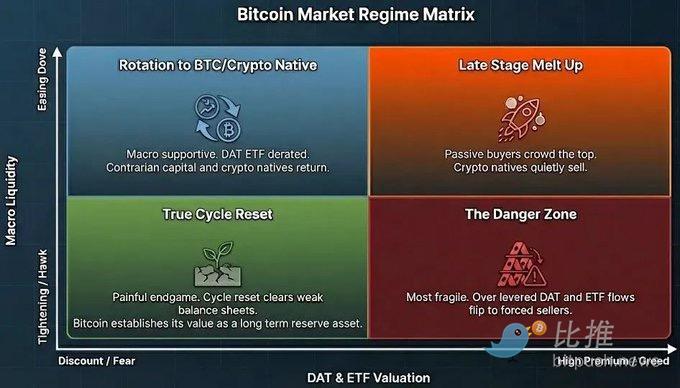
In 2026, we will gradually move from the right quadrant towards the left quadrant, getting closer to the "Loose + Discount" or "Slightly Loose + Discount" cells in our framework. Simultaneously, 2026 will also see several key institutional and market variables:
-
SFT Clearing Service and DTCC 24/7 Tokenization Landing: Bitcoin will further complete its financialization, becoming part of Wall Street's basic collateral; the liquidity断层 caused by time differences will be smoothed out, depth will increase, but so will the leverage上限 and systemic risk.
-
AI Trading Enters "High Expectation Consumption Phase": Signs of "continued excellent performance but钝化 stock price reaction" for AI leaders already appeared in H2 2025; simply beating expectations no longer corresponds to linear gains. Whether BTC, as a high-beta tech factor, can continue to ride the顺风车 of AI capital expenditure and profit revisions will be tested in 2026.
-
BTC and Alt Markets Further Decouple: BTC is connected to ETF flows, DAT balance sheets, sovereign and long-term funds; while alts are connected to a smaller, higher-risk appetite pool of funds; for many institutions, reducing BTC exposure more likely means returning to better-performing traditional assets, not "shifting from BTC to alts."
Is price important? Of course. Bitcoin surpassing $100k has used its price to make this young asset, only 17 years old, a national-level strategic reserve. Beyond price, the next journey for crypto assets remains long. As I wrote in "Hello, Primitive Ventures" when Primitive was established in 2018:
"In our exploration of the crypto cause over the past few years, we have seen the powerful force of distributed consensus among individuals. Coupled with the characteristic that information 'continuously dissipates,' crypto assets possess极强的生命力. It is the fundamental desire for freedom, equality, and certainty of assets and data that makes us see the possibility of 'entropy always increases, crypto lives forever'."
When capital markets and cultural trends intertwine, they release economic and production relationship revolutions more powerful than the cultural trends themselves. Crypto, representing populist finance, is a most typical product of the intertwining of "capital markets + cultural trends."
If in the next few years, we can see the crypto rail, as the only supranational and globalized underlying liquidity infrastructure, generate applications that沉淀大量现金流, users, and balance sheets, allowing some of the victory fruits of ETFs/DATs to flow back on-chain, transforming passive allocation into active use, then everything we discuss today will not be the end of a cycle, but more like the beginning of the next real adoption. From "Code is the law" to "Code is eating the bank." We have already passed the most difficult first 15 years.
The beginning of a revolution means the decline of the old era's faith. The worship of Rome made the domination of Roman civilization a "self-fulfilling prophecy." The birth process of new gods may be random, but the twilight of the old gods is already destined.
Side note: This article is a deep复盘 of the article from six years ago, "The Clear Long Bull from the West" (writing this article even gave me cervical spondylosis). Thanks to all of you who have been同行 since 2017, or even earlier. Together we have witnessed Bitcoin move from narrative to sovereignty, from the fringe to the mainstream, and together we have experienced those beliefs that only those present can truly understand.
Also thanks to the Primitive Ventures team colleagues. This article was co-authored by me and our hardcore researcher Ada老师 @adaYen72.
Twitter:https://twitter.com/BitpushNewsCN
比推 TG交流群:https://t.me/BitPushCommunity
比推 TG订阅: https://t.me/bitpush