2026 Crypto Predictions: Dragonfly’s Hadick Calls Outlook ‘Constructive’

bitcoinistPublished on 2025-12-25Last updated on 2025-12-25

Abstract

Dragonfly general partner Rob Hadick expresses a constructive outlook for crypto in 2026, emphasizing long-term adoption trends over recent volatility. He highlights significant growth in stablecoins, noting they now handle 3% of cross-border payments and could see a tenfold increase. Prediction markets, like Polymarket, are also expanding beyond sports into broader financial use cases. Hadick avoids favoring Ethereum or Solana, stating both will coexist as the market matures, with Ethereum strong in value and stablecoins, and Solana optimized for high-volume, low-cost transactions. He remains optimistic about macroeconomic conditions, tokenization, and continued innovation driving the industry forward.

Dragonfly general partner Rob Hadick struck an upbeat tone on crypto’s medium-term setup, arguing that recent volatility has obscured a broader trend of adoption, especially in stablecoins and prediction markets, that he expects to accelerate into 2026.

Speaking on CNBC’s Squawk Box on Dec. 24, Hadick pushed back on the idea that crypto has entered a new “winter,” framing the year’s disappointment as a function of recency bias rather than a clean break in market structure.

“It hasn’t had a great year. But I think it’s important to zoom out,” Hadick said. “If you look at the returns for bitcoin relative to the day before the election in ’24, bitcoin is up about 26%, Nasdaq is up about 28%... even further than that two years, bitcoin’s doubled, Nasdaq is up 50%.”

Hadick emphasized he’s not trading chart patterns. “I’m not a technical investor. I’m a long-term investor. We’re a VC fund,” he said, adding that he “continue[s] to see a strong and constructive 2026.

2026 Crypto Predictions

Pressed on what “a good 2026” means in practice for the crypto market, Hadick tied his outlook to macro conditions and what he sees as compounding real-world usage. “For the token prices themselves—bitcoin, ethereum—there’s likely to be continued momentum,” he said. “I think from a macroeconomic perspective... we’ll have better monetary policy. And then we’re going to have more and more adoption of tokenized assets.”

One data point he said: “McKinsey just said that they think 3% of all cross-border payments is happening in stablecoins right now. That’s up from basically 0% a year ago,” Hadick said, adding that he expects “another tenfold increase.”

Hadick described Dragonfly as deliberately non-ideological across chains and sectors, positioning the firm less as a “bitcoin vs. ethereum” shop and more as a bet on market-structure innovation. “We invest in everybody that’s doing anything that’s interesting in tokenized digital assets,” he said. “We’re not what I would say ideological about crypto. What we are is investing in the future of innovation in financial markets.”

When the conversation turned from majors to categories, Hadick leaned into two themes: stablecoins and prediction markets. “Stablecoins I think are here to stay. I think it’s going to grow tenfold,” he said. “I think prediction markets are here to stay. I think they’re going to grow tenfold.”

On prediction markets specifically, Hadick argued the addressable market extends well beyond sports betting, despite the current overlap. He pointed to Polymarket’s growth as evidence of expanding use cases. “If you look at Polymarket volume today, they’ve gone from $50 million a month in early ’24... they’re now going to do probably about $4 billion of volume this month,” he said, adding that “only about 35% of that is sports,” putting Polymarket in contrast with Kalshi, which he characterized as “more of a sports platform because they’re infrastructure for Robinhood.”

Hadick also invoked Intercontinental Exchange CEO Jeff Sprecher’s long-running tokenization thesis to argue prediction markets may converge with broader financial infrastructure rather than remain a niche wagering product. “If you talk to Jeff Sprecher over at ICE... he’ll tell you he believes in the tokenization of all markets,” Hadick said. “I talked to him before he made the investment in Polymarket... his perspective is that this is going to be as big as ICE itself. Probably.”

He suggested the functional framing is less “bets” and more programmable risk transfer. “I talked to an insurance company maybe a month ago that was thinking about how they can hedge out risk in weather related activities,” Hadick said. “That’s just one use case... every single thing and every single market and outcome that can be put [into] a market—or really just a binary option, which is what it is.”

Ethereum Vs. Solana

Asked to pick sides in the Ethereum–Solana debate, Hadick refused the “MySpace vs. Facebook” framing. “No, they’re both Facebook,” he said, arguing the market will require multiple settlement environments if tokenization becomes mainstream. In his view, Ethereum’s advantage is where value and stablecoin liquidity already sit, while Solana’s edge is high-throughput, low-cost flow.

“Most stablecoins today are on Ethereum,” Hadick said. “Ethereum is where a large amount of... economic activity exists... but if you look at the trading volume, it’s happening more on Solana, which is more optimized for that type of transaction flow and for low cost transactions.”

Still, Hadick conceded the platform layer is not frozen. He said Dragonfly is invested in a newer chain, Monad, describing it as “trying to be a Solana killer,” and cited figures he said reflected early-stage market positioning: a roughly $2 billion valuation and a token price around $0.002.

At press time, the total crypto market cap stood at $2.92 trillion.
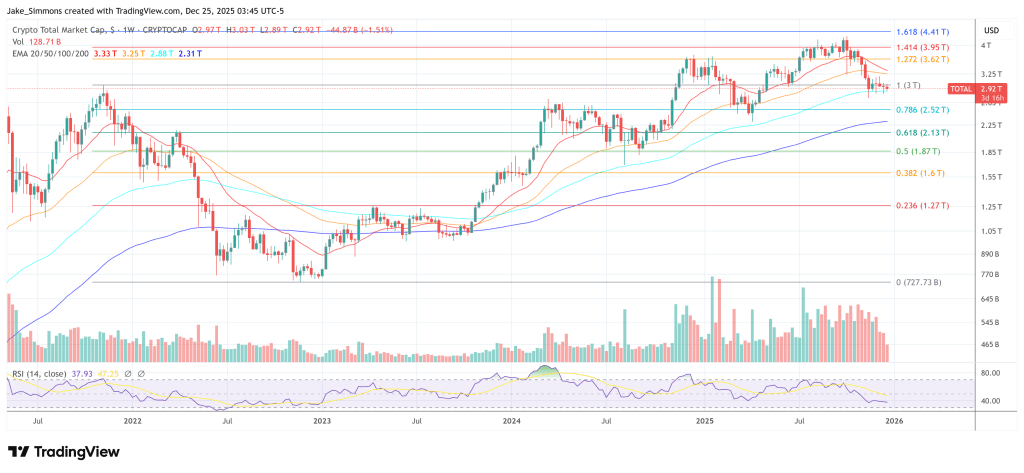
Total crypto market cap sits below the 2021 high, 1-week chart | Source: TOTAL on TradingView.com

Related Questions

QWhat is Rob Hadick's overall outlook for the crypto market in 2026?

ARob Hadick has a 'constructive' and positive outlook for the crypto market in 2026. He expects continued momentum for major tokens like Bitcoin and Ethereum, better monetary policy, and accelerated adoption of tokenized assets, stablecoins, and prediction markets.

QAccording to Hadick, what is the current percentage of cross-border payments happening in stablecoins and what growth does he predict?

AHadick cited a McKinsey report stating that 3% of all cross-border payments are currently happening in stablecoins, up from nearly 0% a year ago. He predicts this will see 'another tenfold increase.'

QWhich two specific crypto categories does Hadick highlight as having significant growth potential?

AHadick highlights stablecoins and prediction markets as two categories with massive growth potential, stating that he believes each is 'here to stay' and will 'grow tenfold.'

QHow does Hadick characterize the debate between Ethereum and Solana?

AHadick refuses to frame it as a 'MySpace vs. Facebook' debate, instead stating 'they’re both Facebook.' He believes the market will require multiple settlement layers, with Ethereum's strength being its existing value and stablecoin liquidity, and Solana's being its high-throughput, low-cost transaction flow.

QWhat example does Hadick give to show that prediction markets extend beyond sports betting?

AHadick gives the example of an insurance company that was exploring how to use prediction markets to hedge risk in weather-related activities. He suggests the functional framing is less about 'bets' and more about programmable risk transfer for various markets and outcomes.

Related Reads

When AI Begins to Audit the World: From Claude Discovering the ZEC Vulnerability, Watching the Encryption Industry Enter the 'Recursive Security Era'

**When AI Audits the World: From Claude's Discovery of a ZEC Vulnerability, Viewing the Crypto Industry Entering a "Recursive Security Era"** This article examines a pivotal shift in the blockchain security landscape, triggered by the convergence of two events: Anthropic's research on AI's "Recursive Self-Improvement" and Claude Opus 4.8's discovery of a critical vulnerability in Zcash's code. Traditionally, crypto security has relied on human experts and automated tools for periodic audits. However, the article argues AI is transitioning from a mere tool to an active participant in understanding and analyzing complex systems. Claude's ability to identify a subtle flaw in Zcash's zero-knowledge proof system demonstrates AI's potential to dramatically lower the cost and time required for risk discovery. This goes beyond finding a single bug; it signals a change in the very mechanism of how vulnerabilities are found. The core thesis introduces the concept of "Recursive Security," drawing a parallel to Anthropic's "Recursive Self-Improvement." Just as AI can accelerate its own development through feedback loops, security systems are evolving towards a continuous cycle of analysis, risk identification, remediation, and re-analysis. Security is becoming a persistent, evolving capability integrated into a system's lifecycle, rather than a one-time pre-launch audit. This shift is particularly urgent for the crypto industry, where system complexity from Layer-2 networks, modular architectures, and ZK-proofs is growing faster than human analysis capacity. AI excels at the pattern recognition and contextual understanding needed to navigate this complexity. Importantly, the article cautions that AI augments both defenders and potential attackers, accelerating the entire threat landscape. The future competitive advantage may not lie in having zero vulnerabilities, but in having the fastest risk discovery, validation, and response capabilities. The Claude-Zcash incident is thus an early signal of an era where AI-driven, recursive security systems become essential for managing risk in an increasingly complex digital world.

marsbit1h ago

When AI Begins to Audit the World: From Claude Discovering the ZEC Vulnerability, Watching the Encryption Industry Enter the 'Recursive Security Era'

marsbit1h ago

From MSTR to STRC+: Where Is the Limit of the Strategy Universe?

From MSTR to STRC+: The Evolution and Limits of the Strategy Universe This article examines the transformation of Strategy (formerly MicroStrategy) from a simple "Bitcoin treasury" company into a complex financial engineering firm building a BTC-backed credit system. **Core Thesis:** Strategy's true significance lies not just in its massive BTC holdings (~844k BTC), but in its attempt to transform this static reserve into a multi-layered credit curve within traditional capital markets and, subsequently, into on-chain yield infrastructure. **The MSTR Flywheel:** The initial model was a reflexive loop: BTC price rises → MSTR stock rises → company raises capital (debt/equity) at a premium → buys more BTC → increases per-share BTC exposure → MSTR premium grows. This "amplified Bitcoin" equity (MSTR) thrives on bullish momentum but is vulnerable to tightening premiums and rising funding costs. **Building the Credit Curve:** Strategy's innovation is slicing its single BTC balance sheet into different risk/return profiles via specialized securities: * **MSTR:** High-volatility equity layer absorbing full BTC upside/downside. * **STRC:** Key product. A perpetual preferred stock designed as "short duration high yield credit," offering ~11.5% floating monthly dividends. It attracts fixed-income investors seeking yield without direct BTC exposure, funding Strategy's operations. * **STRD/STRK/STRF:** Other preferred/share classes with varying durations, conversion rights, and fixed dividends. **Risks of the STRC Model:** STRC's high yield is not risk-free. Its stability depends on: 1) Sufficient BTC asset coverage, 2) Strategy's continued ability to pay dividends, and 3) Market faith in the MSTR/STRC funding flywheel. Stress points include deep BTC price declines eroding the asset buffer, rising dividend costs if STRC trades below par, and a broken flywheel if MSTR's premium (mNAV) falls persistently. **On-Chain Expansion: STRC+:** Projects like **Saturn** and **Apyx** aim to package STRC's (and other DAT preferred stock) cash flows into on-chain stablecoin yield (e.g., sUSDat, apyUSD). They offer DeFi a new yield source distinct from trading fees or incentives—cash dividends from traditional securities. However, this introduces compounded risks: off-chain custody, issuer credit risk, BTC volatility, and protocol execution risk. **Conclusion: The Ultimate Boundary** Strategy's endgame is not infinite BTC accumulation. It is the market's long-term acceptance of a new credit system where BTC serves as collateral for tradable securities whose cash flows can power on-chain financial applications. Its "universe" expands if this BTC-native credit curve gains legitimacy, but contracts if these instruments are repriced purely as high-risk, yield-bearing credit assets without stablecoin mythology.

marsbit1h ago

From MSTR to STRC+: Where Is the Limit of the Strategy Universe?

marsbit1h ago

Trading

Spot
Futures

Hot Articles

Discussions

Welcome to the HTX Community. Here, you can stay informed about the latest platform developments and gain access to professional market insights. Users' opinions on the price of S (S) are presented below.

活动图片