How much of your work do you need to 'outsource' to others, such as colleagues or interns?
On August 6, the AI research institute Epoch AI, in collaboration with the polling firm Ipsos, released a workplace survey report:
One-fifth of American workers say that AI has now largely or completely taken over at least one task that they previously would have assigned to a colleague or contractor.
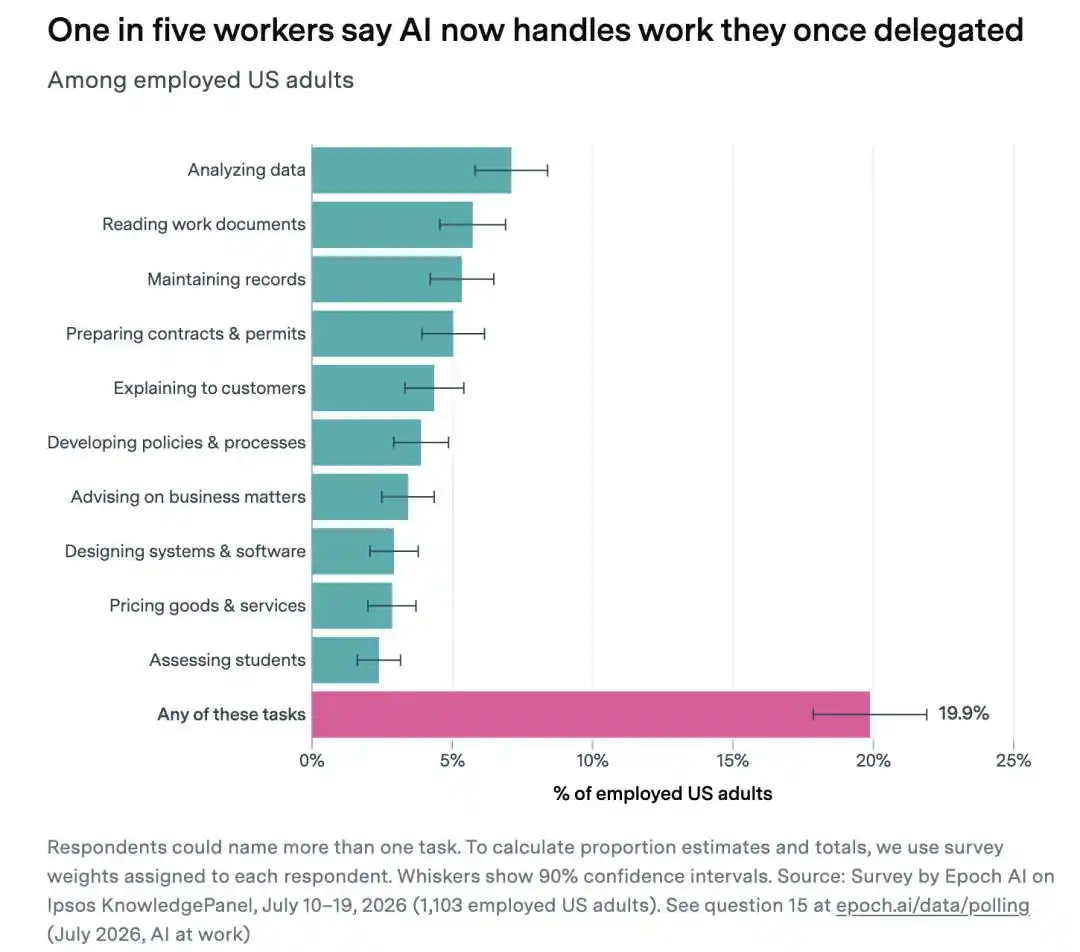
Distribution of tasks originally given to colleagues/contractors, now handled by AI. Data analysis leads at 7.1%; 19.9% of respondents reported at least one such task.
This figure can easily be misinterpreted as: AI has already replaced one-fifth of American jobs.
But what this report really aims to convey is that AI is initially replacing tasks, not jobs.
The jobs remain, but the tasks the workers would have outsourced are now being handed off to AI.
In other words: work is starting to be redistributed between people and AI.
The survey was conducted from July 10 to 19, screening for employment status to obtain 1,106 respondents. The original question was:
Which tasks, that you or your team used to give to contractors or colleagues, are now handled mainly or entirely by AI?
Epoch's qualification in the report is also measured: While task-level displacement is observed, this does not necessarily equate to full worker displacement.
The 20% represents tasks being redistributed, not jobs disappearing.
AI Has Touched All Ten Tasks, But Hasn't Taken Over Any Completely
The survey identified 10 common knowledge work activities from the U.S. Department of Labor's O*NET occupational database, selected and ranked by national employment share.
Among those who perform a given task as part of their regular work, the lowest reported AI usage is for maintaining business records at 25%; the highest is for designing computer/information systems and software applications at 57%; data analysis at 46%, reading work documents at 39%.
AI is being used for all ten tasks.
But another set of numbers shows that even in software design, where AI penetration is deepest, the proportion of workers reporting that AI handles most or all of the task is only 10%. For the other nine tasks, it's all below 7%.
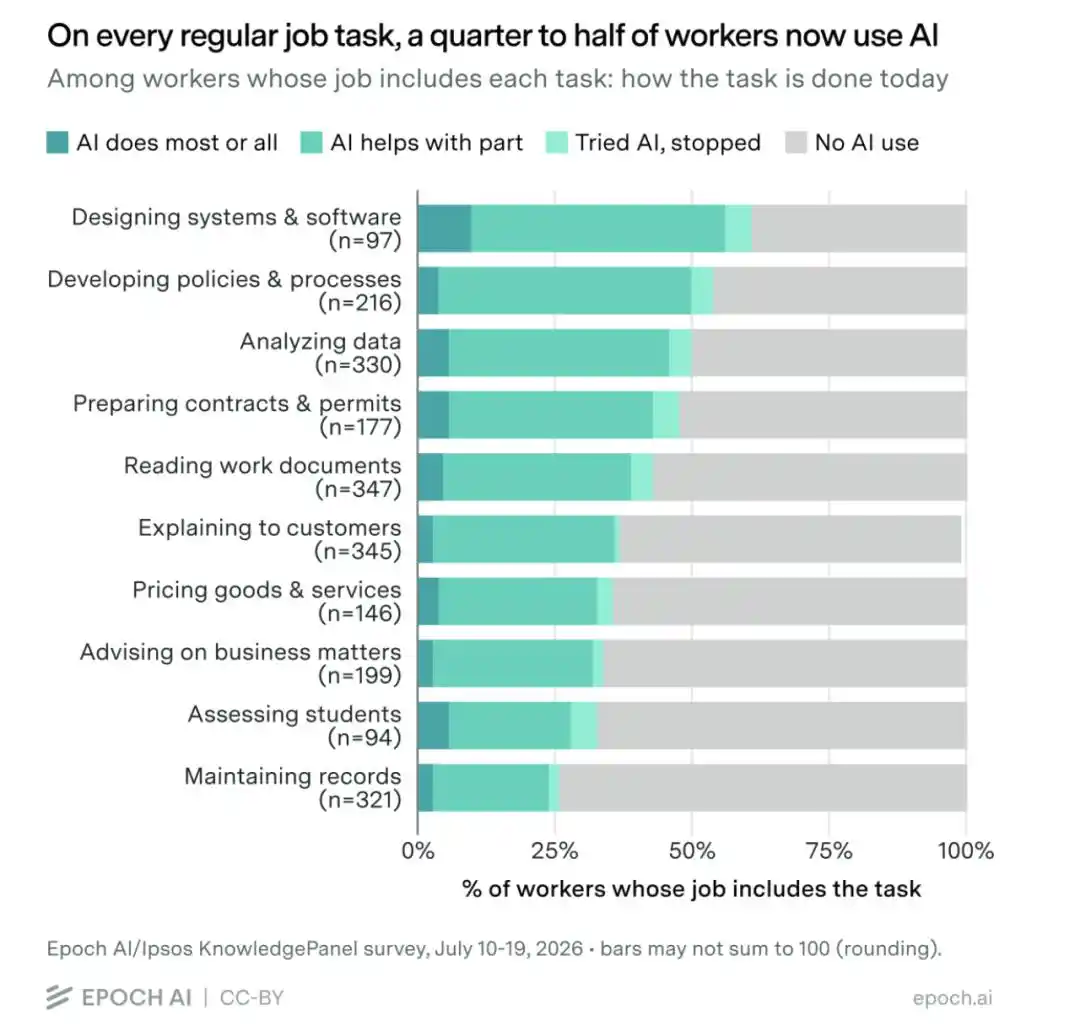
AI usage across the ten tasks. Dark color indicates 'AI handles most or all', light color indicates 'AI handles only part'. Usage rates range from maintaining records (25%) to software design (57%).
AI is spread very widely, present in almost every type of knowledge work, but its penetration is shallow. It rarely takes over an entire task completely.
The Half That Saves Time and the One-Sixth That Takes More Time
When AI only helps with part of a task, 37% of tasks were reported to take less time. When AI handles most or all of a task, this proportion jumps to 53%.
At first glance, the conclusion seems obvious: The more AI does, the more time you save.
But Epoch AI's analysis states this is a correlation, not necessarily causation, and offers three explanations:
It could be that AI taking on more genuinely saves time; or it could be that workers who wanted to speed up proactively offloaded more steps; or it might simply be because these are tasks AI happens to be particularly good at.
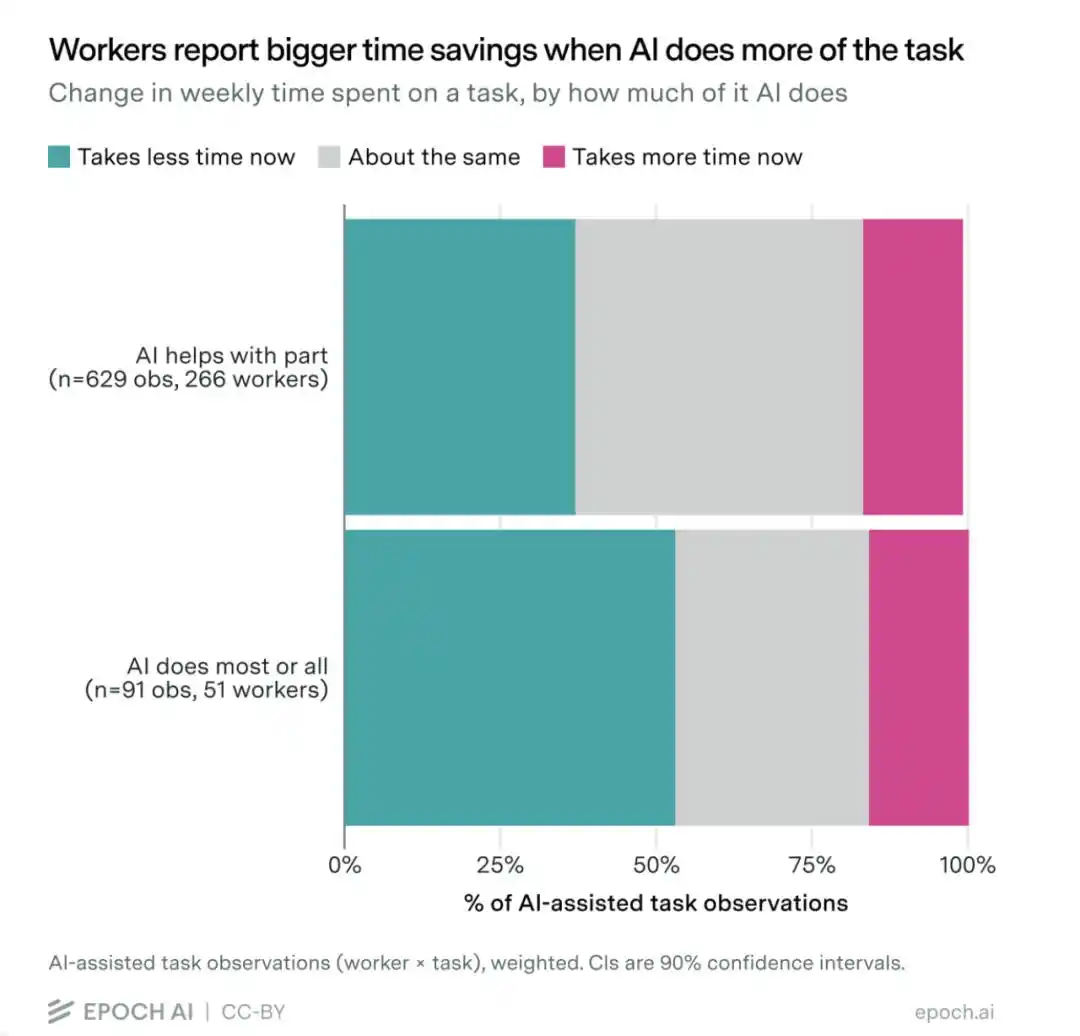
When AI helps partially, 37% of tasks take less time; when AI handles most/all, this rises to 53%. In both groups, about one-sixth of tasks take more time now.
The same data contains another, less-mentioned figure: About one-sixth of AI-assisted tasks now take *more* time than before.
And this proportion is roughly the same whether AI is assisting or taking the lead.
The reasons could be that back-and-forth with AI itself is time-consuming, or that AI freeing up hands allows people to work on the same thing in more detail or do more of it.
In either case, the idea that 'using AI instantly boosts efficiency' needs to be taken with a grain of salt.
66% Used As-Is Doesn't Mean 66% Are Correct
Across all AI-involved tasks, 66% of the outputs are used as-is or with only minor modifications.
Breaking down this data provides more clarity: used completely unchanged is only 5.8%, minor modifications 59.9%, requiring major revisions 27.1%, needing significant rework or essentially starting over 4.7%.
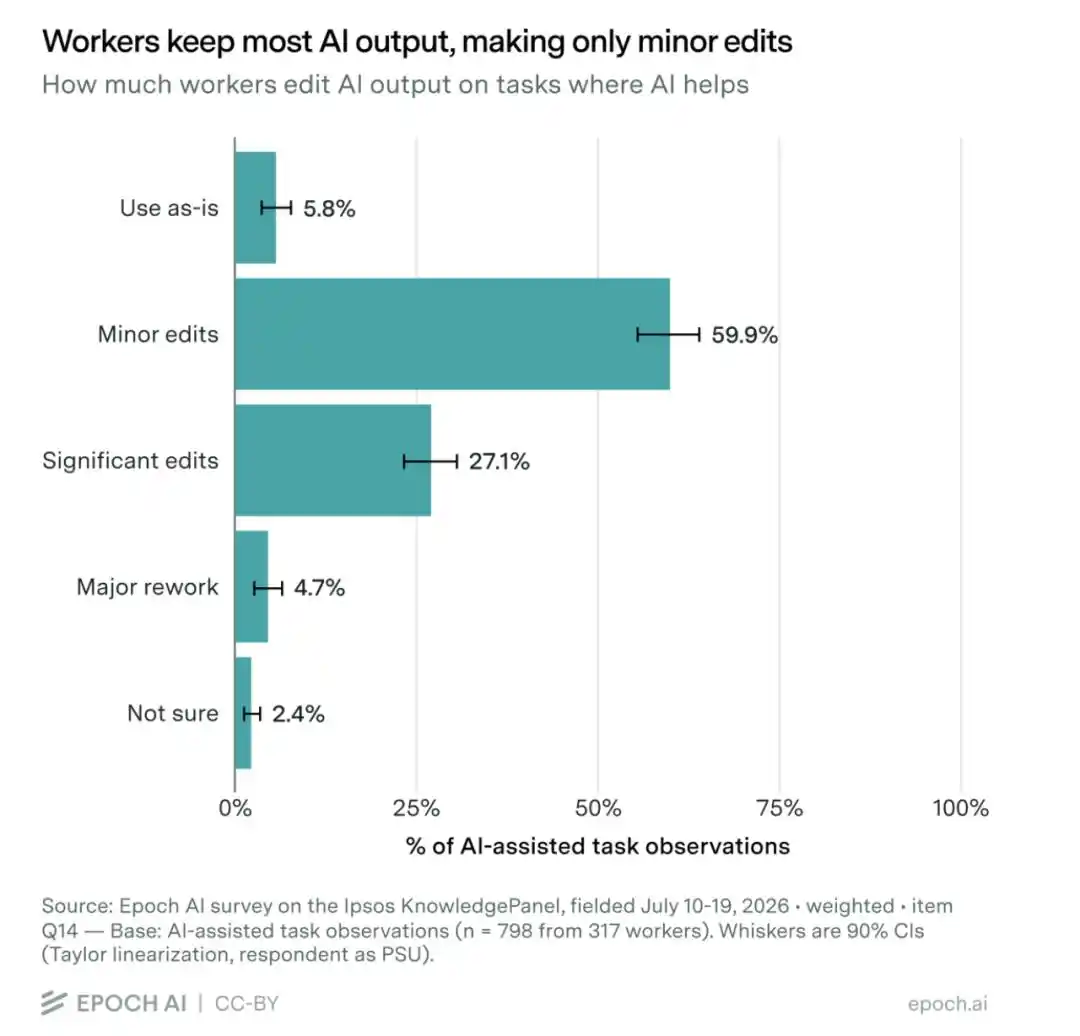
Distribution of modification levels for AI outputs. Only 5.8% are used completely unchanged, 59.9% with minor modifications, 27.1% require major revisions, 4.7% need significant rework.
Epoch notes in the report: The amount of modification work is not a direct measure of output quality. Furthermore, there is no stable correspondence between time saved and modification effort.
This survey did not assess factual accuracy or statistical error rates; it only looked at whether employees were willing to use the output directly.
An output requiring little modification might be genuinely good, or it might just be that no one has the time to scrutinize it carefully.
The First to Go Isn't You, It's Outsourcing
Looking at individual tasks, data analysis tops the list, reported by 7.1% of respondents. Reading work documents is at 5.7%, maintaining business records at 5.3%.
All ten tasks are affected, just to varying degrees of depth.
These tasks share a common characteristic: clear boundaries, deliverable outcomes, can be checked upon completion, and don't require constant in-office back-and-forth alignment with people.
In the past, this was precisely the type of work most suitable for outsourcing.
A marketing manager who used to hire an external data analyst to run a quarterly report can now generate it by opening a chat dialog.
The first link in this chain to feel the impact is contractors, the gig-work type on task-based platforms, which are naturally bundles of tasks that can be individually packaged and sent out.
And what AI is currently best at is precisely handling a clearly defined task bundle.
NBC's report on the same day interviewed two researchers.
The lead researcher on this study, Amreeta Das, concludes:
People are figuring out how to allocate work between themselves and AI; so far, this doesn't necessarily mean entire jobs are being automated, but AI is entering the workplace through tasks within jobs.
Aya Ibrahim, a senior researcher at the AI Now Institute, raised a sharper question.
She believes the role of contractors won't disappear entirely because of this, but task-based contractors will face more direct pressure.
What she really wants people to discuss is how inherently unstable 'jobs that are entirely composed of a string of tasks' are themselves.
This Redistribution Is Not Happening Equally for Everyone
After work is broken down into tasks, who gets broken down first has a distribution.
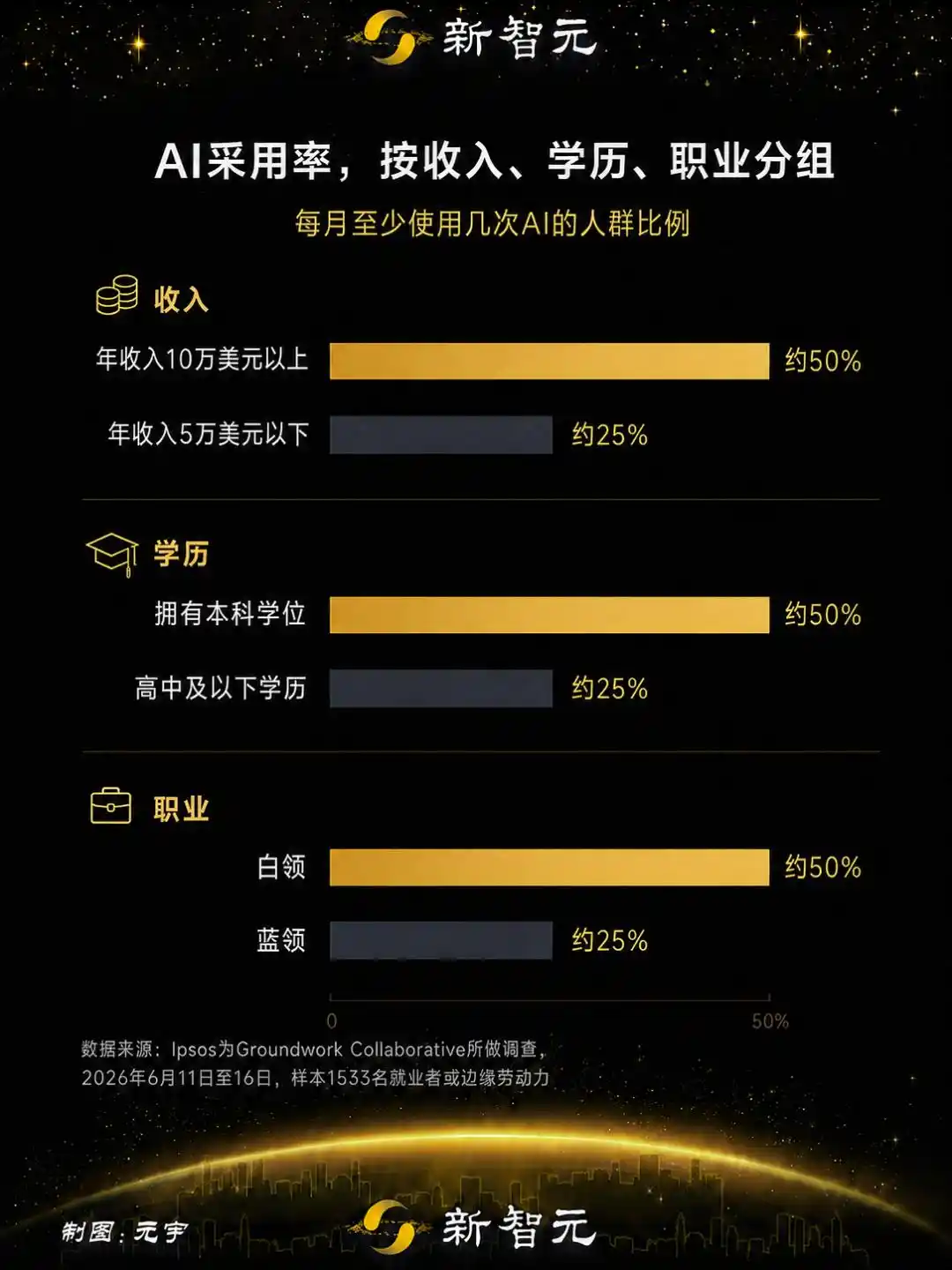
Another survey by Ipsos for Groundwork Collaborative, conducted from June 11-16, covered 1,533 workers or marginal labor force participants.
The conclusion: adoption is highly uneven. While three in ten workers use AI at least weekly, these users are heavily concentrated among high-income, college-educated, and white-collar groups.
Nearly half of those earning over $100,000 annually, those with a bachelor's degree, and white-collar workers use AI at least several times a month.
Among those earning under $50,000 annually, those with high school education or less, and blue-collar workers, this proportion is only about a quarter or even lower.
Expectations are also divided.
In the same survey, two-thirds of workers believe AI will make the workplace experience worse, citing job cuts and increased pressure, rather than taking over repetitive labor.
This judgment is highly consistent across lines of race, gender, education, and income.
But when it comes to their own jobs, the more educated are more optimistic. Nearly half of college graduates think AI will help their work, while only one-fifth of those with high school education or less think so.
Gallup uses a different metric but points in the same direction.
As of May 2026, 52% of U.S. employees use AI at least several times a year, 30% several times a week, and 15% daily.
65% say AI has a positive impact on their productivity, but only 14% strongly agree that AI has already changed how work gets done in their organization.
AI has entered most people's workflows, but it is still only changing individual tasks, not the way work itself is organized.
The 20% Is a Progress Bar, Not the Finish Line
These 10 tasks were selected from O*NET based on employment share; healthcare activities were excluded, as were financial transactions, internal coordination, training, and procurement.
It describes a slice of American knowledge work, not all occupational activities.
So the 20% only presents a cross-section of these 10 tasks: who should perform the work is being reorganized among employees, colleagues, contractors, and AI.
In this process, what's more noteworthy is not how many people are being replaced, but how much work is being broken down.
If a job is merely a string of tasks that can be outsourced, then even before AI, it was already being gradually broken down and outsourced. Today's AI is just accelerating the pace of this breakdown.
So instead of asking 'Will AI replace me?', it might be more useful to ask a more specific question:
How many individually packagable, deliverable, and assignable tasks can my job be broken down into?
The more you can break it down, the larger your exposure surface.
Conversely, those parts of the work that require physical presence, accountability, and constant back-and-forth alignment with people are still hard to package and send out in the short term.
A contract can be drafted by AI, but the signature still needs a person.
This article is from the WeChat public account "AI Era Insights", author: ASI启示录