王川:为什么人们守不住四年三倍的资产?

mediumPublished on 2023-06-25Last updated on 2023-06-25

Abstract

只要牢牢抓住稀缺资源,不要在乎别人怎么卷,让他们挥霍真正的稀缺资源,去高溢价置换和争夺事实上的非稀缺资源好了。

1/ 美国最大资管集团 Blackrock 2023年六月十五号正式向美国证监会申请比特币 ETF 之后,btc 价格已经接近三万一千美元。这个场景让人想起 2019年,也是六月底,btc 价格重回一万美元。四年涨三倍,这个回报,不算太差。应当秒杀同期 99.9%的基金经理。
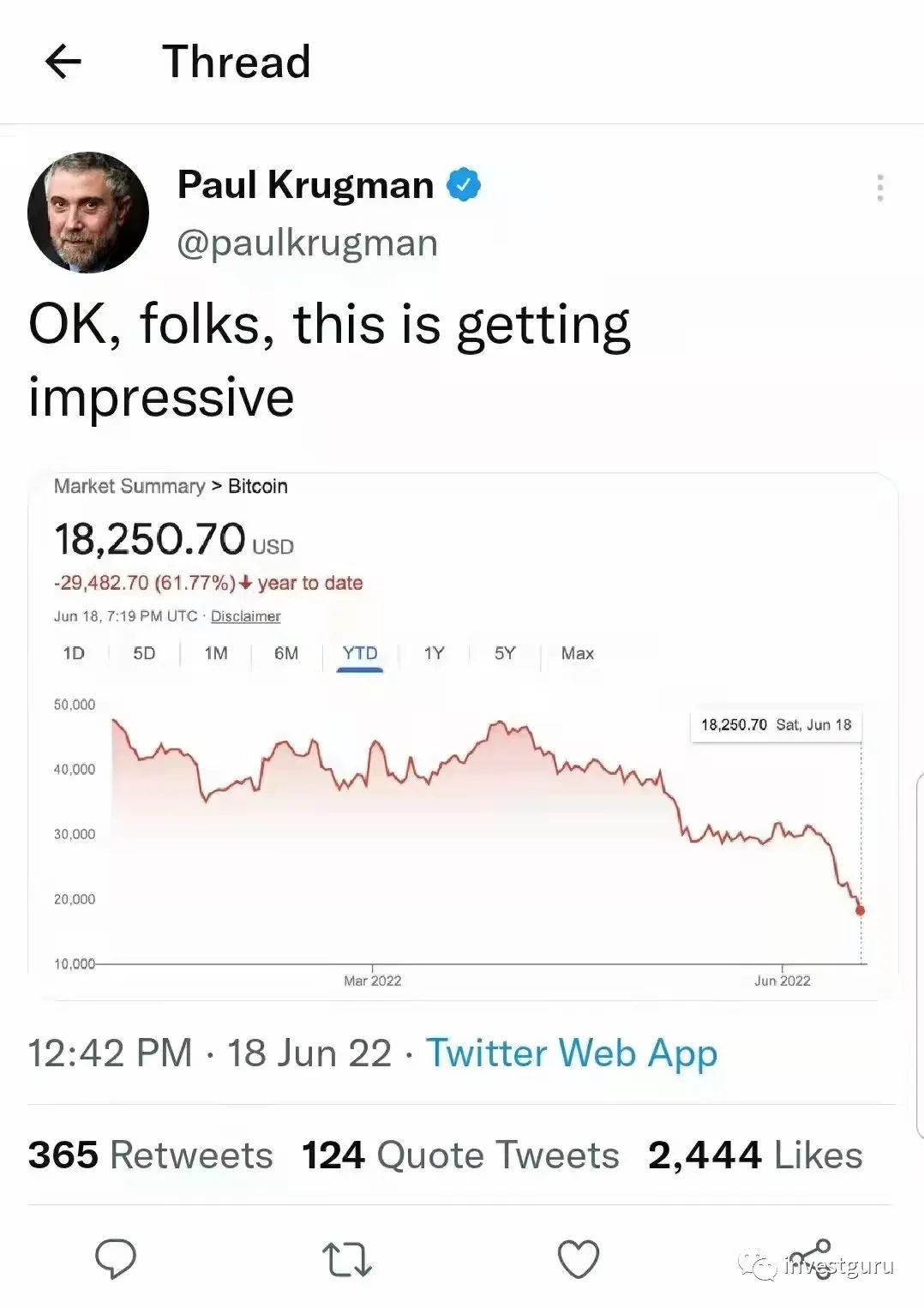
2/ 2022年六月十八号,btc 价格一度下跌到 $18250, 著名经济学家,诺贝尔奖得主克鲁格曼老师又准时的在推特上跳出来,幸灾乐祸的说了一句“老乡们,这太感人了” (之前他在 2018年底比特币跌到 3000美元的时候也跳出来过一次)。克老师发言之后的一年,比特币涨了 69%。确实太感人了。
比特币


3/ 但很多很早入行的人手上已经没有多少 btc 了。原因也很简单,大部分人都想要更高的短期回报,采取各种主观和花哨的策略,但本质都是在加杠杆赌博,不给自己留任何余地。这样迟早在市场的必然但不可预测的大幅波动中,被迫割肉平仓。
4/ 曾经有机构资金在 2020年三月的大跌中险些被平仓,但继续豪赌,后来反而还赚得更多,于是坚持这种激进的策略,这样在 2022年六月的大跌中,毫无悬念的被彻底清零.
5/ 缺乏冗余度的玩家,一旦被某个无法预料的突发事件冲击,可能迅速遭遇连锁反应,一个子系统的崩溃导致更高层系统的连环崩溃,短时间内升级为一个巨大灾害,甚至导致整个系统的全面毁灭。但被灭绝之后,这些人的经验教训也就很难真实传递给后人,也就必然导致下一波不知天高地厚的新人,重复他们的经历。
6/ 很多人无法承受 btc 的价格波动,但这个波动,其实背后反映更多的是美元信贷的增长收缩的变化。美联储自己都无法准确预测通胀和就业的变化,也就更无法预测自己的货币政策的调整。世界上所有的事情,是不可能“既要...又要”的。不可能“既要市场不好的时候价格回撤小, 又要市场上涨时回报好”, 不可能“既要马儿跑,又要马儿不吃草”. 如果客户对你这样要求,离开他,他迟早会投入麦道夫这类骗子的怀抱;如果老板对你这样要求,他只是想出成绩时把功劳揽在名下,出问题时把你当替罪羊而已。
7/ 人们常常把一些因为短期约束而产生暂时溢价的东西,误以为是稀缺资产。俄乌战争爆发后,原油现货价格一度被爆炒到 120美元一桶。冷静坐下来想想,就知道高油价会抑制需求,同时增加开采的活动和供给,原油价格终究会下来的。但不管你购买多少新的矿机去挖矿,btc 的供给不会增加,还会按时每四年减半,这是它和大宗商品/贵重金属的一个最本质的差别。
8/ 2023年3月,当硅谷银行濒临倒闭,上千亿的储户存款面临被剪羊毛受损的重大风险时,美联储果断出手,魔术师般变出几百亿美元的紧急贷款来拯救储户。btc 则根本不在乎,仍然在默默的每十分钟出一个块,仍然在默默的每两周调整一次难度系数。人们这时才突然意识到,什么是真正的稀缺资产,什么则是可以由少数人决定随意增发的游戏。
9/ 只要牢牢抓住稀缺资源,不要在乎别人怎么卷,让他们挥霍真正的稀缺资源,去高溢价置换和争夺事实上的非稀缺资源好了。
Related Reads

Interpreting Investment Opportunities in the Age of Great Navigation, Invesco Great Wall Fund Releases '2026 Report on Chinese Enterprises Going Global'

Invesco Great Wall Fund has released its "2026 China Corporate Globalization Report," titled "The 'Great Navigation Era' of Chinese Enterprises." The report analyzes the new trends and investment opportunities as Chinese companies expand globally, moving from simple product exports to comprehensive overseas operations involving services, branding, and local production. Driven by factors like trade friction, the pursuit of higher profit margins abroad, and policy support, globalization is becoming essential for Chinese companies. The report outlines an evolution: from early product export ("Globalization 1.0") to the current "Globalization 2.0," characterized by overseas capacity, capital goods investment, consumer brand expansion, and service exports. Chinese firms' competitive advantages are highlighted, including a vast engineer talent pool, low-cost and robust infrastructure, and complete industrial clusters. Specific sectors with significant出海 potential are identified: * **Capital Goods** (e.g., engineering machinery, power equipment): Benefiting from global demand, especially in Belt & Road markets and the AI-driven power grid upgrade cycle. * **Consumer Brands**: Transitioning from cost to brand advantage, leveraging供应链 efficiency. * **Technology & Innovation**: Including AI applications, optical modules within global tech supply chains, and new energy vehicles focusing on local production. * **Pharmaceuticals**: Chinese biotech firms are becoming preferred partners for global pharma, with potential for breakthrough drugs in areas like oncology and weight loss. The report concludes that corporate globalization represents a sustained, core theme for China's capital markets, though companies must navigate challenges like geopolitics and localization.

marsbit13m ago

Interpreting Investment Opportunities in the Age of Great Navigation, Invesco Great Wall Fund Releases '2026 Report on Chinese Enterprises Going Global'

marsbit13m ago

GitHub, Transfixed by AI

On the night of February 9th, GitHub suffered a major outage caused by a simple configuration change—reducing a cache refresh interval from 12 to 2 hours—that triggered a cascade of failures. This was not an isolated event, but part of a broader pattern. In early 2026, GitHub experienced at least 8 major incidents, failing to meet its promised 99.9% availability. These outages stemmed from structural issues: explosive growth in load, tight service coupling, and insufficient protection against abnormal traffic. This unprecedented load is driven by AI Agents. In 2025, GitHub handled ~1 billion commits. By 2026, weekly commits reached 275 million, projecting to ~14 billion for the year—a 14x increase. AI tools like Claude Code now contribute 4.5% of all public repository commits, with weekly submissions surging 25x in just three months. AI-generated pull requests jumped from 4 million to 17 million per month in half a year. Unlike human developers, AI Agents work continuously, generating commits at a scale that overwhelms infrastructure designed for human rhythms. The surge also shattered GitHub's business model. Copilot's flat-rate pricing, based on assisting human developers, became unsustainable as Agentic AI sessions consumed resources worth hundreds of dollars for a few dollars in fees. In response, GitHub imposed usage limits and, by June 1st, shifted to a pay-per-use "AI Credits" system. Facing this new reality, GitHub realized a 10x scaling plan was insufficient. It announced a need to *redesign* its architecture for 30x current scale—decoupling services, adding fault isolation, and improving change management to prevent cascading failures. Other platforms like Stripe and AWS are facing similar challenges with AI Agents. Fundamentally, GitHub is transitioning from a human collaboration platform to an "exhaust pipe" for automated AI workflows. Its detailed post-mortem reports aim to maintain trust during this turbulent rebuild. The February outage was not just a technical glitch, but a signal of the software industry's entry into a new, AI-driven era.

marsbit53m ago

GitHub, Transfixed by AI

marsbit53m ago

Both Suffer Massive Losses Exceeding $90 Billion, Which Is in Greater Peril: Strategy or Bitmine?

Facing massive paper losses exceeding $90 billion each amidst a sharp market downturn, "Digital Asset Treasury" (DAT) giants Strategy and Bitmine find themselves in a precarious position, but with different underlying risks. Strategy, heavily invested in Bitcoin (BTC), faces significant financial strain. Its strategy relies heavily on debt, including convertible notes and preferred stock (STRC) requiring substantial dividend payments. With its cash reserves dwindling and BTC offering no staking yield for cash flow, Strategy's high leverage makes it vulnerable. A continued price decline could force asset sales to meet obligations, potentially creating a negative feedback loop. Its market value has already fallen sharply. In contrast, Bitmine, an Ethereum (ETH) holder, appears on firmer financial ground. It primarily funds its purchases through equity offerings (like ATM programs), avoiding debt pressure. It also generates income by staking a large portion of its ETH holdings. While not immune to market drops and shareholder dilution concerns, Bitmine maintains more flexibility, recently announcing a new preferred share offering to raise further capital. The core divergence lies in their financing: Bitmine uses equity (investor money), while Strategy uses debt (borrowed money). Consequently, Bitmine currently faces less immediate liquidity pressure than Strategy, which must navigate the dual challenge of servicing debt/dividends and a declining core asset (BTC) price.

marsbit1h ago

Both Suffer Massive Losses Exceeding $90 Billion, Which Is in Greater Peril: Strategy or Bitmine?

marsbit1h ago

Trading

Spot
Futures
活动图片