Coin price today 06/02: Bitcoin back below $27,000, Altcoin drop slightly, US stocks rally as House passes debt ceiling bill

Tap Chi BitcoinPublished on 2023-06-02Last updated on 2023-06-02

Abstract

The column “Coin Price today” will be updated at 9:00 daily with general market news, readers are welcome to follow.

Bitcoin continues to fall back below $27,000 following its rally over the weekend.
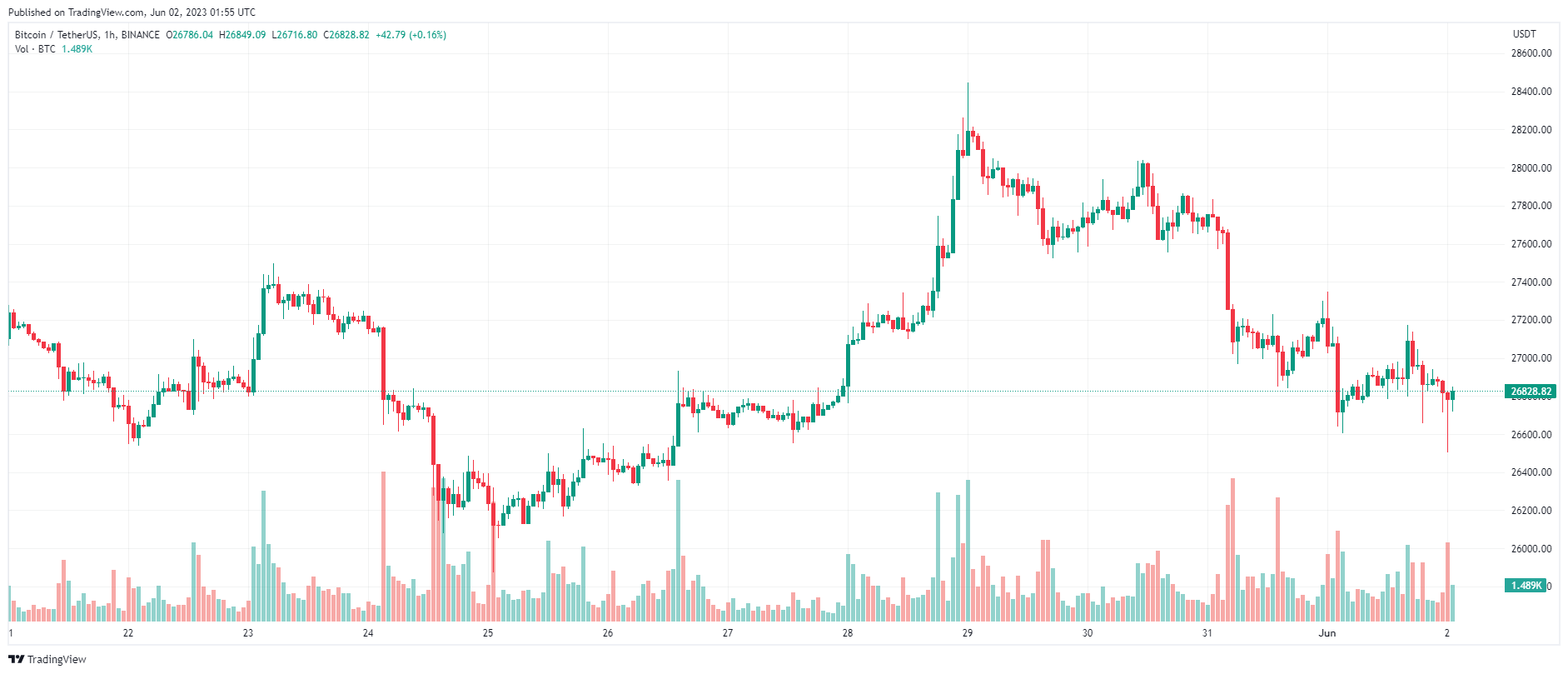
BTC Price Chart – 1 hour | Source: TradingView

US stocks rallied on Thursday (June 1), after the US House of Representatives passed a debt ceiling bill and the bill was then moved to the Senate for discussion.

The Dow Jones Industrial Average ended Thursday's trading session up 153.3 points, or 0.47%, to 33,061.6, despite a 4.7% drop in Salesforce shares after the company reported business results. The S&P 500 gained 0.99% to 4,221 points, while the Nasdaq Composite added 1.28% to 13,101. Both the S&P 500 and Nasdaq Composite closed at their highest levels since August 2022.

The Financial Responsibility Act passed by a vote of 314-117 to bipartisan support Wednesday night (May 31). The majority leader in the Senate, Chuck Schumer, said the Senate will continue to meet until the bill is sent to US President, Joe Biden.

In addition to the debt ceiling battle, investors are waiting for the policy meeting of the US Federal Reserve (Fed) on June 13-14. Philadelphia Fed President Patrick Harker said on Thursday that the central bank is close to a point where it can stop raising rates. However, Harker said earlier in the week that the June 2 jobs report could change the way he will vote at the upcoming meeting.

Data from ADP showed that the US private sector created more jobs than economists forecast in May, while the number of Americans filing for unemployment benefits last week was lower. compared to forecast. The labor market is a closely watched area of the economy, on concerns that its durability could prompt the Fed to raise rates again at its policy meeting this month.

The Nasdaq Composite has rallied nearly 1% so far this week, aiming for a sixth straight week of gains, its longest streak of gains since January 2020. The S&P 500 is up 0.4 percent, while the Dow Jones is down 0.1% week to date.

Meanwhile, gold prices rose to their highest in more than a week on Thursday (June 1), as the dollar fell after dismal US economic data.

Closing the session, the spot gold contract rose 0.76% to $1,977.2 an ounce, after touching $1,981.1 an ounce earlier, its highest level since May 24. Gold futures added 0.65% to $1,994.9 an ounce.

Oil prices rose by the most in two weeks on Thursday (June 1), ahead of the OPEC+ meeting on June 4, while the US House of Representatives passed a debt ceiling bill that helped outweigh the impact of the coronavirus. increased energy reserves in this country.

At the end of the session, the WTI oil contract increased by 2.01 USD (or 3%) to 70.1 USD per barrel, marking the strongest increase since May 5. The Brent crude contract added $1.68, or 2.3%, to $74.65 a barrel, also recording its biggest gain since May 17.

Data from TradingView confirmed BTC ended May in the red, sliding below $27,000.

The trading pair erased all gains over the weekend, returning to familiar range action just below $27,000.
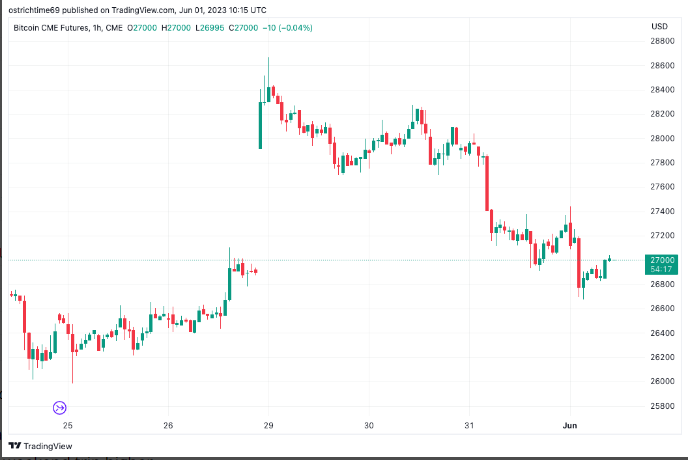
CME Bitcoin futures 1-hour candlestick chart | Source: TradingView

However, BTC/USD has “filled” the gap in CME futures after the rally over the weekend.

“When these gaps fill, the bottom is usually near,” trader Jelle wrote in a comment section.

An additional post argues that BTC price action will soon surpass $30,000 as the market completes a “bearish wedge” pattern with waning volatility.

Despite the gap being filled, trader Daan Crypto Trades still doesn't want to take the risk until BTC has a clearer direction.

“Confluence at $26,750 area with CME gap as well as Golden Pocket above Fibonacci retracement. We will have to wait and XEM how the price reacts when the market returns to this area.”
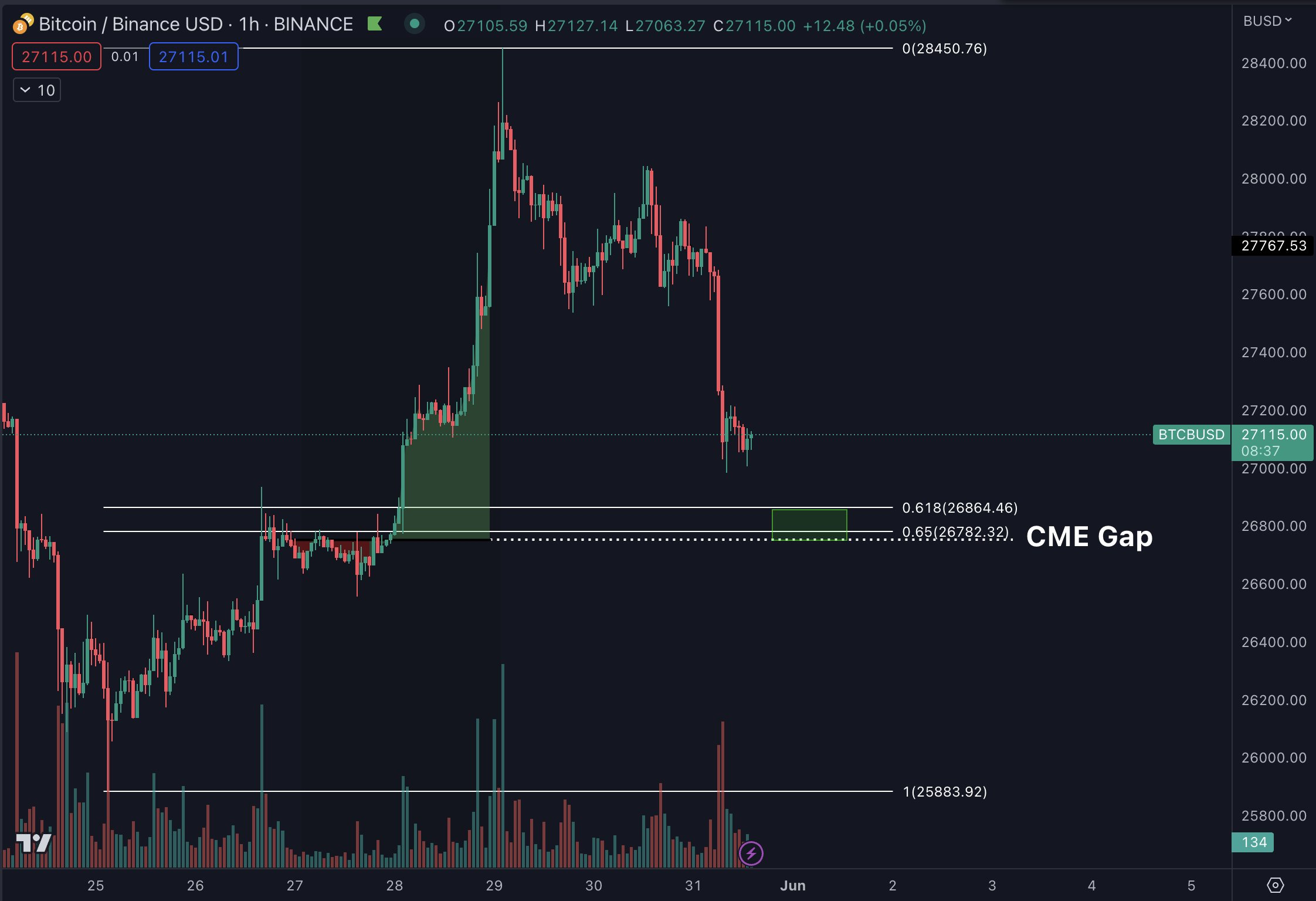
BTC/USD chart with caption | Source: Daan Crypto Trades

Analyst Skew also sees some positive signals from order books and trader activity.

“The gap has been filled, although the market looks pretty weak. To return to the upside BTC price needs to surpass $27,400 and $27,200.”

Bitcoin ended May with a 7% drop. The largest cryptocurrency in the market lost more than 5.5% in Q2, contrasting with a gain of more than 70% in Q1.
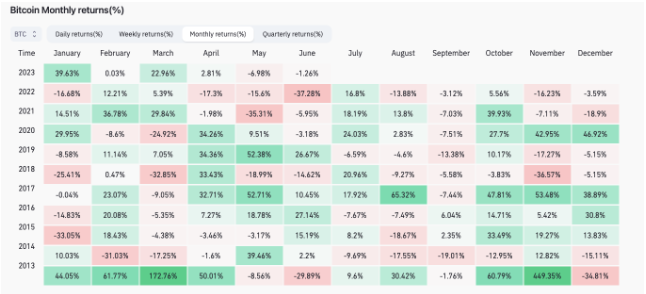
Bitcoin Monthly Profit Chart | Source: CoinGlass

DecenTrader sees little reason to expect an abrupt trend change.

Warning of “bearish” or “decline” signals on proprietary trading instruments, DecenTrader has marked downside support levels tied to key moving averages (MAs) at $26,250 , $26,000 and $23,035 are the 200-week, 20-week, and 200-day MAs, respectively.

The Altcoin market is down slightly as BTC remains in a range below $27,000.

Projects such as Gate Token (GT), The Graph (GRT), Sui (SUI), SingularityNET (AGIX), XDC Network (XDC), KAVA (KAVA), Toncoin (TON), ApeCoin (Ape), Neo (NEO) ), Shiba Inu (SHIB)… all recorded a drop of 3-8% in just the past 24 hours.
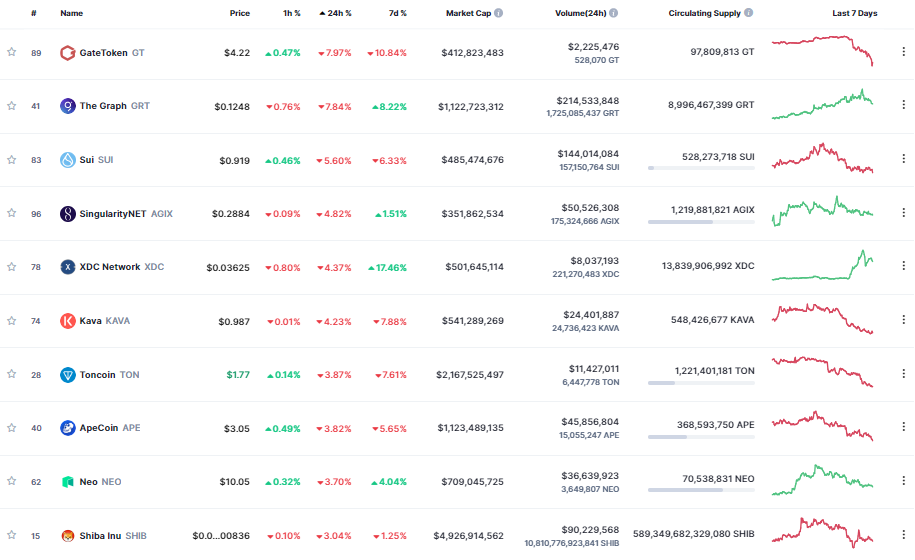
Source: Coinmarketcap

Ethereum (ETH) also continued to record a bit of an intraday performance, after failing to successfully reclaim the $1,900 region, ETH continued to turn around to establish a local bottom at $1,840 before surging slightly around. $1,867 at the moment.
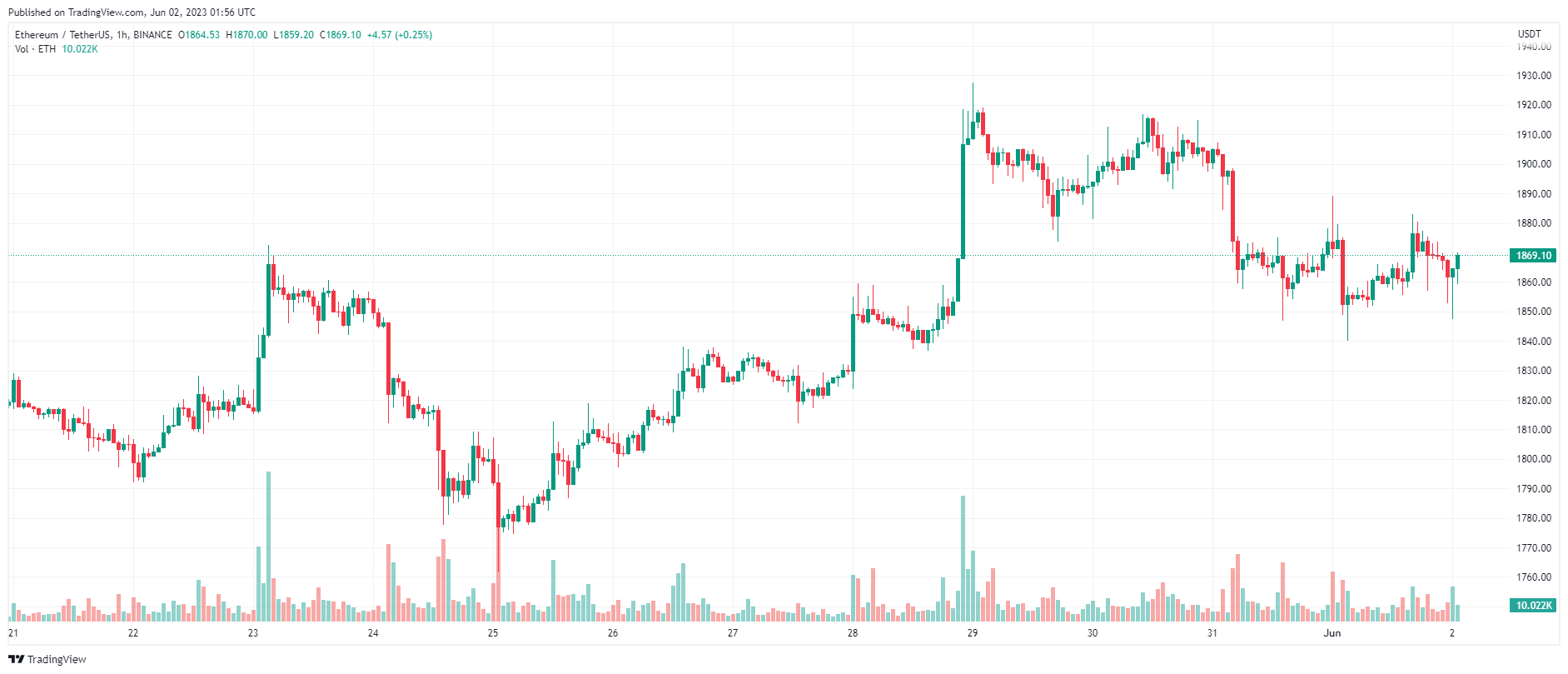
ETH price chart – 1 hour | Source: TradingView

The column “Coin Price today” will be updated at 9:00 daily with general market news, readers are welcome to follow.

Related Reads

Jensen Huang: Prompts are Becoming Obsolete, Loops are the New Paradigm

Jensen Huang, alongside AI leaders like Peter Norvig, Boris Cherny, and Andrew Ng, is advocating for a shift from "prompt engineering" to "loop engineering" as the new paradigm for AI development. Instead of manually crafting individual prompts, the focus is now on designing autonomous loops—systems where AI agents execute tasks, self-validate results, and iterate until completion without constant human oversight. A loop is a management framework that enables agents to operate independently. Key implementations are seen in Claude Code (with features like /loop, /goal, and /schedule) and OpenAI Codex, which employ multiple agents working in parallel within isolated environments. A core principle is the separation of roles: one agent (or model) performs the task, while an independent agent (or a smaller, separate model) validates the output to ensure objectivity. The article outlines a practical roadmap for implementing loops, starting with a "four-condition test" to assess suitability, building a minimal viable loop, and emphasizing critical pitfalls to avoid, such as lacking hard stop conditions or allowing loops to handle tasks requiring human judgment. This evolution is framed as the fourth major shift in AI interaction: from Prompt Engineering (crafting instructions) to Context Engineering (providing background information), then to Harness Engineering (building tool-enabled environments), and finally to Loop Engineering (creating self-sustaining systems). This progression reflects a consistent trend of increasing abstraction, moving human involvement from direct instruction to system design and rule-setting. The concept has academic roots in frameworks like ReAct, which formalized the "reason-act-observe" cycle. While loop engineering promises greater automation, experts caution about managing token costs and warn against outsourcing understanding—AI can assist, but deep problem comprehension remains essential.

marsbit31m ago

Jensen Huang: Prompts are Becoming Obsolete, Loops are the New Paradigm

marsbit31m ago

GPT Designs GPT

OpenAI has unveiled its first custom AI chip, Jalapeño, a move signaling a strategic shift beyond being a mere model company. While many see it as a challenge to NVIDIA, its core aim is to control the entire intelligent production pipeline—from models and chips to data centers and energy. The key driver is the evolving competitive landscape: model advantages are shrinking, while the computational gap in areas like cost-per-token, system throughput, and energy efficiency is becoming the true long-term barrier. Jalapeño is primarily an inference chip, targeting the massive and growing "inference tax"—the daily operational cost of generating tokens for services like ChatGPT and APIs. By designing its own hardware optimized for its specific workloads and future product roadmaps (even using AI to aid the chip design process), OpenAI aims to drastically reduce token generation costs and improve system efficiency. This creates a potential flywheel: better models help design better chips, which lower costs for running next-generation models, supporting more users and products, which in turn provides more data to refine future chips. The strategy mirrors Apple’s integrated approach, building a closed loop where hardware, software, and applications are co-optimized. In the long term, OpenAI is not trying to become the next NVIDIA (a supplier of "shovels" to all AI companies) but to own and operate the entire "mine"—selling the end product of intelligence itself. This move marks OpenAI's ambition to evolve from creating the smartest models to controlling the foundational infrastructure of AI production.

marsbit56m ago

GPT Designs GPT

marsbit56m ago

Ethereum Foundation Interim Executive Director Speaks Out: What Is Our Mission?

The Ethereum Foundation's core mission is to ensure Ethereum remains a truly permissionless, censorship-resistant, private, and open infrastructure for large-scale, sovereign coordination. The article clarifies the EF's focus and dismisses irrelevant objectives, such as pursuing institutional popularity or short-term speculation. Its core work centers on eliminating systemic weaknesses. This involves fortifying Ethereum across multiple layers—protocol, access, user, and institutional—against exploitation, control, or surveillance. Key initiatives include minimizing harmful MEV and preventing privileged control over transaction flow, making unconditional privacy a foundational default, ensuring staking remains permissionless and decentralized, and strengthening user-facing access points to uphold autonomy. Concurrently, the EF aims to seize strategic opportunities. These include leading the transition to post-quantum cryptography, achieving a fully verifiable protocol stack, establishing Ethereum as private digital cash, integrating user-owned AI agents with personal wallets, and demonstrating that trusted-neutral infrastructure can competitively handle disintermediated coordination at an institutional scale. The article also addresses recent organizational changes, stating that personnel departures were due to strategic realignment, role fit, or natural evolution. It clarifies the approach to spin-outs, emphasizing that external funding will be provided only for work critical to the EF's mission that reduces Ethereum's dependency without creating new risks or mission drift. Ultimately, the EF is committed to building an enduring, neutral system that reshapes global coordination, focusing relentlessly on the principles of censorship resistance, openness, privacy, and sovereignty (CROP).

链捕手1h ago

Ethereum Foundation Interim Executive Director Speaks Out: What Is Our Mission?

链捕手1h ago

Trading

Spot
Futures
活动图片