Long-term Bitcoin Holders Data Points to Price Breakout

Tap Chi BitcoinPublished on 2023-06-01Last updated on 2023-06-01

Abstract

Analysts at Bitfinex are currently anticipating “short-term market turbulence and price volatility risks” in June, especially with near-term expiration at the end of the month.Potential price levels that could act as a magnet according to the options market positioning are the maximum pain at expiration in May and June of $27,000 and $24,000 respectively.

Bitcoin volatility is dropping to historic lows due to macroeconomic instability and low market Liquidity . However, on-chain data and options markets signal volatility in June.

Used to measure daily price volatility, the Bitcoin Volatility Index shows a 30-day price movement of 1.52%, less than half of the historical annual average. (usually above 4%).

According to Glassnode, the bullish volatility prediction is a “reasonable conclusion” based on the fact that low volatility has only occurred in 19.3% of Bitcoin’s price history.

The latest weekly update from the on-chain analytics firm shows that Glassnode's monthly logical volatility metric for Bitcoin has slipped below the historic Bollinger Band lower limit, implying volatility is about to increase.
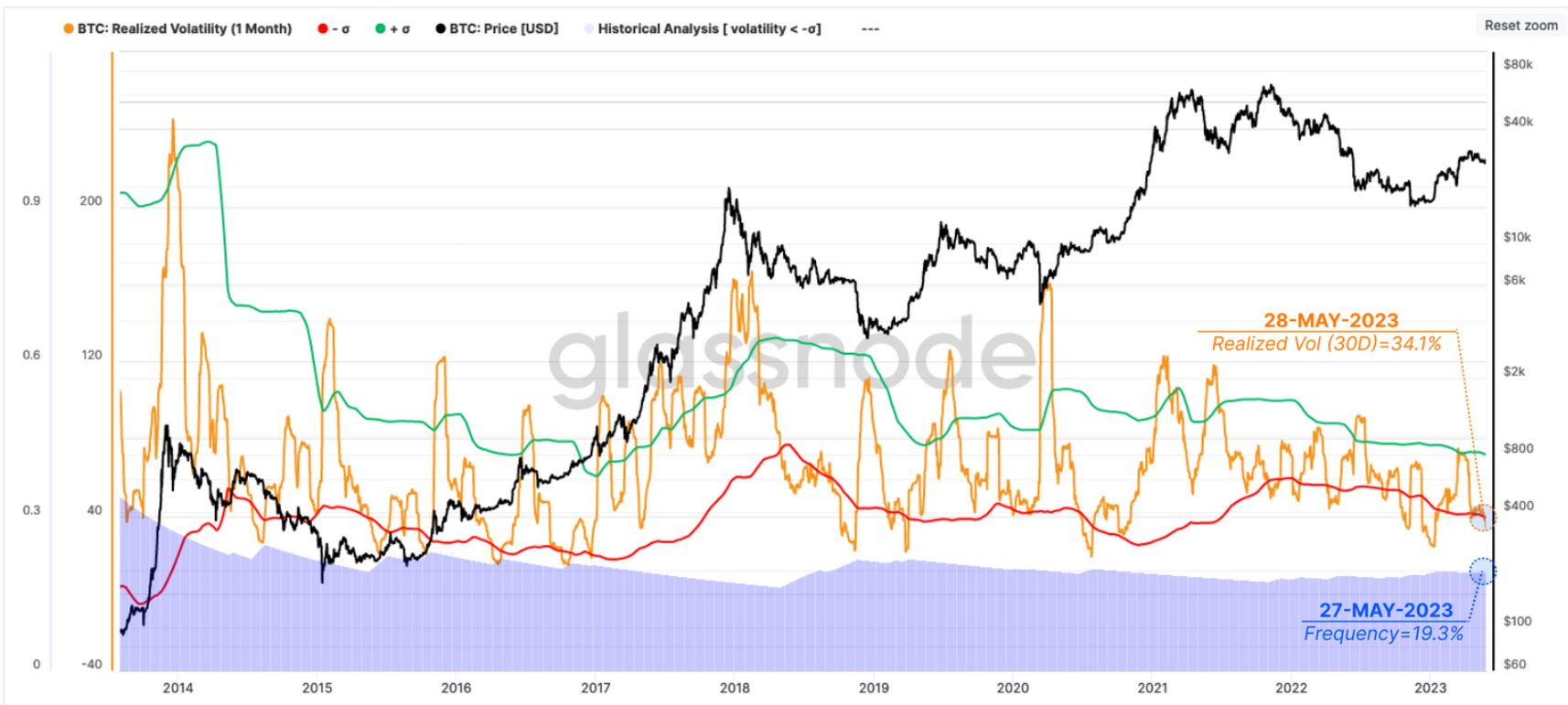
Bolinger Bands for Bitcoin Monthly Reasonable Volatility | Source: Glassnode

Bitcoin on-chain transfer volumes on exchanges have dropped to historic lows. According to the report, the price is also trading in favor of the short-term holders, indicating the “equilibrium position between gains and losses for new investors” who bought during and after the 2021-2022 bull cycle. Currently, only 50% of investors make a profit, the rest lose.

However, while short-term holders have reached equilibrium, long-term holders have moved in the recent correction, reinforcing the volatility argument.

Glassnode classifies coins that hold more than 155 days in a wallet as a long-term holder supply.

The gray bars in the image below show the long-term holders (LTH) binary spending indicator, which tracks whether LTH's average spend over the past 7 days is enough to reduce their total holdings. .

The chart shows previous instances where LTH spending has increased, often with increased volatility.
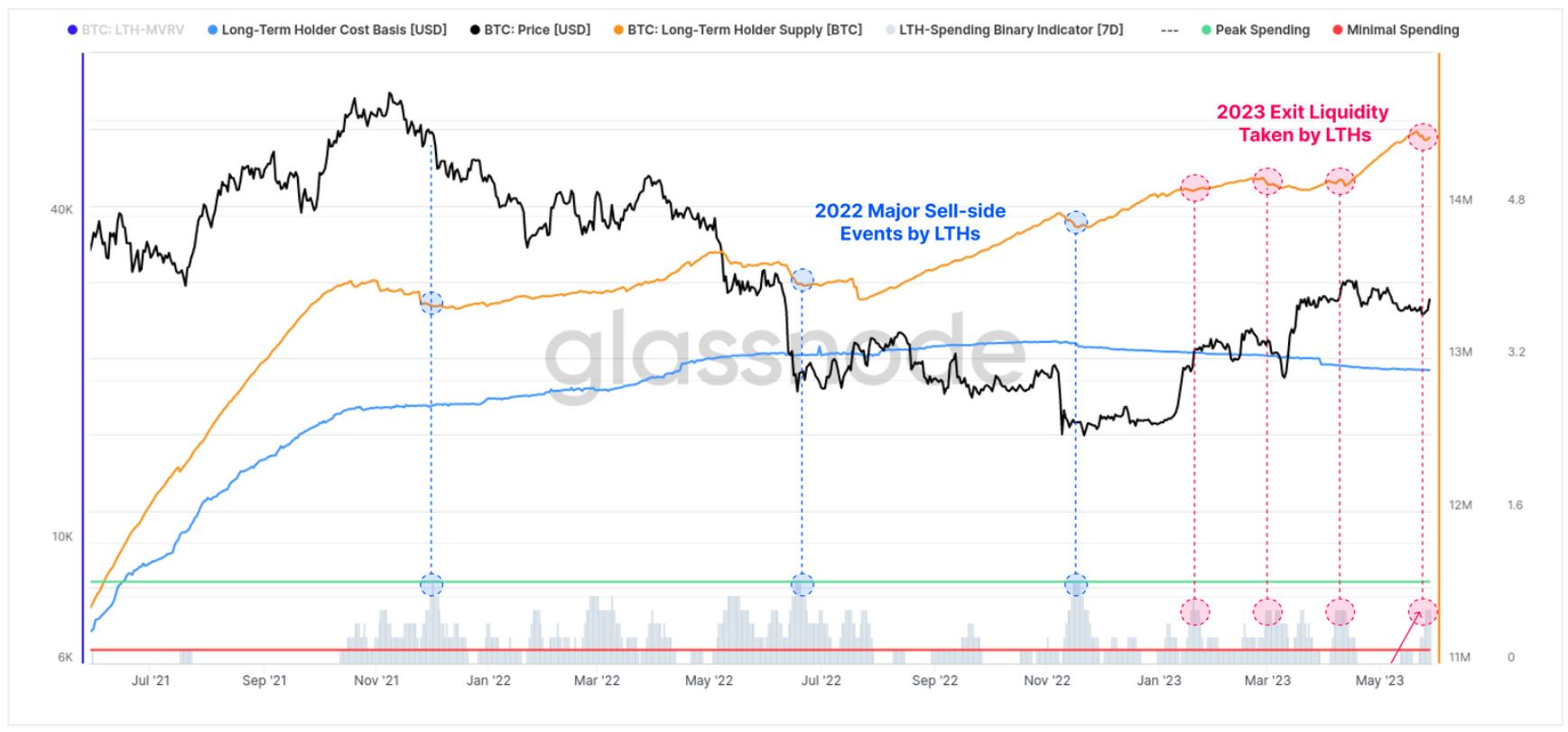
Long Term Holder Spending Binary Indicator | Source: Glassnode

Bitcoin’s recent price correction caused the indicator to drop slightly, “showing 4 out of 7 days of net divestment of LTH, which is similar to the Liquidity exit events so far this year.”

Analysts expect a wave of volatility to reach an equilibrium, where the market moves primarily due to accumulation or distribution of long-term holders' supply.

Options market data points to a similar theory of impending volatility.

The options market's latest expiration in May turned out to be a dull event, despite its nominal value of $2.3 billion. However, prolonged volatility compression could build momentum for an upcoming major price move.

Bitfinex's latest Alpha report shows that the DVOL index (which represents the market's expectations of Bitcoin's potential volatility over the next 30 days) has dropped to 45 from 50 just before expiration, representing a low annual.
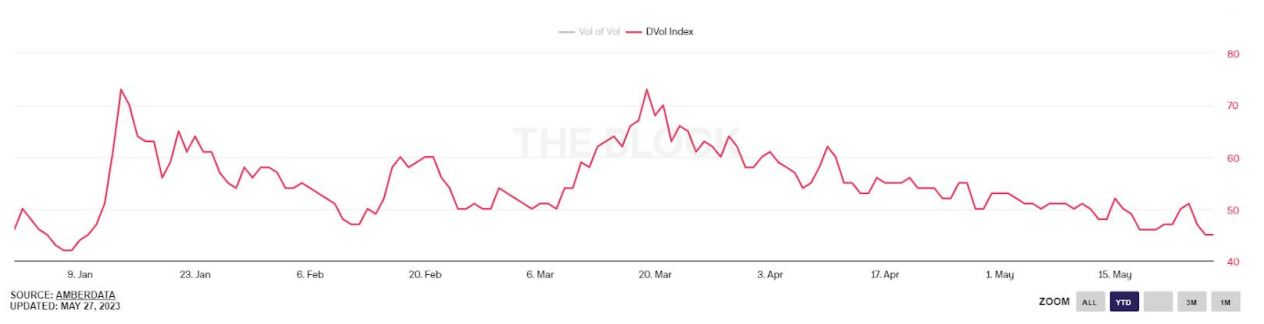
DVOL Index for Bitcoin Options | Source: Bitfinex

Implied volatility in options contracts refers to the market's expectation of an asset's future volatility, as reflected in the options' prices.

Bitfinex analysts said expectations of low volatility could be attributed to "coming events that are expected to change the market" or "uncertainty or market participants' increased risk aversion." ".

Right now, options traders are showing risk aversion and increasing their bearish positions as the month of May approaches the end of June.

Bitcoin put-to-call ratio increased from 0.38 to 0.5. A higher weighted put option shows that traders are slowly turning bearish.

Analysts at Bitfinex are currently anticipating “short-term market turbulence and price volatility risks” in June, especially with near-term expiration at the end of the month.

Potential price levels that could act as a magnet according to the options market positioning are the maximum pain at expiration in May and June of $27,000 and $24,000 respectively.

Maximum pain (also known as option pain) is a concept used in options trading and refers to the price at which the buyer must bear the maximum loss.

Related Reads

Jensen Huang: Prompts are Becoming Obsolete, Loops are the New Paradigm

Jensen Huang, alongside AI leaders like Peter Norvig, Boris Cherny, and Andrew Ng, is advocating for a shift from "prompt engineering" to "loop engineering" as the new paradigm for AI development. Instead of manually crafting individual prompts, the focus is now on designing autonomous loops—systems where AI agents execute tasks, self-validate results, and iterate until completion without constant human oversight. A loop is a management framework that enables agents to operate independently. Key implementations are seen in Claude Code (with features like /loop, /goal, and /schedule) and OpenAI Codex, which employ multiple agents working in parallel within isolated environments. A core principle is the separation of roles: one agent (or model) performs the task, while an independent agent (or a smaller, separate model) validates the output to ensure objectivity. The article outlines a practical roadmap for implementing loops, starting with a "four-condition test" to assess suitability, building a minimal viable loop, and emphasizing critical pitfalls to avoid, such as lacking hard stop conditions or allowing loops to handle tasks requiring human judgment. This evolution is framed as the fourth major shift in AI interaction: from Prompt Engineering (crafting instructions) to Context Engineering (providing background information), then to Harness Engineering (building tool-enabled environments), and finally to Loop Engineering (creating self-sustaining systems). This progression reflects a consistent trend of increasing abstraction, moving human involvement from direct instruction to system design and rule-setting. The concept has academic roots in frameworks like ReAct, which formalized the "reason-act-observe" cycle. While loop engineering promises greater automation, experts caution about managing token costs and warn against outsourcing understanding—AI can assist, but deep problem comprehension remains essential.

marsbit36m ago

Jensen Huang: Prompts are Becoming Obsolete, Loops are the New Paradigm

marsbit36m ago

GPT Designs GPT

OpenAI has unveiled its first custom AI chip, Jalapeño, a move signaling a strategic shift beyond being a mere model company. While many see it as a challenge to NVIDIA, its core aim is to control the entire intelligent production pipeline—from models and chips to data centers and energy. The key driver is the evolving competitive landscape: model advantages are shrinking, while the computational gap in areas like cost-per-token, system throughput, and energy efficiency is becoming the true long-term barrier. Jalapeño is primarily an inference chip, targeting the massive and growing "inference tax"—the daily operational cost of generating tokens for services like ChatGPT and APIs. By designing its own hardware optimized for its specific workloads and future product roadmaps (even using AI to aid the chip design process), OpenAI aims to drastically reduce token generation costs and improve system efficiency. This creates a potential flywheel: better models help design better chips, which lower costs for running next-generation models, supporting more users and products, which in turn provides more data to refine future chips. The strategy mirrors Apple’s integrated approach, building a closed loop where hardware, software, and applications are co-optimized. In the long term, OpenAI is not trying to become the next NVIDIA (a supplier of "shovels" to all AI companies) but to own and operate the entire "mine"—selling the end product of intelligence itself. This move marks OpenAI's ambition to evolve from creating the smartest models to controlling the foundational infrastructure of AI production.

marsbit1h ago

GPT Designs GPT

marsbit1h ago

Ethereum Foundation Interim Executive Director Speaks Out: What Is Our Mission?

The Ethereum Foundation's core mission is to ensure Ethereum remains a truly permissionless, censorship-resistant, private, and open infrastructure for large-scale, sovereign coordination. The article clarifies the EF's focus and dismisses irrelevant objectives, such as pursuing institutional popularity or short-term speculation. Its core work centers on eliminating systemic weaknesses. This involves fortifying Ethereum across multiple layers—protocol, access, user, and institutional—against exploitation, control, or surveillance. Key initiatives include minimizing harmful MEV and preventing privileged control over transaction flow, making unconditional privacy a foundational default, ensuring staking remains permissionless and decentralized, and strengthening user-facing access points to uphold autonomy. Concurrently, the EF aims to seize strategic opportunities. These include leading the transition to post-quantum cryptography, achieving a fully verifiable protocol stack, establishing Ethereum as private digital cash, integrating user-owned AI agents with personal wallets, and demonstrating that trusted-neutral infrastructure can competitively handle disintermediated coordination at an institutional scale. The article also addresses recent organizational changes, stating that personnel departures were due to strategic realignment, role fit, or natural evolution. It clarifies the approach to spin-outs, emphasizing that external funding will be provided only for work critical to the EF's mission that reduces Ethereum's dependency without creating new risks or mission drift. Ultimately, the EF is committed to building an enduring, neutral system that reshapes global coordination, focusing relentlessly on the principles of censorship resistance, openness, privacy, and sovereignty (CROP).

链捕手1h ago

Ethereum Foundation Interim Executive Director Speaks Out: What Is Our Mission?

链捕手1h ago

Trading

Spot
Futures
活动图片