IMF : Interest Rates to Fall to Pre-Pandemic Levels Once Inflation Is Tamed

newsbtcPublished on 2023-04-13Last updated on 2023-04-13

Abstract

When inflation in advanced economies is tamed, real interest rates are likely to drop to pre-pandemic levels, the latest International Monetary Fund (IMF) blog post has said. According to the authors of the blog post, the transition to a “cleaner economy in a budget-neutral way” could result in lower rates in the medium term.

Recent Interest Rate Hikes Temporary

Interest rates in advanced economies are likely to fall to pre-pandemic levels when authorities succeed in bringing inflation back under control, the latest International Monetary Fund (IMF) blog post has suggested. The blog post added that the “recent increases in real interest rates are likely to be temporary.”
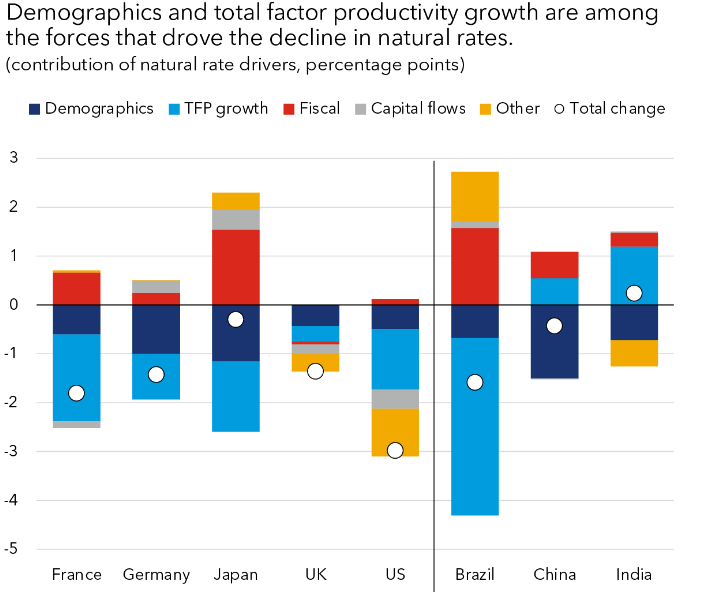
The return of real interest rates to levels seen before the spread of Covid-19 will also coincide with the easing of the respective countries’ monetary policy regimes. As has been reported by Bitcoin.com News, central banks from advanced economies have raised benchmark rates as they seek to tame inflation. The rising interest rates have sparked fears that the global economy may be headed for a recession.

However, in their April 10 blog post, the authors claimed a transition to a green economy may potentially lead to lower real interest rates globally:

Transitioning to a cleaner economy in a budget-neutral way would tend to push global natural rates lower in the medium term, as higher energy prices (reflecting a combination of taxes and regulations) would bring down the marginal productivity of capital. However, deficit-financing of public investment in green infrastructure and subsidies could potentially offset and even reverse this result.

The authors also suggested that so-called deglobalization forces could intensify and this may result in both “trade and financial fragmentation.” According to the authors, this outcome is likely to result in driving up the natural rate in advanced economies and down in emerging markets economies.




Related Reads

Let Funds Flow at Internet Speed

Tokenization bridges the distinct worlds of always-on, permissionless DeFi and traditional funds with scheduled, permissioned settlements, unlocking significant value for those who can manage this integration. The tokenized Real World Asset (RWA) market exceeds $33 billion, with U.S. Treasuries comprising nearly half. It offers corporate treasurers options from low-risk, liquid Treasury funds to higher-yield, programmable investments, all benefiting from the same audit standards as traditional bonds. The core advantage is *composability*: tokenized funds can combine yield, liquidity, and transferability simultaneously, unlike traditional finance which forces a trade-off. However, achieving this requires sophisticated coordination. Tokenized funds remain legally bound to daily net asset value (NAV) updates, KYC-verified holder lists, and redemption cut-offs based on traditional settlement infrastructure (e.g., 5 PM ET). Key challenges in this hybrid model are: 1) **Price**: Determining token value between NAV updates to prevent manipulation; 2) **Compliance**: Embedding KYC/whitelisting (e.g., within a vault) to allow free circulation of receipt tokens in DeFi; and 3) **Cross-chain Consistency**: Maintaining a single source of truth for ownership and value across multiple blockchains. Projects like Centrifuge (with its deRWA framework and V3 architecture) and LayerZero address these by using a hub-and-spoke model. A central "hub" chain manages NAV, accounting, and compliance, while a messaging layer (LayerZero) synchronizes this data with "spoke" chains where tokens are used, enabling DeFi composability. This coordination layer, which handles in-transit asset accounting and prevents redemption gateway conflicts, becomes a critical and valuable piece of infrastructure—akin to SWIFT or Visa in traditional finance. For institutions, effective tokenization enables strategies like rehypothecation, where tokenized Treasury funds are used as collateral to borrow stablecoins for reinvestment, amplifying yield. However, failures in price synchronization, redemption limits, or cross-chain messaging pose risks that must be meticulously managed to build institutional trust. Ultimately, the goal is to break the old rules that force a choice between yield, liquidity, and transferability. If tokenization can make capital work simultaneously in multiple ways without compromising security, it will attract the attention of institutions managing billions in idle cash. The entities that successfully orchestrate this coordination between traditional finance timelines and blockchain speed are positioning themselves for a central role in the future capital markets.

链捕手8m ago

Let Funds Flow at Internet Speed

链捕手8m ago

On the Eve of the US Stock Inflation Test, Wall Street Faces the Most Severe 'Data Deception' in History

On the eve of the crucial US June CPI release, a significant credibility gap is emerging between official inflation data and consumer sentiment. While May CPI and PCE figures suggested a "concerning but not critical" picture, the University of Michigan Consumer Sentiment Index plummeted to its lowest level in nearly 50 years. This contradiction is prompting economists to question the reliability of key macroeconomic indicators. The core issue, as highlighted by labor economist Kathryn Anne Edwards, lies in a systemic flaw within the current inflation measurement framework. The Consumer Price Index (CPI) averages prices across a "market basket" meant for a "typical consumer," thereby masking vastly different inflation experiences across demographic groups. For instance, Bureau of Labor Statistics (BLS) research indicates that from 2006 to 2023, the lowest income quintile faced a cumulative inflation rate 7.7 percentage points higher than the highest quintile—a disparity largely invisible in the headline CPI number. This averaging effect means investors and policymakers relying on aggregate CPI may be basing decisions on a statistically smoothed figure that fails to capture the true distribution of economic pressure. Edwards argues that expanding this measurement framework is technically feasible, requiring primarily political will rather than new data collection. The BLS already tracks 100,000 items monthly; creating more granular indices for different family types, income levels, and housing statuses would mainly involve re-weighting existing data. The BLS has produced such experimental series before. A more nuanced data picture is crucial for accurate policy and market forecasting. Ultimately, improving measurement cannot solve underlying economic stresses. Edwards notes concurrent pressures like slowing hiring, stagnant wage growth, persistently high prices, rising credit card debt, a subdued housing market due to high rates, and AI's potential disruption to jobs. These factors collectively explain the deep chasm between official statistics and consumer pessimism. The key takeaway for markets is the need to look beyond a single headline CPI number. Understanding the divergence in inflation experiences across the population is critical for accurately assessing the real pressure within the economy, the path of Federal Reserve policy, and risks on the consumer side.

marsbit13m ago

On the Eve of the US Stock Inflation Test, Wall Street Faces the Most Severe 'Data Deception' in History

marsbit13m ago

On the Eve of the U.S. Stock Inflation Test, Wall Street Faces the Worst 'Data Deception' in History

On the eve of the US June CPI data release, a stark contradiction is undermining market trust in macroeconomic indicators. Official data, showing May CPI at 4.2% and PCE at 3.4%, paints a picture of manageable inflation pressures. However, the University of Michigan Consumer Sentiment Index hit a record low in May and its second-lowest reading in June across its 50-year history, which includes multiple recessions and crises. This gap highlights a systemic flaw in the current inflation measurement system, as argued by labor economist Kathryn Anne Edwards. The CPI, based on an average "market basket" for a "typical consumer," masks vastly different inflation realities across income and demographic groups. BLS research from 2006-2023 shows the lowest income quintile experienced an annual inflation rate approximately 0.28 percentage points higher than the highest quintile, a cumulative 7.7-point difference. This averaging obscures the true economic pressure distribution from investors and policymakers. Edwards argues the technical barriers to improvement are low. The BLS already collects the necessary price data. Expanding the current three consumer baskets—by factors like household type, income, age, or tenure—would mainly involve re-weighting existing data, a path already demonstrated by BLS's experimental series for seniors and income quintiles. Beyond measurement issues, real economic pressures persist, including slowing hiring, stagnant wage growth, elevated prices, rising credit card debt, high interest rates, and AI's potential labor market impact. These factors explain the deep consumer pessimism. For markets, the key takeaway is to question how well a single aggregate CPI captures the true, differentiated inflation pressures and consumption risks that are critical for understanding the Fed's policy path.

链捕手17m ago

On the Eve of the U.S. Stock Inflation Test, Wall Street Faces the Worst 'Data Deception' in History

链捕手17m ago

Prime Minister Backing, SBI's "Shopping Spree," Lawson's Pilot: Japan Seizing the Compliance Dividend in Crypto

Japan is moving decisively to establish itself as a leader in the compliant crypto ecosystem through a coordinated national strategy. This commitment is underscored by consistent high-level political support, with successive prime ministers addressing the WebX conference to promote regulatory reform and position Web3 as a core industry. The financial giant SBI Holdings is executing a strategic, multi-billion dollar investment spree to build a comprehensive infrastructure stack. Key moves include acquiring the major exchange Bitbank, investing in core infrastructure firms like Gauntlet and EDX Markets, and forming "SBI Solana Global" to develop a yen-denominated stablecoin (JPYSC) and tokenized assets on the Solana network. Concurrently, a pilot by convenience store chain Lawson will test stablecoin payments in a real-world retail setting. The Japanese approach combines high regulatory barriers, which limit competition, with strategic capital from established financial conglomerates (zaibatsu) rather than standalone crypto firms. Upcoming tax reforms, planning to slash crypto capital gains tax from 55% to 20%, are designed to attract domestic savings. This integrated model—strict licensing, deep-pocketed traditional finance, real-world use cases, and favorable taxation—creates a formidable, closed-loop system for early entrants like SBI. It offers a potential blueprint for other jurisdictions seeking to formalize their crypto industries, signaling a shift from regulatory arbitrage to a race for compliance and legitimacy.

marsbit1h ago

Prime Minister Backing, SBI's "Shopping Spree," Lawson's Pilot: Japan Seizing the Compliance Dividend in Crypto

marsbit1h ago

An AI Uncovers a 15-Year-Old Linux Vulnerability in 5 Seconds, While Another AI Turns an Innocent Journalist into a Car Thief Suspect

AI Discovered a 15-Year-Old Linux Bug but Also Wrongly Targeted a Journalist An AI security tool, VEGA, identified "GhostLock" (CVE-2026-43499), a severe Linux kernel vulnerability hidden for 15 years since 2011, affecting nearly all distributions. Exploiting a flaw in the kernel's lock management, an attacker could gain root privileges in about 5 seconds from a standard user account. This demonstrates AI's growing ability to find complex bugs humans missed. In a stark contrast, another AI system caused a dangerous police confrontation. Automotive journalist Joel Feder was surrounded by four police cars after Flock Safety's automated license plate recognition (ALPR) cameras mistakenly flagged his vehicle. The error originated from a typo in a national stolen vehicle database ("34 03 DTM" was entered as "34 DTM"). Feder's manufacturer plate, "34 10 DTM," was misread due to its small font, triggering a nationwide alert. Police, with hands on holsters, detained Feder for an hour before resolving the mistake. The two cases highlight the dual nature of AI in security. On one hand, it can efficiently uncover critical software vulnerabilities, enhancing safety. On the other, it can exponentially amplify human errors—like a simple data entry mistake—when deployed in automated, large-scale surveillance systems without adequate human oversight. The incident underscores the critical need for robust review mechanisms in AI-driven decision systems, especially in high-stakes areas like law enforcement. The greatest vulnerability in the AI era may not be in code, but in the unchecked delegation of final judgment to automated processes.

marsbit2h ago

An AI Uncovers a 15-Year-Old Linux Vulnerability in 5 Seconds, While Another AI Turns an Innocent Journalist into a Car Thief Suspect

marsbit2h ago

Trading

Spot
活动图片